

A SARS tax directive is the instruction that tells you how much employees’ tax to withhold from a severance payment in South Africa. Only the employer can apply for it, never the employee, and the severance rates only apply once the directive is issued. If you employ people in South Africa, directly or through an Employer of Record (EOR), the directive is part of every exit that involves a lump sum. Getting it right protects the employee from over-withholding and protects you from an under-deduction finding at a PAYE audit.
This guide is written for founders, HR leads and finance managers outside South Africa who have to run a retrenchment or a negotiated exit and want to know what the paperwork is, what the tax looks like and where it goes wrong.
TL;DR
- A tax directive is a SARS instruction to the employer on how much tax to deduct from a lump sum. Only the employer or fund administrator can apply; the employee cannot.
- Severance rates apply only in defined cases: age 55 or older, permanent incapacity, or termination because the employer stops trading or reduces staff. SARS sets R550,000 as the tax-free band, reduced by earlier benefits.
- Leave pay, notice pay and pro-rata bonuses are not severance benefits and are taxed as ordinary income.
- If the employer is a foreign company with no South African PAYE registration, SARS has a specific IRP3(a) reason for the severance directive.
- Apply before you pay. A late or wrong directive delays the employee’s tax return and can leave you liable for tax under-deducted.
Table of Contents
- What a SARS tax directive is
- Does the payment qualify as a severance benefit?
- The 2026/27 severance tax table
- How to apply for the directive, step by step
- If your employer entity is outside South Africa
- What to do when a directive is delayed
- What this means for your employment cost planning
- Our view
- Hiring in South Africa with the filings handled
- FAQ
- Sources
What a SARS tax directive is
A directive is an instruction from SARS to an employer, fund administrator or insurer on how to deduct employees’ tax from certain lump sums. Severance is one of them. Without it, you would not know whether to withhold at the severance rates, at normal PAYE rates, or something else, and the employee’s final tax would not reconcile.
The legal basis is the Fourth Schedule to the Income Tax Act: employers must apply for a directive for any lump sum paid as a severance benefit, gratuity or similar amount. SARS then prescribes the tax to withhold and pay over. The form for this is the IRP3(a).
Two practical consequences follow:
- A directive completed by the employee should not be accepted by the employer. The process is the employer’s obligation.
- The severance tax rates can only be calculated once a directive application has been submitted.
Does the payment qualify as a severance benefit?
This is where most mistakes start. The favourable severance table is not available for every termination payment. According to SARS, a payment qualifies where employment ends because of age 55 or older, permanent incapacity, or because the employer stops trading or reduces personnel. An employee holding more than 5% of the employer does not qualify.
In practice that means:
- A genuine retrenchment (an operational-requirements dismissal) generally fits the reduction-of-staff limb.
- A resignation with a payout does not fit automatically. A voluntary package that is really a restructuring may be taxed as ordinary income.
- A dismissal for misconduct or poor performance is not a retrenchment, so the severance table does not apply.
The tax category follows the real reason for termination, not the label on the settlement agreement. If you are running a retrenchment, our guide to the retrenchment process in South Africa covers the legal side, which has to be right before the tax side makes sense.
What does not count as severance
SARS is explicit: leave pay, notice pay and pro-rata bonuses do not qualify as severance benefits and are taxed as normal income. The IRP3(a) guidance says leave pay and notice payments need a separate directive application, using the reason “Other” and the date of accrual.
This matters for audit exposure. SARS notes that where a government institution included leave pay or bonuses in a severance directive, it had to pay the tax under-deducted after a PAYE audit. The same logic applies to any employer. For bonus mechanics, see bonus tax for employers and EORs.
Notice itself is a legal entitlement under the BCEA. Our page on South African notice periods sets out the 1, 2 and 4 week rules.
The 2026/27 severance tax table
When the severance rules apply, the tax is calculated on a progressive table. The 2026/27 Budget tax guide lists these bands (amounts in South African rand, ZAR):
| Taxable severance (cumulative) | Tax |
|---|---|
| R0 to R550,000 | 0% |
| R550,001 to R770,000 | 18% of the amount above R550,000 |
| R770,001 to R1,155,000 | R39,600 plus 27% of the amount above R770,000 |
| Above R1,155,000 | R143,550 plus 36% of the amount above R1,155,000 |
The R550,000 tax-free amount applies from 1 March 2023. The table is revised in the annual national Budget, so check the latest SARS publication before you calculate an exit.
The tax-free amount is cumulative
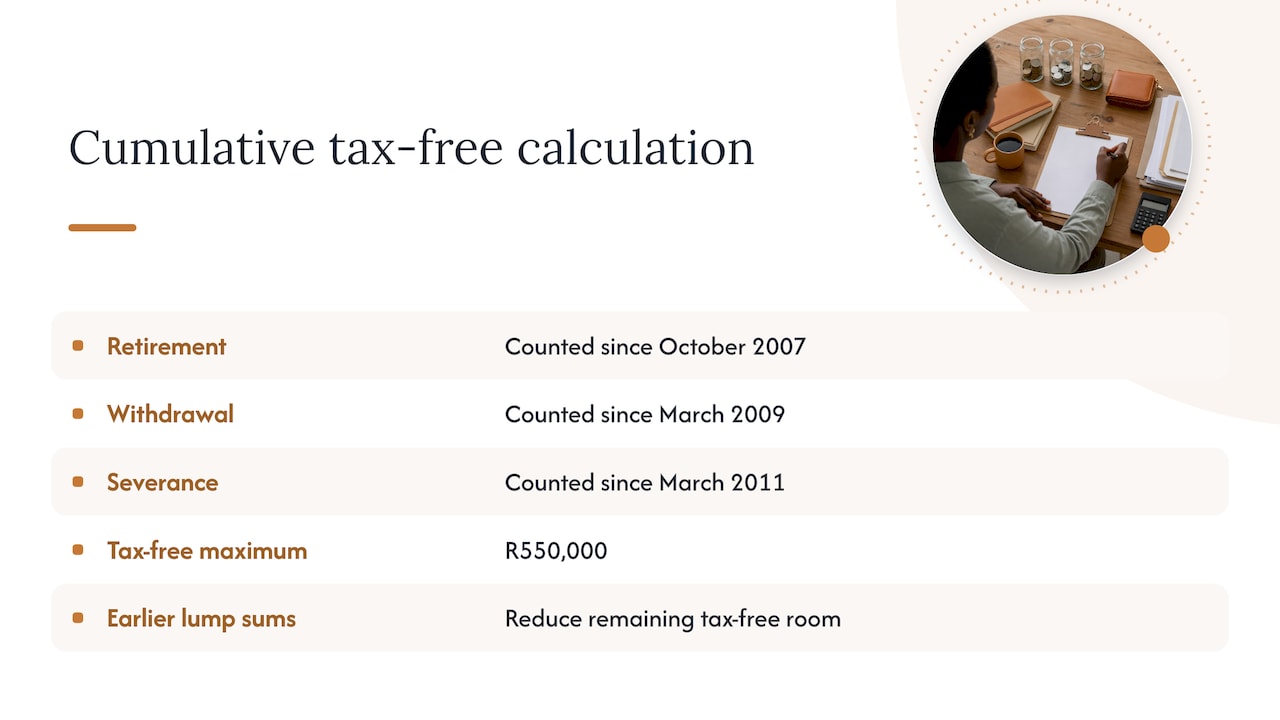
The table is not reset for each exit. The calculation takes into account retirement benefits received since October 2007, withdrawal benefits since March 2009 and severance benefits since March 2011. An employee who took a severance package or a retirement fund lump sum earlier may have less than R550,000 of tax-free room left. SARS applies this when it issues the directive, so the figure on the directive can differ from what a payroll spreadsheet shows.
A worked example
Take a retrenched software engineer with no earlier lump sums and a qualifying severance payment of R800,000.
- The first R550,000 is taxed at 0%.
- The next R220,000 (up to R770,000) is taxed at 18%: R39,600.
- The remaining R30,000 is taxed at 27%: R8,100.
Total tax: R47,700. If the same person had already used R300,000 of the band in an earlier benefit, the calculation starts further up the table and the tax is higher. Your payroll team should never estimate this and withhold on the estimate. The directive gives the figure to withhold.
How to apply for the directive, step by step
- Confirm the reason for termination and the categories of payment. Split the payout into severance, leave pay, notice pay and any bonus. Each category has its own tax treatment, and leave and notice need their own directive.
- Establish the date of accrual. The date of accrual is relevant to the final tax liability on assessment, so decide it carefully. A short read on how the accrual date affects final tax liability shows why timing and certificates matter.
- Complete the IRP3(a). Only the employer or fund administrator can submit it. Use the reason that matches the payment.
- Submit through eFiling or an interface agent. Applications go via eFiling or an interface agent. Email is allowed only in exceptional cases, with a reason and supporting documents after you receive a case number.
- Withhold exactly what the directive states, and pay it over with the monthly EMP201. Our page on the 7-day EMP201 deadline covers the filing and the payment reference number.
- Issue the tax certificate on time. An IRP5 or IT3(a) is due within 14 days after service ends, or within 60 days after the tax year if employment continues.
The common failure points are applying after the money is paid, folding leave pay into the severance figure, and withholding on an estimate. All three leave the employee with a tax return that does not match and the employer with a correction to make.
The statutory minimum severance is a separate question from the tax: the BCEA sets it at one week’s pay per completed year of service for operational dismissals. Our page on calculating severance pay shows the arithmetic.
If your employer entity is outside South Africa
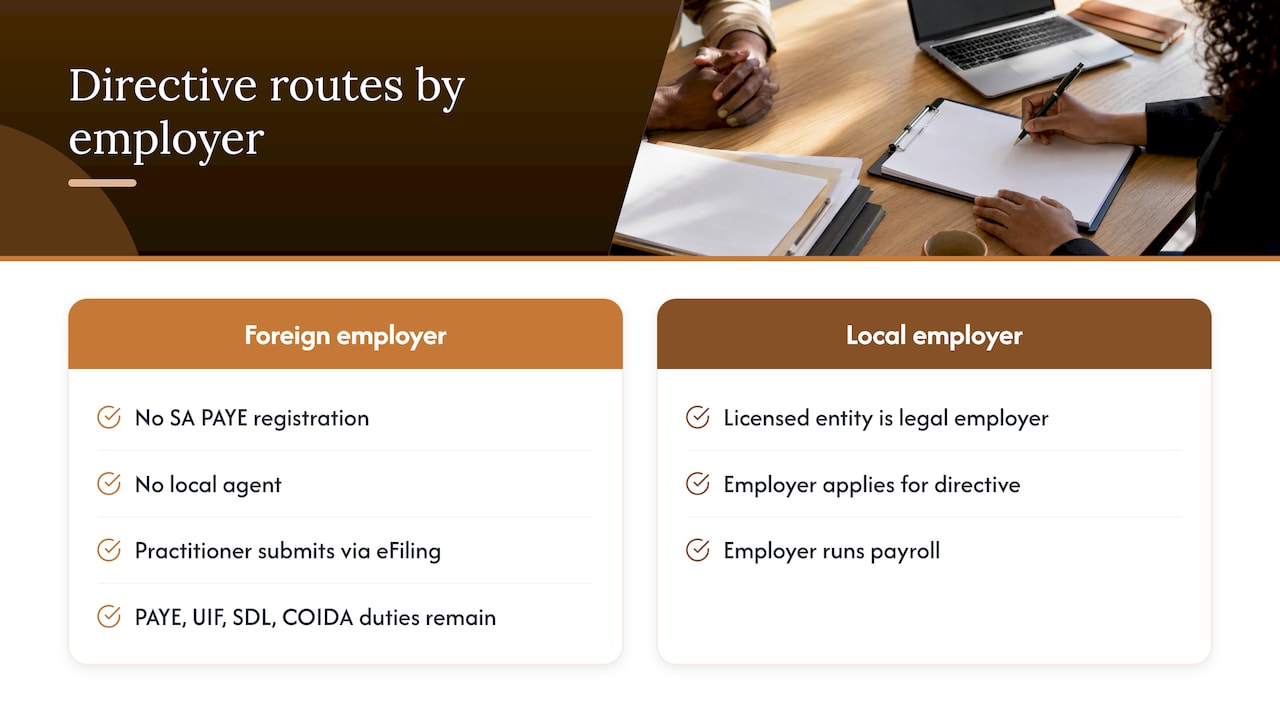
Many readers of this guide employ in South Africa without a local company. SARS has addressed this directly. Since 22 April 2022, the IRP3(a) has included a reason for severance benefits paid by a non-resident employer that is not registered for PAYE in South Africa and has no local agent. For that case, a taxpayer’s tax practitioner can submit through eFiling.
That is a narrow route for a foreign company with no South African footprint. It does not remove the underlying employer obligations. Employment in South Africa carries PAYE, UIF, SDL and COIDA duties, and our overview of non-resident employer PAYE and tax rules explains where they arise. If a local licensed employer is the legal employer, that employer is the party that applies for the directive and runs the payroll, which is how an EOR arrangement is structured. See who the legal employer is under an EOR for the checks to run.
What to do when a directive is delayed
The employer applies, so a delay is first an employer problem. The employee cannot finalize the tax return for that year until SARS has received the lump sum directive and the figures reconcile. Practical steps:
- Employer side: confirm the application was submitted and has a reference. If the application was rejected, correct the reason code or the date of accrual and resubmit. Do not pay the severance at ordinary PAYE rates to “save time”.
- Employee side: the employee should ask the employer for the directive number and keep the IRP5 or IT3(a). They cannot apply themselves.
- If it stalls at SARS: the employer or its tax practitioner raises it through eFiling or the SARS contact centre. The email route is for exceptional cases only, after a case number.
SARS has also announced system changes. Its directive page describes planned 17 April 2026 enhancements, including bulk cancellation of directives and a report of prior eFiling directives. The same page records that Section 8A of the Income Tax Act was repealed from 1 April 2026, having been superseded by Section 8C. Check that page for the processes in force when you apply.
What this means for your employment cost planning
Severance affects more than the employee’s tax. For a finance lead, an exit is a cost made of statutory severance, notice, accrued leave, any bonus, the employer’s UIF and SDL on the taxable portions, and the time it takes to run the process properly. Our pages on South African employment cost and employer taxes show how the pieces fit, and the employment cost calculator lets you model a role before you hire.
Our view
Most severance problems we would expect to see begin before the exit, with a contract and a payroll that were never set up for one. A directive is simple when the payroll is clean: the reason for termination is documented, leave and notice are separated, and the date of accrual is known.
We run South Africa as the only country we cover. That is why we publish the BCEA, SARS and COIDA detail in full: a founder in London or Austin should be able to see what the rules require before an exit, not during it.
Our licensed local partner is the legal employer and handles the ZAR payroll and the statutory filings: PAYE through EMP201, UIF, SDL and COIDA. Our flat fee covers that work with no setup fees or FX loading, so an exit does not arrive with a new bill for the filing work. We also give CCMA-safe dismissal guidance, because a tax-correct payout still has to follow a fair process.
Roel
Hiring in South Africa with the filings handled
If you are planning to employ people in South Africa, we provide Employer of Record services from £299 per month per employee. Our local partner issues BCEA-compliant contracts, runs ZAR payroll and handles the PAYE, UIF, SDL and COIDA filings. Contracts are signed within 48 hours.

If you already have South African staff with another provider, we offer free transfers. For roles you still need to fill, our talent sourcing service is priced at 55%.
FAQ
How is severance pay taxed in South Africa?
A qualifying severance benefit is taxed on a progressive table with the first R550,000 at 0%, then 18%, 27% and 36% in higher bands. The tax-free amount can be reduced by earlier severance or retirement lump sums. Payments that do not qualify are taxed as ordinary income.
What does it mean if SARS issued a tax directive?
It means SARS has told the employer how much tax to withhold from a specific lump sum. The employer must withhold that amount and pay it over. The employee uses the resulting tax certificate in their return.
Can an employee apply for the directive themselves?
No. Only the employer or fund administrator can complete and submit the IRP3(a). A directive completed by the employee should not be accepted by the employer.
Are leave pay and notice pay part of the severance tax-free amount?
No. They are taxed as normal income and need a separate directive application under the reason “Other”. Putting them inside the severance directive can lead to an under-deduction finding at audit.
Is a resigned employee entitled to severance pay?
Statutory severance under the BCEA is owed for dismissals based on operational requirements, not for a resignation. Any payout on a resignation is a contractual or negotiated matter, and its tax treatment follows the facts of the termination.
Sources
- Tax and Retrenchment, SARS
- Completion Guide for IRP3(a) and IRP3(s) Forms, SARS
- I want to get a tax directive, SARS
- Budget Tax Guide 2026/27, SARS
- Tax and Government Employees, SARS