

If you employ someone in South Africa who works from home, the law does not oblige you to pay a home office allowance, but how you structure one decides whether it is taxed, who bears that tax and what your employee can still claim from the South African Revenue Service (SARS). A CMS expert guide states that South African employment law imposes no statutory duty to pay a work-from-home allowance or reimburse remote working costs beyond what the contract agrees. So the allowance is a contract term you design, and the tax treatment follows from the design.
This guide is for founders, HR leads and finance managers outside South Africa who are hiring there. It covers what to put in the contract, how the payment is taxed, and the narrow deduction your employee may be able to claim on their own tax return. If you hire through us, the licensed local partner that employs your people runs payroll and statutory filings, so the tax treatment you choose is applied correctly in ZAR from the first payslip.
TL;DR
- No South African law requires an employer to pay a home office allowance. It exists only if the employment contract or policy provides for it.
- KPMG’s 2026 remote work guide says reimbursing an asset the employee owns is a taxable fringe benefit subject to employees’ tax, while an employer-owned asset used for work is generally not a taxable benefit.
- Employees can claim a SARS deduction only if they work mainly (more than 50% of duties) from a dedicated, exclusively used and specifically equipped room.
- Salaried employees generally cannot deduct bond interest, phone, internet or stationery. Rent, rates, cleaning, electricity and wear-and-tear on equipment may qualify, apportioned by floor area.
- Providing equipment you own, and writing a clear remote work letter, protects both sides at the lowest tax cost.
Table of Contents
- Allowance, reimbursement or equipment: three different things
- Why employer-owned equipment is the cleaner route
- What the employee can deduct from SARS
- Writing the allowance into the contract
- What a remote allowance does to your payroll
- Where we fit
- Perspective
- FAQ
- Sources
Allowance, reimbursement or equipment: three different things
People search for “home office allowance” and mean three different arrangements. They are taxed differently, so separate them before you write a policy.
| Arrangement | What it is | Tax position (per KPMG’s 2026 guide) |
|---|---|---|
| Fixed monthly allowance | A set amount added to pay for home costs | Not on the list of non-taxable allowances, so treat it as part of taxable remuneration |
| Reimbursement of employee-owned items | You repay the employee for a desk, monitor or similar item they bought | Taxable fringe benefit subject to employees’ tax |
| Employer-owned equipment | You buy the laptop, chair or screen and the employee uses it for work | Generally not a taxable benefit |
The first row is our reading of the position rather than a separate rule. The non-taxable allowances commonly listed in South African tax guides are the subsistence allowance and the reimbursive travel allowance. A BGC tax guide gives the 2025 deemed rates for these (R548 a day for meals and incidentals, R169 a day for incidentals only, and R4.84 per km for travel) and neither covers a home office. SARS reviews these rates each year, so use the figures for the current tax year when you build the budget.
For the travel side of remote and hybrid roles, our guide to the SARS per-km rate explains the reimbursive route.
Why employer-owned equipment is the cleaner route
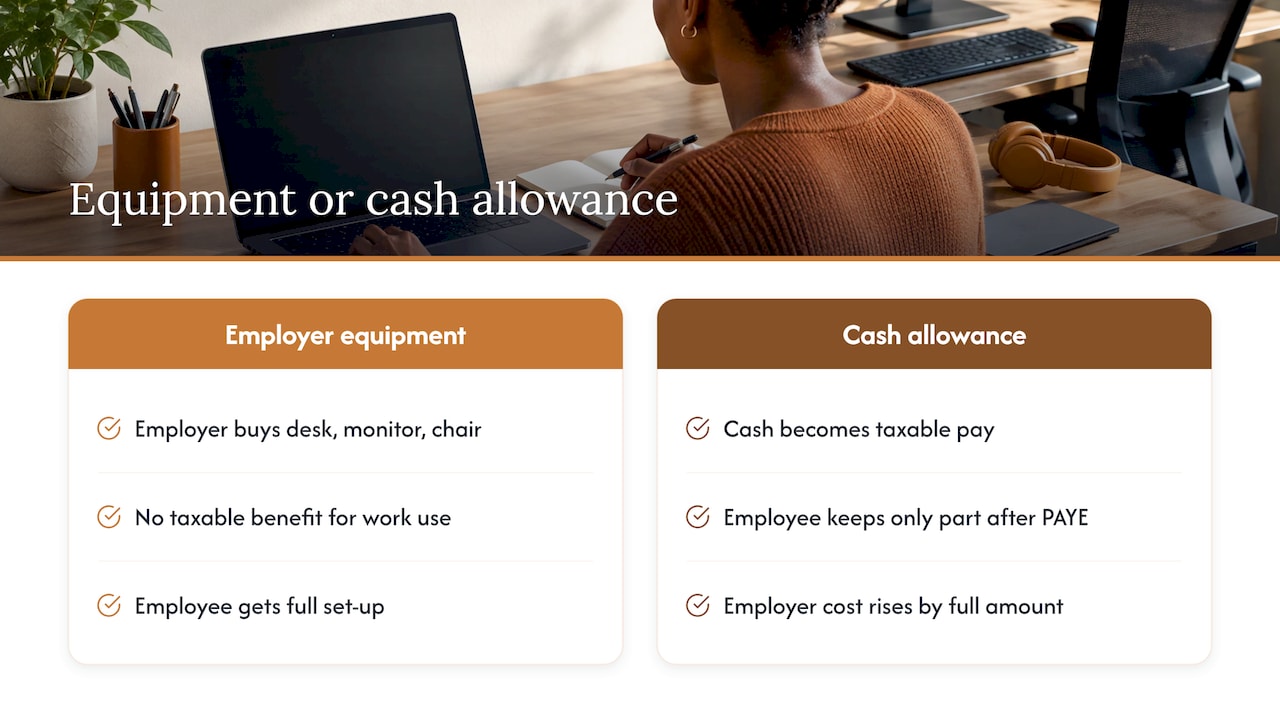
The practical consequence of the table is simple. If you want your remote employee to have a proper desk, a monitor and a good chair, buy them and keep them on your asset register (through us, the asset sits with the arrangement your contract sets out). The employee gets a full set-up, and no taxable benefit arises on an employer-owned asset used for work, according to KPMG.
Cash allowances work against that goal. A cash payment lands in taxable pay, so the employee sees only part of it after PAYE, and your total employer cost rises by the whole amount. You can model that effect with our employment cost calculator and see how any extra pay changes the total cost to company.
Recurring costs such as data and electricity are harder. Many foreign employers handle them by pricing them into the salary package rather than adding a separate line. That keeps payroll simple and avoids a stream of small claims. Our total cost to company guide shows how packages are built in South Africa.
What the employee can deduct from SARS
A separate question is what your employee may claim on their own annual return. You do not file this for them, but you should understand it, because employees ask and because your remote work letter is part of their evidence.
The conditions
SARS sets out the rules in its Home Office Expenses guideline for tax season 2025. In summary, all of these must hold:
- The space is occupied for the purposes of a trade, which includes employment.
- It is specifically equipped for the work, for example a home study with a desk and computer.
- The employee uses it regularly and exclusively for work, so a dining table or a spare bedroom that doubles as a guest room does not qualify.
- For a salaried employee, more than 50% of duties are performed in the home office. For someone earning mainly commission, more than 50% of duties must be performed somewhere other than an office the employer provides, as SARS explains.
- The employer allows the employee to work from home, and SARS may ask for confirmation of this on audit.
SARS also confirms in a published FAQ that a salaried employee can qualify if the legal requirements are met.
What can and cannot be claimed
The SARS page lists rent, repairs to the premises, and premises costs such as rates and taxes, cleaning and electricity. General wear-and-tear on office equipment, furniture and fittings may also qualify. Premises costs are apportioned by floor area. Wear-and-tear on equipment is not.
The limits matter more than the list:
- Bond (mortgage) interest. For most salaried employees it is not deductible. KPMG explains that section 23(m) of the Income Tax Act restricts employment deductions to a closed list, and SARS treats home-loan interest under section 24J, not section 11(a). Independent contractors and mainly-commission earners are generally outside section 23(m).
- Phone, internet and stationery. The BGC guide says these are not available as deductions where remuneration is solely or mainly salary and fringe benefits.
- Where the rules apply from. SARS’s Interpretation Note 28, dated 4 March 2022, reflects section 23(m) changes that apply from the 2023 year of assessment. Older guides that still list bond interest for salaried staff are out of date.
The same note says an employee who incurred business expenses may, depending on the facts, claim reimbursement from the employer to offset financial hardship. That is the link between the two halves of this article: the employer-side reimbursement is the route SARS itself points to.
A worked example
The formula is the home office area divided by the total residence area, multiplied by qualifying premises costs. Take a hypothetical employee with a 12 m² study in a 120 m² rented home. The study is 10% of the floor area. If annual qualifying costs (rent, electricity, cleaning, rates) come to R96,000, the premises deduction is R9,600. The desk and monitor the employee owns are handled separately through wear-and-tear, not floor area. SARS says qualifying amounts are entered under source code 4028 in the “Other Deduction” container of the ITR12 return.
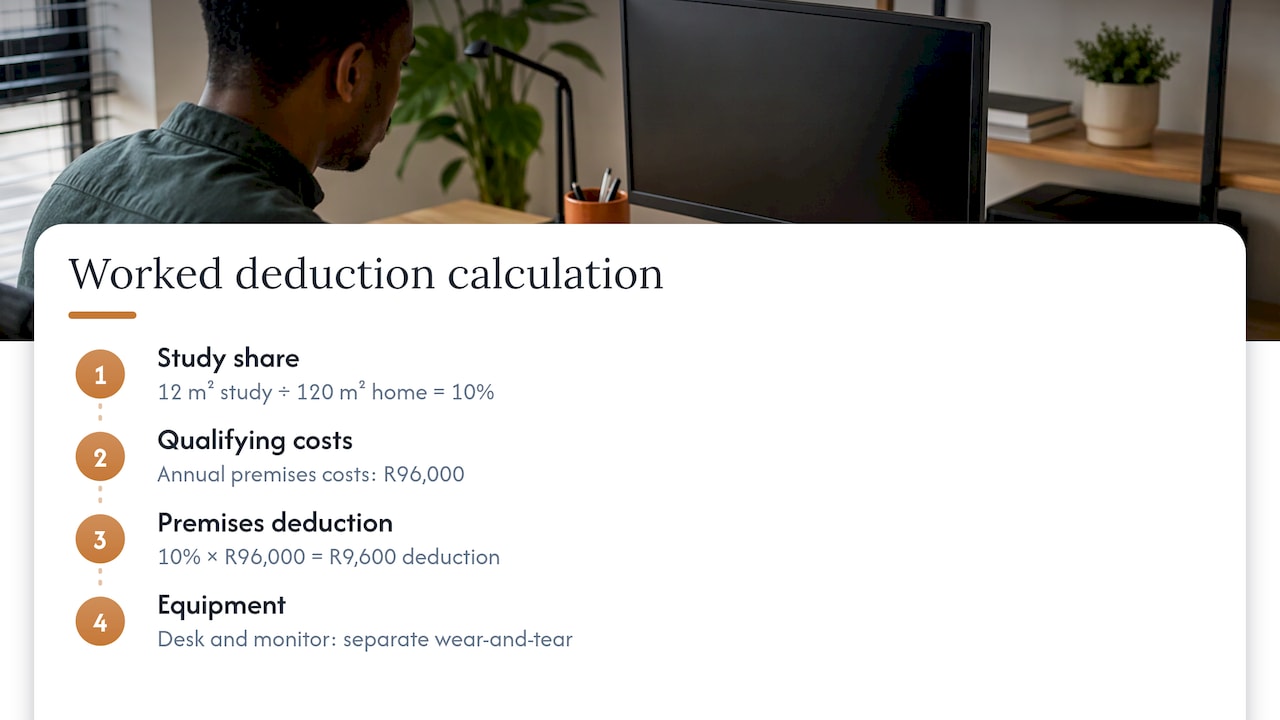
The example is illustrative, so the employee should check their own figures against the SARS page.
The paperwork
The interpretation note requires records supporting the claim to be kept for five years from the date the return was submitted. LawMatch’s guide to deductions says SARS may ask for a floor plan, photographs, an employer letter confirming the employee had to work from home, and invoices. A written remote work letter from you is therefore not a formality. Our guide to a South Africa remote work policy covers what to include.
Writing the allowance into the contract
Because the law leaves the allowance to agreement, the contract has to say what the employee gets. Decide these points before you offer the role:
- What you provide. Equipment you own, a stated cash amount, or both. Name each item.
- Who owns it. Employer-owned equipment is returned at the end of employment. State it, and state the return process.
- Whether the employee works from home by agreement. This supports both your position and any SARS claim the employee makes.
- How changes are made. If you later reduce or end an allowance, the contract and the Basic Conditions of Employment Act (BCEA) rules on variation govern how.
We set out the usual clauses in our guide to employment contract clauses for South Africa. The broader legal frame is in our overview of South African labour law for foreign employers.
What a remote allowance does to your payroll
Anything taxable you pay, whether cash or a reimbursed employee-owned item, has to run through monthly payroll. In South Africa that means PAYE (employees’ tax) declared on the EMP201 return, plus UIF and SDL where they apply, all in rand. Our employer taxes guide shows what you owe and when, and the payroll and tax guide goes through each filing.
An error here is not cosmetic. A reimbursement paid outside payroll as if it were tax-free, when it is a taxable fringe benefit, creates a PAYE shortfall on your side. This is the point where a single-country specialist earns its fee: the benefit is classified once, correctly, and filed.
Where we fit
If you do not have a South African entity, you cannot run any of this yourself without one: contracts, payroll and SARS registrations all require a local employer. We are an Employer of Record for South Africa only. Our licensed local partner employs your people, issues BCEA-compliant contracts, runs ZAR payroll and handles the PAYE (EMP201), UIF, SDL and COIDA filings. The fee is a flat $399 per employee per month (€350 or £299 in those currencies, listed from £299 per month on our pricing page), with no setup fees or FX loading. Signed contracts arrive within 48 hours.
A remote allowance is one line in a package that also has to meet the rules above. Having it written into the contract and applied in payroll from the first month is what keeps it clean.
If you are comparing providers, our EOR services page lists what is included, and the employer of record guide explains who legally employs your staff.
Perspective
Most home office questions we see in this area come back to one point: companies treat the allowance as a perk and forget that it is a payroll event. The perk is easy. The tax classification, the contract wording and the monthly filing are where it goes wrong.
Our advice is to give remote employees equipment you own and keep the cash portion inside the salary package. It keeps the benefit visible to the employee and the payroll simple for you. SARS itself acknowledges in Interpretation Note 28 that the home office rules were written before remote work was common and are applied as they stand, so your employee’s own deduction will stay narrow. A well-built employer package does more for them than the deduction will.
We built Expand to South Africa for one country because rules like section 23(m) and the fringe benefit treatment are exactly the details a 150-country platform skims. Our flat fee covers the contract, the payroll and the filings, so an allowance decision is made once and applied correctly.
Roel
FAQ
Do I have to pay a home office allowance in South Africa?
No. CMS notes that South African law sets no statutory obligation to pay a work-from-home allowance or reimburse remote working expenses beyond what is agreed in the contract. If you promise one, it becomes enforceable through the contract or policy, so write the terms precisely.
Is a home office allowance taxable for the employee?
A cash allowance is not among the usual non-taxable allowances such as subsistence and reimbursive travel, so it should be treated as taxable pay. KPMG’s 2026 guide also says reimbursing an item the employee owns is a taxable fringe benefit, while an employer-owned asset used for work is generally not.
Can my employee claim home office expenses from SARS?
Possibly. They need a dedicated, equipped room used regularly and exclusively for work, and a salaried employee must do more than 50% of their duties there. Bond interest, phone, internet and stationery are generally excluded for salaried staff, and records must be kept for five years.
Does the employee need a letter from me?
SARS says confirmation that the employer allows working from home may be requested on audit. A short letter stating the arrangement and the periods worked from home is the simplest way to provide it.
Sources
- CMS expert guide to remote working: South Africa
- KPMG: Remote work and home office deductions in South Africa (2026)
- BGC tax guide 2025
- SARS: Home Office Expenses guideline, tax season 2025
- SARS: Home Office Expenses
- SARS FAQ: salaried employee home office deduction
- SARS Interpretation Note 28: Home Office Expenses
- LawMatch: tax deductions for salaried employees