

If your South African payroll misses the EMP201 deadline, SARS (the South African Revenue Service) adds a 10% penalty on the unpaid amount plus interest that keeps running until you pay. The deadline is the 7th of the following month, and the penalty is charged to the employer, not the employee. Employers who withhold tax and do not pay it over also face personal liability and, in serious cases, prosecution. This guide explains what each failure costs, how the charges are applied, and how foreign companies keep the filing from becoming their problem.
TL;DR
- The EMP201 is the monthly employer declaration covering PAYE, SDL, UIF and/or ETI. It is due within 7 days after month-end.
- Late payment attracts a 10% penalty plus interest, according to the SARS Guide for Employers. Interest runs from the due date until payment.
- A late EMP501 reconciliation carries a separate administrative penalty: 1% of annual PAYE, rising by 1% per month to a maximum of 10%.
- Wilful or negligent failure to file or pay over deducted tax is a criminal offence, and the employer is personally liable for any shortfall.
- A foreign company hiring through an Employer of Record does not file the EMP201 itself. The local legal employer does.
Table of Contents
- What the EMP201 is and why SARS penalizes it
- When the EMP201 is due
- The penalties, failure by failure
- Personal liability and criminal exposure
- When SARS shows flexibility
- What to do if you are already late
- Why penalties happen to foreign employers
- How an Employer of Record keeps the EMP201 off your desk
- Promo: one country, one flat fee
- Perspective
- FAQ
- Sources
What the EMP201 is and why SARS penalizes it
The EMP201 is the monthly return employers in South Africa use to declare and pay what they have deducted from employees. SARS describes it as covering PAYE, SDL, UIF and/or ETI. In plain terms:
- PAYE is Pay As You Earn, the income tax withheld from each salary.
- SDL is the Skills Development Levy, paid by the employer.
- UIF is the Unemployment Insurance Fund contribution, paid by employer and employee.
- ETI is the Employment Tax Incentive, a reduction that applies to qualifying young employees.
So the answer to a common question is that the EMP201 is not the same as PAYE. PAYE is one line on it. The EMP201 is the declaration, and PAYE is one of the amounts it carries. If you want the full picture of what an employer owes, see our overview of what you pay and when in South Africa.
SARS takes the return seriously because the money in it is not the employer’s. Tax and UIF withheld from salaries are held for the state. That is why the penalties below attach to the employer directly, and why the law treats deliberate non-payment as more than a late fee.
When the EMP201 is due
SARS states that the return and payment are due within 7 days after the end of each month, which in practice means the 7th. When the 7th falls on a weekend or public holiday, the deadline moves to the last business day before it. That is an earlier date, not a later one, and it is the reason many first-time foreign employers are caught out.
Three mechanics matter for penalties:
- You must submit before you pay. SARS says a payment cannot be made without first submitting the EMP201.
- The PRN links the two. The 19-digit payment reference number ties your payment to the declared allocation.
- You keep the records. SARS requires copies of all declarations to be kept for five years.
A registered employer files every month, including months with nothing to pay. We cover the calendar side in Never Miss the 7th: EMP201 deadlines and in our 2026 South Africa payroll calendar.
The penalties, failure by failure
There is no single EMP201 penalty. What you pay depends on what went wrong. The table sets out the main cases and the official source for each.
| What went wrong | What SARS can charge | Source |
|---|---|---|
| Late payment of PAYE, SDL or UIF | 10% penalty on the late amount, plus interest | SARS Guide for Employers |
| EMP201 treated as not received (mandatory fields blank or form unsigned) | Penalties and interest | SARS EMP201 page |
| Incorrect monthly PAYE calculation | Penalties and interest | SARS PAYE page |
| Late EMP501 reconciliation | 1% of annual PAYE, rising 1% per month to 10% | SARS PAYE page |
| Non-payment with intent to evade | Penalty of up to twice the amount not paid | SARS Guide for Employers |
| Wilful or negligent failure to file or pay over | Criminal offence: fine or imprisonment | SARS PAYE page |
The 10% late-payment penalty
The SARS Guide for Employers says a penalty of 10% is imposed in addition to interest on late payments or outstanding amounts. It is calculated on the amount that was not paid on time, not on the whole payroll.
A worked example makes the scale clear. Say your monthly EMP201 shows PAYE, UIF and SDL of ZAR 100,000 and you pay it after the due date. The penalty is ZAR 10,000. Interest is added on top and accrues from the due date until the day you pay. The figure is illustrative, but the arithmetic is the same for any amount.
Interest
Interest is charged at a rate SARS prescribes, and that rate is adjusted from time to time as interest rates move. Because it changes, the right check is the current rate on SARS’s own pages, not a number remembered from an earlier year. Interest is not a one-off charge. It keeps accruing on the outstanding tax until it is settled.
SARS also decides the order in which a payment is applied. According to the Guide for Employers, a payment is allocated to the penalty first, then to interest, and only then to the tax itself. A partial payment can therefore leave tax outstanding that continues to attract interest.
A return that SARS treats as not received
A filed EMP201 can still count for nothing. SARS says penalties and interest may be charged where the return is treated as not received, and it gives two causes: mandatory fields that were not completed, or a return that was not signed. Rushed filings from an unfamiliar system are where this happens.
Wrong numbers
An incorrect calculation of the monthly PAYE liability may also lead to penalties and interest. The bigger consequence appears later. EMP201 figures are reconciled twice a year on the EMP501, and a mismatch between what you declared monthly and what payroll records show forces corrections for the affected months. Our guide on fixing an EMP501 reconciliation takes you through that process.
The EMP501 penalty
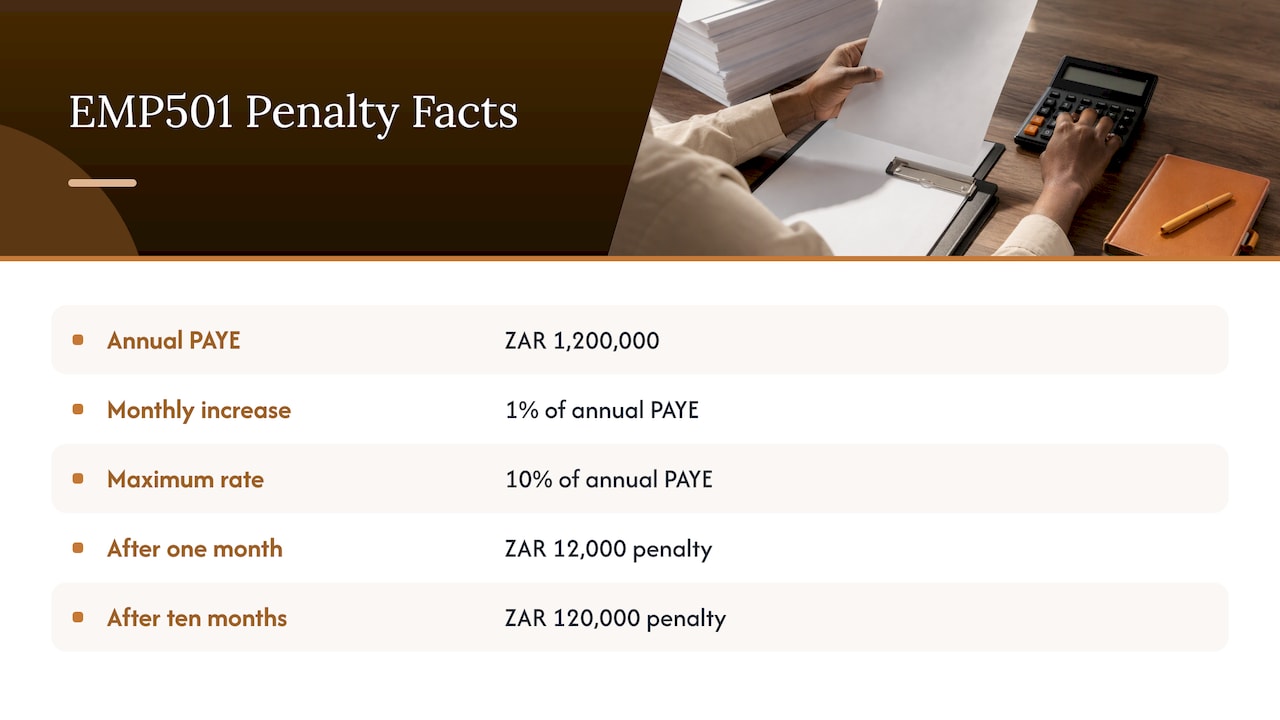
The EMP501 is the reconciliation of everything declared and paid over the period against payroll records. SARS states that a late submission carries an administrative penalty of 1% of annual PAYE, increasing by 1% each month to a maximum of 10%. On an annual PAYE bill of ZAR 1,200,000, the first month’s penalty would be ZAR 12,000, and a full ten months would reach ZAR 120,000. The reconciliation windows recur each year: SARS lists the interim season as 1 September to 31 October and the annual season as 1 April to 31 May.
Personal liability and criminal exposure
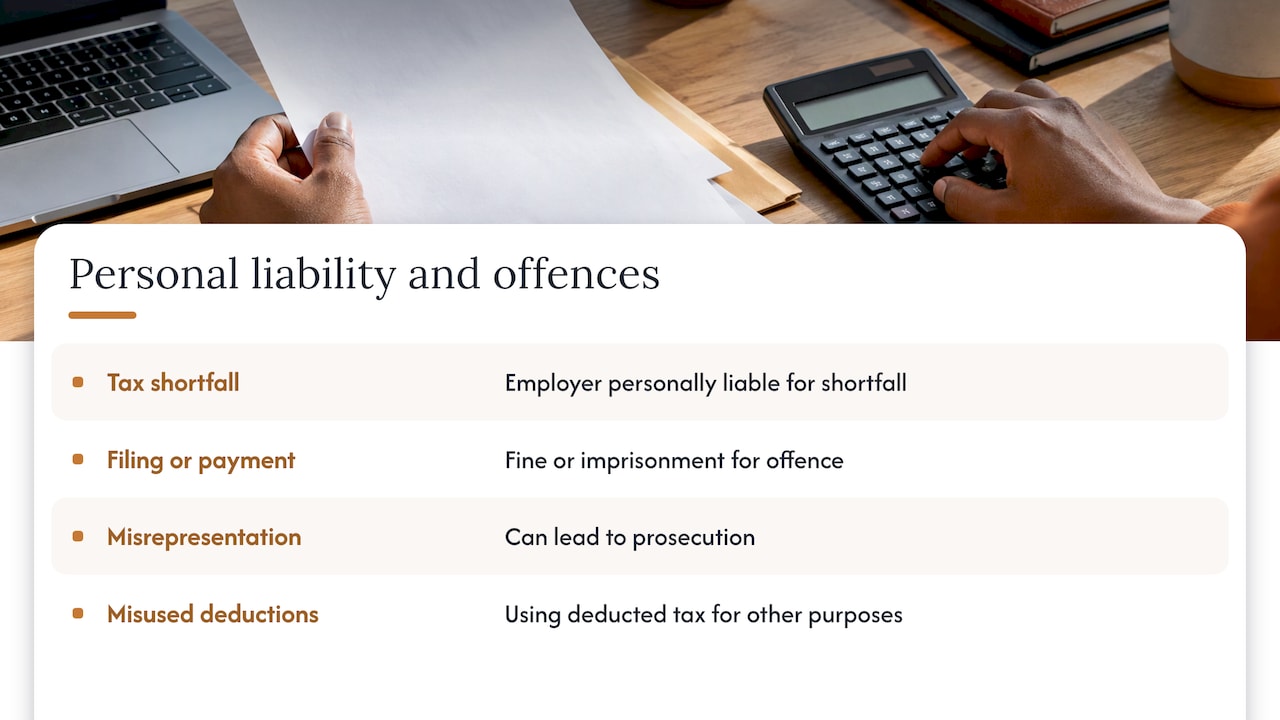
This is the part foreign founders tend to underestimate. The Guide for Employers states that an employer who fails to deduct or withhold the full amount of employees’ tax or UIF is personally liable for the shortfall. SARS also says that a wilful or negligent failure to submit the EMP201 or EMP501, or to deduct or pay PAYE within the prescribed period, is an offence punishable by a fine or imprisonment, as set out on its PAYE page. The same page also says misrepresentation, neglect, false information or non-submission on the EMP201 can lead to prosecution.
The Guide adds a specific offence worth knowing: using tax you deducted for any purpose other than paying it to SARS. For a cash-constrained startup, that means PAYE should never be treated as working capital, even for a few days.
For a company with no local entity, the question is who the employer is. If you pay a South African worker directly or through a contractor arrangement, you may be creating obligations you did not plan for. Our article on non-resident employers and PAYE explains where that line falls.
When SARS shows flexibility
SARS has discretion over due dates. After system delays in July 2025, the Commissioner extended the EMP201 filing and payment date to Monday 14 July 2025 and said it would consider not imposing penalties and interest on employers who would otherwise have been compliant. That was an exception tied to a SARS system problem, and it applied only to employers who were otherwise compliant. It does not make late filing safe in a normal month.
If a penalty arrives that you believe is wrong, the route is to ask SARS to remit it, with a clear written reason and evidence, and to object if the request is refused. Remission is a request, not an entitlement, so the strongest cases are those with a documented cause such as a bank outage or a SARS system failure.
What to do if you are already late
The steps are short, and the order matters.
- Submit the EMP201 now. A late return is better than none. Complete every mandatory field and sign it, so it is not treated as not received.
- Pay what is due with the right reference. SARS’s FAQ explains that penalties and interest for a specific EMP201 are paid by completing the applicable fields on the return when you pay at submission, or by using the 19-digit PRN on that EMP201 if you pay afterwards.
- Check your employer account. SARS’s Managing Your Employer Account page describes how to view the consolidated Employer Statement of Account (EMPSA), spot incorrect or missing transactions and correct unallocated payments.
- Contact SARS early if you cannot pay in full. Payment arrangements are decided by SARS and are not guaranteed, so raise the shortfall before it grows. Interest continues while the balance is open.
- Fix the cause. Late filing usually traces to a missed calendar date, a holiday shift or an unreconciled payroll file. Repair that before the next cycle.
Why penalties happen to foreign employers
Most EMP201 penalties are not caused by bad intent. They come from process gaps that are common for companies new to South Africa:
- The holiday shift. A 7th that lands on a weekend or public holiday moves the deadline to the preceding business day. A team used to a fixed date misses it.
- Foreign time and currency. Payroll approved in one currency and paid in rand adds steps, and each one can push the payment past the deadline.
- Submit-then-pay sequencing. Paying first is not possible, and submitting without paying leaves the amount outstanding.
- Nil months. A registered employer files even when there is nothing to pay.
- Unreconciled returns. Filing from payroll software output without checking it against the ledger produces differences that only show up at the EMP501 stage.
Our wider guide to South African payroll and tax for employers and the explainer on registering within 21 days cover the registration side, which is where compliance starts.
How an Employer of Record keeps the EMP201 off your desk
When you hire through an Employer of Record (EOR), a licensed local entity becomes the legal employer. In our model, that local partner handles BCEA-compliant contracts, ZAR payroll and the statutory filings: PAYE through the EMP201 with SARS, plus UIF, SDL and COIDA. You do not register as an employer in South Africa, you do not log into eFiling, and the EMP201 deadline is not on your calendar.
This is the practical answer for the readers this guide is written for: a European or UK founder hiring a first remote employee, a finance lead comparing EOR options, or a company converting a contractor to an employee. The risk in this article, a 10% penalty, accruing interest and personal liability, sits with the employer of record on the filing. You do see the cost of employment up front, since a public employment cost calculator is available on our site.
We are also open about who employs your people. Your worker is legally employed by the local partner, you direct the day-to-day work, and the contract follows South African labour law.
Promo: one country, one flat fee
Expand to South Africa is an Employer of Record for one country only. Our EOR service in South Africa starts from £299 per month per employee, with no setup fees or FX loading. Contracts are signed within 48 hours, and the local partner files PAYE, UIF, SDL and COIDA for you.

If you are moving from another provider or turning a contractor into an employee, see how our EOR services work, or compare the field in our pricing comparison.
Perspective
Penalties for EMP201 are rarely about the money alone. A 10% charge on a month’s PAYE is a line in the budget. The real cost is that a late or wrong return puts a foreign company in front of SARS with a compliance history it did not know it had.
We built Expand to South Africa around one country because this is where the detail lives: the 7th, the holiday shift, the submit-then-pay order, the EMP501 reconciliation twice a year. A platform covering 150 countries cannot give each of those the same attention.
Our view is simple. If you are hiring full-time in South Africa without a local entity, the filings should be done by the party that legally employs your people and does this every month. You keep the hiring decision and the work. The compliance calendar belongs to the local partner. A flat fee makes the cost visible before the first payslip.
Roel
FAQ
What is the penalty for paying the EMP201 late in South Africa?
The SARS Guide for Employers says a 10% penalty is added to the late or outstanding amount, together with interest. Interest runs from the due date until payment. If the late payment involves intent to evade, the penalty can reach up to twice the amount not paid.
Do I have to submit an EMP201 if I owe nothing?
Yes. A registered employer files every month, including months with no payroll activity. Skipping a nil return can lead to penalties and is treated as a failure to submit. The return must also have all mandatory fields completed and be signed, or SARS may treat it as not received.
Is the EMP201 the same as PAYE?
No. PAYE is the income tax withheld from salaries. The EMP201 is the monthly declaration that reports and pays PAYE together with SDL, UIF and, where applicable, ETI. It is reconciled with your payroll records on the EMP501 twice a year.
Can an EMP201 penalty be removed?
Sometimes. SARS can consider a request for remission where you give a reasonable explanation backed by evidence, such as a documented system failure. It is not automatic, so file the return and pay first, then make the request. If the request is refused, you can object.
Who is liable if my EOR files the EMP201 late?
The legal employer files and pays the EMP201, so the filing obligation sits with them. This is why the choice of a licensed local employer matters. Ask any provider who the legal employer is and who handles each SARS filing.
Sources
- SARS: Completing the monthly employer declaration (EMP201)
- SARS: PAYE-GEN-01-G20 Guide for Employers, 2026 tax year
- SARS: Pay As You Earn
- SARS: Calendar
- SARS: FAQ on paying interest and penalties
- SARS: Managing your employer account
- SARS media release: extension of EMP201 due date, 8 July 2025