

Under South Africa’s Compensation for Occupational Injuries and Diseases Act 130 of 1993 (COIDA), “earnings” are the payments an employer makes regularly to its employees, counted before any deductions, in money or in kind. Those earnings are the base for the annual assessment you pay to the Compensation Fund. For each employee, only earnings up to a yearly ceiling are counted. That ceiling is R668,000 from 1 March 2026.
This guide explains what is in and out of that definition, how the cap works, how the assessment is calculated, and what a foreign employer hiring in South Africa needs to file.
TL;DR
- Earnings means regular payments to employees, gross and before deductions, including cash and the cash value of benefits in kind.
- Regular overtime, all bonuses, commission and regular allowances count. Reimbursements, occasional overtime and ex gratia payments do not.
- The maximum earnings per employee is R668,000 per year from 1 March 2026, applied to each employee’s annual total, not monthly.
- The assessment is earnings divided by 100, multiplied by your industry rate. A minimum assessment of R1,621 applies to employers.
- The Return of Earnings covers 1 March to the end of February, and late filing can trigger an estimated assessment and a penalty of up to 10%.
Table of Contents
- What “earnings” means under COIDA
- What is included in COIDA earnings
- What is excluded
- The earnings cap: R668,000 per employee
- How earnings turn into your assessment
- Reporting earnings: the Return of Earnings
- Domestic workers and COIDA earnings
- Where COIDA sits among your other payroll obligations
- Our perspective
- Let us handle COIDA for your South African team
- FAQ
- Sources
What “earnings” means under COIDA
The Department of Employment and Labour’s Return of Earnings Guidelines describe earnings as all payments made regularly, before any deductions, whether in money or in kind, to employees. The guidelines add that their lists of included and excluded items are not exhaustive. When a payment is unusual, the principle decides it: is it a regular part of what the employee is paid for the work?
The COIDA Service Book adds that the earnings you declare are the salaries and wages paid to your employees during the assessment year, together with the number of employees you had in that year. The assessment year runs from 1 March to the end of February.
Two practical consequences follow:
- Gross, not net. Tax, UIF and pension deductions are not subtracted. The figure comes from the gross column of your payroll.
- Paid, not promised. You report what was paid in the assessment year, summed across the twelve months for each employee.
The COIDA Amendment Act also revisits the wording of the definition of earnings, so confirm the current text on the Department of Employment and Labour’s site when you prepare a return.
What is included in COIDA earnings
According to the Department’s guidelines, these items are included in gross earnings:
- Overtime of a regular nature.
- Bonuses of any kind, including incentive and annual bonuses.
- Commission, even when the amount varies from month to month.
- The cash value of food and quarters supplied as part of the remuneration package.
- The cash value of fringe benefits such as a company car or free accommodation.
- Travel and other allowances paid regularly as part of the package.
- Other items forming part of a benefits package, apart from employer contributions such as medical aid contributions.
- Earnings or drawings paid to working directors of a company or members of a close corporation.
For a company with international staff, the usual surprises are bonuses and commission. A year-end bonus is easy to forget when you build the return from monthly salary alone, yet it counts. Our guide to bonus tax for employers explains how the same payments flow through payroll for tax purposes.
What is excluded
The same guidelines list the following as excluded from earnings:
- Payments of a reimbursive nature.
- Overtime worked only occasionally.
- Payments for specific non-recurring tasks outside the employee’s normal duties.
- Ex gratia payments.
- Intangible fringe benefits, such as the taxable portion of employer medical aid or pension contributions.
- Payments covering special expenses, such as subsistence and travel costs, lunches and business meeting costs.
- Travel and other allowances paid only occasionally.
- Profit sharing of directors and members.
The line to watch is between regular and occasional. A travel allowance paid every month as part of the package is earnings. The same allowance paid once for a single trip is not. Write the pattern into your payroll notes at the time you pay, so the return can be prepared from a record rather than from memory.
Quick reference table
| Payment | Counts as COIDA earnings? |
|---|---|
| Monthly basic salary | Yes |
| Annual or incentive bonus | Yes |
| Commission (variable) | Yes |
| Regular overtime | Yes |
| Occasional overtime | No |
| Company car or free accommodation (cash value) | Yes |
| Monthly travel allowance in the package | Yes |
| One-off travel allowance | No |
| Expense reimbursement | No |
| Ex gratia payment | No |
| Employer medical aid contribution | No |
The earnings cap: R668,000 per employee
The cap limits how much of each employee’s pay counts toward your assessment. Government Gazette 54577 prescribes R668,000 per employee per year as the maximum amount of earnings on which an employer’s assessment is calculated, effective 1 March 2026. The same notice sets a minimum assessment of R1,621 for employers and R560 for domestic employers.
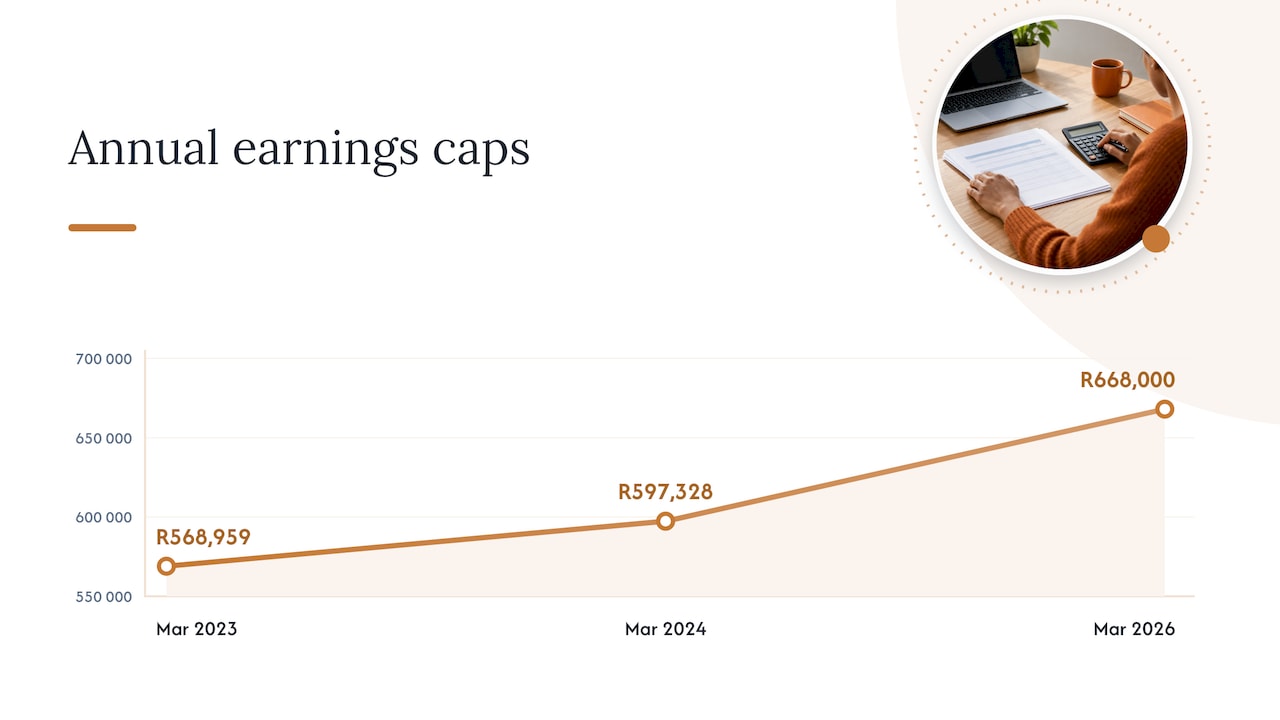
The cap is applied to each person’s annual total at the end of the assessment period, not month by month. Earlier Government Gazette 50386 gave the same rule with figures for past years: R568,959 for the assessment period beginning 1 March 2023 and R597,328 for the period beginning 1 March 2024.
Two figures on one return
The Return of Earnings uses two ceilings, which confuses many first-time filers. According to ClearComply, R633,168 applies to the actual earnings for the year that ended 28 February 2026, and R668,000 applies to provisional earnings and the year you are currently in. The South African Accounting Academy confirms the R633,168 figure for 2025/2026.
| Assessment year | Ceiling per employee |
|---|---|
| 1 March 2023 to 29 February 2024 | R568,959 |
| 1 March 2024 to 28 February 2025 | R597,328 |
| 1 March 2025 to 28 February 2026 | R633,168 |
| From 1 March 2026 | R668,000 |
For more on how the threshold is set and what changed, see our page on the COIDA earnings cap for 2026.
How earnings turn into your assessment
The COIDA Service Book gives the formula: earnings divided by 100, multiplied by the rate. It also explains that the assessment is the annual payment employers make to the Compensation Fund to cover employees injured at work, and that the rate is fixed per industry subclass. The Act provides for a minimum assessment so that the amount is never less than administration costs.
A worked example
This is an illustration, with a rate chosen only to show the arithmetic. Suppose you employ two people in South Africa, and your industry subclass carries a rate of 0.81 per R100 of earnings.
- Employee A earns R420,000 in salary and R60,000 in bonuses and commission over the year. Declared earnings: R480,000. Assessment: 480,000 ÷ 100 × 0.81 = R3,888.
- Employee B earns R800,000 in total. Only R668,000 counts. Assessment: 668,000 ÷ 100 × 0.81 = R5,410.80.
Combined, the assessment is R9,298.80, and the R132,000 that Employee B earned above the cap adds nothing. ClearComply notes that earnings above the ceiling for any individual are excluded from the assessable payroll.
Which rate applies to you
Rates are published by the Compensation Commissioner under Section 83 of COIDA. Per ClearComply, they run from 0.18% for Class A, which covers finance, consultants, medical practices, salons, education and administration, up to 3.34% for Class I, rock drilling and blasting. There are 13 classes and 103 subclasses. The same source reports that the five-year phase-in ended with the 2025 assessment year, so 2026 is the first season in which every business pays its class rate.
The 2026 tariffs per R100 of earnings, as listed by Govchain:
| Class | Rate per R100 |
|---|---|
| A | 0.18 |
| F | 0.29 |
| B | 0.51 |
| D | 0.65 |
| C | 0.81 |
| M | 1.04 |
| L | 1.16 |
| H | 1.65 |
| G | 1.96 |
| E | 2.01 |
| J | 2.65 |
| K | 2.71 |
| I | 3.34 |
Your class depends on the nature of the work, so confirm your classification when you register with the Compensation Fund.
Reporting earnings: the Return of Earnings
In terms of section 82 of COIDA, a registered employer must furnish a Return of Earnings by the 31st day of March each year, and payment to the Fund is due within 30 days of submission, as FHBC explains. The Service Book notes that the online system opens on 1 April each year for filing, and that the Director-General may set a different approved date. The filing window changes from year to year, so check the Department’s announcement for the current deadline.
The Department’s page on submitting earnings statements says the return must state:
- Updated contact details of the employer.
- The number of employees for the assessment period.
- The earnings of every employee, up to the maximum set for that period.
- The nature of the employer’s business.
That last item drives your rate class, so describe the business accurately. The Department’s guidance is the place to confirm the required fields.
Penalties for late or missing returns
Under Section 83(6), if you do not file within the prescribed period, the Director-General may assess you on estimated earnings and impose a fine of up to 10% of the amount assessed. Government Gazette 54043 repeats this warning for employers who miss the deadline. The South African Accounting Academy reports that amendments effective 1 February 2026 stiffen the penalties, including a fine equal to full compensation for failing to report an accident within 7 days, and that non-compliance now leads to administrative penalties rather than criminal offenses.
An estimate is rarely in your favor: it is built without your payroll detail and may ignore the cap on your higher earners.
Domestic workers and COIDA earnings
If you employ a domestic worker in a private home, the same earnings logic applies, because the Constitutional Court ruled that excluding them from the definition of “employee” was unconstitutional. The case, Mahlangu v Minister of Labour, arose after a domestic worker died in a work accident and her family was denied benefits. A legal commentary in the journal Obiter notes that the judgment brought domestic workers within the employee definition, and that COIDA does not exclude workers because their earnings exceed a certain amount.
For domestic employers, Government Gazette 54577 sets a minimum assessment of R560 from 1 March 2026. Their declared earnings are the wages paid to the worker, including the cash value of food or accommodation that forms part of the package. This is relevant to you only if you hire household staff. A foreign company hiring office-based professionals will normally be dealing with the commercial classes above. Wage floors for these workers are covered in our South Africa minimum wage guide.
Where COIDA sits among your other payroll obligations
COIDA is one of four statutory streams on a South African payroll, alongside PAYE, UIF and SDL. They do not share a base. PAYE works from taxable remuneration, while COIDA works from the earnings definition above with its own annual cap. Keeping each stream’s base straight is much of what good payroll practice means here. Our overview of employer payroll taxes in South Africa covers registration, and EMP201 deadlines cover the monthly rhythm. For what coverage means for an employee injured at work, see COIDA coverage for employers. Payslip content is a separate matter, set out in our payslip requirements page.
A checklist for your first return
- Confirm your business is registered with the Compensation Fund and has the right class.
- Export gross pay for each employee for 1 March to the end of February.
- Add regular overtime, bonuses, commission, regular allowances and the cash value of benefits in kind.
- Remove reimbursements, occasional overtime and ex gratia payments.
- Apply the correct ceiling to each person’s annual total.
- Declare provisional earnings for the current year using the current ceiling.
- File within the window the Department announces, then pay within 30 days of submission.
Our perspective
Most COIDA mistakes we see are not about the formula. They come from where the numbers originate. A company with no South African entity has no one who owns the payroll detail: bonuses are agreed in one system, allowances in another, and the annual return is assembled in a rush.
We built Expand to South Africa around one country because this is where depth matters. The earnings definition, the two ceilings on one return and the class selection are small details with real penalties attached, and a platform spread across 150 countries cannot give each of them the same attention.
Our model is a licensed local partner that handles contracts that follow the BCEA, ZAR payroll and the statutory filings, including COIDA, with a flat fee and no setup fees or FX loading. We also tell you plainly who legally employs your people, because you should know where responsibility sits before you rely on it.
If you are comparing options, ask each one how it computes COIDA earnings, which cap it applies and who files the return. A clear answer to those three questions says a lot about the rest of the service.
Roel
Let us handle COIDA for your South African team
Our Employer of Record service in South Africa starts at £299 per employee per month, with no setup fees or FX loading. Your employee is engaged through our licensed local partner, which handles BCEA-compliant contracts, ZAR payroll and the statutory filings, including PAYE, UIF, SDL and COIDA.

See the full pricing, read how our EOR services work, or look at our payroll services if payroll is your first question.
FAQ
Are bonuses part of COIDA earnings?
Yes. The Department of Employment and Labour’s guidelines include bonuses of any kind, covering incentive and annual bonuses, in gross earnings. Commission is also included even if it changes from month to month. Include them before the cap is applied to each employee’s annual total.
Is the R668,000 cap a monthly or annual limit?
It is annual and per employee. It is applied to each person’s total earnings at the end of the assessment period, which runs from 1 March to the end of February. It applies from 1 March 2026, while R633,168 applies to actual earnings for the year that ended 28 February 2026.
Do reimbursed expenses count as earnings?
No. Payments of a reimbursive nature, and payments covering special expenses such as subsistence and travel, are excluded. A travel allowance paid regularly as part of the package is different and is included. When a payment sits between the two, the regular-or-occasional test decides it.
What happens if I don’t submit the Return of Earnings on time?
The Director-General may raise an assessment based on estimated earnings and add a fine of up to 10% of the assessed amount. Payment is due within 30 days of submission. Check the Department’s current announcement for the filing window each year.
Sources
- Return of Earnings Guidelines, Department of Employment and Labour
- COIDA Service Book, Version 23
- How to submit earnings statements to the Compensation Fund
- COIDA new maximum earnings for 2025/2026, South African Accounting Academy
- COIDA 2026 ROE submission dates and amendments, South African Accounting Academy
- COIDA tariffs of assessment 2026/2027, ClearComply
- COIDA return of earnings calculator, Govchain
- COIDA annual return of earnings submissions, FHBC
- Mahlangu v Minister of Labour, ESCR-Net case summary
- Mahlangu v Minister of Labour case note, Obiter