

When an Employer of Record (EOR) pays South African staff, your money starts in dollars, euros or pounds and ends as rand in an employee’s bank account. Somewhere in between, the currency is converted, and the provider can earn a margin on that conversion without ever listing it as a fee. This guide shows where that margin hides, how to calculate what it costs you, and which contract terms keep it at zero.
TL;DR
- FX cost on EOR payroll usually sits in the exchange rate, not on the invoice. A provider can quote a low monthly fee and still add a spread to the rate it uses.
- Ask four things before signing: which rate is used, on which date, whether any markup is added, and whether the deposit, exit fee and statutory pass-throughs are listed.
- Compare providers on total monthly cost per employee, including conversion, not on the headline fee.
- Our model is a flat €350 / $399 / £299 per employee per month, with no setup fees and no FX loading.
- Exchange control rules mean cross-border funds should move through authorized channels, so keep the paper trail for every payroll funding.
Table of Contents
- Where FX fees come from in South African payroll
- Why the markup is easy to miss
- A worked example: what a 2% spread costs
- Other charges that sit beside the FX line
- What to check in an EOR contract
- Ways to reduce FX cost
- Make your South African payroll predictable
- How to compare two EOR quotes properly
- FAQ
- Sources
Where FX fees come from in South African payroll
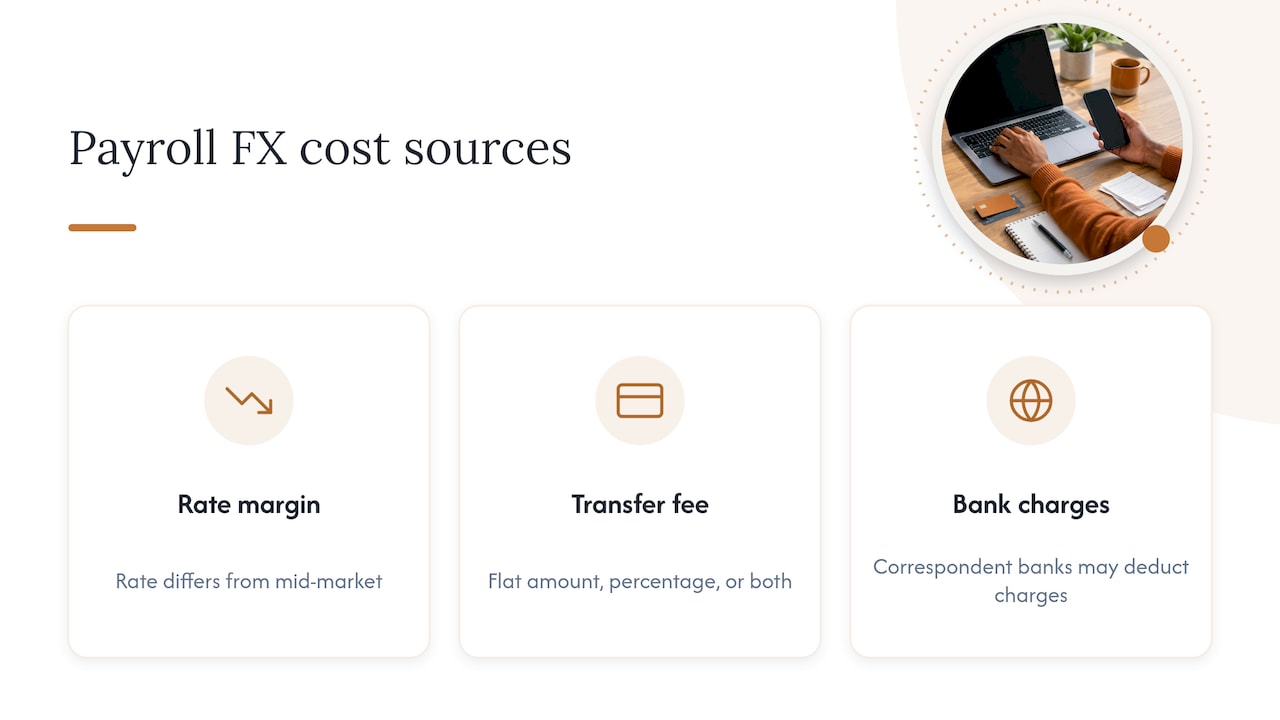
South African employees are paid in rand (ZAR), and PAYE, UIF, SDL and COIDA obligations are calculated and filed in rand as well. Your company almost certainly budgets in another currency. So every payroll run involves at least one conversion, and there are three places a cost can enter.
1. The exchange rate itself. Banks and payment providers quote a rate that differs from the mid-market rate, the midpoint between buy and sell prices. The gap is the margin. It never appears as a line called “fee”, which is why it is easy to miss.
2. A separate transfer or processing fee. This is the visible charge: a flat amount per payment, a percentage of the value, or both. Some providers charge it per employee, some per payroll batch.
3. Intermediary and receiving charges. International wires can pass through correspondent banks, and each may deduct a charge before the funds arrive. For payroll this matters, because a short-paid salary becomes an employment problem, not just a banking one.
South Africa also operates exchange control. Foreign currency moving into the country should be remitted through an authorized dealer, which is a bank, and the paperwork, such as the agreement, the SWIFT confirmation and the conversion advice, is what lets that dealer confirm the transaction is legitimate. A South African law firm’s overview of exchange control sets out this principle for inward funding. For payroll, the practical consequence is simple: you want a provider that funds salaries through a licensed local structure and gives you a clean record for each run, rather than ad hoc transfers.
Why the markup is easy to miss
A fee has a name and an amount. A markup is a difference between two numbers, and you only see it if you know both. On an invoice that reads “payroll funding: $3,400”, nothing tells you whether the provider converted at the mid-market rate or at a rate that is 2% worse.
Three habits make it harder still:
- Invoices in your currency only. If the invoice shows a single converted total with no rate, you cannot audit it.
- Rate set by the provider at its discretion. Phrases such as “our prevailing rate” or “the rate on the day of processing” give the provider room to pick a favorable moment.
- Bundling. The conversion cost is folded into a “payroll processing” or “platform” line, so it looks like part of the service.
The fix is to ask for the rate to be shown. A written exchange-rate policy can use either the mid-market rate on payday or a fixed monthly rate. Both are workable, provided the policy names the rate source and states that no margin is added.
A worked example: what a 2% spread costs
The numbers below are an illustration, not a quote. We assume a rate of R18 to $1 and a gross monthly salary of R60,000, and we assume a provider adds a 2% spread to the conversion.
| Item | Calculation | Result |
|---|---|---|
| Salary converted at mid-market | R60,000 ÷ 18 | $3,333 per month |
| 2% spread on that amount | $3,333 × 2% | about $67 per month |
| Annual cost per employee | $67 × 12 | about $800 |
| Team of 10 | $800 × 10 | about $8,000 per year |
The spread alone is modest on one salary, but it scales with payroll and with the salary level. Hiring a senior engineer on R120,000 doubles the margin. And the spread is calculated on the full salary, not just on the provider’s fee, so it grows as your team does.
Now compare it with a flat fee. At $399 per employee per month, our fee comes to $4,788 per employee per year. The point of the comparison is not that FX is the biggest cost; it is that FX is the one cost nobody quotes you. A provider whose headline price looks $50 lower per month can end up level with, or above, a flat-fee provider once a spread is applied to the whole payroll.
To run your own numbers, start from the gross salary, add the statutory employer costs, and then add whatever conversion margin your contract permits. Our employment cost calculator does the first two steps, and the guide to calculating employer costs in South Africa explains each component.
Other charges that sit beside the FX line
FX is one of several costs that never appear in a monthly fee. When you compare providers, check each of these as well.
Security deposits
Some EORs hold a refundable deposit, often about one month of salary or total cost per employee, for the length of the engagement. It is not a fee, but it is working capital you cannot use, and on a ten-person team it adds up quickly. Ask for the amount, whether it is interest-bearing, where it is held, and the timeline for return after offboarding. Our model does not rely on a deposit-based structure to be priced; see the pricing page for what is included.
Statutory pass-throughs
Employer contributions are real costs and legitimately passed through at cost: UIF and SDL on payroll, plus COIDA assessments. What you want is for them to be itemized, not buried. A provider that lists them separately lets you check them against the rates; one that bundles them into a single “employer costs” figure does not. If you want to build your own tracking of what is charged separately from a base fee, tracking systems for SME payroll workflows show how businesses reduce errors in the underlying data that feeds payroll. Our guide to payroll taxes for employers in South Africa covers registration and filing, and paying employees in ZAR explains the EMP201 cycle.
Setup, transfer and exit fees
Some providers charge to onboard an employee, to move an employee in from another provider, or to terminate the arrangement. Each should be a stated figure in the contract. We charge no setup fees and offer free transfers from other EOR providers. For the end of an engagement, see our offboarding checklist for South Africa.
Sourcing fees
If the provider also recruits for you, the placement fee is a separate line and should be agreed before the search begins. Our talent sourcing is priced at 55%, as listed on that page.
What to check in an EOR contract
Use this list when you review a draft agreement. Each item should be answerable from the contract, not from a sales call.
- Rate source. Does the contract name the rate (for example the mid-market rate from a named source)?
- Rate date. Is it the payday rate, a fixed monthly rate, or the date the provider processes the transfer?
- Markup. Does the contract state that no margin is added to the rate? If a margin exists, is it a stated percentage?
- Currency of invoice. Are you invoiced in your own currency, and does the invoice show the rate and the ZAR amount?
- Payment timing. When must you fund payroll, and what happens if the funding arrives late? Employees must be paid on time whatever happens with the transfer.
- Deposit. How much, where it is held, when it is returned.
- Pass-throughs. Are UIF, SDL and COIDA itemized at cost?
- Exit terms. Is there a termination fee, and what notice does the contract require from you?
- Data handling. Where is employee data stored, and under which regimes? Ours is handled under POPIA and GDPR with EU data residency.
Ways to reduce FX cost
You cannot remove conversion from cross-border payroll, but you can stop paying a margin on it.
- Choose a pricing model with no FX loading. The simplest way to avoid a markup is a provider that states, in writing, that there is none.
- Demand the rate on the invoice. If you can see the rate and compare it to a public mid-market rate on the same day, any difference is visible.
- Fund on a predictable schedule. Regular funding dates make it easier to budget the exchange rate. Some companies prefer a fixed monthly rate to smooth swings, and that can be a sensible choice if the rate is set transparently.
- Budget in a single currency. Mixing invoices in several currencies multiplies the conversion points. Ask for one invoice in your base currency.
- Consider the salary currency early. Salaries are paid in rand. If you want to protect a hire from rand weakness, discuss any review mechanism in the employment contract itself, with legal advice, rather than by paying in a foreign currency informally.
Also confirm the legal side. A provider that employs your people through a licensed local partner handles BCEA-compliant contracts, ZAR payroll and filings with SARS. Be clear about who the legal employer is. We tell clients plainly that our licensed local partner is the employer of record.
Our view on FX in EOR pricing
We built Expand to South Africa for one country, and that shapes how we price. Global platforms cover 150 countries and charge $400 to $599 per month for it, and in a multi-country model the conversion layer is one more place to earn revenue. We chose not to do that.
Our fee is flat: €350, $399 or £299 per employee per month, with no setup fees and no FX loading. That means the number you see in the proposal is the number you budget. If you can see the rate, you can check the rate.
We would rather a finance lead compare us line by line than take our word for it. The employment cost calculator is public for that reason, and the API has public docs and sandbox keys. Payroll should be the least surprising line in your cost base.
Roel
Make your South African payroll predictable
If you are comparing EOR options for a first hire or switching away from a provider whose invoices you cannot reconcile, start with the cost. Our EOR service for South Africa starts at £299 per employee per month, with signed contracts within 48 hours and onboarding within days. Salary savings of 40 to 60% against UK and EU rates are typical for skilled roles, and the time zone overlap is within one hour of CET.

See the full pricing or read the complete guide to Employer of Record in South Africa before you decide. For the broader cost picture, our page on EOR cost in South Africa goes further, and the payroll services page describes how a run works end to end.
How to compare two EOR quotes properly
A fair comparison puts both quotes on the same basis for one employee for twelve months.
- Write down the monthly fee for each.
- Add the deposit as a cash-flow cost: the amount tied up for the length of the engagement.
- Add any setup, transfer or exit fee as a one-off.
- Estimate the FX margin: annual gross salary in your currency multiplied by the stated or suspected spread.
- Add statutory employer costs, which should be about the same across providers since they are set by South African law, and check that both quotes include them.
- Divide by twelve to get a true monthly figure.
If one provider will not state its margin, treat the margin as unknown and ask them to put it in writing. A clear answer such as “none, we convert at the mid-market rate” is the one you want to see on paper.
FAQ
Do EORs charge forex fees on South African payroll?
Some do, usually as a spread added to the exchange rate rather than as a named fee. Others state that they add none. Check the contract for the rate source, the rate date and an explicit statement on markup. Our pricing has no FX loading.
Does an EOR need a security deposit?
Many providers ask for a refundable deposit, commonly around one month of salary per employee, and hold it until offboarding. The terms differ by provider, so ask for the amount, the location and the refund timeline in writing before you sign.
Which exchange rate should payroll use?
Either the mid-market rate on payday or a fixed monthly rate can work, as long as the contract names the source and says no margin is added. What matters is that the rate is visible on the invoice, so your finance team can reconcile it.
Can I pay a South African employee in dollars or euros directly?
Salaries for employees working in South Africa are normally paid in rand through local payroll, with PAYE, UIF and SDL filed in rand. Cross-border funds should move through authorized channels. Ask a South African tax adviser before setting up any foreign-currency arrangement outside payroll.
Sources
- Exchange Control in South Africa: What Foreign Investors Must Clear
- Attendance Tracking Systems for SMEs, FlowLab Insights