

Onboarding a remote employee in South Africa means doing three things before day one: putting a legally compliant employment relationship in place, registering the employee for payroll taxes and statutory contributions, and giving them the access, equipment and structure to be productive. If you do not have a South African entity, the relationship is usually set up through an Employer of Record (EOR), which employs the person locally on your behalf while you direct their daily work. This guide walks through each step in order, with the South African rules that apply and the points where onboarding most often stalls.
TL;DR
- A foreign company that signs employment contracts in South Africa can be treated as doing business there, so decide early between a local entity and an EOR.
- The Basic Conditions of Employment Act (BCEA) requires written particulars of employment when the job starts, covering pay, hours, leave, notice and place of work.
- Payroll registration (PAYE with SARS, UIF, SDL and COIDA) must be sorted before the first payslip, and SARS expects registration within 21 business days of becoming an employer.
- With an EOR, signed contracts can follow within 48 hours and full onboarding within days; with your own entity, expect weeks to months.
- Plan the first 30 days: secure access, equipment, a named buddy and a clear time-zone overlap with your team.
Table of Contents
- Choose the employment route first
- The onboarding timeline at a glance
- Step 1: Prepare the offer and screen the candidate
- Step 2: Issue a compliant contract and written particulars
- Step 3: Collect payroll documents
- Step 4: Register for payroll taxes and statutory contributions
- Step 5: Explain leave and working time on day one
- Step 6: Equipment, access and security
- Step 7: Design the first 30 days
- How long does remote onboarding take?
- What an EOR does and does not do
- Our view: why single-country depth matters for onboarding
- Hire your first South African employee with us
- FAQ
- Sources
Choose the employment route first
Every other step depends on this one. You have three realistic options for a person who lives and works in South Africa.
| Route | Who is the legal employer | Who handles payroll and filings | Typical onboarding effort |
|---|---|---|---|
| Own South African entity | Your subsidiary | You, or a payroll bureau you hire | Company registration, tax and UIF registrations, bank account, then the hire |
| Employer of Record | The EOR’s licensed local partner | The EOR and its partner | Contract, ID and tax details, then start |
| Independent contractor | Nobody; the person is self-employed | The contractor | Fast, but with misclassification risk if the person works like an employee |
The entity question is not academic. According to DLA Piper’s South Africa employment guide, a foreign company is regarded as conducting business in South Africa if it is party to one or more employment contracts there, or if over the past six months it has shown an intention to continually conduct business there. Hiring directly under your own foreign contract therefore tends to create obligations you did not plan for.
Contractors look cheaper, but a person who works fixed hours, under your direction, using your tools, for one client, is behaving like an employee. If you are converting a contractor, read our Remote Hiring in South Africa guide first, because the conversion changes leave, notice and tax treatment from the first day.
For a US company, the practical comparison and the payroll rules on both sides are set out in US Hiring in South Africa.
The onboarding timeline at a glance
A sensible sequence looks like this:
- Before the offer: confirm the role, salary in rand, hours and the employment route.
- Offer and background checks: with the candidate’s consent.
- Contract and written particulars: signed before or on the start date.
- Payroll data collection: ID, tax number, bank details.
- Statutory registration and set-up: PAYE, UIF, SDL, COIDA.
- Equipment and access: shipped or provisioned ahead of day one.
- First 30 days: structured introduction, goals and check-ins.
The legal and payroll steps (3 to 5) are where timelines slip. Through an EOR, that work sits with a partner that is already registered, so it runs in parallel rather than in sequence. Through a new entity, each registration waits on the one before it.
Step 1: Prepare the offer and screen the candidate
Agree the essentials in writing before anything else: job title and scope, place of work (the employee’s home counts and should be stated), start date, ordinary hours and days, gross monthly pay in rand, and how overtime is treated. Salary expectations in South Africa for skilled roles are typically 40% to 60% below comparable UK or EU salaries, which is why many founders hire here, but offer a market rate rather than the lowest figure you can get away with. Strong people in tech, finance and customer support have options with other international employers.
Background screening needs care. According to DLA Piper, a criminal record check may be done only if the candidate provides fingerprints, and the Protection of Personal Information Act (POPIA) requires their consent. Qualification and identity verification follow the same consent logic. Our background checks guide explains which checks are common and how long they take.
If you do not yet have a candidate, talent sourcing is available alongside the employment service, so sourcing and onboarding run as one process.
Step 2: Issue a compliant contract and written particulars
The BCEA is the baseline. When employment starts, the employer must give the employee written particulars. The Act itself lists them: the employer’s full name and address, the employee’s name and occupation or a brief job description, the place of work, the start date, ordinary hours and days of work, the wage, the overtime rate, any other cash or in-kind payments, and how often pay is made. It also covers deductions, leave, notice periods and any documents incorporated into the contract. Changes must be recorded and given to the employee in writing.
The 2014 amendment regulations repeat the same list and add that any applicable sectoral determination must be referred to. In practice, that means checking whether your employee’s sector has a minimum-wage or conditions instrument layered on top of the BCEA.
Good contracts go beyond the statutory minimum. For remote work, add clauses on:
- Work location and equipment: who owns the laptop, who pays for connectivity, and what happens during power outages.
- Confidentiality and intellectual property: drafted to be enforceable under South African law.
- Data protection: the employee’s duties when handling customer personal information.
- Probation and notice: stated clearly, because dismissal disputes often begin with vague terms.
We list the clauses in more detail in Essential Employment Contract Clauses for South Africa. One caution: an offer letter or a foreign-law contract is not a substitute. The contract must work under South African labour law, including the Labour Relations Act, because disputes go to the CCMA rather than your home courts.
Step 3: Collect payroll documents
Onboarding data is boring and unforgiving. Mistakes in an ID number or tax reference surface later as rejected filings or a wrong tax code. Before or on the first day, collect:
- Full legal name and South African ID number or passport
- Date of birth and contact details
- Bank account details for rand payment
- SARS income tax reference number
- Previous IRP5 or IT3(a) certificates where relevant
- Start date, employment type and agreed overtime terms
That list follows a South African payroll onboarding checklist. Ask for documents through a secure channel, never by plain email attachment, and keep only what you need. The Information Regulator’s guidance says personal information must be collected lawfully and fairly for a specific, defined purpose, kept no longer than necessary and protected with appropriate security. If you are a European company, the same data also falls under GDPR, so decide where it is stored. Our platform keeps data under POPIA and GDPR with EU data residency.
Step 4: Register for payroll taxes and statutory contributions
Whoever is the legal employer must be registered for four things.
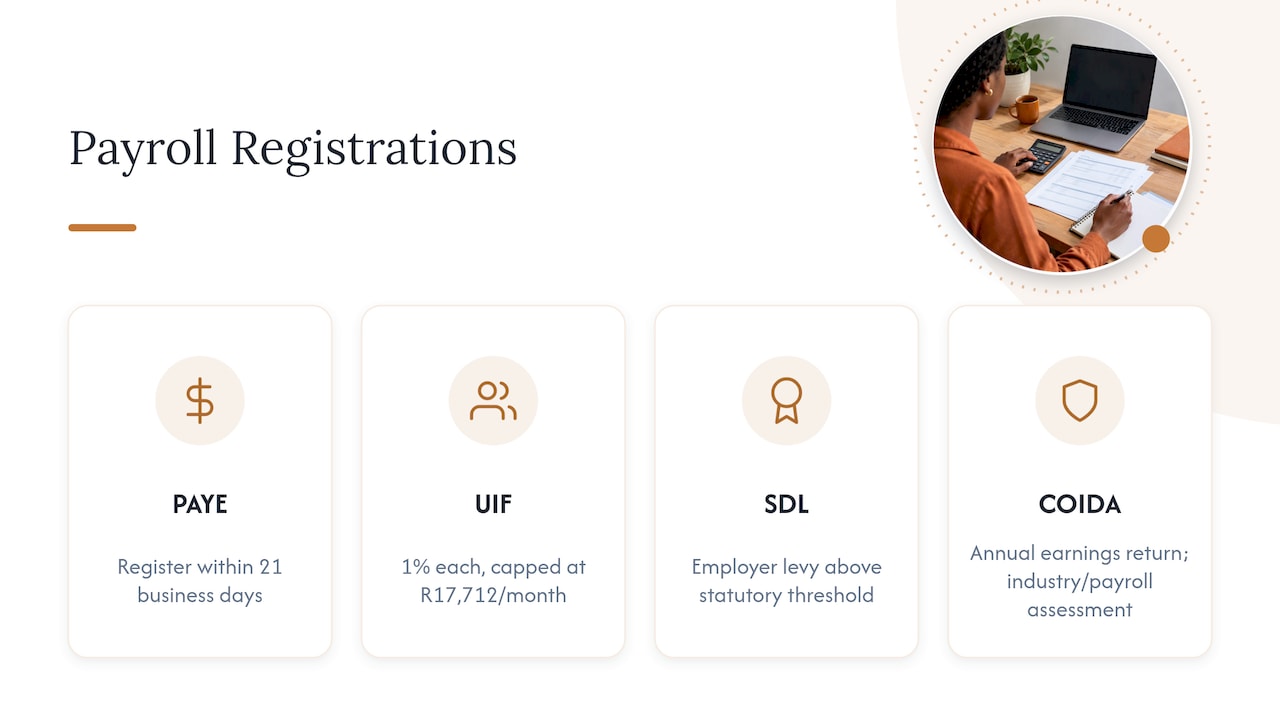
PAYE. Employers must apply to SARS for registration for employees’ tax within 21 business days of becoming an employer, unless none of the employees is liable for normal tax, according to the SARS employer guide. Monthly returns (EMP201) follow. The top personal income tax rate is 45%, per DLA Piper, so withholding on senior salaries is material and should be built into your cost model.
UIF. The Unemployment Insurance Fund contribution is 1% from the employer and 1% from the employee, applied up to a remuneration ceiling of R17,712 per month for the 2027 tax year, per the same SARS guide.
SDL. The Skills Development Levy is a payroll-based levy paid by employers over the statutory threshold. See our SDL registration checklist for the registration sequence.
COIDA. Workplace injury cover is administered through the Compensation Fund, with an annual return of earnings and an assessment based on industry and payroll. It is the obligation foreign employers miss most often, because it is not deducted monthly like UIF.
For the full picture of rates, registration order and filing deadlines, see Register Within 21 Days: Payroll Taxes for Employers in South Africa. Because these thresholds are revised, always confirm the current figures with SARS before you finalize a payslip.
Step 5: Explain leave and working time on day one
Remote employees often start with no idea what they are entitled to, and they may compare notes with friends in US or UK jobs. Be explicit. Under the BCEA, as summarized in the Government Gazette regulations, employees are entitled to 21 consecutive days of annual leave, and six weeks of paid sick leave over a 36-month cycle. Paying an employee instead of granting leave is prohibited except on termination.
That last point matters to US employers used to unlimited or cashed-out PTO. If your standard policy lets staff sell back vacation days, it cannot be applied as is. Our guide to annual leave in South Africa shows how payroll teams handle accrual and carry-over. For a practical template that turns these rules into a written policy, see this South African leave policy toolkit. Include public holidays too: South Africa has its own calendar, and your team’s shared calendar should show it.
Step 6: Equipment, access and security
The contract and registrations make the hire legal. The next layer makes it work. Our research did not turn up a single South African standard for remote equipment, so treat this as operating practice rather than law.
- Laptop and peripherals: ship or procure locally before day one. Local purchase avoids customs delays, and an EOR can reimburse the expense through payroll if you agree it in writing.
- Identity and access: create accounts with single sign-on and multi-factor authentication before the start date, with least-privilege access that widens as the person settles in.
- Connectivity and power: load-shedding has eased in recent periods but has not vanished. Ask whether the employee has fibre plus a backup (mobile data or a UPS or inverter) and consider a connectivity allowance. It costs far less than lost days.
- Security training: a short briefing on phishing, password managers and handling personal data, signed off in the first week.
If your employee will process customers’ personal information, you may also need a data processing agreement. Our POPIA data processing agreement checklist covers what it should contain.
Step 7: Design the first 30 days
Remote onboarding fails less often on paperwork than on isolation. South Africa sits within about one hour of Central European Time, so overlap with European teams is nearly complete. UK teams share the working day, and US East Coast teams get a morning window, roughly the early part of the South African afternoon. Write down the overlap hours in the contract or welcome pack so expectations are shared from the start.
A simple structure works:
- Week 1: welcome call with the manager, tool access, a named buddy, three small tasks that ship quickly.
- Weeks 2 to 3: meet cross-functional colleagues, review documentation, agree 30, 60 and 90-day goals.
- Week 4: a candid review: what is unclear, what is missing, and whether hours and communication rhythms are working.
Schedule the first payday explanation too. Employees paid in rand should know the pay date, what each deduction on the payslip means (PAYE, UIF) and where to find their IRP5 certificate at year end. Few things erode trust faster than a confusing first payslip.
How long does remote onboarding take?
There is no official benchmark, so the honest answer is a range that depends on the route.
- Through an EOR: with us, signed contracts typically follow within 48 hours of agreeing terms, and full onboarding within days, because the local employing partner is already registered for PAYE, UIF, SDL and COIDA.
- Through your own entity: you must register the company, open a bank account and complete tax and statutory registrations before the employee can legally be paid. Plan for several weeks at the very least. The SARS 21-business-day window is a deadline for registration, not a promise of how quickly it will be processed.
- Delays that apply to both: a candidate serving notice at their current job (often one month, sometimes longer), missing or mismatched ID and tax details, a slow background check, and contract negotiation over non-compete or IP clauses.
The notice period is the delay people forget. Ask early, and build the real start date around it.
What an EOR does and does not do
An EOR is the legal employer on paper. It issues the BCEA-compliant contract, runs ZAR payroll, files PAYE, UIF, SDL and COIDA, and handles statutory leave and termination formalities. You manage the work: assign tasks, set goals, evaluate performance.
We believe you should know exactly who employs your people. In our model, a licensed local partner is the legal employer, and we are open about that on the contract. The comparison with other options comes down to cost, depth and control, not hidden structure. For the detail, see our EOR services page or the complete EOR guide.
When you eventually part ways, the same compliance applies in reverse: notice, fair procedure, final pay and leave settlement. Our offboarding checklist covers twelve steps, and it is worth reading before you sign the contract, not after.
Our view: why single-country depth matters for onboarding
We do one country, and onboarding is where that shows. Platforms covering 150 countries must standardize their process, so a South African hire often gets a generic template, a general support queue and pricing built for global breadth, typically $400 to $599 per month. A single-country team knows which sectoral determination might apply, how COIDA assessments catch new employers, why the UIF ceiling needs rechecking each year, and how a CCMA dispute begins with a poorly worded probation clause.
Three things we hold to:
- Flat, published pricing: €350, $399 or £299 per employee per month, with no setup fee and no FX loading.
- Compliance before speed, then speed: contracts are right first, which is also why they can be signed within 48 hours.
- No lock-in on the way in or out: if you already use another EOR, transfers to us are free, and our dismissal guidance is built to withstand a CCMA hearing.
Onboarding done well is invisible to the employee: the contract is clear, the first payslip is correct, and the laptop works on Monday morning.
— Roel
Hire your first South African employee with us
If you want the legal employment, payroll and statutory filings handled while you focus on the work, our Employer of Record service costs a flat $399 per employee per month (€350 or £299), with no setup fees. You can also check total employer cost with our public employment cost calculator before you commit, or start from the main site to talk through your first hire.
FAQ
Can I onboard a remote employee in South Africa without a local entity?
Yes, through an Employer of Record. The EOR’s local partner becomes the legal employer and runs payroll and filings, while you direct the work. Hiring them directly under a foreign contract is risky, because a foreign company that is party to South African employment contracts can be regarded as conducting business there.
What must the employment contract include?
The BCEA requires written particulars at the start of employment, including the parties, job description, place of work, start date, hours, pay, overtime, deductions, leave and notice. Any applicable sectoral determination must also be referenced. Contracts for remote roles should add equipment, confidentiality and data protection terms.
Which payroll registrations are required?
The legal employer registers for PAYE with SARS, which must be done within 21 business days of becoming an employer, plus UIF, SDL and COIDA. UIF is 1% from each side up to a monthly ceiling of R17,712 for the 2027 tax year. Check current thresholds with SARS before running payroll.
How much leave does a South African employee get?
The BCEA gives 21 consecutive days of annual leave and six weeks of paid sick leave over a 36-month cycle. Employers cannot pay out leave in place of granting it, except at termination. Public holidays come on top.
Can I check a candidate’s criminal record?
Only with the candidate’s consent, and a criminal record check can be carried out only if the candidate provides fingerprints. POPIA requires that consent. Keep results confidential and retain them no longer than needed.
Sources
- Basic Conditions of Employment Act (Department of Employment and Labour)
- BCEA Regulations Amendment, Government Gazette 38312
- SARS PAYE-GEN-01-G21 Guide for Employers
- DLA Piper Global Expansion Guide: Employment, South Africa
- Information Regulator guidance note
- Payroll onboarding checklist for South Africa