

Integrating your HRIS with South African payroll means moving employee, pay and leave data from your global system into a payroll that calculates PAYE, UIF and SDL in rand and feeds SARS filings. You can do it with an API, a scheduled CSV export, or by letting an Employer of Record (EOR) run payroll locally while your HRIS stays the record for everything else. The right choice depends on headcount, the payroll software on the South African side, and who is legally the employer.
This guide is written for founders, HR leads, finance managers and CTOs outside South Africa who have hired, or are about to hire, people there.
TL;DR
- Decide the direction of data first: your HRIS usually owns hires, changes and leave, while South African payroll owns tax calculations and statutory filings.
- There is no universal “South African payroll API”. Confirm the exact product line and deployment model, and use scheduled CSV files when a real-time API is not available.
- Build for audit: SARS reconciliation needs every pay-run change traceable, so approvals and change logs matter more than speed.
- Personal data leaving South Africa falls under POPIA’s cross-border transfer rules, so map where your HRIS stores it.
- For a handful of South African employees, an EOR often replaces the integration entirely. Ours starts from £299 per employee per month.
Table of Contents
- What an HRIS-to-payroll integration actually moves
- The South African rules your integration has to respect
- API, CSV or manual: choosing the integration method
- Governance: build the audit trail before the sync
- Cross-border data: POPIA and your HRIS
- Who is the employer matters more than the pipe
- Our perspective
- When an EOR replaces the integration
- A phased plan for a small international team
- FAQ
- Sources
What an HRIS-to-payroll integration actually moves
Before choosing a method, list the data that has to cross the line. In practice it falls into four groups:
- Employee master data: legal name, ID or passport number, tax reference, bank details, start date, job title, cost center.
- Pay data: basic salary, allowances, bonuses, deductions, and any retirement or medical contributions.
- Time data: leave taken, unpaid leave, overtime and, where relevant, time and attendance records.
- Events: new hires, terminations, promotions, salary changes.
The general principle behind HR and payroll integration is that each fact is entered once and flows onward, so nobody re-types a bank account number or a salary change into a second system. That removes the most common source of payroll errors.
What the integration should not do is calculate South African tax in your HRIS. PAYE, UIF and SDL rules change every tax year and are tied to SARS filings. Let the payroll engine own them.
The South African rules your integration has to respect
A payroll integration that ignores local rules will pass data happily and still produce wrong payslips. Four details drive the configuration.
UIF caps
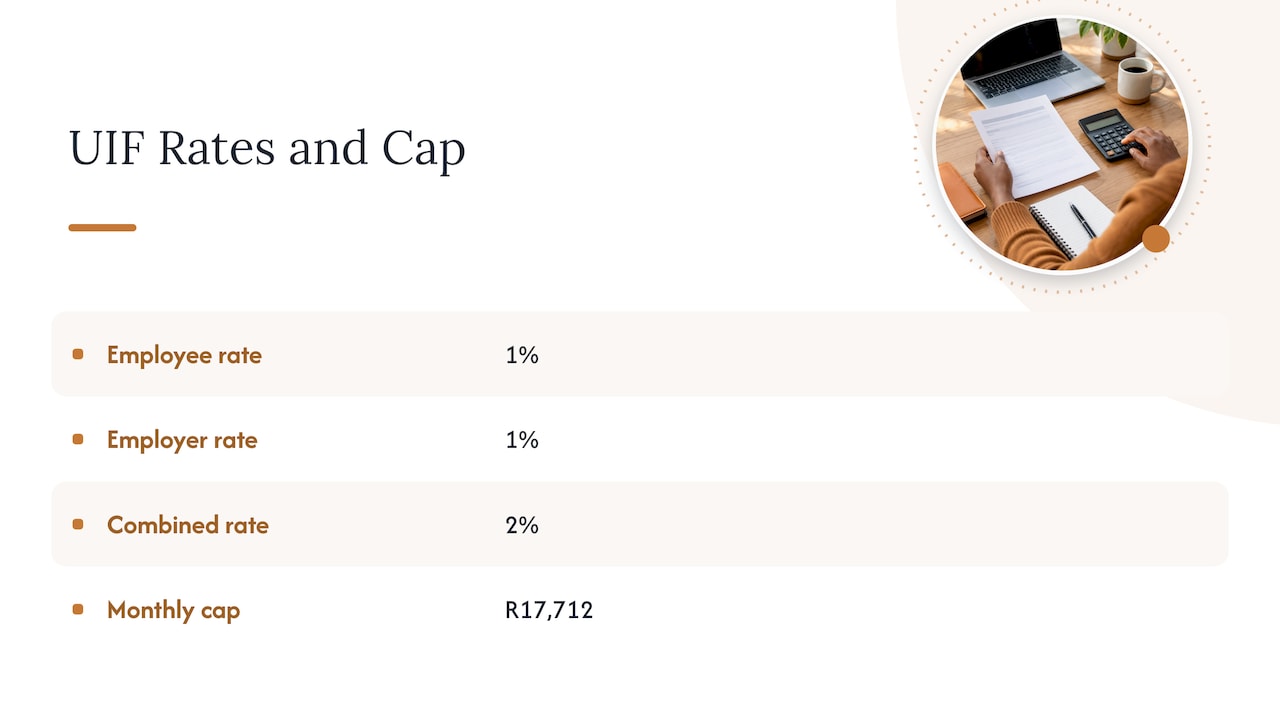
UIF is 1% from the employee and 1% from the employer, 2% in total, and the maximum monthly remuneration on which it is calculated is R17,712. A system that applies a flat 2% to a senior engineer’s full salary will over-deduct every month. Check that the cap is configured, not just the percentage. Our guide to UIF contributions and the R17,712 cap shows the mechanics.
Monthly EMP201 and the interim EMP501
Employers declare and pay PAYE, UIF and SDL monthly through the EMP201, generally by the seventh day after month end. Twice a year they reconcile those declarations through the EMP501. For 2026, the interim reconciliation window runs from 21 September to 31 October 2026 and covers 1 March to 31 August 2026. If you are reading this in late October, that window is about to close, and mismatches between your monthly declarations and your payroll records are exactly what it surfaces. Our walkthrough on fixing EMP501 reconciliation covers the usual causes, and the EMP201 deadline guide covers the monthly rhythm.
COIDA
COIDA works differently from monthly tax. The Compensation Fund assessment is annual, and from 1 March 2026 the maximum annual earnings used for assessment is R668,000 per employee, with a minimum assessment of R1,621 for general employers. Because it sits outside the monthly pay run, it is the filing most often forgotten when teams wire up an HRIS and assume “payroll” covers everything.
PAYE thresholds
Tax brackets, rebates and thresholds update each tax year. Whatever integration you build, the payroll side must receive the new tables before the first March pay run. See our note on 2026 PAYE thresholds for what to check.
API, CSV or manual: choosing the integration method
There are three realistic ways to connect systems. None is wrong in every case.
| Method | Best for | Strengths | Watch out for |
|---|---|---|---|
| Direct API | Larger teams, frequent changes, in-house engineers | Near real-time sync, fewer manual steps | Different authentication and data models per product, build and maintenance cost |
| Scheduled CSV or flat file | Small teams, older payroll systems | Simple, robust, easy to inspect | Column mapping errors, file timing, manual upload steps |
| Manual entry by a payroll provider | One to five employees | No engineering | Re-keying errors, slower changes |
Direct API connections are the modern standard for real-time automation, but many established South African systems still depend on scheduled CSV or flat-file exports, which remain a robust, low-risk alternative when real-time APIs are unavailable or too costly. For a team of three South African employees, a monthly CSV with a checked mapping is usually the better engineering decision than a custom API project.
Avoid the one-size-fits-all connector
The most common pitfall is forcing a single generic automation model onto every payroll product. Integration specialists note that local systems use distinct API standards, so a working integration needs a clear understanding of each product’s data model. Even within one vendor, products differ: a legacy on-premise people-management suite and a cloud business platform can have entirely different authentication schemes and data structures, as this API documentation explains. Confirm the exact product line and deployment model before you scope any work.
A pre-build checklist
- Which system is the source of truth for salary, and which for leave balances?
- Is the sync one-way (HRIS to payroll) or two-way (payslip data back to HRIS)?
- How are terminations and mid-month changes handled?
- What happens when a record fails validation, for example an invalid ID number?
- Who approves a change before it reaches a pay run?
- Can you export a full history of changes for an auditor or for SARS?
Governance: build the audit trail before the sync
South African payroll is about traceability. SARS reconciliation requires complete data that reflects every pay-run change, so an ideal integration supports role-based approval workflows and a clear change history. Automation that bypasses those checks tends to produce statutory filing errors that are expensive to unwind.
In practice, that means:
- Separate duties. The person who enters a salary change should not be the one who approves it.
- Log every change with who, when, old value and new value.
- Freeze pay runs after approval, so late HRIS edits cannot silently alter a submitted run.
- Reconcile monthly, not only at the interim and annual EMP501 deadlines.
If you want a plain explanation of why this matters for finance teams, what an audit trail is and how it proves your numbers is a good place to start, even though that article is framed around UK accounting. The principle is identical for a South African pay run.
Cross-border data: POPIA and your HRIS
If your HRIS is hosted in the US or EU, you are sending South African employees’ personal information abroad every time you sync. Under section 72 of POPIA, personal information may not be transferred to a third party in a foreign country unless specific conditions are met, such as the recipient being subject to law or binding rules providing adequate protection, or the data subject consenting. The Act itself is available from the Information Regulator’s published text.
Three practical steps:
- Document where each system stores South African employee data, including backups and sub-processors.
- Put data processing terms in place with your HRIS vendor and your payroll provider.
- Limit the fields you sync to what payroll needs. Medical or disciplinary notes rarely belong in a payroll feed.
We cover the employer-side obligations in more depth in POPIA compliance for foreign employers.
Who is the employer matters more than the pipe
Integration discussions often assume you already have a South African entity with its own payroll registration. If you do not, the first question is not technical. Someone must be registered with SARS as the employer, hold the UIF and SDL registrations, and file the monthly EMP201. Registration is time-bound: see registering for employer payroll taxes within 21 days and the SDL registration checklist.
There are three typical set-ups:
- Your own South African subsidiary. Full control, full responsibility. You integrate your HRIS with a local payroll engine and file everything yourself.
- Contractors. Low administration, but misclassification risk when the person works like an employee. Converting contractors to employees is a common trigger for this project.
- An Employer of Record. The EOR is the legal employer, runs payroll and files with SARS. Your HRIS holds the people records and receives payroll outputs.
For US companies weighing these routes, our overview of hiring in South Africa from the US compares them, and we are candid about the trade-offs in Employer of Record risks.
Our perspective
We run an Employer of Record for one country, and the pattern we see is consistent: companies start by asking for an integration and discover that what they needed was a compliant employer and a reliable monthly payroll file.
Our view, in four points:
- Start from the filing, not the API. If the EMP201 is wrong, a beautiful sync does not help. Work backwards from what SARS receives.
- Do not over-engineer for three people. A checked monthly file with approvals beats a fragile custom connector. Build the API link when volume justifies it.
- Be honest about the legal employer. Your team should know exactly who employs them, who pays them and who files on their behalf.
- Treat data location as a design input. We handle data under POPIA and GDPR with EU data residency, and we suggest every company ask the same question of every vendor in its chain.
We also publish an open API with public docs and sandbox keys for teams that want to automate employment workflows themselves, so engineers can test before committing.
— Roel
When an EOR replaces the integration
An integration project makes sense when you already run a local entity or expect dozens of South African employees. Below that, the cost and upkeep rarely pay off. With an EOR, you do not connect your HRIS to a local payroll engine. You send hire details and changes, and the EOR produces BCEA-compliant contracts, runs payroll in rand and handles PAYE, UIF, SDL and COIDA filings. Your HRIS stays the place for performance, equipment and org charts.
That is the model we offer. Employer of Record services in South Africa start from £299 per month per employee, and our payroll services page explains what the monthly run includes. If you are also looking for the person to hire, there is our talent sourcing service. For teams moving from another provider, our model includes free transfers.
What to ask any provider before you integrate
- Which payroll product and version sits behind the service?
- Can you export every pay-run change with approver and timestamp?
- How are the EMP201 and EMP501 handled, and who submits them?
- Where is employee data stored, and under which transfer mechanism?
- What does a termination look like, and how is it kept safe at the CCMA? Our offboarding checklist shows the steps.
A phased plan for a small international team
A realistic rollout for a company with up to ten South African employees:
- Week 1: map data and ownership. Decide the source of truth for each field and who approves changes.
- Week 2: confirm the legal employer. Entity, contractor conversion or EOR. This decides everything downstream. If speed matters, see how we get contracts signed within 48 hours.
- Week 3: choose the method. Use CSV unless you have a clear need for real-time sync.
- Week 4: run a parallel payroll. Compare payslips from the new set-up with expected values, especially UIF capping and PAYE.
- Ongoing: reconcile monthly. Tie each EMP201 to the pay run and keep the file ready for the interim and annual EMP501.
Automating the monthly steps also reduces penalty exposure; our article on automating global hiring and avoiding EMP201 fines goes into it. If you pay in rand from abroad, paying employees in ZAR covers the currency side.
FAQ
Do I need a South African entity to integrate my HRIS with local payroll?
To file with SARS directly, someone must be the registered employer. That can be your own entity or an Employer of Record. Without either, an integration has nowhere compliant to send data.
Is a CSV file integration acceptable for payroll?
Yes. Scheduled flat-file exports are widely used in South Africa and are low risk when the column mapping is documented and every upload is approved and logged. Move to an API when change volume or headcount makes manual steps a bottleneck.
Can I sync South African employee data to a US or EU HRIS?
Yes, but POPIA section 72 restricts cross-border transfers unless conditions such as adequate protection or consent are met. Document your data flows and sign processing terms with each vendor. A privacy professional should confirm the mechanism for your situation.
Which South African payroll filings does the integration need to support?
Monthly EMP201 declarations covering PAYE, UIF and SDL, the interim and annual EMP501 reconciliations, and the annual COIDA assessment. The payroll side must also apply the current UIF cap of R17,712 per month.
Sources
- ERSBio: How to Integrate Time & Attendance with Payroll
- Alpion Connect
- Payroll integration API documentation (Supergood)
- SARS: Employer Interim Declarations (EMP501), 21 September to 31 October 2026
- SARS: Guide for Employers in respect of Employees’ Tax 2026
- Government Gazette General Notice 3910 of 2026 (COIDA)
- POPIA section 72: Transfers of personal information outside the Republic
- Protection of Personal Information Act, 2013 (full text)
- Keystone: What is an audit trail