

Fixed term contracts are lawful in South Africa, but section 198B of the Labour Relations Act tightly regulates how they are used. If a contract or its renewals run past three months without a justifiable reason, it can be deemed indefinite, and in certain cases, longer durations may also have additional consequences, and letting a fixed term contract lapse without a documented reason can count as a dismissal. Employees should keep every written offer and renewal letter as evidence.
TL;DR:
- Section 198B covers employees below the BCEA earnings threshold, with exclusions for smaller employers and certain work; basic BCEA rights still apply above it.
- Each renewal must state a justifiable reason supported by business records; the employer bears the burden, and a brief paperwork gap will not reset the clock.
- For project specific contracts reaching 24 months, employers owe one week’s remuneration per completed year unless they offer further work on the same or similar terms.
- Renewal patterns, assurances, and vacancy notices can establish a reasonable expectation of continued work; CCMA deadlines apply, and compensation is more common than reinstatement.
Table of Contents
- Statutory Framework: What Section 198B and the BCEA Require
- Timing Rules: The Three-Month Test and the 24-Month Deeming Rule
- Expiry vs Dismissal: When Non-Renewal Becomes Unfair
- Practical Checklist: What to Keep and What to Demand
- A Compliance Note From Roel on Fixed Term Contract Administration
- Fixed Term Contracts vs Temporary and Casual Employment
- How the BCEA Shapes Fixed Term Employment
- How a Fixed Term Contract Can End
- Leave, Benefits, and Protections During a Fixed Term Contract
- When a Fixed Term Contract Becomes Permanent
- What the Case Law Shows About Fixed Term Disputes
- What Tends to Persuade Arbitrators in These Disputes
- A Compliance-First Way to Hire in South Africa
- FAQ
- Sources
Statutory Framework: What Section 198B and the BCEA Require
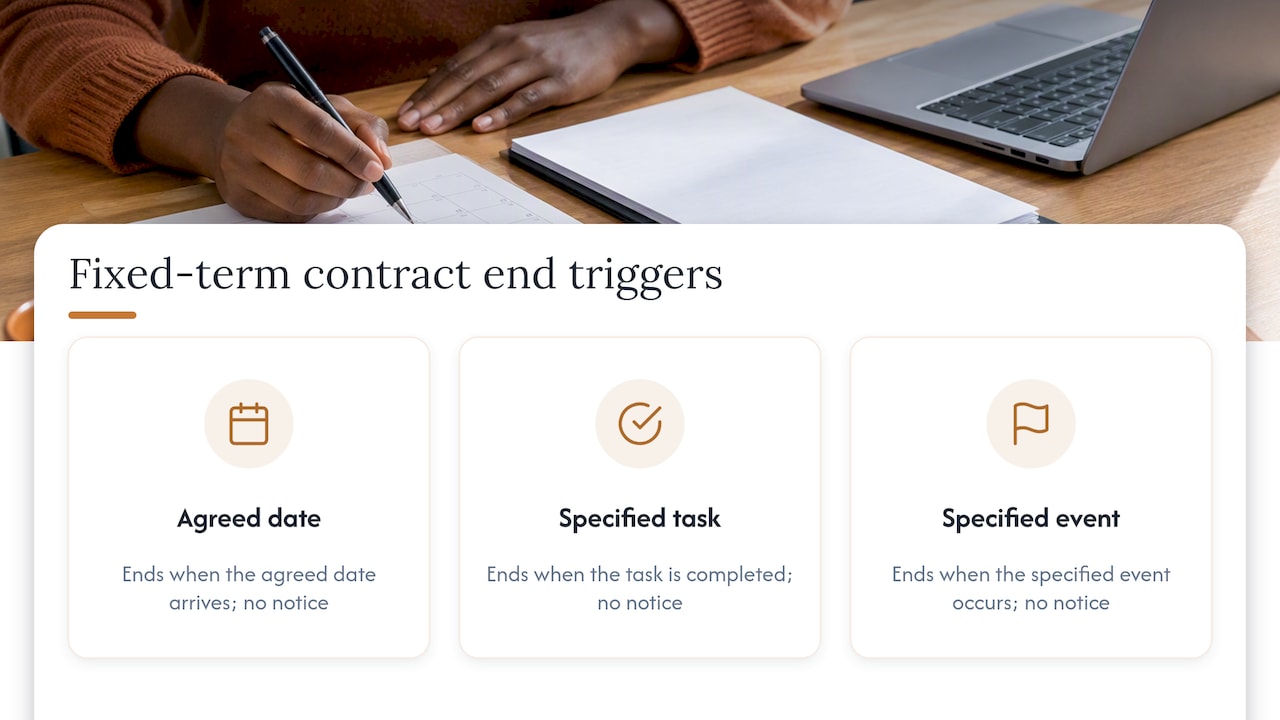
A fixed term contract ends on an agreed date, on completion of a specified task, or on the occurrence of a specific event, and that end point must be determinable and recorded in writing. This definition matters because vague or open-ended “temporary” arrangements rarely qualify as genuine fixed term contracts under South African law.
Section 198B does not apply to everyone. It covers employees earning below the earnings threshold set under the Basic Conditions of Employment Act, and it carries exclusions for smaller employers and certain categories of work. For employees who fall within its scope, the law is specific about what employers must do.
- A fixed term contract, or successive fixed term contracts, lasting longer than three months is only lawful if the employer can show a justifiable reason for fixing the term.
- Each written offer or renewal must state that reason; silence or a generic label like “temporary” does not satisfy the requirement.
- The onus sits with the employer, not the employee, to prove the reason was genuine when a dispute arises.
Employment below the BCEA earnings threshold and lasting beyond three months without a stated justifiable reason is deemed to be of indefinite duration under section 198B. That single rule drives most of the disputes that end up at the CCMA, because employers often renew contracts informally without ever writing down why the role needed a fixed end date.
If you review the sample employment agreements in our guide to essential employment contract clauses for South Africa, you will notice that compliant fixed term offers always spell out the reason for the fixed duration in the body of the contract itself, not as an afterthought.
Timing Rules: The Three-Month Test and the 24-Month Deeming Rule
The three-month threshold is the first checkpoint. Once a fixed term contract, or a series of them with the same employer, crosses three months, the employer needs a documented and objectively justifiable reason for keeping the role fixed rather than permanent. Practitioners note that this is where most employers slip up.
- Rolling renewals without a fresh written reason are flagged repeatedly by labor practitioners as the most common employer error, and the label “fixed term” alone offers no protection once the statutory threshold is crossed, according to MJ Kotze Inc.
- A break between contracts needs to be genuine and substantial. Short administrative gaps or delays in reissuing paperwork are unlikely to convince a tribunal that the employment relationship actually ended, per the same guidance.
- For project-specific contracts, the 24-month mark triggers a completion gratuity obligation, equal to one week’s remuneration for each completed year of service, unless the employer offers further employment on the same or similar terms, as explained by Burgerhuyser Attorneys.
The practical lesson for anyone reviewing a string of renewals is to look at substance over form: did the business reason change at each renewal, and was it written down each time, or did the paperwork simply repeat itself while the underlying job stayed identical?
Expiry vs Dismissal: When Non-Renewal Becomes Unfair
Letting a fixed term contract lapse is not automatically neutral. Under section 186(1)(b) of the Labour Relations Act, failing to renew a contract, or refusing to offer indefinite employment, can amount to a dismissal if the employee held a reasonable expectation of renewal or conversion. The CCMA applies an objective test here, weighing evidence rather than the employee’s subjective hope.
If an employee reasonably expected renewal or conversion to indefinite employment and the employer failed to renew or retain them, that failure can constitute a dismissal, assessed through objective evidence of the expectation.
- Tribunals look at the pattern of past renewals, internal communications, vacancy notices and any assurances given to the employee about continued work.
- Reinstatement is rarely available once the contract has already expired before a finding is made, so compensation becomes the practical remedy in most of these cases, according to CCMA guidance.
- A referral to the CCMA must happen within the statutory timelines that apply to unfair dismissal disputes, so delay works against the employee’s case.
Evidence that tends to succeed includes repeated renewal letters, promises of ongoing work, or a pattern of replacing fixed term staff with permanent hires in the same role.
Practical Checklist: What to Keep and What to Demand
Whether you are the employee or the employer, the paper trail decides most fixed term disputes. Building that record early avoids a scramble later.
- Keep every signed contract, renewal letter, email, and payslip in one place, along with any vacancy notices or messages suggesting continued employment.
- Check that each written offer or renewal states a specific, dated reason for the fixed term, not a repeated generic phrase.
- If you are the employer, preserve the underlying business records (project briefs, funding letters, client contracts) that support the stated reason.
- If a contract lapses without explanation, calculate the referral window for a CCMA complaint before it closes, and review our guide on CCMA unfair dismissal timelines for the practical steps.
- Where the facts are contested or the amounts involved are significant, get advice from a labor law practitioner before accepting a settlement offer.
Pro Tip: Save renewal letters as PDFs with the date in the file name; a messy inbox search has cost many employees their best evidence at a CCMA hearing.
A Compliance Note From Roel on Fixed Term Contract Administration
The employer mistakes we see most often are rolling renewals issued without a fresh written reason, and verbal assurances about “definitely renewing next time” that later become the employee’s strongest evidence. Good contract administration is not complicated: state the reason, date it, and keep the underlying business record that supports it.
For employers hiring across borders, this is exactly the gap we close. We draft BCEA and LRA compliant contracts, file the statutory returns, and keep the renewal paperwork in order so a fixed term arrangement does not quietly become an indefinite one by accident.
Fixed Term Contracts vs Temporary and Casual Employment
A fixed term contract is not the same thing as casual or temporary work, though the three terms get used loosely in everyday conversation. A fixed term contract has a defined end point tied to a date, task, or event, and once it falls within section 198B’s scope, it carries the full set of justification and written-reason obligations described above.
Casual employment typically refers to irregular, short-duration engagement, often a few hours a week, with no expectation of a fixed term or ongoing renewal pattern. Temporary employment through a labor broker or temporary employment service sits under a separate statutory regime (section 198 of the Labour Relations Act), with its own rules about deeming the broker’s client to be the employer after three months in certain circumstances.
The distinction matters because the protections differ. A genuinely casual arrangement with no fixed end date does not trigger the section 198B tests at all, while a fixed term contract that is really a disguised permanent role, just relabeled to avoid giving notice or benefits, is the kind of arrangement that tribunals scrutinize most closely. Calling a role “temporary” in a contract does not change its legal character if the underlying facts show an ongoing, indefinite need for the work.
How the BCEA Shapes Fixed Term Employment
The Basic Conditions of Employment Act sets the earnings threshold that determines whether section 198B’s protections apply to a given employee at all. Employees earning above that threshold fall outside most section 198B’s specific fixed term protections, though they remain covered by the BCEA’s general provisions on leave, working hours, and notice.
Beyond the threshold question, the BCEA governs the basic entitlements that apply during a fixed term contract regardless of its length: annual leave accrual, sick leave, family responsibility leave, and rules on working hours and overtime all apply to fixed term employees in the same way they apply to permanent staff, proportional to the length and nature of the engagement. The BCEA does not carve out a lesser set of rights simply because the contract has an end date.
This is one of the more common misunderstandings we see among employers new to South African labor law: a fixed term contract limits the duration of employment, not the basic statutory protections that apply during it. Treating fixed term staff as exempt from BCEA leave accrual or notice requirements is a frequent compliance error, and one that surfaces quickly in a CCMA dispute.
How a Fixed Term Contract Can End
A fixed term contract ends in one of three ways: the agreed date arrives, the specified task is completed, or the specified event occurs. None of these endings require notice in the way an indefinite contract does, because the parties agreed to the end point in advance.
Ending a fixed term contract early, before its natural end date, is a different matter entirely. Early termination for misconduct, poor performance, or operational requirements still requires a fair process under the Labour Relations Act, the same substantive and procedural fairness tests that apply to any dismissal. Our guide to misconduct dismissal in South Africa walks through what a fair process looks like when an employer needs to end employment before the contract’s natural term.
Where a project-specific fixed term contract reaches the 24-month mark, ending it triggers the completion gratuity obligation described earlier, one week’s pay per completed year, unless the employer offers further work on similar terms. Employers sometimes assume that reaching the contract’s end date closes the matter cleanly; in practice, the gratuity and reasonable-expectation tests mean the paperwork and communication around that ending carry real legal weight.
Leave, Benefits, and Protections During a Fixed Term Contract
Fixed term employees are entitled to the same basic protections as permanent staff for the duration of their contract, proportional to their length of service. This includes annual leave, sick leave, family responsibility leave, and protection against unfair discrimination and unfair labor practices.
Section 198B goes further for employees within its scope, requiring that fixed term employees be treated on the whole not less favorably than comparable permanent employees performing the same or similar work, unless there is a justifiable reason for different treatment. This extends to access to opportunities for permanent vacancies and to training.
Fixed term employees also accrue the right to challenge non-renewal as a dismissal under section 186(1)(b) where a reasonable expectation of renewal existed, a protection that permanent employees do not need because their employment does not have a built-in end date to begin with. Taken together, these rules mean a fixed term label limits the duration of the role, not the quality of the protections that apply while it lasts.
When a Fixed Term Contract Becomes Permanent
Conversion to indefinite employment can happen two ways: by operation of law, or by an employer’s explicit offer. Legal commentary on section 198B stresses that the deeming provision operates automatically once the statutory conditions are met, without requiring a tribunal to make a finding first.
That automatic operation surprises many employers. If a fixed term contract runs past three months without a justifiable reason, the employment is deemed indefinite from that point, whether or not either party has formally acknowledged it. An employer who later tries to let the contract “expire” on its original end date may find they are actually attempting a dismissal of an indefinite employee, with all the fairness requirements that involves.
The practical consequence is that fixed term contracts are not a mechanism for avoiding permanent-employment protections. Employers who want a genuinely temporary arrangement need to document the business reason at the outset and refresh that justification at every renewal; employees who suspect their fixed term status has quietly become indefinite should treat the three-month and 24-month thresholds as the first thing to check.
What the Case Law Shows About Fixed Term Disputes
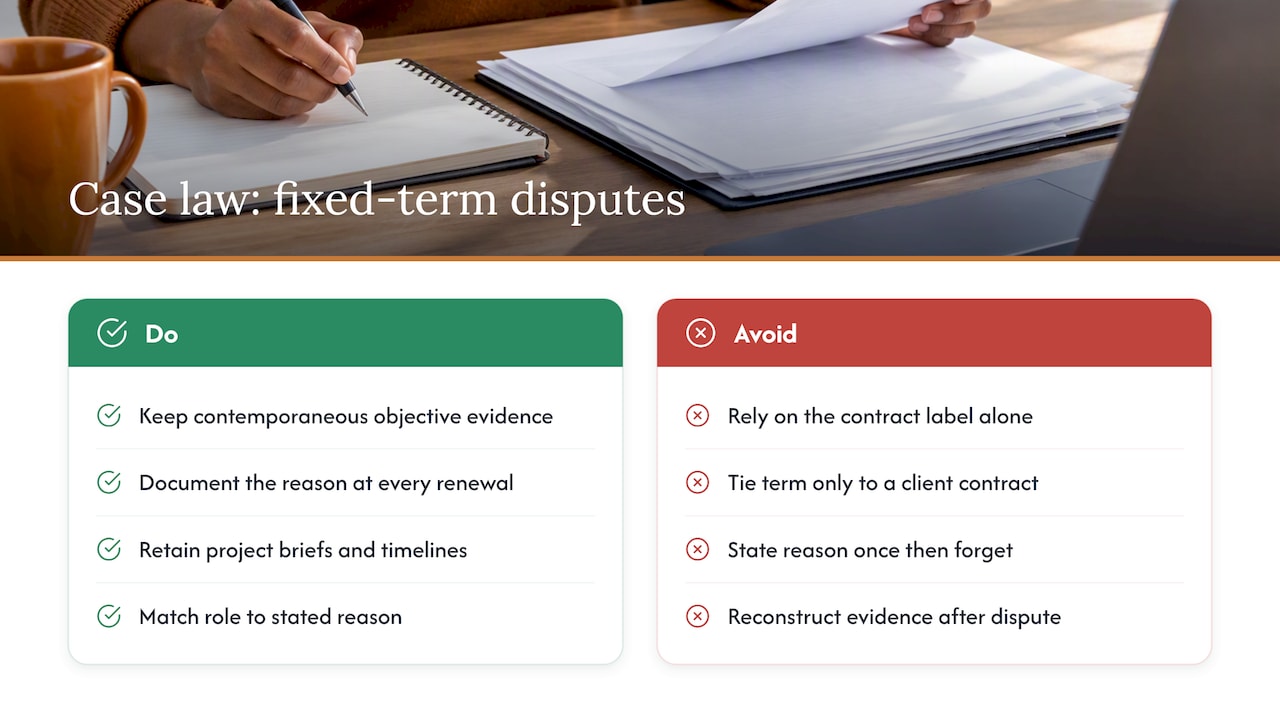
Tribunals and courts consistently test the substance of an employer’s stated reason rather than accepting the label on the contract. One instructive pattern from case law extracts is that tying a fixed term contract to the life of a client contract is often treated with suspicion. If the underlying work continues after the client contract ends, or if the employee’s role was never genuinely dependent on that specific client relationship, the justification can fail.
Courts have also pushed back on employers who rely on a reason stated once at the start of employment but never revisited at subsequent renewals. The expectation from case law is that employers keep contemporaneous, objective evidence, project briefs, funder correspondence, timelines, that substantiates the reason at each renewal point, not just at the outset.
A recurring theme across these disputes is that labeling alone persuades no one. Arbitrators and judges look past the words “fixed term” or “temporary” in the contract and ask what the role actually required and whether the employer can produce documents, not just assertions, to back the stated justification. For employees and employers alike, the practical lesson is the same: the written record made at the time of each renewal carries far more weight than any explanation offered after a dispute has already started.
What Tends to Persuade Arbitrators in These Disputes
The strongest cases, from either side, turn on documentary proof made at the time, not recollections offered after the fact. Arbitrators focus on whether the employer actually wrote down a justifiable reason at each renewal and whether that reason matches the business records produced in evidence. The onus sits with the employer, so silence or vague paperwork tends to resolve in the employee’s favor.
Patterns matter as much as single documents. Repeated renewals, consistent vacancy notices for the same role, and casual assurances in emails or messages about “next time” all build toward a reasonable expectation of renewal, even when no one intended to create that expectation formally.
Where reinstatement is no longer realistic because the contract has already run its course, arbitrators tend to calculate compensation based on the loss the employee actually suffered, weighing how long the pattern of renewals had continued and how firm the expectation of continuation really was.
— Roel
A Compliance-First Way to Hire in South Africa
If you are an employer trying to get fixed term contracts right while hiring across borders, the rules above are exactly where things go wrong: missing written reasons, informal rolling renewals, and no system for preserving the business records that justify a fixed term in the first place. We built an Employer of Record solution focused on South Africa to help reduce compliance risks for international companies.

We act as your Employer of Record in South Africa, drafting BCEA and LRA compliant contracts, handling ZAR payroll, and filing PAYE, UIF, SDL and COIDA correctly every month, for a flat fee starting from £299 per employee per month with no setup fees or currency loading. Unlike global platforms, we focus exclusively on South Africa, aiming to ensure our contracts comply with section 198B’s written-reason and timing requirements. If you also need to find the right person for the role, our talent sourcing service handles vetted candidate searches for 55% of the first month’s salary. Check your employer of record options to see exactly what compliant hiring costs for your team.
This article is general information, not a substitute for advice from a qualified lawyer. Consult a qualified legal professional about your own circumstances before acting on anything here.
FAQ
What are the disadvantages of a fixed-term contract?
A fixed term contract limits job security for the employee, since employment ends automatically unless renewed, and it can create ongoing compliance risk for the employer if renewals are not documented with a justifiable reason each time. Employers who rely on rolling renewals without fresh written justification risk having the contract deemed indefinite under section 198B.
How many times can you renew a fixed-term contract in South Africa?
The law does not set a fixed number of renewals; instead it asks whether the employer has a justifiable reason for each renewal once the contract or its successive renewals pass three months. Beyond that, the 24-month mark triggers a completion gratuity obligation for project-specific contracts under guidance from Burgerhuyser Attorneys.
How long can you stay on a fixed-term contract?
A fixed term contract can run as long as the stated date, task, or event requires, provided the employer maintains a justifiable reason once the three-month threshold under section 198B is crossed. Without that justification, the employment is deemed indefinite by operation of law.
What are the four types of employment contracts in South Africa?
South African labor law generally recognizes permanent (indefinite) contracts, fixed term contracts, temporary employment through a labor broker or temporary employment service, and part-time contracts, each governed by different provisions of the Labour Relations Act and the BCEA. Which category applies depends on the actual terms and duration of the work, not just the label used in the contract.
Can a fixed-term contract be ended early in South Africa?
Yes, but early termination still requires a fair process under the Labour Relations Act, the same substantive and procedural fairness standards that apply to dismissing a permanent employee. Ending a fixed term contract before its agreed date without following a fair process can itself amount to an unfair dismissal.
Sources
- Labour Relations Amendment Act (Government Gazette) / section 198B
- Reasonable expectation of contract renewal – CCMA
- Fixed-term contracts in South Africa: the 3-month rule (MJ Kotze Inc)
- The regulation of fixed-term employment contracts under section 198B of the Labour Relations Act (Polity)