

CCMA arbitration is a formal, evidence-driven hearing a commissioner holds after conciliation fails to resolve a dispute, and it ends in a binding award. Three deadlines govern the CCMA arbitration process: you generally have 90 days from the conciliation certificate to refer the matter, the CCMA must give you at least 21 days’ written notice of the hearing date, and commissioners aim to issue their award within 14 days of the hearing closing. Your immediate task is straightforward, even if the process ahead is not.
- File LRA Form 7.13 and serve it correctly on the other party
- Diarize the 21-day notice period and the 90-day referral window
- Decide now whether you need a representative, since Rule 25 limits legal practitioners in some cases
Pro Tip: Missing the 90-day referral window doesn’t automatically end your case. A commissioner can grant condonation if you show good cause and act quickly once you realize the deadline has passed.
Key Takeaways
Winning at CCMA arbitration depends less on argument and more on filing the correct forms on time, building an indexed evidence bundle, and knowing exactly which representation rules apply to your case.
| Point | Details |
|---|---|
| Meet the referral deadline | File LRA Form 7.13 within 90 days of the conciliation certificate, or apply for condonation immediately if late. |
| Respect the 21-day notice rule | Confirm your set-down date the moment notice arrives, since 21 days is the statutory minimum. |
| Build a numbered bundle | Index, number, and cross-reference exhibits to witnesses before the hearing, not during it. |
| Check representation limits | Rule 25 restricts lawyers in certain dismissal matters, so apply early with a motivated written request. |
| Track the award timeline | Commissioners aim to issue awards within 14 days, and review applications carry strict time limits. |
Table of Contents
- When Does CCMA Arbitration Apply and How Do You Refer a Dispute?
- What Happens Before the Hearing: Notice, Conferences, and Case Statements
- How Do You Prepare Evidence for a CCMA Arbitration Hearing?
- What Is the Step-by-Step Flow of a CCMA Arbitration Hearing?
- Who Can Represent You at a CCMA Arbitration?
- What Remedies Come Out of a CCMA Arbitration Award, and How Are They Enforced?
- What Procedural Mistakes Most Often Derail an Arbitration?
- Your Pre-Arbitration Checklist From Expand to South Africa
- Expand to South Africa Helps You Avoid CCMA Exposure Before It Starts
- Where to Find the Official CCMA Rules and Forms
- What the Conventional Advice on CCMA Arbitration Gets Wrong
- Sources
When Does CCMA Arbitration Apply and How Do You Refer a Dispute?
Arbitration follows conciliation when a dispute falls under the Labour Relations Act (LRA), Basic Conditions of Employment Act (BCEA), or Employment Equity Act (EEA) and conciliation hasn’t resolved it. Not every dispute qualifies. Disputes about the interpretation of a collective agreement, for example, or matters better suited to the Labour Court, fall outside standard arbitration.
Some categories skip straight to combined conciliation and arbitration, known as con-arb, on the same day. Probation-related dismissals and certain BCEA claims typically fall into this fast-tracked category, so check your referral notice carefully.
To formally request arbitration:
- Complete LRA Form 7.13 and lodge it with the CCMA within the 90-day window
- Serve a copy on the other party and keep proof of service
- Apply for condonation immediately if you’ve missed the deadline, explaining the delay and showing you have a reasonable prospect of success
What Happens Before the Hearing: Notice, Conferences, and Case Statements
The CCMA must give both parties at least 21 days’ written notice of the arbitration set-down under the consolidated Rules, though parties can agree to a shorter period in writing. Missing this notice is grounds to challenge the proceeding, so confirm the date the moment you receive it.
For more complex matters, a commissioner may order both sides to prepare before the hearing:
- Statements of case setting out the material facts, which points are admitted or denied, and the evidence each side plans to lead
- A pre-arbitration conference, usually held about 14 days before the hearing, where both parties try to agree on common facts and narrow the real disputes
- A signed minute, delivered to the CCMA roughly 7 days before the hearing, recording what was agreed and what remains contested
A tightly drafted minute does more work than most people expect. Pinning down agreed facts in writing before the hearing cuts down on wasted hearing time and reduces the risk of a commissioner catching you off guard with an issue you hadn’t prepared for.
How Do You Prepare Evidence for a CCMA Arbitration Hearing?
Evidence wins arbitrations, not eloquence. Commissioners decide cases on what’s documented and testified under oath, so the quality of your bundle matters more than how confident you sound in the room.
Build your bundle with these elements:
- An index page listing every document in order
- Numbered exhibits (Exhibit A, B, C) referenced consistently throughout your statement
- Clear, legible copies for the commissioner, the other party, and yourself
Pair your bundle with a chronology that lays out events in date order and an exhibit map connecting each document to the witness who will speak to it. This single step often separates a persuasive presentation from a confusing one.
On witnesses, be selective. Only call people with direct, firsthand knowledge of the disputed facts, and get a short written statement from each one before the hearing so their testimony doesn’t drift. If a witness is reluctant to attend voluntarily, the CCMA can issue a subpoena, but weigh that option carefully: subpoenas cost money, and a witness compelled to testify is rarely as cooperative as one who shows up willingly.

Pro Tip: Write a one-line “witness plan” for each person you’re calling, stating the single fact they exist to prove. If you can’t articulate that in one sentence, reconsider whether you need them at all.
What Is the Step-by-Step Flow of a CCMA Arbitration Hearing?
Arbitration hearings follow a predictable sequence, and knowing it in advance takes the edge off nerves considerably.
- Preliminary issues come first: jurisdiction disputes, representation objections, postponement requests, and challenges to documents.
- Opening statements outline what each party intends to prove.
- Evidence under oath follows, with each witness examined, then cross-examined by the other side.
- Documentary evidence gets introduced and tested against witness testimony.
- Closing arguments summarize each side’s case before the commissioner reserves the ruling.
Commissioners typically write awards based on the evidence and testimony presented, weighing credibility and the documentary record, and they aim to issue that award within 14 days of the hearing closing. In practice, complex matters can take longer, so treat 14 days as a target rather than a guarantee.
Stay professional throughout. Address the commissioner respectfully, don’t interrupt cross-examination, and stick to facts rather than arguing your case during testimony. Save the argument for closing.
Who Can Represent You at a CCMA Arbitration?
By default, employees can represent themselves, appear with a trade union official, or bring a co-employee. Employers can send an owner, director, employee, or a registered employers’ organization representative.
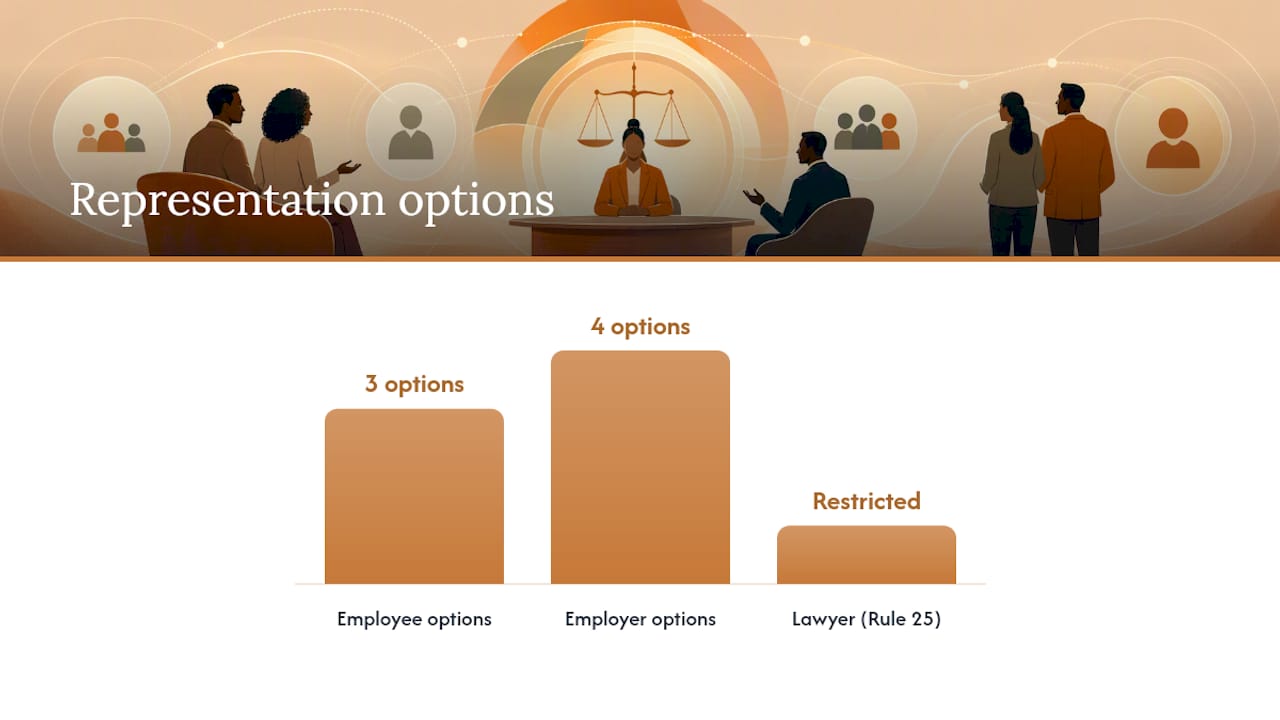
Legal practitioners face restrictions under Rule 25, particularly in dismissals related to misconduct or incapacity, where lawyers are generally excluded unless both parties and the commissioner agree otherwise. Commissioners weigh the complexity of the legal or factual issues, whether one party would be unfairly disadvantaged without representation, and the parties’ own preferences.
If you want a lawyer or candidate attorney present, raise it early:
- Submit a written, motivated request before or at the start of the hearing
- Address the specific Rule 25 factors directly, not just your general preference
- Have a fallback representative ready in case the request is refused
For businesses managing this from outside South Africa, our partner network for cross-border employment counsel can help identify when specialist legal support is warranted.
What Remedies Come Out of a CCMA Arbitration Award, and How Are They Enforced?
Awards typically fall into a few buckets: reinstatement, re-employment on new terms, or compensation calculated against the employee’s earnings. Reinstatement sounds appealing on paper, but think through whether the working relationship is actually salvageable before pushing for it. It rarely works when trust has broken down entirely.
Once issued, generally within 14 days, an award can be certified for enforcement like a Labour Court order if the losing party doesn’t comply voluntarily.
- Certification turns the award into an enforceable court order without a separate court case
- Rescission applications are available in narrow circumstances, such as a default award granted in your absence
- Reviews go to the Labour Court, not an appeal, and only on limited grounds like gross irregularity or a commissioner exceeding their powers
- Review applications carry strict time limits, so act within weeks of receiving the award, not months
What Procedural Mistakes Most Often Derail an Arbitration?
Procedural missteps cause more lost cases than weak arguments do. A few shows up again and again.
- Assuming a postponement is automatic. Formal applications under Rule 31 require good cause, and commissioners can refuse them.
- Not showing up. A no-show can result in a default award against you, and reversing it requires a rescission application with a solid explanation.
- Disclosing evidence late. Documents produced for the first time at the hearing invite objections and can be excluded entirely.
Serve everything on time, confirm receipt, and keep proof.
Your Pre-Arbitration Checklist From Expand to South Africa
Preparing well in the two weeks before a hearing is what separates a controlled presentation from a scramble. Work through this list in order:
- Confirm your referral form was accepted and diarize the hearing date the moment notice arrives
- Serve all documents on the other party and keep dated proof
- Finalize your bundle: index, numbered exhibits, and a chronology linking each document to a witness
- Draft your pre-arbitration minute, listing agreed and disputed facts
- Confirm hearing logistics, remote or in-person, including tech checks if you’re appearing by video
Businesses managing South African employees from abroad face a specific version of this problem: disciplinary and dismissal disputes that end up at the CCMA often trace back to gaps in the original employment contract or a disciplinary process that skipped a step. Getting the underlying employment relationship right the first time prevents most arbitrations before they start.
If your dispute touches on a dismissal, our guide to misconduct dismissal compliance covers where employers most often go wrong procedurally. When representation rules leave you needing a lawyer, apply early and be specific about why.
Expand to South Africa Helps You Avoid CCMA Exposure Before It Starts
Most CCMA arbitrations trace back to a contract clause left vague or a dismissal process that skipped a required step. If you’re hiring in South Africa from abroad, Expand to South Africa’s Employer of Record service puts BCEA-compliant contracts, disciplinary guidance, and CCMA-safe dismissal support in place from day one, for a flat €350 per employee per month with no setup fees. Our employment contract guide is a good starting point if you’re reviewing existing agreements for gaps that could become tomorrow’s referral.
Where to Find the Official CCMA Rules and Forms
- CCMA arbitration guidance and forms
- Consolidated Rules for the CCMA on SAFLII
- Plain-language arbitration explainer
What the Conventional Advice on CCMA Arbitration Gets Wrong
Most guidance on CCMA arbitration treats it like a formality after conciliation, a box to check before an inevitable outcome. That’s backward. The evidence shows arbitration is where cases are actually won or lost, and preparation quality matters more than the underlying merits of a dispute in many close calls.
The overrated piece of advice is “just be honest and it’ll work out.” Honesty matters, but a poorly organized bundle or a witness who can’t answer basic cross-examination questions will sink a legitimate claim just as fast as a weak one. What’s underrated is the pre-arbitration conference. Parties treat it as procedural throat-clearing, when a sharp minute that pins down disputed facts can shrink a two-day hearing into an afternoon.
If you take one thing from this: prioritize your evidence bundle over your opening statement. Commissioners decide on documents and testimony, not rhetoric. Get the paperwork right first, and the rest of your preparation falls into place around it.
— Roel
Sources
- Arbitration – CCMA
- Rules for the conduct of proceedings before the CCMA (consolidated) — SAFLII
- Understanding the arbitration process – Employment guide – bbrief
Recommended
- Misconduct Dismissal in South Africa: A Compliance Guide | Expand to South Africa
- Section 197 Transfer: What Every Employer Must Know | Expand to South Africa
- Employer of Record Risks: What U.S. Companies Must Know | Expand to South Africa
- Atlas EOR Alternatives for HR & Finance Teams (2026) | Expand to South Africa