

A COIDA Letter of Good Standing is an official certificate from the Compensation Fund confirming that an employer is registered, has submitted its Return of Earnings (ROE), and has cleared its assessment or holds an active instalment arrangement. You need all three conditions in place before the Fund will issue it. Employers typically request the letter for:
- Government tenders and procurement bids
- Construction site access as a principal contractor or subcontractor
- Onboarding as a supplier to corporate or public sector clients
Without it, tender evaluators and site managers usually stop the process cold. That makes this certificate one of the most consequential pieces of paper a South African employer keeps on file.
Key Takeaways
A COIDA Letter of Good Standing requires current ROE submission and a cleared assessment, and either lapse invalidates it immediately.
| Point | Details |
|---|---|
| Three conditions for issuance | Registration, submitted ROE, and cleared assessment or active instalment plan must all be current. |
| 2026 ROE deadline | Submissions ran April 1 to June 30; late filing triggers a 10% penalty plus interest after 30 days. |
| Apply through ROE Online | Submit ROE, pay the assessment, then request the letter through the CompEasy portal. |
| Verify before you trust a PDF | Use the Fund’s online verification tool and certificate number to confirm authenticity. |
| Fix blockers at the source | Match EFT references correctly, file outstanding ROEs, and align registration details to avoid delays. |
Table of Contents
- What a COIDA Letter of Good Standing Proves
- The ROE Cycle That Controls When You Get Your Letter
- How to Get Your COIDA Letter of Good Standing
- Processing Times, Costs, and How Long the Letter Lasts
- Fixing the Most Common Reasons a Letter Won’t Issue
- Keeping COIDA Compliance Current With a Managed EOR
- Editorial Take: Compliance as a Deadline Discipline, Not a Documentation Problem
- Sources
What a COIDA Letter of Good Standing Proves
The letter certifies compliance with the Compensation for Occupational Injuries and Diseases Act, which funds medical care and income replacement for employees injured or made ill on the job. Any employer with employees must register with the Compensation Fund, though domestic or household employers face lower minimum assessments while still sitting inside the same annual cycle.
Beyond the legal requirement, the letter carries commercial weight. It signals to clients and regulators that you’re not a liability risk waiting to surface mid-contract. Common scenarios where you’ll be asked to produce it include:
- CIDB contractor grading and renewal
- Principal contractors requiring proof before granting site access
- Corporate procurement teams vetting vendors under PFMA or PPPFA frameworks
- Public sector tender submissions where CIDB grading depends on current compliance
If your business has no employees, skip this certificate entirely. Tender documents sometimes conflate it with SARS tax clearance or a CIPC certificate, so confirm exactly which one a client is asking for before you chase the wrong agency.
The ROE Cycle That Controls When You Get Your Letter
The annual Return of Earnings is what triggers your assessment, and your assessment is what triggers the letter. Miss the window, and the letter simply won’t issue until you catch up.
- Employers submit ROE data covering total earnings paid to employees during the prior period.
- The Fund calculates your assessed contribution based on that figure and your industry risk class.
- A Notice of Assessment is issued, starting the payment clock.
Statistic callout: For the 2026 cycle, the ROE window ran from April 1 to June 30. Until the penalty and balance clear, your Letter of Good Standing stays invalid, no matter how compliant you were the year before.
How to Get Your COIDA Letter of Good Standing
Before you log in anywhere, gather your compensation reference number, prior ROE records, and proof of any payments made. Missing documentation is the number one reason employers stall halfway through this process.
- Log in to ROE Online (CompEasy). This is the Compensation Fund’s official portal for registration, ROE submission, and certificate requests.
- Submit your Return of Earnings. Enter total earnings for the assessment period accurately. Errors here delay everything downstream.
- Receive your Notice of Assessment. The Fund calculates what you owe based on your submitted earnings and industry classification.
- Pay the assessment or set up an instalment arrangement. Cashflow-constrained employers can sometimes arrange to pay in stages, with the Fund issuing a letter valid for one month at a time while payments stay current.
- Request your Letter of Good Standing. Once your payment or arrangement reflects in the system, request the letter through the same portal.
- Download and save the certificate. Keep the PDF and note the certificate number, since you’ll need it for verification later.
Pro Tip: Double check your EFT reference number matches your compensation reference exactly before you pay. A single typo sends your payment into an unallocated holding pattern, and the system won’t release your letter until someone manually matches it, which can take days you don’t have during tender week.
Check your portal inbox regularly. The Department of Employment & Labour’s online tools.aspx) flag outstanding items directly, so you can catch a blocker before it becomes a deadline problem.
Processing Times, Costs, and How Long the Letter Lasts
Plan around realistic timelines rather than best-case scenarios. Once your ROE is submitted correctly, expect:
- A few business days for the Notice of Assessment to generate
- 5 to 10 business days for payment to reflect and clear in the Fund’s system
- Manual submissions or disputed assessments can take considerably longer
The Fund does not charge a fee for the letter itself. You’re paying your assessed contribution, calculated against your payroll and industry risk class. If you use an agency or fast-track service to handle the paperwork, that’s a separate, optional cost, not a government fee.
The letter is valid for a limited period tied to your compliance status, not a fixed calendar term. Renew it well ahead of tender deadlines rather than waiting until a client asks, since a lapsed letter during a live bid can disqualify you outright.

Fixing the Most Common Reasons a Letter Won’t Issue
Third parties verify a certificate’s authenticity through the Compensation Fund’s online verification tool, using the certificate number printed on the document. Advise anyone evaluating your letter to check the number directly rather than trusting a scanned PDF, since forged certificates do circulate.
The most frequent blockers, and their fixes:
- Unallocated payment: wrong or mistyped EFT reference. Contact the Fund with proof of payment to request manual matching.
- Missing ROE submission: the letter cannot be requested until the current year’s ROE is filed, even if prior years are clean.
- Registration detail mismatches: company name, address, or reference number inconsistencies between your records and the Fund’s system. Update your registration details before resubmitting.
Pro Tip: Never buy a Letter of Good Standing from anyone outside official channels. If you suspect a forged certificate, report it through the Fund’s fraud contact channels listed on ROE Online rather than accepting it at face value.
Keeping COIDA Compliance Current With a Managed EOR
Chasing ROE deadlines, matching payments, and renewing certificates is manageable for a South African-based HR team. It’s a different problem entirely for an international company with no local staff to own the process. That’s the gap Expandtosouthafrica fills.
As your Employer of Record, Expandtosouthafrica’s licensed local partner handles:
- Compensation Fund registration and annual ROE submission
- ZAR payroll and statutory filings, including PAYE, UIF, SDL, and COIDA
- Data handling under POPIA and GDPR with EU data residency
- CCMA-safe dismissal guidance if an employment relationship needs to end
For a flat monthly fee, with no setup costs and no FX loading, you get compliance handled by people who track these deadlines for a living. If a tender is on the line and you can’t afford a lapsed letter, an in-house DIY approach carries real risk. A managed EOR is worth it once the cost of a missed deadline outweighs the monthly fee.
| Do it yourself | Use a managed EOR |
|---|---|
| You track ROE deadlines and payment references manually | Your local partner submits ROE and manages payment matching |
| Compliance mistakes fall on your internal team | Statutory filings, including COIDA, sit with a licensed partner |
Editorial Take: Compliance as a Deadline Discipline, Not a Documentation Problem
Most guidance on this topic treats the Letter of Good Standing as a paperwork exercise: fill in a form, wait, download a PDF. That framing misses the actual failure point. The letter doesn’t fail because employers don’t know it exists. It fails because ROE deadlines, payment references, and registration details drift out of sync over twelve months, and nobody notices until a tender clock is running.
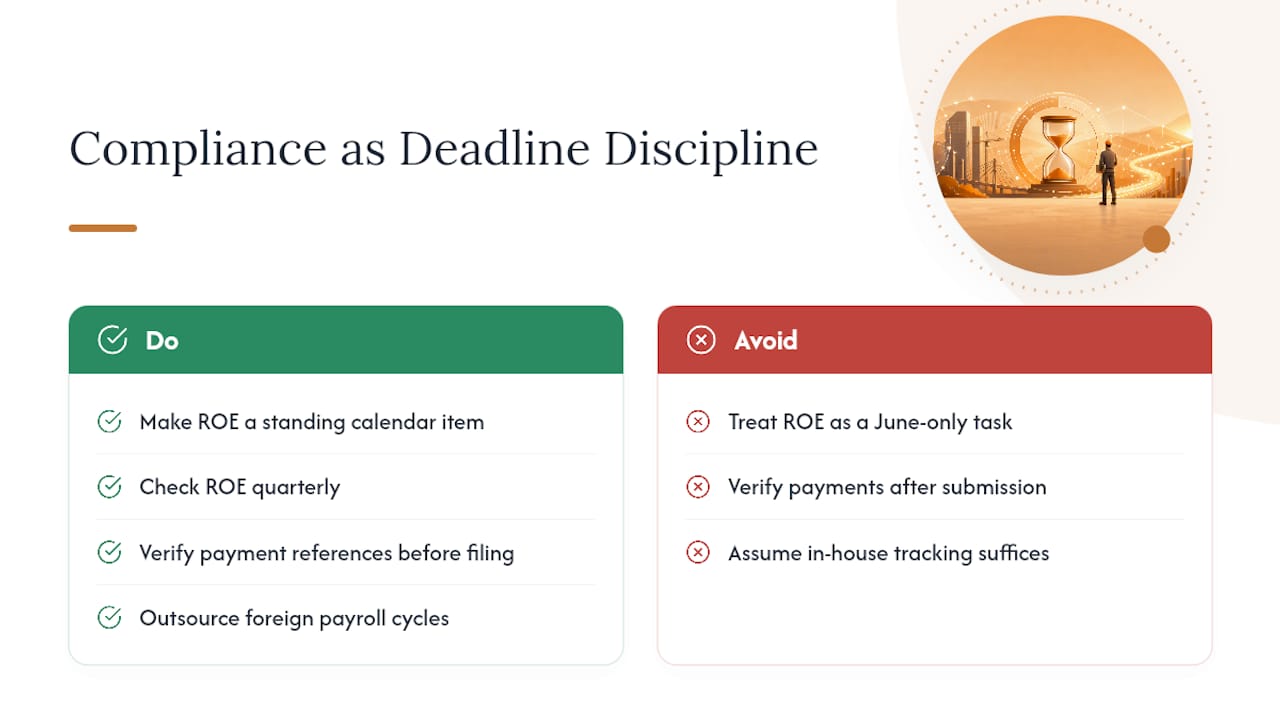
The real cost is a disqualified bid or a blocked site access application the week you needed the certificate most. Employers who treat this as a once-a-year fire drill will keep getting burned by it.
What should change: stop treating the ROE window as a June deadline and start treating it as a standing calendar item, checked quarterly, with payment references verified before, not after, submission. For international companies without South African payroll infrastructure, the honest answer is that in-house tracking of a foreign statutory cycle is a weak spot worth outsourcing, not a badge of operational independence.
— Roel
Sources
- Register with the Compensation Fund — Government of South Africa
- ROE Online — Compensation Fund / Department of Employment & Labour