
South African employers deal with four recurring payroll obligations: PAYE withheld from salaries, UIF at 1% from you and 1% from the employee, the Skills Development Levy (SDL) at 1% of payroll once you pass R500,000 a year, and COIDA assessments for workplace injury cover. Only UIF, SDL and COIDA are true employer costs. PAYE is the employee’s income tax, which you collect and pass to the South African Revenue Service (SARS). This guide gives the current rates, caps and deadlines, then shows what they add up to on a real salary.
TL;DR
- PAYE is withheld from the employee’s pay and paid to SARS monthly. It is not an extra cost on top of salary.
- UIF is 1% employer plus 1% employee, capped at a monthly earnings ceiling of R17,712, so the most you pay is R177.12 per employee per month.
- SDL is 1% of total remuneration, but only if you expect annual payroll above R500,000.
- COIDA requires registration with the Compensation Fund within 7 days of your first hire and an annual Return of Earnings.
- PAYE, UIF and SDL are due by the 7th of the following month, with EMP501 reconciliations twice a year.
Table of Contents
- The four payroll obligations at a glance
- PAYE: tax you withhold, not tax you bear
- UIF: 1% each, capped at R17,712
- Skills Development Levy: 1% above R500,000
- COIDA: workplace injury cover
- Deadlines and filings: the monthly and yearly rhythm
- A worked example: what a hire costs in statutory charges
- When the employer is a foreign company
- Perspective: why we treat this as a one-country problem
- Hiring in South Africa without running payroll yourself
- A short compliance checklist
- FAQ
- Sources
The four payroll obligations at a glance
Before going into detail, here is how the obligations compare. The first column tells you whether the amount comes out of your pocket or the employee’s.
| Obligation | Who bears the cost | Rate | Paid to | Frequency |
|---|---|---|---|---|
| PAYE | Employee (withheld by you) | 18% to 45% progressive | SARS | Monthly |
| UIF | Employer 1%, employee 1% | 2% total, capped | SARS (declared via EMP201) | Monthly |
| SDL | Employer | 1% of remuneration | SARS | Monthly |
| COIDA | Employer | Assessed by industry class | Compensation Fund | Annual return |
The client-side summary is simple: your real statutory cost on top of gross salary is usually between 1% and 2% from UIF and SDL, plus the COIDA assessment. Compared with payroll burdens in many European countries, that is light. Our page on employer payroll taxes in South Africa covers the registration steps in more depth.
PAYE: tax you withhold, not tax you bear
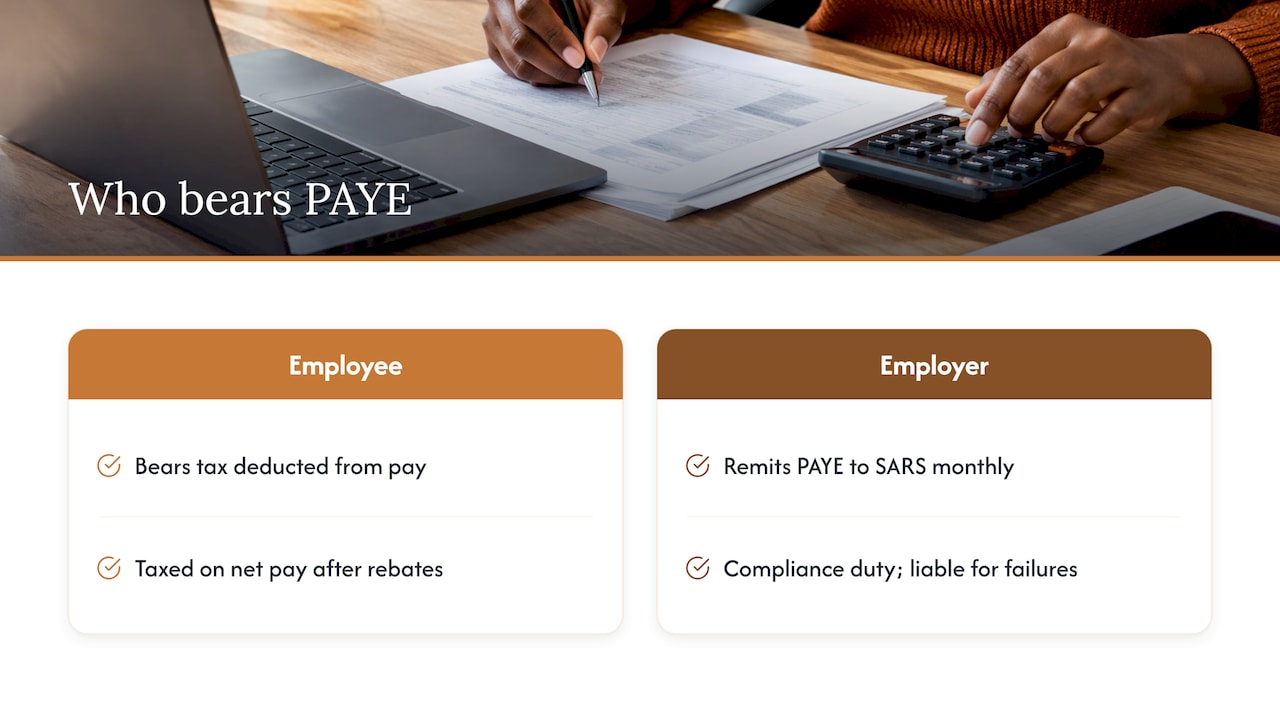
Search results often list PAYE as an employer tax, which causes confusion for founders used to US payroll terms. PAYE (Pay As You Earn) is tax deducted by the employer from an employee’s remuneration and paid to SARS monthly. Think of it as the South African equivalent of federal income tax withholding. The employee bears it. You carry the compliance duty and the liability if you fail to withhold or pay.
The 2026/2027 tax year runs from 1 March 2026 to 28 February 2027. Individual rates are progressive, from 18% on taxable income up to R245,100 to 45% on taxable income above R1,878,600. The primary rebate is R17,820, which gives a tax threshold of R99,000 for employees under 65. Below that income, no PAYE is due.
Because employees are taxed on net pay after rebates, your monthly calculation depends on each person’s age, medical scheme credits, retirement fund contributions and other items. For the year’s brackets and what payroll must update, see our guide to PAYE thresholds.
What PAYE means for your gross-to-net conversations
When you offer a South African hire a salary, quote it as gross in rand. The employee’s PAYE and UIF come out of that figure. If you promise a net amount, you take on the tax gross-up, which can surprise a finance team that budgeted on the headline number.
UIF: 1% each, capped at R17,712
The Unemployment Insurance Fund is a social security contribution. Both employer and employee contribute 1% of remuneration, for a total of 2%. The monthly earnings ceiling is R17,712 (R212,544 a year), effective 1 June 2021. For employees earning above the ceiling, the maximum deduction is R177.12 per month from each side.
The Department of Employment and Labour’s uFiling portal confirms the same logic from the other direction: where remuneration subject to UIF exceeds R17,712, the combined contribution is R354.24.
In practice that means:
- An employee on R10,000 a month: R100 from you, R100 from them.
- An employee on R17,712 or more: R177.12 from you, R177.12 from them.
The cap means UIF becomes a smaller share of cost the more you pay. For senior engineers, it is close to negligible. Our guide to UIF contributions and the EMP201 versus uFiling distinction explains how declarations reach the fund.
Skills Development Levy: 1% above R500,000
SDL is a levy meant to fund training in South Africa, distributed through sector education and training authorities (SETAs). Employers who expect total salaries to exceed R500,000 over the next 12 months must pay it at 1% of salaries. Below that, you are exempt.
Two points matter for a small foreign team:
- The threshold is measured on your total expected annual payroll in South Africa, not per employee. Two hires at R30,000 a month each (R720,000 a year) put you over the line.
- The levy applies to total remuneration, with no cap like UIF’s.
SDL is also what gives companies a way to recoup part of the cost, through training grants. Our page on the SDL rate for employers covers that, and the SDL registration checklist covers the paperwork.
If you are planning a sales hire, SDR hiring benchmarks help you set a realistic base salary, which is the figure SDL and UIF are then calculated on.
COIDA: workplace injury cover
The Compensation for Occupational Injuries and Diseases Act requires employers to cover employees against workplace injury and disease. The Department of Employment and Labour’s COIDA service book sets out the main duties:
- Register with the Compensation Fund within 7 days of employing your first employee.
- Submit an annual Return of Earnings by 31 March, or the date approved by the Director-General.
- A late return carries a penalty of 10% of the final assessment.
The assessment itself depends on your industry classification and total earnings, so a software company pays a different amount from a construction firm. Ask the Fund or your payroll provider for the rate class that applies to you. See our COIDA coverage guide for how this works under an Employer of Record arrangement.
Deadlines and filings: the monthly and yearly rhythm
Most late-payment problems come from missing the calendar, not from misunderstanding rates.
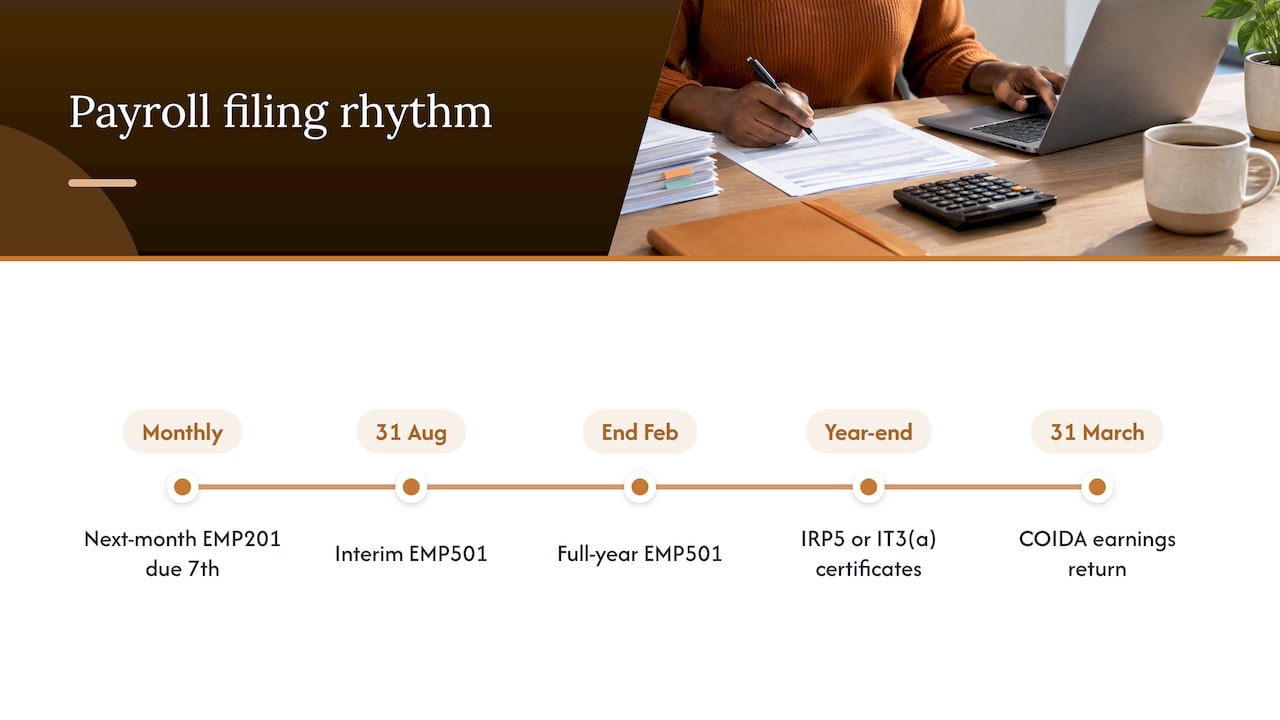
Monthly. You must remit PAYE, UIF and SDL to SARS by the 7th day of the following month, or the last business day before it if the 7th falls on a weekend or public holiday. The monthly declaration is the EMP201. Our EMP201 deadlines guide sets out the routine for payroll teams.
Twice a year. You must submit an Employer Reconciliation Declaration (EMP501) for the interim period (1 March to 31 August) and for the full tax year (1 March to the end of February). The reconciliation must agree with what you declared and paid month by month. If it does not, you correct it before submitting. Our EMP501 reconciliation steps walk through that.
Year-end. In most cases you must give employees an IRP5 or IT3(a) tax certificate for each tax period, showing among other details the tax deducted.
Annually for COIDA. Return of Earnings by 31 March, as above.
Because the South African tax year starts in March, your payroll calendar will not match a calendar-year or US fiscal-year routine. Plan for the interim reconciliation in the late summer and the annual one in the spring (South African autumn).
A worked example: what a hire costs in statutory charges
Take an employee on a gross salary of R60,000 a month (R720,000 a year). Using the rates above and assuming SDL applies because total payroll exceeds R500,000:
| Item | Calculation | Monthly amount |
|---|---|---|
| Employer UIF | 1% capped at R17,712 | R177.12 |
| SDL | 1% of R60,000 | R600.00 |
| Total employer statutory charges (excl. COIDA) | R777.12 |
That is about 1.3% of gross salary. The employee’s side is separate: R177.12 UIF plus PAYE, both deducted from their pay.
Now take a smaller case: one employee on R15,000 a month, so annual payroll of R180,000. SDL does not apply, because payroll is below R500,000. Employer UIF is 1% of R15,000, or R150. That is 1% of salary.
In both cases, add the COIDA assessment for your industry class, and the cost of running payroll and filings, whether in-house or through a provider. These figures are statutory charges only. They exclude benefits such as medical aid, retirement funding, bonuses and leave, which are set by your contract and market practice.
When the employer is a foreign company
This is where the search results disagree, and where many international founders get stuck. Deloitte Africa notes that the 2023 Taxation Laws Amendment Bill extended PAYE withholding obligations to non-resident employers with a permanent establishment in South Africa. That requirement was not extended to the SDL and UIF Acts, so a foreign employer without a permanent establishment or representative employer in South Africa still has SDL and UIF obligations.
The practical reading: hiring a South African resident directly does not remove your payroll duties, and it can create a permanent establishment question on top. You need to register, file in rand and meet the deadlines above from abroad. Our guide for a non-resident employer in South Africa covers the rules in detail. Take advice from a South African tax professional on your specific structure.
Perspective: why we treat this as a one-country problem
Foreign founders usually ask us about rates first. The rates are the easy part. UIF, SDL and PAYE are published, stable and simple to calculate.
What causes trouble is the combination: a March tax year, a 7th-of-the-month deadline, two reconciliations, a separate Compensation Fund return, and a labour law framework (BCEA, LRA) that decides how contracts and dismissals must be handled. Each is manageable alone. Together, they are a lot for a team that has never run South African payroll.
That is why we only work in South Africa. Our licensed local partner is the legal employer, handles BCEA-compliant contracts, ZAR payroll and the filings for PAYE (EMP201), UIF, SDL and COIDA, and we tell you plainly who employs your people. Our pricing is flat, with no setup fees or FX loading, so the statutory costs above are the only variable you need to model.
Skilled South African roles typically cost 40% to 60% less than comparable UK or EU roles, and the time zone sits within about one hour of CET. Those two facts, combined with predictable employer charges of roughly 1% to 2% of salary, make the country a sound place to hire when payroll is handled properly.
Roel
Hiring in South Africa without running payroll yourself
If you would rather not register for PAYE, UIF, SDL and COIDA from abroad, our Employer of Record service covers it. Employment runs through a licensed local partner, who issues the contract, pays your employee in rand and files every return on time. Pricing starts from £299 per employee per month.
Signed contracts typically take 48 hours and full onboarding a few days. If you already work with another provider, we offer free transfers. You can also read how our payroll services in South Africa work in detail, or use the Employer of Record guide to compare how the model works.
A short compliance checklist
Use this list when planning your first hire:
- Confirm your total expected annual payroll to decide whether SDL applies (threshold R500,000).
- Register as an employer with SARS for PAYE, UIF and, if applicable, SDL.
- Register with the Compensation Fund within 7 days of the first hire.
- Set up payroll in rand, with gross salaries quoted in the contract.
- Diarize the 7th of every month for EMP201 payment and declaration.
- Diarize the interim (31 August period end) and annual (end of February) EMP501 reconciliations.
- Diarize 31 March for the COIDA Return of Earnings.
- Issue IRP5 or IT3(a) certificates at the end of each tax period.
Rates and ceilings change. The UIF ceiling has stood at R17,712 since 1 June 2021, but PAYE brackets and rebates are reset in the Budget each year, so check the SARS pages linked above before you run payroll for a new tax year.
FAQ
Does the employer pay PAYE in South Africa?
No, not as a cost of its own. PAYE is the employee’s income tax, which you withhold from salary and pay over to SARS each month. You are responsible for calculating it correctly and paying it by the 7th of the following month.
How much UIF does an employer pay?
You pay 1% of the employee’s remuneration, matched by 1% from the employee. Remuneration is capped at R17,712 a month, so the most you pay is R177.12 per employee per month, and the combined maximum is R354.24.
Do all employers pay the Skills Development Levy?
No. SDL at 1% of remuneration applies to employers expecting total salaries above R500,000 over the next 12 months. Below that threshold, you are exempt. The test is on your total payroll, not on each individual salary.
Do foreign companies with no South African entity owe these taxes?
Often yes. Deloitte Africa notes that SDL and UIF obligations still apply to foreign employers without a permanent establishment, while PAYE withholding was extended to non-resident employers with one. Confirm your position with a South African tax adviser before hiring.
Sources
- SARS: Pay As You Earn
- SARS: Guide for Employers in Respect of Employees’ Tax (2027)
- SARS: 2026 Budget Tax Guide
- SARS: Unemployment Insurance Fund
- Department of Employment and Labour: uFiling UIF
- SARS: Skills Development Levy
- Department of Employment and Labour: COIDA Service Book
- Deloitte Africa: Foreign employers and their SA employment tax obligations