

Retrenchment in South Africa is a dismissal for operational requirements under the Labour Relations Act, and it comes with three immediate obligations. Employers must issue a written section 189(3) notice, engage in meaningful consultation before any decision is final, and pay at least one week’s severance for every completed year of service. Notice pay and accrued leave still apply on top of that minimum.
TL;DR:
- Employers must issue a detailed section 189(3) notice early in the process, outlining reasons, alternatives considered, and employee impact, before any final decision.
- Consultation should follow a clear sequence with multiple structured meetings, documenting every proposal and employer response to build a solid defense if challenged.
- Large-scale retrenchments under section 189A trigger a 60-day facilitation process at the CCMA, requiring employers to avoid issuing termination notices before completion.
- Fair selection criteria are prioritized, with default methods like LIFO, but bumping and skills-based scoring are recommended when reasonably practicable, with proper documentation.
- Proper documentation, complete disclosures, and genuine negotiation are key to avoiding costly CCMA disputes, especially for international companies managing South African retrenchments through an Employer of Record.
Table of Contents
- What the Retrenchment Process in South Africa Actually Requires
- A Step-by-Step Guide to Section 189 Compliance
- Large-Scale Retrenchments and the 60-Day CCMA Facilitation Window
- Choosing Fair Selection Criteria and Considering Bumping
- Severance Pay, Notice, Leave, and What SARS Takes
- Five Mistakes Employees Make During Retrenchment
- Where to Turn If the Process Goes Wrong
- Who Does What: Employer and Employee Roles in Consultation
- Keeping the Paper Trail Airtight
- What Happens to Benefits and Pension Funds
- Retraining and Redeployment as Genuine Alternatives
- Protecting Vulnerable Employees During Retrenchment
- Support After the Notice: Counselling and Practical Help
- A Compliance-First View of Retrenchment
- How Expand to South Africa Reduces Retrenchment Risk for Employers Abroad
- Primary Sources for Retrenchment Law in South Africa
- Sources
- FAQ
What the Retrenchment Process in South Africa Actually Requires
The legal foundation sits in Sections 189 and 189A of the Labour Relations Act, which set out when an employer may dismiss for “operational requirements” and how the consultation must run. Operational requirements cover economic pressure (falling revenue, lost contracts), technological change (new systems replacing roles), or structural shifts (restructuring, mergers, closing a division). It is a narrower category than most employers assume. A manager who is simply underperforming cannot be retrenched. That is a misconduct or incapacity matter, governed by different rules entirely.
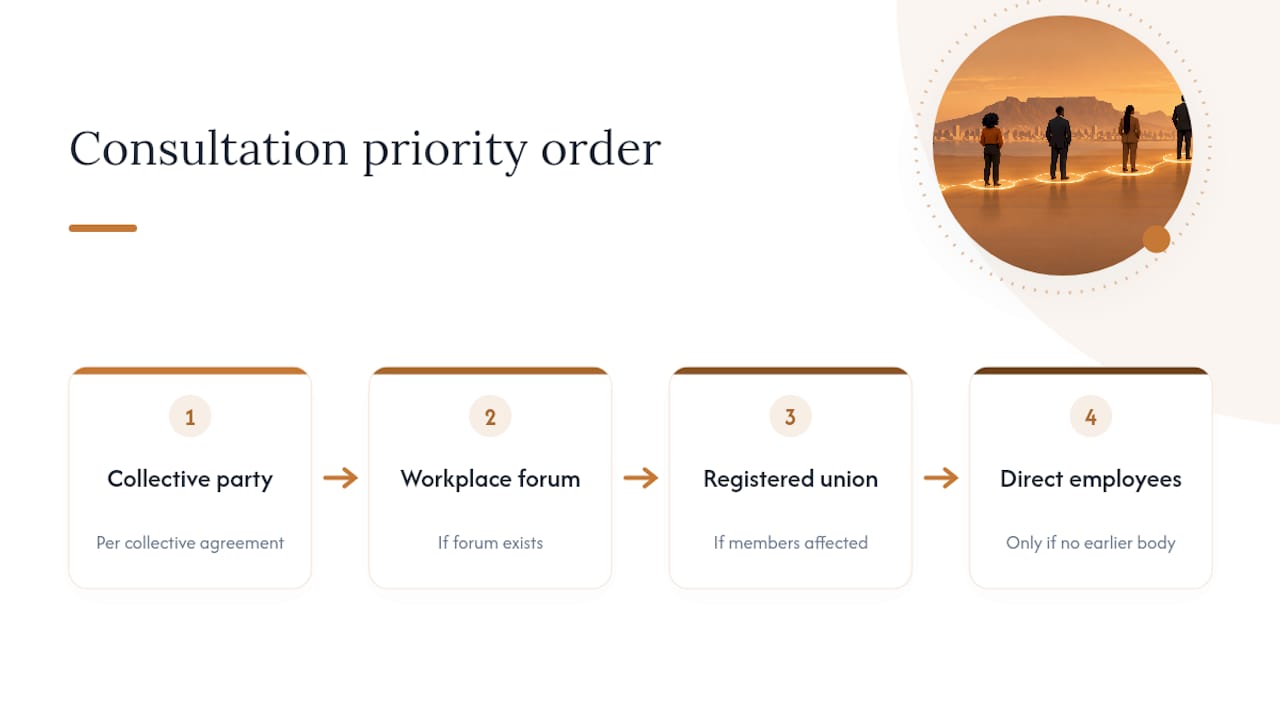
The order of consultation matters as much as the content. The LRA requires employers to consult, in order of priority, with any party a collective agreement requires, then a workplace forum if one exists, then a registered trade union whose members are affected, and only then directly with the employees themselves. Skipping a step in this hierarchy, even when the substance of consultation is sound, is a common way employers stumble into a procedural unfairness finding at the CCMA.
The BCEA runs alongside the LRA and governs the financial side, including notice periods and how leave pay is calculated on termination. Together the two statutes create a dual test: was the reason for retrenchment genuinely operational, and was the process followed fair? Employers can lose a case on either ground even when the other is airtight. That dual exposure is why HR teams that treat section 189 as a form to fill out, rather than a genuine negotiation, tend to end up defending their decision at the CCMA months later.
A Step-by-Step Guide to Section 189 Compliance
Section 189 consultation is not one meeting. It is a process, and the sequence matters.
- Issue the written section 189(3) notice as soon as retrenchment becomes a genuine contemplation, not after the decision is made. The notice must disclose the reasons for the proposed dismissals, alternatives already considered and rejected, the number of employees likely affected and their job categories, the proposed selection criteria, the timing of dismissals, proposed severance pay, and any retrenchments the employer carried out in the preceding 12 months, according to government guidance on the section 189 process.
- Schedule consultation meetings with a real agenda, not a single sit-down to announce numbers. Each meeting should invite counter-proposals on ways to avoid the dismissals, minimize the number affected, change the timing, or mitigate the impact (severance, retraining, redeployment).
- Document every proposal and every employer response in writing. If a union suggests a shorter workweek instead of layoffs, the employer’s written reply explaining why that was accepted or rejected becomes the evidence that decides a later unfair dismissal case.
- Only issue termination notices once consultation has run its proper course and the employer has genuinely engaged with alternatives. Termination letters sent before consultation has meaningfully concluded are one of the fastest routes to a procedural unfairness finding.
Pro Tip: Keep a single consultation file per employee category, with dated minutes. If a matter reaches the CCMA a year later, that file is your entire defense.
Large-Scale Retrenchments and the 60-Day CCMA Facilitation Window
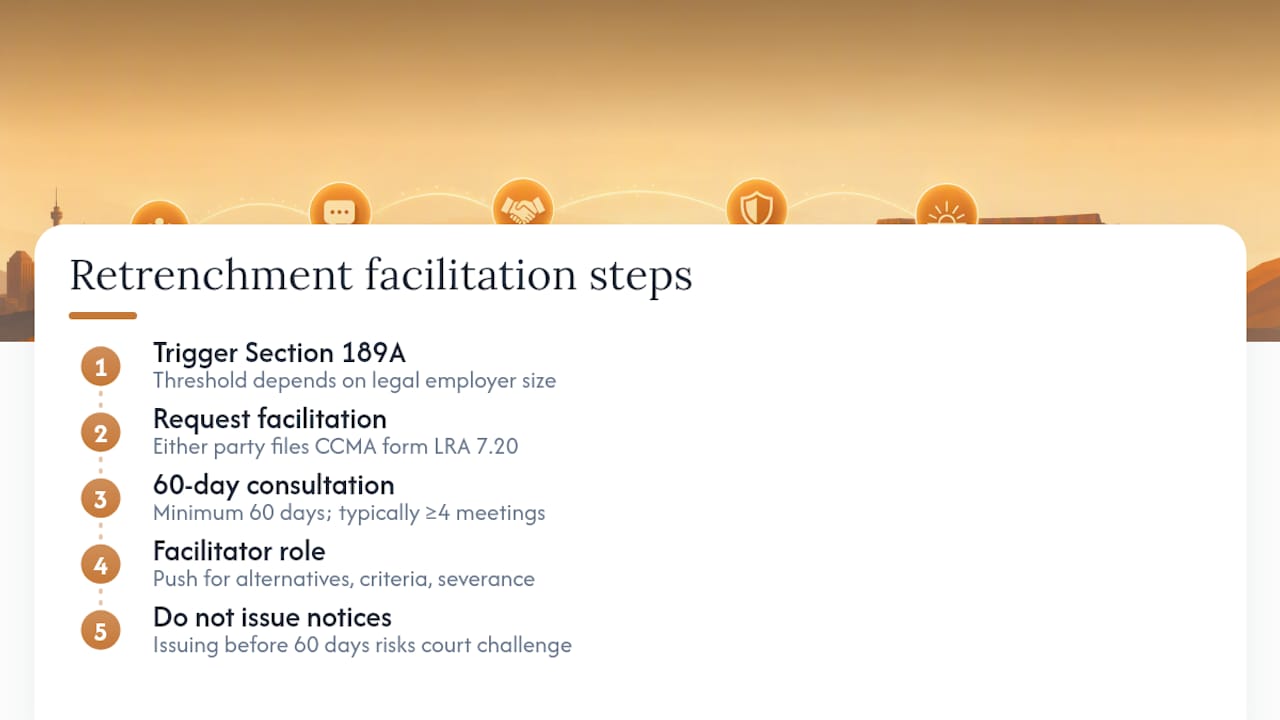
Section 189A kicks in for large-scale retrenchments, and the threshold depends on employer size: it generally starts at ten or more employees at smaller employers, increasing with the size of the workforce of the actual legal employer, not a parent company or group. Getting the “who is the employer” question wrong is a common trap for multinational groups with several South African entities.
Once thresholds are met, either party can request the CCMA to facilitate under form LRA 7.20. Facilitation imposes a minimum 60-day consultation period and typically involves at least four structured meetings, according to CCMA facilitation guidance. The facilitator’s role is to push both sides toward consensus on alternatives, selection criteria, and severance, not simply to rubber-stamp the employer’s plan. Facilitated agreements reached with prejudice can bind both parties.
Employers who issue termination notices before the 60-day window closes, or before facilitation has run its course, expose themselves to an urgent Labour Court challenge. Courts have shown little patience for employers who treat the deadline as a formality rather than a floor.
Choosing Fair Selection Criteria and Considering Bumping
The starting point is always agreement. If the employer and the union or affected employees can agree on selection criteria, that agreement governs. Only when no agreement is reached does the employer fall back on criteria that must be fair and objective, and courts scrutinize this closely.
- LIFO (last in, first out) is the traditional default, simple to apply and hard to challenge, but it can strip out newer employees with scarce skills the business still needs.
- Skills-based scoring protects operational capability but invites bias claims unless the scoring matrix and weightings were disclosed and applied consistently.
- Performance ratings are defensible only where the ratings predate the retrenchment process and were not manufactured for it.
Bumping, moving a more senior employee into a junior role to avoid dismissing them, must be considered where it is reasonably practicable, particularly when the senior employee has the skills to do the junior job with minimal retraining. Employers who ignore bumping entirely, without explaining why it was not viable, hand employees an easy procedural challenge.
Recent Labour Court commentary is blunt about the risk of a “checklist” approach: legal analysis of section 189 practice notes that courts set aside retrenchments where alternatives were listed on paper but never genuinely explored.
Pro Tip: If you reject bumping or redeployment, write down the specific operational reason. “Not considered” in the minutes is worse than no minutes at all.
Severance Pay, Notice, Leave, and What SARS Takes
Statutory minimum severance is one week’s remuneration for every completed year of continuous service, calculated on the employee’s ordinary pay, according to CCMA guidance on retrenchment. Many employment contracts offer more, but nothing legally binding sits below that floor. Use a severance calculation approach that separates severance from notice pay and accrued leave, since all three appear as distinct line items on a final payslip and are taxed differently.
Tax note: SARS applies a special zero-rate threshold to qualifying severance benefits. From March 2023, the first R550,000 of a qualifying severance benefit is subject to that zero-rate threshold, subject to eligibility rules and any earlier retirement lump sums that reduce the available amount, per SARS guidance on retrenchment tax.
Notice pay follows BCEA minimums (generally one to four weeks depending on length of service) and accrued but taken annual leave must be paid out in full. Employees should also complete a UI-19 form so their employer can process a UIF unemployment claim, and check what happens to pension or provident fund contributions, since fund rules on preservation versus withdrawal vary by scheme. Employees with earlier retirement lump sums should ask their payroll or a tax practitioner how those affect the zero-rate threshold before assuming the full amount applies.
Five Mistakes Employees Make During Retrenchment
Retrenched employees, and the HR teams supporting them, make predictable errors that weaken their position.
- Signing a severance agreement on the day it is presented. There is no legal requirement to sign immediately, and rushing usually means missing something in the disclosure.
- Treating any alternative job offer as automatically reasonable. Courts weigh remuneration, seniority, status, and job security when deciding whether refusing an alternative role still entitles the employee to severance.
- Not requesting the underlying financial disclosure behind the employer’s stated reasons for retrenchment.
- Failing to get union or legal advice early, especially once facilitation or a section 189A process is underway.
- Losing the paper trail. Every notice, minute, and email should be kept, not just the final termination letter.
A short document checklist to request: a copy of the section 189(3) notice, the financial information disclosed to justify the retrenchment, written employer responses to any counter-proposals, and the selection criteria applied with the scoring or reasoning behind it.
Where to Turn If the Process Goes Wrong
Employees who believe the process was unfair, procedurally or substantively, can refer a dispute to the CCMA, typically within 30 days of the dismissal. Large-scale section 189A disputes can go straight to the Labour Court for urgent relief, including interdicts stopping a dismissal that jumps the 60-day facilitation window.
Remedies include compensation (capped under the LRA), reinstatement in limited circumstances, orders compelling disclosure of financial information withheld during consultation, and urgent interdicts halting premature terminations. Conciliation at the CCMA usually happens within 30 days of referral; arbitration or Labour Court proceedings, if conciliation fails, can take considerably longer, often months, depending on the court roll and complexity of the dispute. Employers facing a section 189A facilitation should treat the 60-day clock as a hard floor. Employees facing a rushed process should treat an early urgent application as a real option, not a last resort.
Who Does What: Employer and Employee Roles in Consultation
Consultation is a joint problem-solving exercise, not a one-way announcement, and the LRA expects both sides to show up prepared to engage.
The employer’s job is to disclose enough information for the other side to respond meaningfully, chair the process in good faith, and genuinely consider every counter-proposal raised, whether that comes from a union, a workplace forum, or individual employees. That includes responding in writing to specific suggestions, not just acknowledging them verbally in a meeting.
Employees, and the unions representing them, carry a reciprocal duty to engage constructively. That means raising real alternatives (shorter hours, voluntary retrenchment, redeployment, retraining) rather than simply objecting to the process on principle. A union that refuses to propose anything constructive weakens its own later argument that consultation was inadequate. HR professionals running the process should document who attended each meeting, what was proposed, and what was resolved or left open, since a one-sided record favors whichever party kept it.
Keeping the Paper Trail Airtight
The single biggest predictor of whether a retrenchment survives a CCMA challenge is the quality of the documentation behind it, not the substance of the business decision itself.
Every consultation meeting needs dated minutes, ideally circulated for comment within a day or two so neither side can later dispute what was said. Every written proposal from an employee or union deserves a written response explaining acceptance or rejection, a practice practitioner guidance on section 189 flags as the difference between genuine consultation and a defensive paper exercise. Financial disclosures shared to justify the retrenchment should be logged with dates and recipients, since disputes over “what was actually shared” are common and hard to resolve without a clear record.
Communication should go through one consistent channel, usually email with meeting minutes attached, so nothing important gets lost in a verbal exchange nobody wrote down. HR teams juggling multiple affected departments benefit from a single tracking sheet: employee name, meeting dates, proposals raised, employer response, and final outcome. That sheet becomes the backbone of any CCMA defense, and building it during the process is far easier than reconstructing it under pressure months later.
What Happens to Benefits and Pension Funds
Retrenchment ends the employment relationship, and most employee benefits, medical aid subsidies, group life cover, disability cover, end on the last day of service unless the employer’s policy says otherwise. Employees should ask HR for the exact termination date of each benefit rather than assuming continuity.
Pension and provident fund treatment depends on the specific fund rules, but retrenched employees generally have the option to preserve their retirement savings in a preservation fund, transfer to a new employer’s fund, or withdraw the full amount in cash. Withdrawing triggers tax at the retirement lump sum tax tables, and any amount withdrawn reduces the tax-free portion available on the severance benefit itself, since SARS treats the two as connected for tax purposes. Employees weighing this decision should get the actual fund statement before deciding. HR teams should flag the interaction between severance tax and retirement withdrawal tax early in consultation, since employees frequently assume the two are unrelated and are surprised by a smaller net payout than expected.
Retraining and Redeployment as Genuine Alternatives
Retrenchment is meant to be a measure of last resort, and both the LRA and CCMA guidance expect employers to have seriously explored alternatives before dismissal notices go out. Redeployment into a vacant role, even one requiring some retraining, counts as a genuine alternative if the employee has a reasonable prospect of performing it after a short training period.
Employers who can point to specific vacancies considered, and specific reasons why an employee was or was not matched to them, are in a far stronger position than those who state generically that “no alternatives were available.” A short internal retraining program, even a few weeks, can be cheaper than the severance and legal exposure of a contested dismissal, and it preserves institutional knowledge the business would otherwise lose. Employees should proactively raise their own transferable skills during consultation rather than waiting for the employer to identify them, since the disclosure duty runs both ways in practice even though the LRA places the primary burden on the employer.
Protecting Vulnerable Employees During Retrenchment
Certain categories of employees carry extra statutory protection that HR teams must factor into selection criteria, not treat as an afterthought.
Pregnant employees and those on maternity leave cannot be selected for retrenchment because of the pregnancy or leave itself, and doing so converts what might otherwise be a fair operational dismissal into an automatically unfair one, which carries no compensation cap. Trade union representatives and shop stewards enjoy similar scrutiny: selecting a shop steward for retrenchment invites an inference of victimization unless the employer can show the selection was based entirely on the agreed or objective criteria applied to everyone else. Employees on other protected leave, or those who raised a recent grievance or whistleblower complaint, deserve the same caution.
The practical safeguard is consistency. Apply the same selection criteria and scoring to every employee in the affected category, and keep the underlying scoresheet, so any claim of targeting can be answered with the same document used for the rest of the workforce.
Support After the Notice: Counselling and Practical Help
The retrenchment process does not end when the final payslip is issued. Larger employers increasingly offer exit counselling, CV support, or referrals to outplacement services as part of a retrenchment package, and while none of this is a statutory requirement, it materially reduces the emotional and reputational fallout of a large-scale process.
Employees should register for UIF benefits promptly using the UI-19 form issued by the employer, since delays in submission push out the first payment. Community Advice Offices and Legal Aid South Africa remain the most accessible free options for employees who cannot afford private legal advice but need help understanding a severance offer or CCMA referral. HR teams running larger retrenchments should build a short resource list, UIF process, CCMA contact details, and any employee assistance program, into the final consultation pack, since employees under financial stress rarely have the bandwidth to research this themselves in the days after termination.
A Compliance-First View of Retrenchment
The gap between a defensible retrenchment and a costly CCMA loss almost never comes down to whether the business reason was genuine. It comes down to three things: whether disclosure was complete, whether consultation was a real negotiation, and whether someone wrote it all down as it happened.
International employers face an added layer: correctly identifying the legal employer of record for threshold and filing purposes, since group structures routinely confuse this and expose the wrong entity to section 189A obligations. Get that identification wrong and every subsequent step, however well run, sits on a shaky foundation. If there is one habit that cuts litigation risk more than any other, it is responding in writing to every counter-proposal, on the day it is raised.
— Roel
How Expand to South Africa Reduces Retrenchment Risk for Employers Abroad
If you’re a founder or HR lead outside South Africa managing a retrenchment without a local entity, the operational risk multiplies fast, since you’re relying on a patchwork of local advisors to get contracts, payroll, and statutory filings right at the exact moment scrutiny is highest. An Employer of Record model built specifically around South African labour law can help by handling BCEA-compliant contracts, ZAR payroll, and statutory filings (PAYE, UIF, SDL, COIDA) through one accountable local partner instead of several disconnected vendors.
That structure matters most during a retrenchment, when payroll continuity and correct statutory filings cannot pause while you sort out disclosure obligations. Because Expandtosouthafrica already handles your ongoing payroll and statutory filings, the entity-identification problem that trips up international groups during a section 189A process is resolved before it becomes a dispute. Review the employer of record pricing for South African employees and see whether a single accountable local employer, rather than a five-vendor patchwork, makes your next compliance decision simpler.
Primary Sources for Retrenchment Law in South Africa
For the statute itself, read the Labour Relations Act directly. For step-by-step government guidance, use the Department of Employment and Labour’s section 189 explainer. For facilitation mechanics, the CCMA’s large-scale facilitation page and its small-scale retrenchment info sheet cover both scales. For tax computation, consult SARS’s retrenchment tax guidance directly.
This article is general information, not a substitute for advice from a qualified lawyer. Consult a qualified legal professional about your own circumstances before acting on anything here.
Sources
FAQ
What Is a Normal Retrenchment Package in South Africa?
The statutory floor is one week’s pay per completed year of service, though many employers offer more by policy or negotiation. Notice pay and accrued leave are paid separately on top of that severance minimum, as set out in CCMA guidance.
What Are Common Mistakes During Retrenchment?
Employers most often fail by treating consultation as a formality rather than a genuine negotiation, skipping the required order of whom to consult, or issuing termination notices before the process has properly concluded. Employees most often sign severance agreements too quickly or fail to request the financial disclosure behind the decision.
What Are the Selection Criteria for Retrenchment in South Africa?
Agreed criteria between employer and employee representatives take priority; without agreement, employers must fall back on fair and objective measures such as LIFO, skills, or documented performance. Bumping a senior employee into a junior vacant role must be considered where it is reasonably practicable.
How Long Does the Retrenchment Process Take?
Small-scale retrenchments have no fixed statutory minimum but typically run several weeks to allow genuine consultation. Large-scale retrenchments under section 189A require at least 60 days of facilitated consultation before a valid termination notice can be issued, according to CCMA facilitation rules.
Can an Employer of Record Help With Retrenchment Compliance?
Yes, an Employer of Record like Expandtosouthafrica manages the underlying employment contract, payroll, and statutory filings so international employers have one accountable local party handling the compliance groundwork. Current pricing is available on the Expandtosouthafrica pricing page.