

Did you know that remote job opportunities in South Africa surged by 28% in the first half of 2026 alone? This growth signals a massive shift in how global firms access top-tier talent, yet many employers remain paralysed by the fear of misclassification. You likely recognise the immense potential of the local workforce, but the threat of SARS penalties and the confusion surrounding ZAR payroll can make the process feel incredibly daunting. It’s a common concern for businesses looking to scale without the overhead of a local office.
We understand that you need a solution that avoids the legal minefield of entity setup. This guide promises to help you master remote hiring South Africa by providing a clear, compliant, and operational framework. You’ll learn how to navigate the 2026 statutory landscape with specialized confidence, ensuring your onboarding is seamless and your risk is zero.
We’ll deconstruct the nuances of South African labour law, including the ZAR 30.23 minimum wage and the latest UIF contribution caps. You’ll also discover how to manage local expectations like the 13th-cheque and SDL requirements without losing sleep over hidden costs. This is your roadmap for onboarding South African staff with predictable monthly expenses and total regulatory mastery.
Key Takeaways
- Leverage the “Time Zone Advantage” to integrate high-calibre, English-speaking South African talent seamlessly into your UK or EU operations.
- Discover how to bypass the complexity of local entity setup by using a specialised Employer of Record to handle all BCEA compliance and statutory filings.
- Master the specific SARS criteria to avoid the “Contractor Trap” and protect your business from the severe financial penalties associated with misclassification.
- Streamline your 2026 strategy for remote hiring South Africa by using local cost calculators to ensure total transparency over ZAR payroll and 13th-cheque expectations.
- Optimise your global expansion budget by switching from opaque, percentage-based pricing to a disciplined, flat-fee EOR model that guarantees predictable monthly costs.
Why South Africa is the Strategic Choice for Remote Hiring in 2026
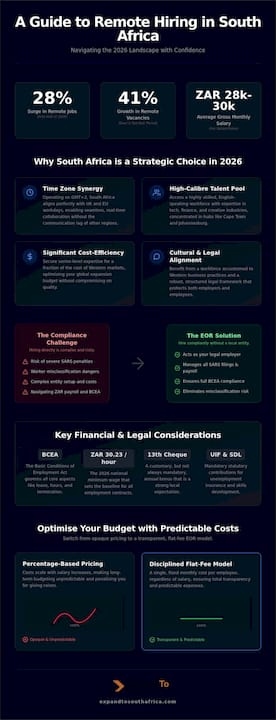
South Africa has evolved from a regional player into a global powerhouse for distributed teams. By mid-2026, remote job vacancies in the country grew by 41% over a two-year period. This isn’t a coincidence. It’s the result of a highly skilled workforce looking beyond local borders for stable, full-time careers. For international employers, remote hiring South Africa offers a rare combination of high-calibre output and significant operational cost-efficiency. You aren’t just finding cheaper labour; you’re accessing a talent pool that matches the technical and professional standards of London, Berlin, or New York.
The appeal goes deeper than just the bottom line. The local market is underpinned by a robust legal framework. Understanding South African labour law is vital for any firm looking to scale here, as it provides a structured environment that protects both the employer and the employee. This stability, combined with the fact that the average gross monthly salary sits between ZAR 28,000 and ZAR 30,000, makes the region incredibly competitive for tech, finance, and creative roles. Businesses can secure senior-level expertise for a fraction of the overhead required in traditional Western markets.
The Time Zone and Cultural Synergy
Real-time collaboration is the heartbeat of efficient remote teams. South Africa operates on GMT+2, which means perfect alignment with most of Europe and only a two-hour difference with the UK. You won’t find the “lag” associated with Asian or American outsourcing. Teams share a business language and a work ethic rooted in Western standards. This cultural synergy ensures that projects move faster and communication remains clear, whilst the shared legal foundations reduce the friction often found in cross-border partnerships. It’s the perfect middle ground for operations that require constant, synchronous communication.
The 2026 Talent Landscape
The local tech scene is thriving. Cape Town and Johannesburg have matured into sophisticated hubs for software engineering and specialised financial services. In 2026, top-tier talent no longer views remote work as a “gig” or a temporary fix. It’s a career choice. Skilled professionals now actively prefer international roles that offer global exposure and competitive compensation. Successfully managing remote hiring South Africa means tapping into a pool of experts who are ready to integrate into your existing workflows from day one. This shift has improved retention rates for international employers, as local staff value the stability of full-time employment over the uncertainty of the local job market.
Navigating South African Labour Law without a Local Entity
Establishing a local subsidiary in South Africa is an expensive administrative hurdle. For teams under 20 people, the costs of local directors, legal fees, and tax registrations are simply not justifiable. Instead, an Employer of Record (EOR) serves as the legal employer on paper. You maintain the day-to-day management whilst the EOR manages the complex regulatory requirements. This is the most efficient route for remote hiring South Africa. It allows you to bypass the months of red tape associated with entity setup and focus on your core business goals.
All employment relationships are governed by the Basic Conditions of Employment Act (BCEA). This act sets the floor for working hours, leave entitlements, and notice periods. You cannot contract out of these rights. Any remote hiring South Africa strategy must respect these core protections to avoid CCMA (Commission for Conciliation, Mediation and Arbitration) disputes. Ignoring these basics is the fastest way to face local litigation or severe financial penalties from the Department of Employment and Labour.
The Role of an EOR in South Africa
The EOR takes on the legal “burden of proof” for compliance. They ensure that every employment contract mirrors your global standards whilst adhering to local nuances. This includes managing ZAR payroll and distributing taxes via the South African Revenue Service (SARS). It’s a high-stakes environment where precision matters. If you’re unsure of the local landscape, checking a comprehensive Guide to Hiring in South Africa can clarify the practical differences between direct employment and EOR models. Using a specialised partner ensures you don’t fall foul of local tax authorities.
Statutory Contributions and Filings
Compliance isn’t just about the monthly salary. It’s about the statutory “add-ons” that keep the relationship legal. You must account for several mandatory filings that are unique to the South African market:
- UIF (Unemployment Insurance Fund): A mandatory 2% contribution. This is split equally between employer and employee, with each contributing 1% of the remuneration.
- SDL (Skills Development Levy): If your total annual payroll exceeds ZAR 500,000, you are required to pay a 1% levy. This funds national skill development initiatives.
- COIDA: The Compensation for Occupational Injuries and Diseases Act requires employers to contribute to a fund that covers workplace injuries. Even for remote workers, this remains a legal requirement.
Managing these variables manually is a recipe for error. To get a clear picture of your total commitment, you can use an employer cost calculator to see exactly how these statutory contributions impact your monthly budget.
Independent Contractor vs Employee: Avoiding the Misclassification Trap
Many global hiring platforms suggest that the easiest way to scale is by treating every remote worker as an independent contractor. This is a dangerous oversimplification. In South Africa, the line between a contractor and a “deemed employee” is strictly policed by the South African Revenue Service (SARS). Misclassification isn’t just an administrative error; it’s a significant financial liability. If SARS determines your contractors are actually employees, you’ll face backdated claims for PAYE (income tax), UIF, and SDL, along with heavy interest and penalties. For any business serious about remote hiring South Africa, understanding the legal “tests” is non-negotiable.
The risk extends beyond payroll taxes. There is the persistent threat of “Permanent Establishment.” If your contractors perform core revenue-generating activities, the authorities may decide your foreign company has a taxable presence in the country. This triggers corporate tax obligations you didn’t plan for. Using an EOR model eliminates this risk by ensuring the worker is locally employed by a South African entity, keeping your parent company’s tax profile clean and predictable.
The SARS “Dominant Impression” Test
SARS doesn’t rely on the title you put in your contract. Instead, they apply the “Dominant Impression” test to evaluate the reality of the working relationship. As of May 2026, any individual earning below ZAR 269,600.90 annually is presumed to be an employee if just one of several conditions is met. Key factors include:
- Control and Supervision: Do you dictate the worker’s hours or the specific manner in which they complete tasks?
- Economic Dependence: Does the worker rely on your company for the vast majority of their income?
- Provision of Tools: Did you provide the laptop, software licences, or other essential equipment?
If the answer to these is “yes,” the worker is an employee in the eyes of the law. Failing to recognise this reality can lead to costly CCMA disputes that damage your reputation and your balance sheet.
IP Security and Data Protection
IP protection is often an afterthought in contractor agreements, but it shouldn’t be. Enforcing an NDA or an IP transfer clause against a freelancer in a foreign jurisdiction is notoriously difficult. Full-time employment via a specialized EOR provides a much stronger legal anchor. It ensures that all intellectual property created during work hours is automatically and legally transferred to your business. Additionally, employment contracts make it easier to enforce POPIA (Protection of Personal Information Act) compliance. This is vital for remote hiring South Africa if your team handles sensitive customer data. A stable, employed workforce offers far better long-term security and lower churn than a fragmented group of freelancers.
A Step-by-Step Framework for Onboarding South African Talent
Successful onboarding in a foreign jurisdiction requires more than just a digital signature. It demands a disciplined sequence that respects local customs whilst protecting your global interests. For remote hiring South Africa, the process must be both legally sound and operationally efficient. You cannot afford to guess your way through statutory requirements or cultural expectations. A structured framework ensures your new hires are productive from day one, without leaving your business exposed to compliance gaps.
The first step is always financial clarity. Before you interview a single candidate, you must define the role and use a specialised Employer Cost Calculator to budget for total employment costs. Once your budget is set, source talent through local experts who understand the cultural nuances of the South African market. This prevents the “mismatch” that often occurs when using generic global job boards. After selecting your candidate, you must draft a BCEA-compliant contract that specifically addresses local leave entitlements and notice periods.
Forecasting Total Employment Cost
The 13th cheque remains a significant cultural expectation in South Africa. Whilst it is generally discretionary rather than a statutory requirement in 2026, many top-tier candidates view it as a standard component of a competitive package. You must decide whether to build this into the base salary or offer it as an annual bonus. Additionally, you need to calculate the “Gross to Net” gap. With the tax-free threshold sitting at ZAR 17,235 for the 2025/2026 tax year, understanding how much your employee actually takes home is vital for making competitive offers that stick. Factor in the twelve annual public holidays and the standard twenty-one consecutive days of annual leave to avoid scheduling friction later.
Seamless Digital Onboarding
Execution is the final hurdle. You must collect mandatory documents early, including the employee’s South African ID, tax number, and local bank details. For businesses looking to scale, executing this via a centralised South Africa Employment API is the most efficient route. This allows you to integrate local payroll data directly with your global HRIS, ensuring a single source of truth for your workforce. Finally, establish your ZAR payroll cycles and statutory filing schedules for PAYE, UIF, and SDL. Clear communication regarding remote work behaviour and communication protocols should be part of this digital hand-off. To simplify this entire sequence and ensure total compliance, you can leverage our South Africa payroll services to manage the heavy lifting of local administration.
Simplifying Remote Hiring with a Flat-Fee EOR Partner
The global EOR industry has long relied on percentage-based pricing models. This structure is fundamentally flawed. It creates a “success tax” where your costs increase simply because you’ve hired high-value talent. We believe in a different approach. ExpandTo South Africa offers a disciplined flat fee of €350 per employee per month. This transparency allows you to scale your remote hiring South Africa strategy with total financial certainty. You shouldn’t be penalised for paying your team what they’re worth.
Choosing a specialised local partner provides a level of “Local Mastery” that generic global platforms cannot match. Large providers often struggle with the granular mechanics of South African compliance. They might miss specific COIDA requirements or fumble the nuances of SDL filings for larger teams. We focus exclusively on this region. This means every ZAR is accounted for, and every statutory filing is executed with precision. You get the confidence of a partner who understands the local landscape better than a generalist ever could.
Transparency in Pricing and Compliance
Predictable costs are essential for long-term growth. A flat-fee model simplifies your financial forecasting. It removes the hidden variables that often creep into percentage-based contracts as salaries increase or bonuses are paid. Our approach ensures that your overhead remains constant regardless of the seniority of your hire. We handle the technical burden of PAYE, UIF, and SDL filings via our specialised South Africa Employment API. This programmatic approach reduces human error and keeps your business in good standing with SARS at all times.
Future-Proofing Your South African Team
Scaling a team from one hire to fifty requires a robust infrastructure. We bridge the gap between finding talent and managing it compliantly. Through our integrated talent sourcing with EmbedPeople, you can identify the right candidates whilst we handle the legal heavy lifting. Our platform is built for speed. You can move from an offer letter to a fully onboarded employee in days, not weeks. As South African labour laws evolve, we provide continuous monitoring to ensure your contracts and filings remain current. Ready to hire? Calculate your total cost of employment today to see how we can simplify your expansion into the South African market.
Scale Your Global Team with Specialized Confidence
South Africa represents one of the most significant opportunities for global expansion in 2026. You’ve seen how the combination of cultural synergy and a high-calibre talent pool can transform your operations. Success depends on moving past the “Contractor Trap” and embracing a legally sound framework. By prioritising BCEA compliance and structured ZAR payroll, you protect your business from the financial volatility of SARS penalties. It’s about building a sustainable presence without the administrative burden of a local office.
You don’t need a local entity to access this market. Remote hiring South Africa is at its most effective when you use a specialised partner who understands the local nuances of SDL and COIDA filings. We’ve simplified the process into a predictable, transparent model that prioritises your growth. Ready to take the next step? Hire your first South African employee for a flat fee of €350 and experience the benefits of compliant ZAR payroll managed by local experts. We handle the complexity whilst you focus on building your world-class team. Your journey to a high-performing, distributed workforce starts here.
Frequently Asked Questions
Can I hire a South African employee without having a local legal entity?
You can hire South African staff without a local entity by using an Employer of Record (EOR). The EOR acts as the legal employer on paper, managing all local compliance and statutory filings whilst you retain full control over the employee’s daily work. This is the fastest way to start remote hiring South Africa without the high costs and delays of setting up a local subsidiary.
What is the difference between an EOR and a PEO in South Africa?
The primary difference is the legal requirement for a local entity. An EOR acts as the legal employer, meaning you don’t need a registered South African company to hire staff. A PEO (Professional Employer Organisation) operates on a co-employment model, which requires you to have your own registered entity in South Africa. For most international firms looking to scale quickly, the EOR model is the more efficient choice.
Is a 13th-cheque bonus mandatory for remote employees in South Africa?
A 13th-cheque bonus is not mandatory under South African law. It’s a discretionary benefit often included in employment contracts to remain competitive in the local market. Whilst it’s a common cultural expectation, especially during the December period, it remains a matter of negotiation between the employer and the employee. Clear communication in the initial contract is essential to manage these expectations from the start.
How does payroll work when paying in South African Rand (ZAR) from abroad?
You pay your EOR partner in your preferred currency, and they manage the conversion and distribution in South African Rand (ZAR). This process includes calculating and deducting PAYE, UIF, and SDL before the net salary reaches the employee’s bank account. It removes the complexity of managing fluctuating exchange rates and ensures that all local tax obligations are met accurately and on time every month.
What are the mandatory notice periods for South African employees?
Notice periods are strictly governed by the Basic Conditions of Employment Act (BCEA). If an employee has worked for less than six months, the minimum notice is one week. Between six and twelve months, it’s two weeks. For those employed for more than a year, a four-week notice period is mandatory. These statutory minimums must be respected in every employment contract to avoid potential legal disputes at the CCMA.
Who is responsible for paying UIF and SDL contributions?
Both the employer and the employee contribute to UIF, whilst the employer alone pays the SDL. The Unemployment Insurance Fund (UIF) is a 2% contribution, split equally at 1% each. The Skills Development Levy (SDL) is a 1% contribution paid by the employer if their total annual payroll exceeds ZAR 500,000. Your EOR partner calculates these amounts and handles the monthly filings on your behalf.
What are the risks of hiring a South African as an independent contractor?
Hiring a South African as an independent contractor carries significant misclassification risks. SARS uses the “Dominant Impression” test to determine if a worker is actually a “deemed employee.” If you fail this test, your business will be liable for backdated taxes, interest, and penalties. This is why remote hiring South Africa via an EOR is the safer, more compliant path for businesses seeking long-term stability.
How does the ExpandTo South Africa flat-fee model work?
Our model replaces traditional percentage-based pricing with a transparent flat fee of €350 per employee per month. This approach ensures that your costs remain predictable as you scale, regardless of the employee’s seniority or salary level. It’s a straightforward solution designed for businesses that value honesty and financial clarity. You won’t be penalised for paying your high-performing talent a competitive salary.

Article by
ExpandTo Editorial Team
The ExpandTo Editorial Team is a group of writers and Employer of Record specialists who create practical, reliable content on global employment, labor law, compliance, payroll, and international hiring. Drawing on industry expertise and ongoing research, the team helps businesses understand complex employment requirements and expand into new markets with confidence.