

South Africa now operates a single, gender-neutral parental leave allocation shared between parents when both are employed. A single employed parent receives the full parental leave entitlement. This change flows directly from the Constitutional Court’s Van Wyk judgment of October 2025, which read new provisions into the Basic Conditions of Employment Act (BCEA) on an interim basis while Parliament has until October 2028 to enact permanent legislation.
The immediate practical implications for parents and employers include who qualifies (biological, adoptive, and commissioning parents in surrogacy arrangements, regardless of gender), a total parental leave entitlement shared between parents when both are employed (with full allocation to one employed parent), a mandatory recovery period for the birth parent before returning to work without medical clearance, unpaid leave as set by the BCEA with UIF as the primary income-replacement mechanism for eligible contributors, and an immediate requirement for employers to update policies under the in-effect interim framework.
“All parents now share a total parental leave allocation of four months and ten consecutive days, with no sub-categorization for maternity, paternity, adoption, or commissioning parental leave under the interim framework.” — The Conversation
For official guidance, consult the Department of Employment and Labour, the UIF, and legal summaries from Bowmans and BDO.
Table of Contents
- What changed: the Van Wyk ruling and the new interim framework
- Who qualifies and how parents can split the 4 months + 10 days
- How parental leave is paid: UIF, employer top-ups, and claim steps
- What employers must change now: policy, payroll, and process updates
- Special situations: miscarriage, stillbirth, adoption, surrogacy, and fixed recovery periods
- Practical steps for international employers and when to consider an Employer of Record
- Key takeaways
- The reform’s real risks: what most employers are getting wrong
- Expandtosouthafrica handles South Africa parental-leave compliance for you
- Official sources and further reading
What changed: the Van Wyk ruling and the new interim framework
The Constitutional Court’s October 2025 Van Wyk judgment is the legal event that restructured parental leave in South Africa. The Court found that the BCEA’s gendered leave categories — maternity leave for birth mothers, paternity leave for fathers, adoption leave, and commissioning parental leave — were unconstitutional. Its remedy was a “reading-in”: the Court rewrote the relevant BCEA provisions on an interim basis, collapsing all four categories into a single, gender-neutral parental leave entitlement.
“The Van Wyk ruling effectively collapsed gendered leave categories into a single, gender-neutral parental leave entitlement and ordered interim measures while Parliament enacts permanent legislation.” — BDO
The timeline matters for compliance planning. The interim reading-in took effect immediately upon the judgment in October 2025. Parliament has a suspension period within which permanent legislation must be enacted by 2028. Until then, employers operate under the interim BCEA framework, which creates transitional grey areas, particularly for sectoral determinations and collective agreements that reference the old categories.
For HR and payroll teams, the compliance risk is concrete. Any employment contract, HR policy, or HRIS label that still refers to “maternity leave,” “paternity leave,” or “adoption leave” as separate categories is now misaligned with the law. The shift is not merely a terminology update; it requires reworking HR processes, payroll systems, and manager training to avoid discrimination claims and administrative errors.
Who qualifies and how parents can split the 4 months + 10 days
Eligibility under the interim framework is broad. The Children’s Act definition of “parent” covers biological parents, adoptive parents, and commissioning parents in surrogacy arrangements. Gender and route to parenthood are irrelevant to eligibility.
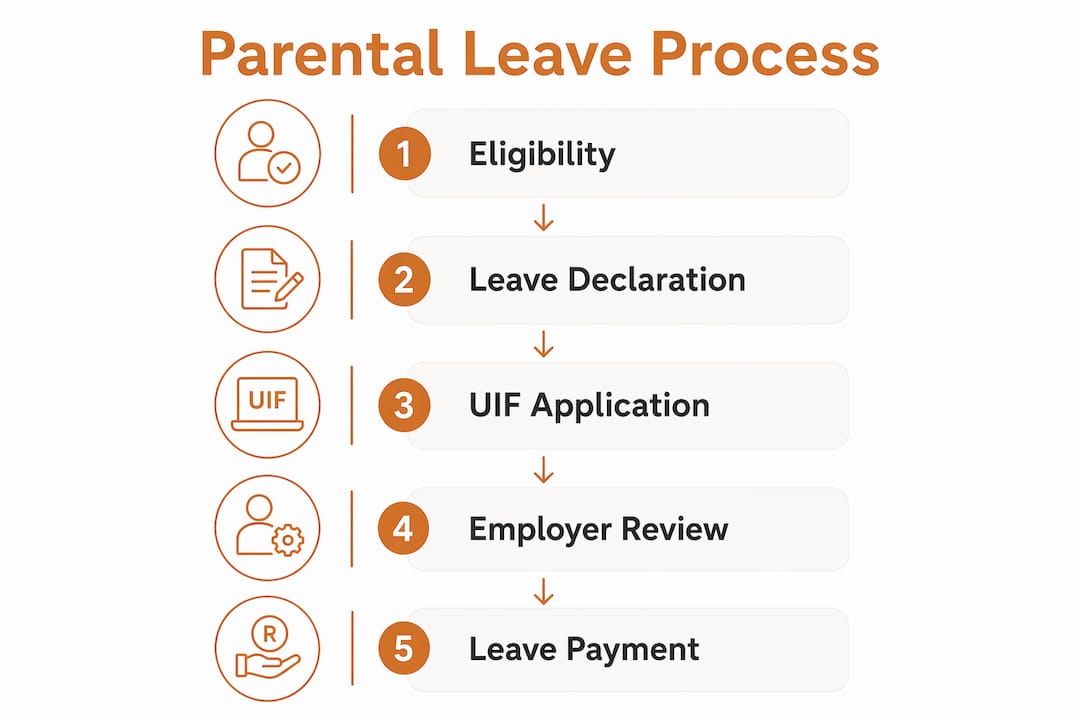
The allocation rules turn on employment status:
- Single employed parent: Receives the full parental leave entitlement.
- Both parents employed: Share a collective parental leave entitlement between them.
Parents can divide the leave concurrently (both taking leave at the same time), consecutively (one after the other), or in staged blocks. If parents cannot agree on the split, the default arrangement is as close to an equal division as possible. This default is a hidden operational risk: a birth parent who cannot reach agreement with a partner may end up with substantially less time than the historical four-month maternity entitlement. The mandatory six-week recovery period for the birth parent remains non-negotiable and cannot be waived without medical certification.
| Scenario | Total entitlement | How it splits |
|---|---|---|
| Single employed parent | Parental leave entitlement | Full allocation to that parent |
| Both employed, agreement reached | Parental leave entitlement | As agreed (concurrent, consecutive, or staged) |
| Both employed, no agreement | Parental leave entitlement | Default: as close to equal as possible |
| Adopting parent (one employed) | Parental leave entitlement | Full allocation to adopting parent |
| Commissioning parent (surrogacy) | Parental leave entitlement | Shared if both parents employed; full if one |

Pro Tip: Before leave starts, both parents should sign a written Shared Parental Leave Declaration Form specifying dates, blocks, and the employer of each parent. Include the other parent’s employer name and UIF reference number to prevent double-claim complications. HR teams should make this form a standard part of the leave-request process.
How parental leave is paid: UIF, employer top-ups, and claim steps
The BCEA sets the leave entitlement but does not require employers to pay employees during parental leave. The statutory minimum is unpaid leave. UIF is the primary income-replacement mechanism for eligible contributors, and understanding how to claim it is the most practical step most parents need to take.
Employers are not legally required to top up UIF payments, though many do as an employment benefit. Common arrangements include full paid leave (employer covers the gap between UIF and full salary), a partial top-up, or unpaid leave with UIF only. Your employment contract or company policy governs which applies to you.
Claiming UIF during parental leave: step by step
- Confirm UIF eligibility. You must have contributed to UIF for at least 13 weeks in the four years before your claim.
- Gather required documents. You will need your ID, a completed UI-2.7 form (maternity/parental leave claim), a UI-19 form from your employer confirming your leave dates and last salary, and a bank confirmation letter.
- Submit your claim. Claims can be submitted at a Department of Employment and Labour office or online via the filing portal. Submit as early as possible, ideally before leave starts.
- Await processing. UIF claims can take several weeks to process. Delays are common when documentation is incomplete or when both parents are claiming simultaneously from different employers.
- Receive payment. UIF pays a sliding-scale benefit based on your earnings, up to a statutory ceiling. Higher earners receive a lower replacement rate.
“Employers must support UIF claims by issuing accurate UI-19 forms promptly and must not request the other parent’s payslip without that parent’s written consent under POPIA.” — Department of Employment and Labour
When both parents work for different employers, each employer issues a UI-19 form for their own employee. The UIF reconciles the combined claim against the shared entitlement. Payroll teams should flag this scenario early to avoid overpayment or duplicate-claim rejections.
What employers must change now: policy, payroll, and process updates
The interim framework is in effect today. Employers who have not yet updated their policies are already exposed to discrimination claims. BDO’s employer guidance identifies immediate policy updates, gender-neutral language, and standardized Shared Parental Leave Declaration Forms as the three most urgent actions.
“The shift from gendered leave categories to a unified parental leave framework is a major compliance trap: outdated contract language and HR templates can expose employers to discrimination claims and must be updated urgently.” — BDO
Immediate employer action checklist:
- Audit all employment contracts, HR policies, and HRIS labels for references to “maternity leave,” “paternity leave,” “adoption leave,” and “commissioning parental leave” as separate categories.
- Consolidate into a single “Parental Leave” policy that reflects the four months and ten consecutive days entitlement and the shared-allocation rules.
- Introduce a Shared Parental Leave Declaration Form as a mandatory step in the leave-approval process.
- Update payroll and HRIS systems to track a single parental-leave pool per qualifying event, not separate gendered buckets.
- Revise notice requirements in contracts to align with the interim framework.
- Train line managers and HR business partners on the new allocation rules, the six-week recovery protection, and how to handle disputes between parents.
- Establish a POPIA-compliant verification workflow: you may request proof of the qualifying event (birth certificate, adoption order, surrogacy agreement) but cannot demand the other parent’s payslip or employment details without written consent.
The operational risk of inaction is significant. Employers who retain gendered leave language face potential discrimination claims under the Employment Equity Act, and payroll systems that cannot reconcile a shared leave pool across two employers create administrative exposure that compounds over time.
Special situations: miscarriage, stillbirth, adoption, surrogacy, and fixed recovery periods
Some parental circumstances carry specific legal protections that sit outside the general allocation rules.
Third-trimester miscarriage and stillbirth. Employees who experience a third-trimester miscarriage or a stillbirth are entitled to six weeks of parental leave, even if parental leave had already commenced. This protection is mandatory and cannot be reduced by employer policy or agreement.
“The mandatory six-week recovery period for the birthing parent remains non-negotiable under the BCEA and must be reflected as an automatic portion of parental leave in employer policies.” — The Conversation
Adoption. Adoptive parents qualify for the full parental leave entitlement under the interim framework. Proposed legislation has discussed extending adoption leave eligibility to children up to six years of age, but this remains subject to final parliamentary enactment. Until permanent legislation passes, the interim BCEA reading-in governs.
Surrogacy and commissioning parents. Commissioning parents in surrogacy arrangements qualify as parents under the Children’s Act and are entitled to parental leave on the same basis as biological or adoptive parents.
Documentation employers should request:
- Birth certificate or hospital confirmation (for biological parents).
- Adoption order from the Children’s Court (for adoptive parents).
- Confirmed surrogacy agreement and, where applicable, a court order confirming parentage (for commissioning parents).
- Medical certificate confirming a third-trimester miscarriage or stillbirth, where the six-week protection is invoked.
Pro Tip: Store all parental-leave documentation in a POPIA-compliant HR system with access restricted to authorized personnel. Never request documentation beyond what is needed to confirm the qualifying event, and never share one parent’s employer information with the other parent’s employer without explicit written consent from both parties.
Practical steps for international employers and when to consider an Employer of Record
International companies employing staff in South Africa face a compressed compliance window. The interim framework is in effect now, and the absence of finalized implementing legislation does not reduce employer obligations. It increases them, because grey areas require judgment calls that a local legal or HR partner is better positioned to make.
Immediate action checklist for international employers:
- Conduct a prompt policy audit: identify all leave-related language in contracts, handbooks, and HRIS.
- Confirm your payroll provider can track a single parental-leave pool and issue accurate UI-19 forms.
- Update HRIS labels and leave-type codes to reflect the unified parental leave category.
- Brief your South African HR contacts or line managers on the new allocation rules and dispute-handling process.
- Establish a template Shared Parental Leave Declaration Form and make it part of your standard onboarding and leave-request documentation.
When an Employer of Record makes sense
If you do not have a registered South African entity, or if your local HR capacity is limited, an Employer of Record (EOR) absorbs the compliance burden directly. The scenarios where an EOR is the faster and lower-risk route:
- You are hiring your first South African employee and have no local entity.
- Your payroll provider does not handle UIF, SDL, or COIDA filings natively.
- You need BCEA-compliant contracts updated to reflect the interim parental-leave framework within days, not months.
- You want POPIA-compliant document handling without building a local data-management process from scratch.
Expandtosouthafrica provides EOR services in South Africa that cover BCEA-compliant employment contracts, ZAR payroll with full statutory filings (PAYE, UIF, SDL, COIDA), and POPIA/GDPR-aligned data handling. For international employers evaluating the cost and complexity of in-house compliance versus an EOR, the employment cost calculator provides a transparent starting point.
| Approach | Speed to compliance | Local statutory expertise | Cost structure |
|---|---|---|---|
| In-house (with local entity) | Slower; requires legal review and system updates | Depends on internal team | Fixed overhead regardless of headcount |
| EOR partner | Fast; compliant contracts within 48 hours | Built-in local expertise | Per-employee monthly fee; no setup cost |
Key takeaways
South Africa’s unified parental leave framework, effective October 2025, gives parents a shared allocation of four months and ten consecutive days, with the birth parent’s six-week recovery period protected absolutely.
| Point | Details |
|---|---|
| Unified entitlement | Four months and ten consecutive days, shared when both parents are employed; full allocation for a single employed parent. |
| Six-week recovery | The birth parent cannot return to work within six weeks of delivery or a third-trimester loss without medical clearance. |
| UIF is the pay mechanism | The BCEA sets unpaid leave; UIF income replacement requires early claim submission with a UI-19 form from the employer. |
| Employer action required now | Update contracts, HRIS labels, and policies to gender-neutral parental leave language; introduce Shared Parental Leave Declaration Forms immediately. |
| Expandtosouthafrica | Provides BCEA-compliant contracts, UIF/PAYE/SDL/COIDA payroll filings, and POPIA-compliant document handling for international employers needing immediate South Africa compliance. |
The reform’s real risks: what most employers are getting wrong
The Van Wyk judgment is structurally sound policy. Collapsing gendered leave categories removes a long-standing inequity and, in principle, gives all parents equal standing. But the transition period is where the practical damage happens, and most employers are underestimating it.
The most common mistake is treating this as a terminology update. Changing “maternity leave” to “parental leave” in a policy document is not compliance. The underlying logic of payroll systems, leave-tracking tools, and manager approval workflows was built around gendered categories. A payroll system that still runs separate leave buckets for maternity and paternity will misreport leave balances, generate incorrect UI-19 forms, and create reconciliation problems when both parents work for different employers.
The second mistake is ignoring POPIA when trying to verify a partner’s leave. HR teams instinctively want to cross-check the other parent’s employer to prevent double-claiming. Requesting that information without written consent from both parties is a POPIA violation. The correct approach is a well-designed Declaration Form that each parent signs, disclosing their own employer details voluntarily.
The third, and most consequential, mistake is leaving the default sharing arrangement unaddressed. Without a written agreement, a birth parent can end up with roughly half the total entitlement. For a parent who expected four months, receiving two months is a significant and avoidable outcome. HR teams should proactively advise employees to formalize sharing agreements before leave starts, not after a dispute arises.
Parliament has until October 2028 to finalize permanent legislation. Until then, the grey areas are real, and the employers who navigate them best will be those who treat this as a systems and culture change, not a paperwork exercise.
Expandtosouthafrica handles South Africa parental-leave compliance for you
Keeping up with South Africa’s interim parental-leave framework while running payroll across time zones is a genuine operational challenge. Expandtosouthafrica is built for exactly this: international companies that need BCEA-compliant employment in South Africa without the overhead of a local entity.
Every employee on the platform is covered by a BCEA-compliant contract updated to reflect the unified parental-leave framework, ZAR payroll with full UIF, PAYE, SDL, and COIDA statutory filings, and POPIA/GDPR-aligned document handling for sensitive leave records. When a parental-leave event occurs, the payroll and UIF filing process is handled locally, with UI-19 forms issued accurately and on time.
The flat fee is €350 per employee per month, with no setup fees. Contracts are signed within 48 hours. For international employers who need to get compliant fast, the South Africa EOR service is the direct route. You can also review the full employer of record guide to understand exactly what is covered before you commit.
This article is general information, not legal advice. Confirm current rules with the Department of Employment and Labour or a qualified South African labor attorney for your specific situation.
Official sources and further reading
- Basic Guide to Maternity Leave — Department of Employment and Labour. The primary statutory reference for leave entitlements, timing, and the six-week return-to-work rule.
- Basic Guide to Family Responsibility Leave — Department of Employment and Labour. Covers the separate three-day paid family responsibility leave entitlement for qualifying events such as a child’s illness or a family member’s death.
- Van Wyk judgment FAQ — Bowmans. Detailed legal Q&A on the Constitutional Court ruling, the reading-in remedy, and employer obligations. Recommended for HR and legal teams.
- SA shift from maternity leave to unified parental leave — BDO. Employer-focused checklist covering policy updates, HRIS changes, and discrimination risk. Practical starting point for HR managers.
- South Africa’s new parental leave policy — The Conversation. Academic analysis of the policy’s equality rationale and its practical shortcomings, including the default-split risk for birth parents.
- End of an era for parental leave in South Africa — BusinessTech. News summary of the judgment’s immediate effect and the October 2028 legislative deadline.
- Parental leave: What all South African parents-to-be should know — SA People. Plain-language explainer for employees covering allocation rules, UIF basics, and the risks of the default sharing arrangement.
For complex or contested cases, consult a qualified South African labor attorney. The law is in a transitional state, and sector-specific determinations may apply.