

Garden leave is valid and enforceable under South African labor law when a written employment contract authorizes it, as the Johannesburg Labour Court confirmed in Vodacom v Motsa. The employee stays employed and paid throughout the notice period, but the employer can restrict duties, client contact, and system access. Practically, this means HR teams need a clear contractual clause and disciplined recordkeeping before they exclude anyone from active work.
TL;DR:
- Garden leave must be expressly included in the employment contract to be enforceable, and it cannot be used to bypass minimum BCEA notice periods or pay requirements.
- Courts will uphold garden leave clauses when the employer demonstrates a genuine proprietary interest and documents the decision to place the employee on leave with clear instructions.
- Combining garden leave with restraint of trade clauses requires careful assessment, as the total period of inactivity must be reasonable and directly related to protecting confidential information.
- Employers should implement operational protocols such as contract audits, documented instructions, and proper payroll adjustments to reduce disputes and litigation risks.
- Most legal issues arise from poorly drafted contracts, inconsistent access restrictions, and misapplied pay, emphasizing the importance of proactive compliance before employee resignation.
Table of Contents
- What garden leave is and how it fits into South African employment law
- Key case law: Vodacom v Motsa and what courts look for
- How garden leave interacts with restraint of trade clauses
- Employer implementation checklist: how to lawfully place someone on garden leave
- Employee rights and risks while on garden leave
- Typical durations, BCEA notice rules, and how courts assess reasonableness
- Implementation pitfalls and how to reduce litigation risk
- Publisher perspective: practical guidance for international employers hiring in South Africa
- How Expand to South Africa can help with garden leave compliance
- Sources
- FAQ
What garden leave is and how it fits into South African employment law
Garden leave is a contractual mechanism, not a statutory leave category. Nowhere does South African legislation define it or grant it automatically. An employer can only place an employee on garden leave if the employment contract expressly permits it, or if both parties agree to it at the point of departure.
This distinguishes garden leave sharply from annual leave, unpaid leave, or summary dismissal. Annual leave is a statutory entitlement the employee chooses to use. Unpaid leave suspends remuneration by agreement. Immediate termination ends the employment relationship outright. Garden leave does none of these: the employment relationship continues in full, remuneration continues in full, and the employee simply performs no active duties for a defined period, usually the notice period.
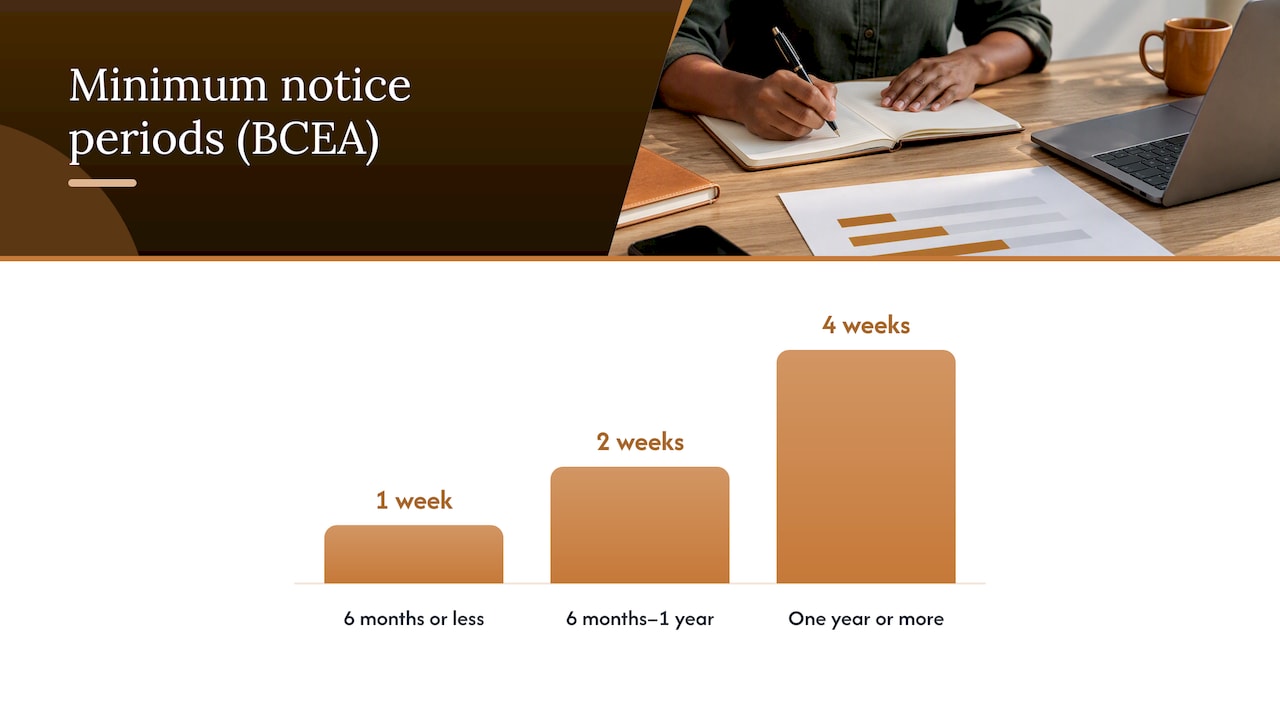
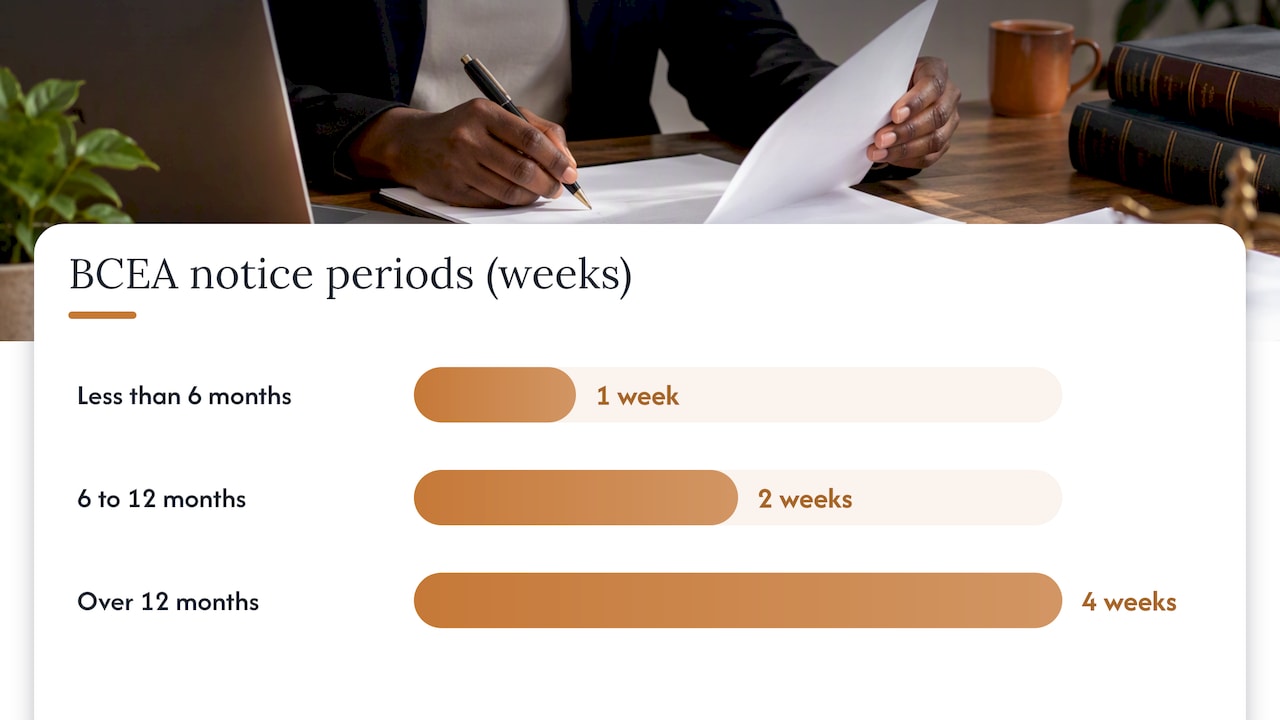
The Basic Conditions of Employment Act still governs the relationship throughout. Minimum notice periods under the BCEA run from one week for employment of six months or less, to two weeks for service between six months and one year, to four weeks for service of one year or more. An employer cannot use garden leave to sidestep these minimums, and pay during the notice period must match what the employee would have earned working normally, including benefits.
Because the BCEA is silent on garden leave itself, enforceability depends entirely on contract wording. Employers who want the option should build it into the employment agreement from the start rather than trying to impose it informally at exit.
- Garden leave keeps the employment relationship, pay, and benefits fully intact.
- Annual leave is the employee’s statutory choice, not an employer-imposed exclusion from duties.
- Unpaid leave and dismissal both interrupt or end remuneration, unlike garden leave.
- An express written clause is the only reliable basis for enforcing garden leave in South Africa.
For related payroll mechanics during notice, see how BCEA working hours rules apply to notice-period calculations.
Key case law: Vodacom v Motsa and what courts look for
The leading authority on garden leave in South Africa is Vodacom v Motsa, decided by the Johannesburg Labour Court in 2016. The employer sought to enforce a six-month garden leave period against a senior employee who had access to strategic and confidential business information, and the Court granted the order.
Garden leave “sterilizes” an employee’s access to confidential information during the notice period, allowing the employer to protect its proprietary interest without terminating the employment relationship.
The Court’s reasoning, drawn from Judge Van Niekerk’s judgment, treats garden leave as a legitimate protective tool distinct from a restraint of trade, but one that must still be assessed for proportionality against what the employer is genuinely trying to protect.
Several practical lessons follow for HR and legal teams drafting or enforcing these clauses:
- Courts will enforce garden leave when the contract grants the right and the employer can show a genuine proprietary interest.
- The judgment considered garden leave alongside a post-termination restraint, signaling that courts view combined periods of inactivity as one package.
- Employers should document the specific decision to invoke garden leave, including dates, instructions given, and the business reason.
- Evidence of the employee’s actual access to sensitive information matters more than job title alone.
The PELJ analysis of this case notes that peer-reviewed commentary treats garden leave and restraint clauses as a single commercial-inactivity package for fairness purposes, a theme that shapes how courts weigh stacked protections in later disputes.
How garden leave interacts with restraint of trade clauses
South African courts do not assess a restraint of trade clause in isolation. When an employee has already served garden leave, the court looks at the total period of commercial inactivity, garden leave plus any post-termination restraint, and asks whether that combined length is reasonable given the employer’s actual proprietary interest.
This creates real risk for employers who stack protections without thinking it through. A six-month garden leave period followed by a six-month restraint might be justified for an executive with access to strategic pricing and client data, as it was in Vodacom v Motsa. The same combination applied to a mid-level employee with limited access to sensitive information invites a court to reduce or strike the restraint entirely. The PELJ commentary is direct on this point: a restraint will only be enforced if it protects something garden leave has not already protected.
Drafting patterns that reduce this risk include:
- Cap garden leave at “up to” a stated maximum rather than a fixed term, giving flexibility to shorten it.
- Include a waiver or commutation clause allowing the employer to pay out and release the employee early.
- Limit the scope of any accompanying restraint to the specific market, clients, or technology the employee actually touched.
Pro Tip: Before enforcing both garden leave and a restraint, write down exactly what proprietary interest each one protects; if you cannot separate the two, a court may decide you only needed one.
Both measures can still stand together when the employee held genuinely sensitive strategic knowledge and the employer can point to specific, provable harm from early competition. Vague concerns about “competitive advantage” will not carry that weight.
Employer implementation checklist: how to lawfully place someone on garden leave
Getting garden leave right is largely an operational discipline. Employers who treat it as a formality, rather than a documented process, are the ones who end up in front of the Labour Court explaining gaps in their own paperwork.
- Confirm the employment contract contains an express garden leave clause before doing anything else.
- Check the applicable notice period against the BCEA minimums and the employee’s length of service.
- Issue a clear, dated written instruction electing garden leave, stating the start date, duration, and expectations.
- Set out duties, availability requirements, confidentiality obligations, and client-contact limits in that same instruction.
- Adjust IT and building access consistently with the clause, and record exactly what was changed and when.
- Continue full pay and contractual benefits for the duration, calculated correctly against BCEA remuneration rules.
- Settle any accrued annual leave separately, since garden leave is not a substitute for statutory leave pay.
- Document handover instructions and preserve records that support your proprietary interest, in case of later dispute.
- Consider a negotiated early release or payment in lieu where litigation risk outweighs the benefit of enforcing the full term.
| Step | Primary risk if skipped | Who owns it |
|---|---|---|
| Contract audit | Clause unenforceable, employee can refuse | HR/legal |
| Written election notice | No evidence of employer’s decision or date | HR |
| Access and duties instructions | Ambiguity leads to disputes over conduct | IT/line manager |
| Continued pay and benefits | BCEA remuneration claim | Payroll |
| Handover and evidence documentation | Weak proprietary interest case in court | HR/legal |
Employers drafting these clauses for the first time should review essential employment contract clauses for wording that supports enforceability from the outset, and confirm payroll treatment against South African payslip requirements.
Employee rights and risks while on garden leave
An employee on garden leave remains employed in every legal sense. Salary, benefits, and any contractual perks continue exactly as if the employee were working, and the employer cannot use garden leave to reduce pay or delay it.
In exchange, most contracts impose real restrictions: no contact with clients, continued confidentiality obligations, and often a bar on starting new employment until the garden leave period ends. Courts generally enforce these restrictions where the contract states them clearly, particularly when tied to a demonstrable proprietary interest as in Vodacom v Motsa.
Problems arise when employers act inconsistently, withholding pay, changing duties without notice, or extending the period beyond what the contract allows. An employee facing this kind of treatment may have grounds for a claim, including constructive dismissal if the employer’s conduct becomes intolerable, or a claim for unpaid remuneration.
- Request written confirmation of the garden leave terms, including start date, duration, and pay arrangements.
- Keep personal records of instructions received and any changes to access or duties.
- Continue to comply with confidentiality and non-compete terms unless formally released.
- Seek legal advice promptly if the employer withholds pay or acts outside the contract’s terms.
For context on how statutory leave differs from this arrangement, see sick leave entitlements under the BCEA, and on annual leave payout mechanics, see annual leave rules in South Africa.
Typical durations, BCEA notice rules, and how courts assess reasonableness
Garden leave usually operates within the notice period the BCEA already requires, one week, two weeks, or four weeks depending on length of service, rather than as an additional period tacked on top. For senior employees, contracts commonly extend notice itself to several months, and garden leave then runs for that longer contractual term.
In Vodacom v Motsa, the Labour Court upheld six months of garden leave stacked with a six-month post-termination restraint, based on the employee’s access to highly sensitive strategic information.
Courts weigh several factors when deciding whether a garden leave period, or a combined garden leave and restraint period, is reasonable:
- Seniority and the degree of access the employee actually had to confidential or strategic information.
- The realistic commercial harm the employer would suffer if the employee moved to a competitor immediately.
- The hardship the period places on the employee’s ability to earn a living.
- Any broader public interest, such as competition in a specialized market.
A junior employee with no meaningful access to sensitive data is unlikely to face an extended garden leave period upheld by a court, regardless of what the contract says.
Implementation pitfalls and how to reduce litigation risk
Most garden leave disputes trace back to avoidable HR mistakes rather than genuinely difficult legal questions. The clause was never written into the contract in the first place. Garden leave gets confused with annual leave on the payslip, creating a paper trail that contradicts the employer’s own position. IT access gets revoked inconsistently, sometimes immediately and sometimes days later, undermining the claim that the employer was protecting anything urgently. Pay calculations miss benefits the employee was contractually entitled to.
The fixes are straightforward operational habits:
- Audit every senior employment contract now, before a departure forces the question.
- Use one standard written election template for every garden leave instance, dated and signed.
- Apply the same access-change checklist every time, regardless of who is leaving.
- Keep payroll instructions separate and explicit so garden leave pay is never mistaken for leave payout.
Pro Tip: Where the facts are close and the employee is cooperative, a negotiated commutation or early release usually costs less than a contested Labour Court application.
Litigation makes sense when the proprietary interest is real and provable. Negotiation makes sense in almost every other case.
Publisher perspective: practical guidance for international employers hiring in South Africa
International employers often assume garden leave works the same way it does at home. It does not. South African courts test it against the actual contract wording and the employer’s proven proprietary interest, not against convention, which is exactly why Vodacom v Motsa keeps coming up in every serious HR conversation about departures.
The pattern we see most often is a contract silent on garden leave, discovered only when a senior employee resigns and the employer wants them out of the building immediately. That gap is entirely preventable with a proper contract audit before hiring even starts. Getting the notice, pay, and access provisions right from day one, alongside correct PAYE, UIF, and SDL handling, saves far more trouble than trying to fix it during an exit.
— Roel
How Expand to South Africa can help with garden leave compliance
Handling garden leave correctly means getting the underlying employment contract, notice provisions, and payroll right from the start, not scrambling when someone resigns. Expand to South Africa builds BCEA-compliant contracts, runs ZAR payroll, and manages the statutory filings that keep a garden leave period defensible if it ever reaches a court.

Our service covers:
- BCEA-compliant employment contracts with garden leave and restraint wording drafted correctly from day one.
- ZAR payroll with accurate PAYE (EMP201) filing, UIF, SDL, and COIDA handled monthly.
- Contract audits that catch missing clauses before they become a departure-day problem.
- Signed contracts within 48 hours and full onboarding within days.
Pricing is a flat $399 per employee per month, with no setup fees or currency loading, so you know your total employment cost before you hire. If you are bringing on senior South African staff and want the contract terms right the first time, get in touch through our Employer of Record services page.
Sources
- Vodacom v Motsa (Johannesburg Labour Court, 2016) — SAFLII
- Basic Conditions of Employment Act No. 75 of 1997 (South Africa)
- The relationship between restraints of trade and garden leave (PER / PELJ, 2017) — Scielo
FAQ
What are the rules around gardening leave in South Africa?
Gardening leave is governed by contract, not statute: an employer can only impose it if the employment agreement expressly allows it. The employee stays employed and paid, and BCEA notice and remuneration rules apply throughout.
Is garden leave legal in the United States?
This article addresses South African labor law, where garden leave is a contractual arrangement enforced through the Labour Court when the employment contract permits it. Employers evaluating garden leave for other jurisdictions should check the specific labor law that applies there.
How long does garden leave usually last?
Garden leave typically runs for the length of the applicable notice period, which for senior employees may extend to several months under the contract. In Vodacom v Motsa, the Labour Court upheld a six-month garden leave period for a senior employee with access to strategic information.
What does it mean to be placed on garden leave?
Being placed on garden leave means the employee remains formally employed and fully paid but performs no active duties, often with client contact and system access restricted. The arrangement continues until the notice period ends or the employer releases the employee early.
Can an employer stack garden leave with a restraint of trade clause?
Yes, but South African courts assess the combined period of commercial inactivity for reasonableness rather than treating each measure separately. The PELJ analysis notes that a restraint is enforced only when it protects something garden leave has not already covered.