

Yes. If your business is registered for PAYE and stays tax compliant, you can reduce your monthly PAYE liability by up to R1,500 per qualifying employee for the first 12 months, and R750 for months 13 through 24, as long as remuneration stays below R7,500 a month. You claim it through your EMP201, not as a separate application. Before your next submission, check each employee’s age, ID or permit status, and monthly remuneration band, and flag their qualifying months in payroll so the claim is accurate the first time.
TL;DR:
- Employers must update payroll systems to apply the new SARS ETI formulas based on the R2,500 reference point and R7,500 cap to avoid underclaiming or penalties.
- Only employees aged 18-29 earning under R7,500 monthly qualify, unless working in a Special Economic Zone where age restrictions do not apply.
- Accurate recording of each employee’s eligibility, hours worked, and months qualifies is critical, especially for part-time staff requiring gross-up calculations before claiming.
- Using a dedicated payroll process or outsourced Employer of Record service helps ensure timely, compliant ETI claims and reduces the risk of costly SARS penalties.
Table of Contents
- What Is ETI in South Africa and What Changed on April 1, 2026?
- What Is ETI and Why Do Employers Use It?
- Who Qualifies for ETI in South Africa?
- How Do You Calculate the Monthly ETI Amount?
- How Do You Claim ETI Through EMP201, and What Are the Penalties?
- What Should Your Monthly Payroll Checklist Look Like?
- How Does an SA-Only EOR Reduce ETI Compliance Risk?
- What Employers Should Prioritize Before the Next Filing Cycle
- A Simpler Way to Stay ETI-Compliant Without an In-House Payroll Team
- Sources
- FAQ
What Is ETI in South Africa and What Changed on April 1, 2026?
The Employment Tax Incentive got a formula update on April 1, 2025, and if your payroll system still runs the old bands, you are either underclaiming or risking a rejected EMP201. The revised structure uses a R2,500 reference point and keeps the R7,500 remuneration cap, but the math connecting the two shifted.
Between R2,500 and R5,499.99, the incentive holds flat at R1,500 for the first 12 months and R750 for months 13 to 24. Above R5,500, the incentive tapers down on a sliding scale until it hits zero at R7,500.

These changes came through a SARS legislative notice, which means payroll teams should treat the current bands as the operative rule for now, but keep an eye on future budget announcements that could shift them again. Before your first EMP201 submission under the new bands, run a handful of test payslips through your payroll system and confirm the output matches the SARS calculation tables. A mismatch caught in testing costs you an afternoon. A mismatch caught by SARS costs you a penalty.
What Is ETI and Why Do Employers Use It?
The Employment Tax Incentive exists to make it cheaper to hire young, inexperienced workers by cutting the PAYE an employer owes for each qualifying employee. SARS introduced it in 2014, and it is scheduled to run until February 28, 2029, unless Parliament extends it before then.
For employers, the appeal is immediate cash flow rather than a delayed tax credit. ETI reduces the amount of PAYE you hand over on your EMP201 the same month you claim it. That is different from a rebate you wait a year to see. If your PAYE bill in a given month is smaller than your accumulated ETI, the excess does not vanish. It gets ring-fenced and can be refunded at the SARS reconciliation periods at the end of August and February, provided you remain tax compliant.
This mechanism matters most for businesses that carry a lean payroll and feel every rand of monthly overhead. A small or growing company hiring its first few junior developers, retail assistants, or admin staff can shave a meaningful slice off its PAYE bill simply by tracking eligibility correctly. It rewards you for the hiring you were already planning to do, not for restructuring your business around the incentive.
Who Qualifies for ETI in South Africa?
Two separate checklists apply here, one for the employer and one for each employee, and both have to pass before you claim a cent.
On the employer side, you must be registered for PAYE and remain tax compliant. National, provincial, and local government entities are excluded, along with municipal entities, and any employer SARS has disqualified for previous non-compliance.
On the employee side, the qualifying conditions are more granular:
- The employee must be between 18 and 29 years old, unless they work for an employer operating in a Special Economic Zone, in which case the age limit falls away.
- They need a valid South African ID, or a valid asylum or refugee permit.
- They cannot be a domestic worker employed in a private household.
- They cannot be a “connected person” to the employer, such as a close relative of the business owner or a major shareholder.
- They must have been employed on or after October 1, 2013.
- Monthly remuneration must sit below the R7,500 cap, with a R2,500 reference point used to determine which calculation band applies.
Remuneration checks get trickier for part-time staff. If an employee worked fewer than 160 hours in a month, SARS requires you to gross up their pay to a full 160-hour equivalent to figure out which band they fall into, then gross the incentive back down proportionally. Skip that step and you will either overclaim or underclaim without realizing it.
How Do You Calculate the Monthly ETI Amount?
The calculation runs off two variables: which 12-month period the employee falls into, and which remuneration band they sit in. Here is how the bands break down under the rules effective April 1, 2025:
| Monthly remuneration | Year 1 formula (months 1–12) | Year 2 formula (months 13–24) |
|---|---|---|
| Below R2,500 | 60% of remuneration | 30% of remuneration |
| R2,500 to R5,499 | R1,500 flat | R750 flat |
| R5,500 to below R7,500 | Sliding scale down to zero | Sliding scale down to zero |
| R7,500 and above | Zero, not eligible | Zero, not eligible |
Three examples make this concrete:
- Employee earning R2,000/month: Falls in the first band. Year one ETI is 60% of R2,000, or R1,200/month. Year two drops to 30%, or R600/month.
- Employee earning R4,000/month: Falls in the flat band. Year one ETI is R1,500/month, the maximum available. Year two is R750/month.
- Employee earning R6,500/month: Falls in the sliding scale band, where the incentive reduces as remuneration climbs toward R7,500. The exact figure comes from the SARS formula for that band, but it lands well below the R1,500 ceiling.
Qualifying months are not the same as calendar months on the job. SARS counts a month as qualifying only when the employee met every eligibility test that month, and a gap in employment does not reset the 24-month clock, it just means you need accurate records of exactly which months counted. For any employee who worked under 160 hours in a given month, remember the gross-up step before applying the band formula. Get that wrong and the error compounds every month it goes unnoticed.
How Do You Claim ETI Through EMP201, and What Are the Penalties?
You do not file a separate ETI application. You claim it directly on your monthly EMP201, where it reduces the PAYE amount you pay over to SARS.
- Calculate ETI for each qualifying employee using the current band formulas, factoring in gross-up adjustments for part-time months.
- Deduct the total ETI from your PAYE liability on the EMP201 before submission.
- Track any excess ETI that exceeds your PAYE liability in a given month. That excess is ring-fenced rather than lost.
- Reconcile at the end of August and February, the two periods when SARS assesses whether ring-fenced ETI can be refunded.
- Confirm tax compliance status before reconciliation, since refunds only go out to employers who remain compliant. Non-compliant employers forfeit the ring-fenced amount.
The penalty side deserves close attention. SARS can impose a 100% penalty on the value of any ETI claimed improperly, which effectively doubles the cost of a careless mistake. Separately, if SARS determines that an employer displaced an existing employee specifically to claim ETI on a replacement, the penalty is R30,000 per displaced worker. Standard under-statement penalties under the Tax Administration Act can also apply on top of these, depending on the circumstances.
Pro Tip: Run your ETI reconciliation as a standalone review, not a side task during your EMP501 filing. Pulling qualifying-month records and remuneration bands into a separate check two weeks before the August or February deadline gives you time to fix errors before they become penalty triggers.
What Should Your Monthly Payroll Checklist Look Like?
A reliable ETI process is less about knowing the formulas and more about running the same checks every single cycle without skipping a step when things get busy.
At onboarding, verify each new hire’s ID or permit, confirm their start date, and log their contracted hours. Document your connected-person check explicitly, even when the answer is obviously no, because that record is what protects you in an audit.
In your payroll configuration, build the current remuneration bands into your system, automate the gross-up and gross-down logic for part-time months, and flag each employee’s qualifying-month count so nobody has to reconstruct it manually at reconciliation time; consider partnering with T-Ledgers payroll services to streamline these tasks efficiently.
- Confirm employee eligibility (age, ID, remuneration) before the first ETI claim on a new hire.
- Test payroll outputs against the SARS calculation tables whenever bands or formulas change.
- Ring-fence any unclaimed ETI monthly, rather than discovering the total at reconciliation.
- Reconcile EMP201 submissions against IRP5 and IT3(a) records at each period close.
Pro Tip: The most common ETI errors are not exotic. Incorrect gross-up for part-time months, unflagged connected persons, and unclaimed ETI that never gets ring-fenced are the three patterns that draw SARS scrutiny most often. Building all three into a monthly checklist catches most of the risk before it becomes a problem.
How Does an SA-Only EOR Reduce ETI Compliance Risk?
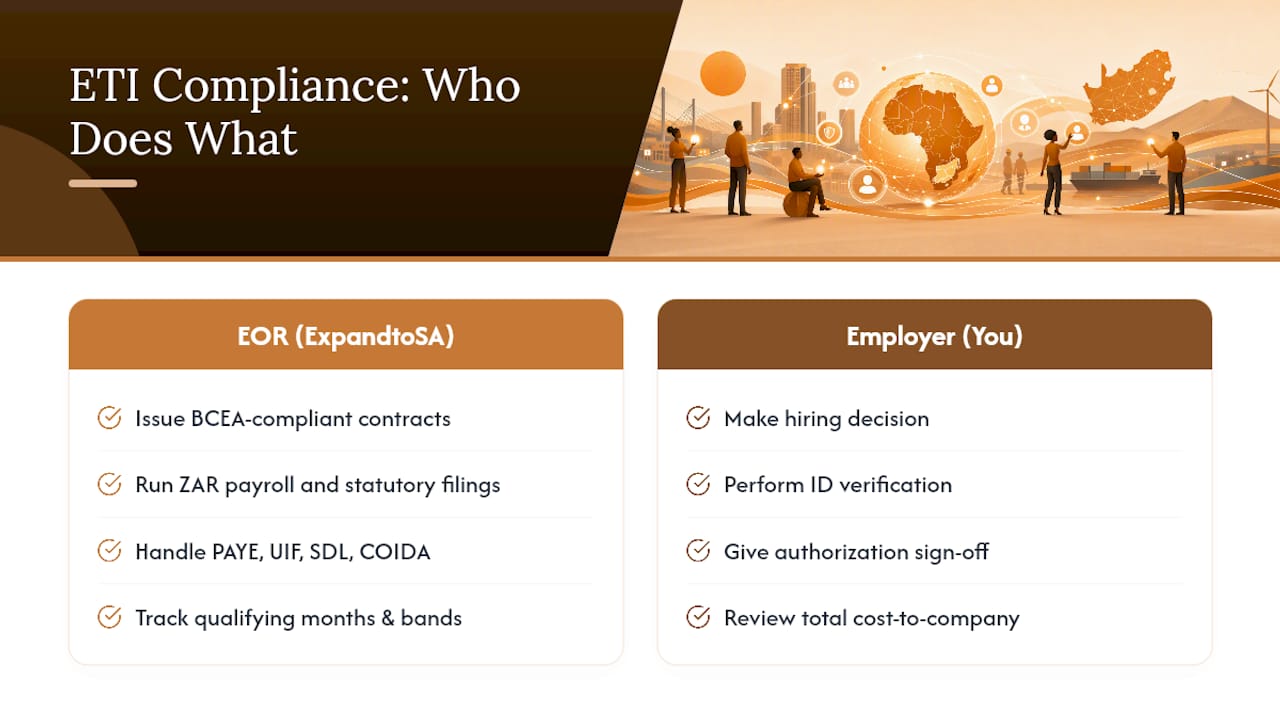
International employers hiring their first South African staff often underestimate how much operational tracking ETI demands. Expandtosouthafrica handles this as part of its Employer of Record service, issuing BCEA-compliant contracts and running local ZAR payroll with the statutory filings, PAYE, UIF, SDL, and COIDA, built into the same process.
For a business with no local finance team, the practical benefit is that qualifying-month tracking, band calculations, and EMP201 submissions happen inside a system already built for South African payroll law, rather than being bolted onto a foreign payroll platform after the fact. Ring-fencing excess ETI and reconciling it at the August and February periods is a routine task for a local specialist and a genuine risk point for a company managing it remotely for the first time. Data handling runs under POPIA and GDPR with EU data residency, which matters if your compliance team is asking questions about where employee records live.
What stays with you as the employer is the hiring decision itself, along with identity verification and authorization sign-off. The total cost to company picture, including ETI’s effect on your PAYE line, is something worth reviewing before your first South African hire starts.
What Employers Should Prioritize Before the Next Filing Cycle
ETI rewards employers who treat it as a payroll discipline rather than an annual afterthought. The businesses that benefit most are the ones hiring young, entry-level staff anyway and simply making sure their payroll system captures every eligible rand instead of leaving it on the table.
My priority list for 2026 is short: update your payroll rules for the April 2025 bands if you have not already, run test payslips against the SARS tables before you trust the output, and treat the August and February reconciliation dates as fixed deadlines, not flexible ones. With the program running until 2029, there is time to build a solid process, but no guarantee the current formulas last that long. Watch SARS notices the way you watch any other tax deadline.
— Roel
A Simpler Way to Stay ETI-Compliant Without an In-House Payroll Team
If your company has no South African entity and no local finance staff, chasing SARS band updates and EMP201 deadlines from another time zone is a real drain on attention. Some Employer of Record services offer a flat monthly fee per employee covering local payroll, PAYE, UIF, SDL, COIDA filings, and compliant contracts through licensed local partners.

The EOR services plan handles ETI tracking and EMP201 submission as part of standard payroll operations, so qualifying months and reconciliation deadlines do not depend on someone remembering to check a spreadsheet. You still make the hiring calls and sign off on identity checks. Expandtosouthafrica manages the filings and statutory mechanics underneath them. Contracts typically get signed within 48 hours, with onboarding wrapped up in days. If you are planning your first South African hire or want to see how the flat fee compares to what you are paying now, check the pricing and service details to get a quote for your specific headcount.
FAQ
Who Qualifies for ETI in South Africa?
Employees between 18 and 29 with a valid South African ID or asylum/refugee permit, earning under R7,500 a month, hired on or after October 1, 2013. The employer must be PAYE-registered and tax compliant, and the age limit does not apply to employees working in a Special Economic Zone.
What Is ETI and How Does It Work?
ETI is a SARS incentive that lowers the PAYE an employer pays over each month for qualifying employees, claimed directly through the EMP201. It runs for a maximum of 24 months per employee, split into two 12-month bands with different formulas.
How Do I Calculate My ETI Remuneration?
You apply the current band formula to the employee’s monthly remuneration, using R2,500 and R7,500 as the key thresholds. For part-time employees working under 160 hours in a month, you must gross up remuneration to a 160-hour equivalent first, then gross the resulting incentive back down proportionally.
What Is ETI on a Payslip?
It refers to the Employment Tax Incentive amount deducted from the employer’s PAYE liability for a qualifying employee that month, not an amount paid directly to the employee. It reduces what the employer owes SARS rather than changing the employee’s take-home pay.