

A disciplinary hearing in South Africa is the employer-run process used to decide whether an employee committed alleged misconduct and, if so, what sanction fits. Your essential rights include a clear charge, adequate notice, disclosure of evidence against you, and a genuine opportunity to respond, all grounded in the Labour Relations Act and its Code. If you are facing or chairing one, check the applicable notice period, preserve every document, and remember that an unfair dismissal referral to the CCMA must happen within the stipulated legal timeframe.
TL;DR:
- Proper notice periods for a disciplinary hearing vary, with many policies requiring five to ten working days instead of the minimum 48 hours recommended by the CCMA.
- Employers must disclose evidence early and keep detailed records to prevent disputes, as incomplete documentation often results in losses at the CCMA or Labour Court.
- The hearing process follows a predictable sequence, and employees should request and review the charge sheet and evidence bundle before the hearing to prepare effectively.
- Sanctions range from warnings to dismissal, and the final decision should consider both the conduct’s seriousness and the employee’s disciplinary history.
- Procedural flaws like vague charges, late evidence, or chair bias are common reasons for successful CCMA challenges, making meticulous process adherence essential for all parties.
Table of Contents
- The legal framework behind South African disciplinary hearings
- Who attends a disciplinary hearing and what each person does
- What has to happen before the hearing starts
- How a disciplinary hearing actually unfolds
- What sanctions can follow a disciplinary hearing
- Procedural mistakes that most often lead to disputes
- What happens after the hearing ends
- A practical checklist for anyone involved in a disciplinary hearing
- Why procedure and record-keeping matter more than most employers expect
- Build a compliant hiring process before you need a disciplinary hearing
- Sources
- FAQ
The legal framework behind South African disciplinary hearings
The Labour Relations Act (LRA) and its Schedule 8, known as the Code of Good Practice: Dismissal, set the baseline obligations every employer must meet before dismissing someone for misconduct. The Code requires an investigation, proper notice, a genuine opportunity for the employee to state their case, and written reasons for the outcome. A CCMA commissioner or arbitrator must weigh these requirements against whatever workplace procedure, policy, or collective agreement applies at that specific employer, since internal rules can add detail the Code does not specify. Many companies set out their own disciplinary steps inside the employment contract, and those terms matter once a dispute reaches the CCMA.
Two separate questions decide whether a dismissal holds up: was there a fair reason (substantive fairness), and was a fair process followed to reach that decision (procedural fairness). A chair can get the sanction right and still lose the case on process, or vice versa.
- Substantive fairness asks whether the misconduct actually happened and whether dismissal was a reasonable response to it.
- Procedural fairness asks whether the employee had proper notice, disclosure, and a chance to respond before the decision was made.
- Inquiry by arbitrator is an alternative route where both parties agree to let a CCMA-appointed arbitrator run the hearing directly, producing a binding award rather than an internal decision subject to appeal.
Who attends a disciplinary hearing and what each person does
A fair hearing depends on clear roles. The chairperson must be impartial, meaning they should have no prior involvement in the investigation or decision to charge the employee, and their job is to run the hearing, weigh the evidence, and decide on the outcome.
- Chairperson: runs proceedings, rules on procedure, and reaches the final finding and sanction.
- Case presenter: represents the employer’s side, presents the charges, calls witnesses, and leads evidence.
- Employee: responds to the charges, cross-examines witnesses, and presents their own case.
- Representative: typically a fellow employee or union representative; formal legal representation is generally not automatic and depends on the workplace policy or the complexity of the case.
- Witnesses and interpreter: witnesses give firsthand evidence under questioning, and an interpreter is provided when language could prevent the employee from understanding or participating fully.
What has to happen before the hearing starts
Correct pre-hearing procedure protects both sides, and most CCMA disputes trace back to failures here. The CCMA’s guidance on disciplinary procedures recommends giving the employee not less than 48 hours’ notice of an inquiry, but that figure is a floor, not a fixed rule: many workplace policies, contracts, and collective agreements require five to ten working days instead, so check the applicable instrument before assuming 48 hours is enough.
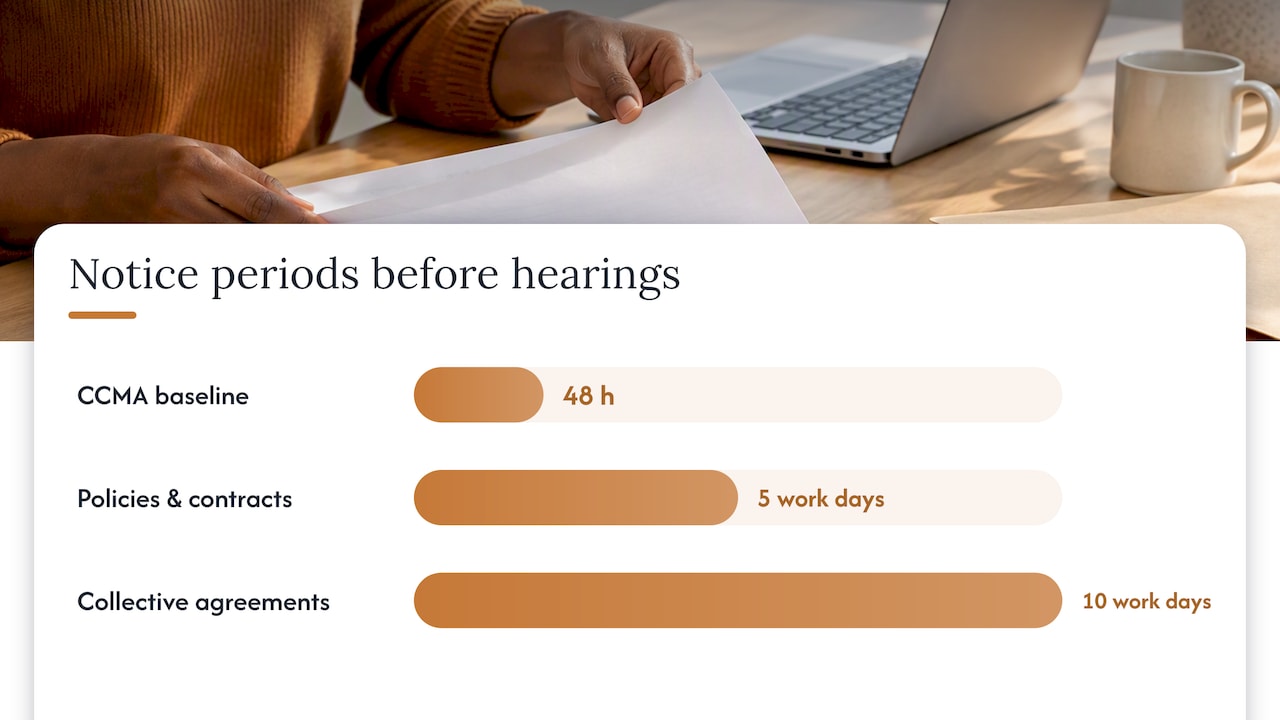
Statistic callout: no fixed minimum universally applies. The CCMA states an enquiry should happen as soon as reasonably possible, with not less than 48 hours’ notice as the baseline, while acknowledging that workplace instruments can lawfully extend that period. Treating 48 hours as a nationwide standard is a common and costly misreading.
The notice itself should include:
- Date, time, and venue of the hearing, given with enough lead time to prepare.
- The charges, written in enough factual detail that the employee understands what they are accused of and can answer it.
- Representation rights, stating who may accompany or represent the employee.
- The evidence bundle, disclosed early enough for the employee to review it before the hearing, with employers expected to share documents and witness statements they intend to rely on.
Where allegations are serious enough to justify it, employers may suspend the employee on full pay as a precaution while the investigation continues, but this is a holding measure, not a sanction, and should not be indefinite.
How a disciplinary hearing actually unfolds
The hearing itself follows a predictable sequence, and knowing it in advance removes most of the anxiety for employees and most of the risk for employers.
- The chair opens proceedings, introduces everyone present, and reads out the charges.
- The employee pleads to each charge, admitting or denying it.
- The case presenter leads evidence and calls witnesses to support the charges.
- The employee, or their representative, cross-examines each witness.
- The employee presents their own evidence and witnesses in response.
- The case presenter may re-examine, and both sides make closing arguments.
- If there is a finding of guilt, the employee is given a chance to present mitigation before any sanction is decided.
- The chair records written reasons for the finding and sanction, then communicates the outcome.
Pro Tip: Ask for the charge sheet and evidence bundle in writing before the hearing date, and keep a copy regardless of the outcome; it is the single most useful document if the case ever reaches the CCMA.
Mitigation matters more than many employees realize. Length of service, a clean disciplinary record, personal circumstances, and genuine remorse can all shift a sanction away from dismissal, which is why skipping this stage, or rushing through it, is one of the more common chair errors.

What sanctions can follow a disciplinary hearing
Outcomes range widely, and there is no fixed hierarchy that every employer must climb through. According to CCMA guidance, the commonly requested outcomes are no finding, counselling or corrective action, a verbal or written warning, a final written warning, and dismissal, with some workplace codes adding suspension without pay or demotion.
- Counselling or corrective action for minor, first-time issues.
- Verbal or written warning, the standard response to less serious misconduct.
- Final written warning, used for repeated or more serious conduct.
- Suspension without pay or demotion, where the workplace policy provides for it.
- Dismissal, reserved for serious misconduct or conduct that makes continued employment untenable.
There is no legally fixed number of warnings an employee must receive before dismissal becomes fair, and a sufficiently serious first offense can justify dismissal outright. The chair’s written reasons should explain how the evidence led to the finding and why that particular sanction fits the seriousness of the conduct, the employee’s record, and whether continuing the employment relationship remains workable. If dismissal results, employers also need to calculate any severance obligations correctly, since this is a separate calculation from the disciplinary outcome itself.
Procedural mistakes that most often lead to disputes
Certain errors show up again and again in CCMA referrals, and most of them are avoidable with basic discipline around process.
- Vague or ambush charges: an employee does not need a technically perfect charge sheet, but they must receive enough factual information to understand and meaningfully answer the case against them.
- Late evidence or refused postponements: introducing new evidence during the hearing without giving the employee a chance to respond, or refusing a reasonable postponement request, undermines the fairness of the process.
- Chair bias: a chairperson who investigated the case, made the decision to charge, or has a personal stake in the outcome compromises the impartiality the process requires.
- Incomplete records: failing to keep the notice, charge sheet, evidence, minutes, or outcome letter leaves the employer with little to show if the fairness of the hearing is challenged later.
Pro Tip: If you are an employee and evidence is withheld or disclosed late, say so on the record during the hearing itself; a documented objection carries far more weight at the CCMA than a complaint raised for the first time after the fact.
These defects matter because arbitrators and the Labour Court assess fairness against the full record, and gaps in that record tend to be read against the party who should have kept it, usually the employer.
What happens after the hearing ends
Once the chair communicates the outcome, the clock starts running on several possible next steps. Many workplace policies allow an internal appeal, typically lodged in writing within a set number of days, where a more senior manager reviews the chair’s decision.
- Internal appeal: check the workplace policy for the format and deadline, since these vary by employer.
- CCMA referral: an unfair dismissal dispute must be referred to the CCMA within 30 days of the dismissal, and missing this window can bar the claim.
- Arbitration versus review: the CCMA arbitrates the fairness of the dismissal itself, while a review challenges the arbitrator’s decision in the Labour Court on narrower legal grounds.
- Inquiry by arbitrator: where both parties previously agreed to this route, the CCMA-appointed arbitrator’s award is typically issued within 14 days and is final and binding, subject only to review by the Labour Court rather than a fresh arbitration.
- Remedies: successful claims commonly result in reinstatement, re-employment, or compensation, depending on what the circumstances support. For a fuller walkthrough of what happens once a dismissal is contested, see our guide on CCMA unfair dismissal timelines.
A practical checklist for anyone involved in a disciplinary hearing
Whether you are the employee facing charges or the employer running the process, the same discipline around evidence protects you if things end up in dispute.
- Save every document: the notice, charge sheet, evidence bundle, hearing minutes, and outcome letter, from day one.
- Request disclosure in writing: ask for the evidence bundle and witness statements before the hearing, and keep that request on record.
- Log every refusal or delay: if disclosure is withheld or a postponement is denied, note the date and reason in writing.
- Prepare mitigation early: employees should gather service records and supporting evidence; employers should document the investigation thoroughly.
- Know when to escalate: consult a labour lawyer or union representative if the charges are serious, the process feels irregular, or dismissal is a realistic outcome, and bring your full paper trail to the CCMA if you refer a dispute.
Pro Tip: A complete, dated paper trail is usually worth more than a strong argument; most disciplinary disputes are won or lost on the record, not on eloquence.
Why procedure and record-keeping matter more than most employers expect
Having worked through how South African disciplinary law applies to employers hiring across borders, the pattern is consistent: companies rarely lose CCMA disputes because the misconduct was unclear. They lose because the paper trail was incomplete, the notice period did not match their own policy, or the chair was not independent enough. International employers hiring South African staff without local HR support face this risk more acutely, since they are applying unfamiliar procedure under time pressure. Thorough, contemporaneous records protect employees from unfair outcomes and protect employers from costly reversals at the CCMA or Labour Court. Getting the local detail right the first time is almost always cheaper than fixing it after a referral.
— Roel
Build a compliant hiring process before you need a disciplinary hearing
Running a fair disciplinary hearing in South Africa depends on having BCEA-compliant contracts and clear workplace policy in place long before any misconduct arises, and that groundwork is exactly where international employers tend to stumble without local presence. Expand to South Africa handles employment through a licensed local partner that manages BCEA-compliant contracts, ZAR payroll, and statutory filings including PAYE, UIF, SDL, and COIDA, so the procedural foundation for a fair hearing already exists before you need it. Our Employer of Record services in South Africa are priced from £299 per month per employee, with no setup fees or FX loading, and signed contracts are typically ready within 48 hours. If you are hiring in South Africa and want the compliance groundwork handled properly from day one, check your employment cost and get started.
This article is general information, not a substitute for advice from a qualified lawyer. Consult a qualified legal professional about your own circumstances before acting on anything here.
Sources
- Disciplinary procedures – CCMA
- Labour Relations Act: Code of Practice: Dismissal
- Inquiry by Arbitrator – CCMA
FAQ
What is the minimum notice period for a disciplinary hearing in South Africa?
The CCMA recommends not less than 48 hours’ notice as a baseline, but this is a floor rather than a universal rule. Many workplace policies, contracts, and collective agreements require longer, sometimes five to ten working days, so the applicable workplace instrument always takes precedence over the general guidance.
What are the possible outcomes of a disciplinary hearing?
According to the CCMA, the commonly requested outcomes are no finding, counselling or corrective action, a verbal or written warning, a final written warning, and dismissal. Some workplace codes also include suspension without pay or demotion as options, depending on the seriousness of the conduct.
How can an employee successfully challenge a disciplinary hearing?
There is no guaranteed way to beat a disciplinary hearing, but employees improve their position by insisting on proper notice, full disclosure of evidence, and a genuine chance to respond and cross-examine witnesses. If the charges were vague, evidence was withheld, or the chair lacked independence, these are the procedural defects most likely to support a successful CCMA referral afterward.
What happens after a disciplinary hearing concludes?
Once the chair delivers a written outcome, most workplace policies allow an internal appeal within a set deadline, and an unfair dismissal dispute must be referred to the CCMA within 30 days of dismissal. Depending on the circumstances, a successful claim can lead to reinstatement, re-employment, or compensation.