

Yes, you can convert a contractor to an employee in South Africa, but you must satisfy two separate legal tracks that do not always reach the same conclusion: labour law and SARS tax rules. Labour law applies a statutory presumption tied to an earnings threshold, while SARS applies its own mechanical tests for withholding. Your first move is a documented classification check, followed by employer tax registration within 21 business days if the check confirms liability.
TL;DR:
- Below the earnings threshold, any one of seven factors can presume employment; above it, tribunals weigh control, integration, and economic dependence together.
- SARS may require PAYE when work is mainly performed at the client’s premises under supervision, even if labour law classifies the person as a contractor.
- Once liable, register with SARS within 21 business days, then file monthly EMP201 returns and withhold PAYE; set up UIF, SDL, and COIDA as well.
- Do not backdate the start date: reclassification can trigger retroactive PAYE, UIF, SDL, and leave liabilities dating from when employment actually began.
- If you lack a registered South African entity, an Employer of Record can employ locally and manage the contract, payroll, and statutory filings.
Table of Contents
- Step-by-step checklist for converting a contractor
- How South African labour law decides employment status
- SARS and PAYE: when tax law treats a contractor as an employee
- Contract and payroll mechanics you need on day one
- Compact timeline: who does what from week 0 to week 8
- When an Employer of Record is the right route
- Contractor versus employee: what actually changes legally
- Managing dismissal risk safely during and after conversion
- How conversion changes benefits and entitlements
- UIF contributions and claims after conversion
- Staying audit-ready after the conversion is complete
- Three non-negotiables for a safe conversion
- A faster, compliant way to convert contractors in South Africa
- FAQ
- Sources
Step-by-step checklist for converting a contractor
Converting a contractor into a proper employee works best as a structured sequence rather than a single contract swap. Skipping steps is where most employers create exposure, particularly around payroll and backdated liability.
- Run a documented classification assessment. Compare the working relationship against the statutory factors and record your reasoning in writing, not just your conclusion.
- Decide your employment route. Choose between direct employment through a registered local entity or an Employer of Record arrangement if you have no South African entity or want to limit misclassification exposure.
- Draft and issue a BCEA-compliant offer. Specify contract type, notice period, and probation terms before the start date.
- Align pay and benefits, then configure payroll. Set up PAYE, UIF, SDL, and COIDA deductions and update your HR systems to reflect the new status.
- Close out the contractor relationship properly. Reconcile any outstanding invoices, terminate the service agreement in writing, and retain every document in an audit trail.
A few practical details make the difference between a clean conversion and a messy one:
- Keep the classification memo on file even after conversion, since SARS or the CCMA may request it years later.
- Avoid back-dating the employment start date to match invoice history, since this can create tax and leave-accrual complications.
- Update your organizational chart and reporting lines the same week the contract changes, not weeks later.
Pro Tip: Treat the classification memo as a legal document from day one, written as though a CCMA commissioner or SARS auditor will read it later, because they sometimes do.
How South African labour law decides employment status
South African labour law does not rely on what the contract calls someone. Under the BCEA and LRA, a worker earning below the official earnings threshold benefits from a rebuttable presumption of employment if any one of seven listed factors applies, a structure confirmed in practitioner guides summarizing sections 83A and 200A. The seven factors generally considered are:
- The manner of work is subject to the control or direction of another person.
- The person’s hours of work are subject to the control or direction of another person.
- The person forms part of the organization.
- The person has worked for that other party for an average of at least 40 hours per month over the last three months.
- The person is economically dependent on the other party.
- The other party provides the tools of trade or work equipment.
- The person works for or renders services to only one party.
The Department of Employment and Labour’s 2026 threshold update determines who falls under this presumption, meaning the higher the threshold, the more workers get the benefit of the doubt in a dispute.
Above the threshold, courts and the CCMA apply the “dominant impression” test instead, weighing control, integration into the business, and economic dependence as a whole picture rather than a checklist, with the threshold determined by the Department of Employment and Labour. Either way, the written contract label carries little weight on its own. The Code of Good Practice: Who is an Employee remains the authoritative reference tribunals consult when the facts are contested.
SARS and PAYE: when tax law treats a contractor as an employee
SARS applies its own test under the Fourth Schedule, and it can reach a different conclusion than labour law entirely. SARS interpretative guidance on employees’ tax explains that amounts paid to a service provider become remuneration subject to PAYE withholding once the relationship meets specific statutory conditions, regardless of what the invoice says. One common trigger is work performed mainly at the client’s premises under that client’s control or supervision, which pushes the arrangement into “personal service provider” territory for tax purposes.
A single practical fact drives most disputes here: where someone works primarily on-site, under direct supervision, SARS can treat that income as remuneration even if a labour tribunal would classify the same person as a genuine contractor.
Once your assessment confirms tax liability, the immediate steps are detailed in this SARS-safe guide for SA SMEs providing practical partner guidance on handling independent contractor payments and tax-safe treatment; relevant to the article’s payroll and SARS obligations sections.
- Register as an employer with SARS for employees’ tax within 21 business days of becoming liable, following the SARS employer and PAYE guide.
- Set up monthly EMP201 filings and withhold PAYE accordingly, a process our payroll tax registration guide walks through in more detail.
- Flag cases where the labour and tax findings diverge, since you may owe PAYE on someone a tribunal would still call a contractor, or vice versa.
Contract and payroll mechanics you need on day one
A converted role needs a BCEA-compliant contract and a payroll setup that actually functions as employment, not a relabeled invoice arrangement.
- Draft the core contract clauses. Include job description, working hours, remuneration, leave entitlement, notice period, probation, intellectual property and confidentiality terms, and the dispute resolution forum. Our contract clause checklist covers the detail employers tend to miss.
- Convert the contractor fee into a salary structure. Decide whether the agreed rate becomes gross or net pay, build in leave accrual, and settle any outstanding contractor invoices before the first payroll run so the two income streams never overlap.
- Configure payroll mechanics. This means payslips, PAYE calculation, UIF, SDL, and COIDA registration and contributions, plus a consistent payslip cadence, areas our payroll services page addresses for employers without in-house payroll staff.
- Document the operational change. Transfer equipment formally, update reporting lines, issue a company email address, and record the new place of work. These details become your evidence trail if status is ever questioned.
Pro Tip: Keep the contractor’s final invoice and the employee’s first payslip in the same file, dated clearly, so the transition is easy to explain to an auditor years later.
Compact timeline: who does what from week 0 to week 8
A realistic conversion rarely moves faster than a few weeks, and rushing the payroll steps is where most problems start.
- Weeks 1 to 2, HR and legal: Complete the classification memo and legal review, then decide on the employment route.
- Week 3, HR and hiring manager: Finalize the offer and draft the BCEA-compliant contract.
- Weeks 4 to 5, finance and payroll: Register for employees’ tax within 21 business days of becoming liable and prepare the first pay run.
- Days after the contract start date, IT and HR: Issue email credentials, transfer equipment, and update the HRIS record.
A few notes worth keeping in mind:
- An Employer of Record route typically compresses weeks 3 through 5 into days, since contracts and payroll registration are already in place.
- Under an EOR arrangement, the local partner holds the statutory employer responsibilities, while you retain day-to-day management of the role.
When an Employer of Record is the right route
If you do not have a registered entity in South Africa, or you want to avoid the retroactive liability risk that comes with a misclassification finding, an Employer of Record arrangement solves the structural problem directly: someone locally licensed becomes the legal employer of record while you manage the work itself.
We specialize exclusively in South African employment, for a flat fee of £299 per employee per month, with no setup fees or FX loading added on top.
- Employment runs through a licensed local partner who issues BCEA-compliant contracts, runs ZAR payroll, and files PAYE through EMP201, UIF, SDL, and COIDA on your behalf.
- Data is processed in compliance with relevant data protection laws, with data residency in appropriate jurisdictions.
- Contracts can be signed quickly, and onboarding can be completed promptly.
If speed and compliance matter more than building your own entity, our EOR services overview outlines how the arrangement works in practice.
Contractor versus employee: what actually changes legally
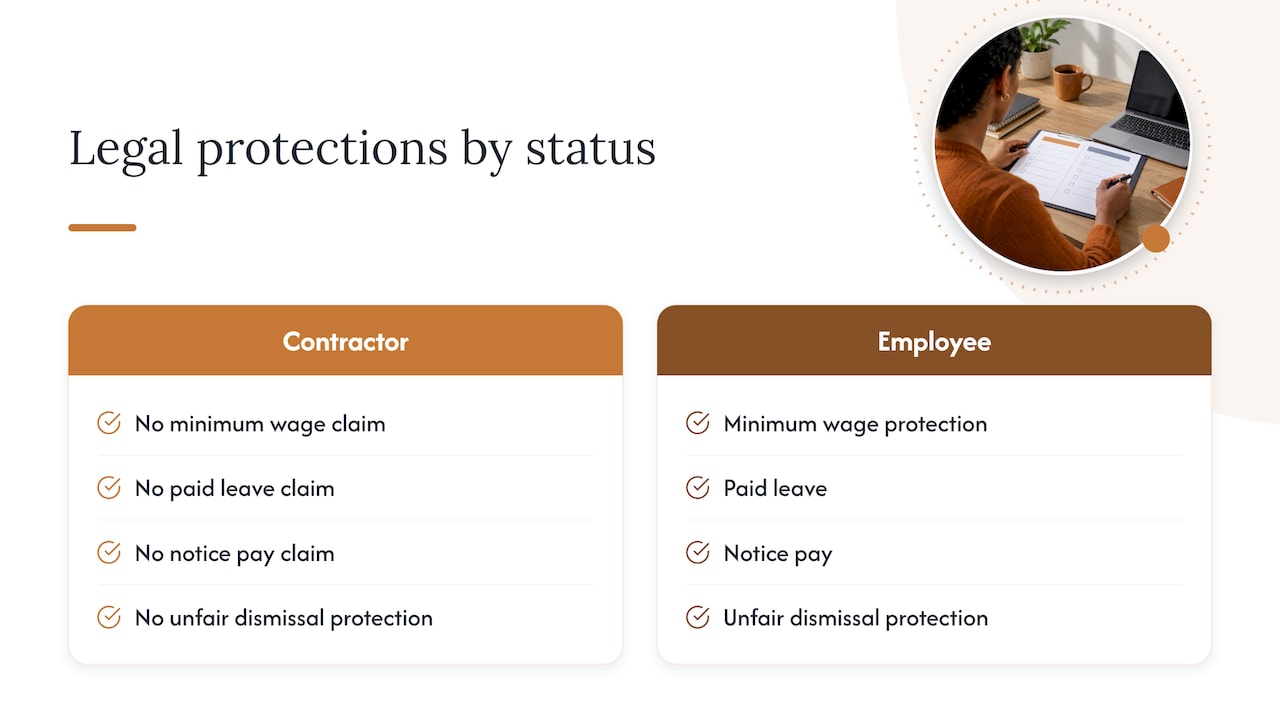
The legal gap between contractor and employee status in South Africa is wide, and most employers underestimate it until a dispute forces the issue. A genuine independent contractor has no claim to minimum wage protections, paid leave, notice pay, or protection against unfair dismissal under the LRA. An employee gets all of these, plus access to the CCMA for dismissal and unfair labour practice disputes, which contractors generally cannot access.
Misclassification does not just risk a one-off penalty. HR practitioner analysis of misclassification risk notes that a successful reclassification claim can trigger retroactive liability for PAYE, UIF, and SDL contributions, plus backdated leave pay, calculated from whenever the true employment relationship actually began rather than from the date of any new contract.
Temporary employment services and fixed-term placements add another layer. Under sections 198A and 198B of the LRA, workers placed through a labour broker for extended periods can be deemed employees of the client, not the broker, creating joint liability that catches employers who assumed the broker carried all the risk. The lesson across every one of these scenarios is the same: a written label is weak evidence next to the practical reality of how the work actually happens day to day.
Managing dismissal risk safely during and after conversion
Converting a contractor into an employee changes your dismissal exposure immediately, even if nothing else about the working relationship changes. Once someone is an employee, dismissing them without a fair reason and a fair process opens the door to a CCMA referral, and the burden sits with you to prove both elements.
A few practices reduce that risk substantially during the transition:
- Set a genuine probation period in the new contract and use it to document performance formally, since probation dismissals still require a fair process, just a lighter one than confirmed employment.
- Avoid terminating a contractor relationship and immediately citing performance issues as the reason, since this pattern looks like an attempt to dodge employee protections through timing.
- Keep every performance conversation in writing from the first week of employment, not just once a problem becomes serious.
If the role does not work out shortly after conversion, a structured incapacity or misconduct process, with a clear paper trail, remains your safest path. Skipping that process because “they were only recently a contractor” is a common and costly misunderstanding, since the CCMA looks at current status, not history.
How conversion changes benefits and entitlements
The benefits gap between contractor and employee status is where the financial impact of conversion becomes concrete. As a contractor, someone typically has no statutory leave, no notice pay, and no retrenchment protection. Once converted, BCEA minimums kick in automatically: annual leave, sick leave, family responsibility leave, and notice periods scaled to length of service.
Retrenchment rights also activate at this point. An employee facing redundancy is entitled to a fair process and statutory severance pay under the LRA, an obligation that simply does not exist for a genuine contractor whose service agreement ends. If your organization restructures a year after converting someone, that history counts toward length of service for severance calculations, so document the actual employment start date precisely rather than defaulting to the date the new contract was signed.
Bonus structures often need adjusting too. A contractor’s rate may have implicitly priced in the absence of benefits, so converting without reviewing total compensation can leave you paying full employee benefits on top of an unchanged fee, inflating your actual cost per role more than expected.
UIF contributions and claims after conversion
Unemployment insurance only becomes relevant once someone is a genuine employee, since contractors are not covered under the Unemployment Insurance Fund at all. From the first day of employment, you and the employee each contribute to UIF, and that contribution history starts accumulating from that date, not from whenever the earlier contractor relationship began.
This timing matters most if the employment ends soon after conversion. UIF claims depend on a minimum contribution history, so someone converted only weeks before a retrenchment or resignation may find their claim smaller than expected, simply because the contractor years never counted. It is worth explaining this clearly to a converted employee at the outset, since it is a common source of confusion and frustration later.
Getting UIF registration right at the point of conversion also protects you administratively. Registering late or inconsistently creates gaps in the contribution record that are difficult to fix retroactively, and those gaps can delay a legitimate claim significantly when an employee needs the fund most.
Staying audit-ready after the conversion is complete
Converting a contractor is not a one-time administrative event. SARS and the Department of Employment and Labour can both examine a classification years after the fact, so the file you build at conversion needs to survive that kind of scrutiny indefinitely.
Build a simple recurring review into your compliance calendar:
- Revisit the classification memo annually, especially if the person’s duties, hours, or exclusivity have shifted since conversion.
- Keep payroll records, EMP201 filings, and UIF contribution history organized and accessible rather than scattered across systems.
- Review any remaining contractor relationships against the same seven factors periodically, since a contractor relationship can drift into deemed employment over time without a new contract ever being signed.
A short annual compliance check, even a half-day internal review, costs far less than a retroactive PAYE and UIF assessment triggered by an audit. Our knowledge hub carries ongoing updates on South African employment rules worth checking periodically as thresholds and guidance evolve.
Three non-negotiables for a safe conversion
If I had to narrow this down, three things matter more than everything else: document the practical shift in working reality the day it happens, not after a dispute forces you to reconstruct it; register and pay employer payroll taxes on time, since the 21-business-day window is unforgiving; and use an Employer of Record if you lack a local entity, since trying to self-manage compliance from abroad is where most mistakes start.
— Roel
A faster, compliant way to convert contractors in South Africa
If building a local entity to employ one or two people feels disproportionate to the task, we handle the entire conversion for you: a compliant employment contract, ZAR payroll, and every statutory filing, PAYE, UIF, SDL, and COIDA, for a flat £299 per employee per month with no setup fees.

Contracts are typically signed within 48 hours, and your converted employee can be fully onboarded within days. Check our pricing page to see exactly what a compliant conversion costs for your team.
FAQ
How can I convert a contractor to a full-time employee in South Africa?
Run a documented classification assessment against the seven statutory factors, then issue a BCEA-compliant contract and register for employees’ tax within 21 business days if you become liable, as outlined in the SARS employer guide. If you have no local entity, an Employer of Record arrangement handles the contract and payroll registration for you within days.
What are the key differences between a contractor and an employee in South Africa?
An employee is entitled to BCEA minimums like paid leave, notice pay, and protection against unfair dismissal through the CCMA, while a genuine independent contractor has none of these statutory protections. The classification depends on the practical working relationship, not the contract’s title, under the test summarized in practitioner guides on contract worker rights.
How do I change an independent contractor into an employee?
Start with a written classification memo comparing the relationship against the statutory factors, then draft a new BCEA-compliant contract, configure payroll for PAYE, UIF, SDL, and COIDA, and formally close out the old contractor agreement. Keep every document from this process in an audit trail in case the classification is ever questioned later.
Do contractors pay tax in South Africa?
Independent contractors generally handle their own provisional tax rather than having PAYE withheld, but SARS can still treat payments as remuneration subject to employer withholding under specific conditions. SARS interpretative guidance explains that work performed mainly at a client’s premises under that client’s control is one common trigger for this outcome.
What happens to UIF contributions when a contractor becomes an employee?
UIF contributions only start from the date someone becomes a genuine employee, since contractors are not covered by the fund at all. This means the contribution history used for a future claim begins at conversion, not at the start of the earlier contractor relationship.
Sources
- Department of Employment and Labour sets a new threshold in the protection of employees
- SARS interpretative guidance on employees’ tax and independent contractors
- A complete guide to contract worker rights in South Africa | Burger Huyser Attorneys
Recommended
- Hire in South Africa Fast for UK, EU & US HR: Contracts in 48 Hours
- Remote Hiring in South Africa: The 2026 Employer’s Guide to Compliant Scaling
- Employer of Record South Africa: The Complete Guide for International Businesses (2026)
- Hiring in South Africa for International Employers: Benefits, Costs, EOR