

When your business provides an employee with a vehicle, South African Revenue Service rules treat it as a taxable fringe benefit added to gross income. The headline figure is 3.5% of the vehicle’s determined value per month, dropping to 3.25% when a maintenance plan is included. Vehicles under an operating lease are taxed differently, using actual lease cost plus fuel, and employees can reduce the taxable amount at assessment with a verified logbook.
TL;DR:
- For an operating lease, payroll must use actual monthly lease costs plus fuel costs, verify the agreement qualifies, and report the benefit under code 3816.
- A qualifying logbook must record trip dates, destinations, purposes, and kilometers, with opening and closing odometer readings from March 1 through the last day of February.
- Payroll generally includes 80% of the monthly benefit in remuneration for PAYE when provisional business use is claimed; SARS determines the final reduction at assessment.
- Report benefits from vehicles the employer owns under code 3802 on the employee’s IRP5 or IT3(a), and include their cash value before calculating PAYE.
Table of Contents
- 1. How SARS calculates the monthly taxable value for employer-owned vehicles
- 2. How to treat vehicles under an operating lease (actual-cost method)
- 3. Using a SARS logbook to reduce the fringe benefit at assessment
- 4. Where the car fringe benefit appears on IRP5/IT3 and payroll reporting actions
- 5. A concise compliance checklist for employers and payroll teams
- 6. How company car tax affects employee take-home pay and total employer cost
- 7. Comparing owning versus leasing company cars from a tax perspective
- 8. Typical company car tax rates and thresholds for the current tax year
- 9. Procedures and timelines for SARS assessment and appeals related to company car tax
- 10. Why employers often outsource payroll tasks tied to company-car taxation
- How Expand to South Africa handles fringe benefits in your payroll
- FAQ
- Sources
1. How SARS calculates the monthly taxable value for employer-owned vehicles
For a vehicle your business owns and makes available to an employee, SARS starts with the determined value, generally the original cost of the vehicle including VAT, before any trade discount. Where the vehicle was acquired under a previous arrangement, such as the employer assuming ownership after a lease, specific adjustments to the base value can apply, and payroll should confirm the correct starting figure before running calculations.
The core formula is straightforward:
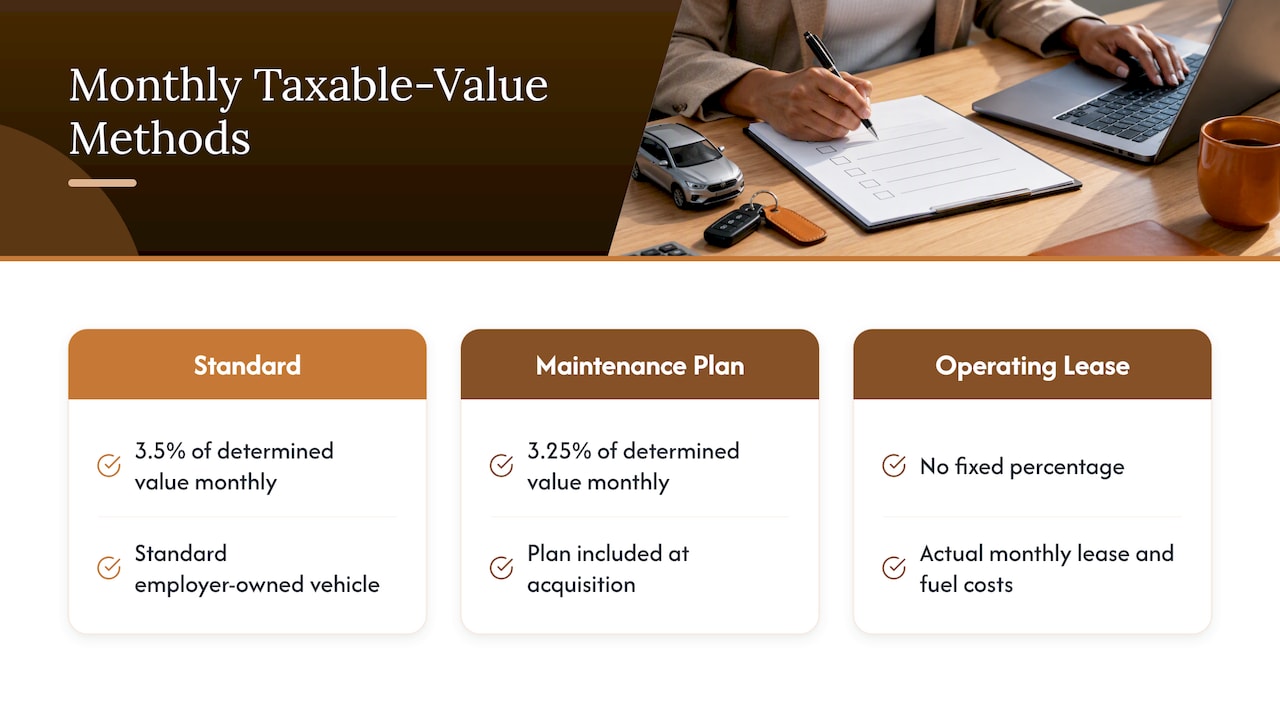
- Multiply the determined value by 3.5% for each month the vehicle is available for private use.
- Use 3.25% instead when the vehicle came with a maintenance plan at acquisition.
- Apply the calculation monthly, not annually, so the benefit accrues alongside regular pay.
- Pro-rate for partial months when a vehicle is allocated or returned mid-month.
The taxable fringe benefit for an employer-provided vehicle is calculated monthly at 3.5% of the vehicle’s determined value, reduced to 3.25% with a maintenance plan. For example, a vehicle with a typical determined value of several hundred thousand rand without a maintenance plan would have a corresponding monthly taxable benefit calculated at around 3.5%. With a maintenance plan, the percentage is slightly lower, resulting in a reduced monthly taxable benefit. Payroll teams should keep these figures in a reference table tied to each vehicle’s acquisition documents for quick verification during audits.
2. How to treat vehicles under an operating lease (actual-cost method)
When your business holds a vehicle under a genuine operating lease rather than owning it outright, the fixed-percentage method falls away. Instead, the taxable benefit equals the actual cost your business incurs under the lease agreement, plus the cost of fuel provided for the vehicle.
- Confirm the agreement qualifies as an operating lease under the criteria SARS applies, rather than an installment sale dressed up as a lease.
- Track monthly lease invoices and fuel costs separately, since both feed directly into the taxable value.
- Expect the benefit amount to fluctuate month to month as fuel costs change, unlike the fixed percentage used for owned vehicles.
If your business pays a typical monthly amount for an operating lease plus fuel costs, the taxable fringe benefit for that month equals the total of those amounts, fluctuating as costs vary. This differs meaningfully from the fixed-percentage approach, and operating lease vehicles use actual lease cost plus fuel instead of a fixed percentage. Payroll systems need a separate code and calculation path for lease vehicles so the two methods never get conflated on an employee’s record.
3. Using a SARS logbook to reduce the fringe benefit at assessment
Employees who use a company car for business travel can reduce the taxable fringe benefit, but only with a logbook that meets SARS requirements. The reduction happens at assessment, not automatically through payroll each month.
- Record the opening odometer reading on March 1 and the closing reading on the last day of February each year.
- Log the date, destination, purpose and kilometers traveled for every business trip throughout the year.
- Keep the logbook and supporting records for at least five years, since SARS can request them during a review.
- Submit the logbook with the tax return to support a claim for business-use reduction.
The SARS eLogbook sets out the minimum fields required and the five-year retention rule, and electronic logbooks are accepted provided they capture the same detail as a paper version. During the year, payroll typically applies a provisional reduction, including only 80% of the monthly fringe benefit value in remuneration for PAYE purposes, on the assumption that some business use will be proven later. At assessment, SARS recalculates the actual reduction using the ratio of business kilometers to total kilometers traveled, which may differ from the provisional 80% figure and can result in additional tax owed or a refund.
Pro Tip: Reconcile logbook entries against payroll’s provisional reduction every month rather than waiting until tax season, since gaps are far easier to fix while the trip details are still fresh.
4. Where the car fringe benefit appears on IRP5/IT3 and payroll reporting actions
Company car benefits don’t just affect take-home pay, they also need to land on the correct tax certificate codes so SARS can match what payroll reported against what the employee declares.
- Use code 3802 for the taxable benefit from an employer-owned vehicle under the fixed-percentage method.
- Use code 3816 when the vehicle is held under an operating lease and taxed on actual cost plus fuel.
- Include the cash-equivalent value in remuneration before calculating PAYE for that pay period, since it forms part of gross income.
- Apply the provisional reduction, when logbook evidence supports one, before the PAYE calculation runs each month.
- Issue IRP5 or IT3(a) certificates reflecting the correct code and cumulative value at the end of the tax year.
Guidance in the PAYE-GEN-01-G02 employer fringe benefits guide sets out the accrual timing and certificate codes payroll teams rely on. Employers should also check that EMP201 submissions each month reflect the PAYE calculated after any provisional reduction, since an error here compounds across every pay period until caught.
5. A concise compliance checklist for employers and payroll teams
Getting company car tax right is mostly about discipline: capturing the right documents at the start and running the same checks every month afterward, which can be supported efficiently by using white-label HR diagnostics for UK HR consultants.
- Record the determined value, purchase or lease invoices, and maintenance plan status when the vehicle is first allocated to an employee.
- Decide which method applies, fixed percentage for owned vehicles or actual cost for operating leases, and flag it clearly in the payroll system.
- Apply the monthly calculation consistently, including any employee contributions toward running costs, which can reduce the taxable value.
- Require a logbook from day one rather than waiting until year-end, and store records centrally so they survive staff turnover.
- Build a year-end reconciliation file linking payroll totals for each vehicle to the employee’s logbook evidence, ready for assessment or a SARS query.
Pro Tip: Set a calendar reminder for the first week of March each year to confirm opening odometer readings are logged for every company vehicle, since a missed starting point undermines the whole year’s logbook.
6. How company car tax affects employee take-home pay and total employer cost
Adding a vehicle’s taxable value to an employee’s gross income increases the PAYE withheld each month, which means the benefit of “free” transport comes with a real reduction in cash salary. An employee with a monthly fringe benefit of R14,000 will see their taxable income rise by that amount, pushing more of their earnings into higher PAYE brackets depending on where they sit on the SARS individual tax tables.
For employers, the cost runs in the opposite direction: the vehicle itself, whether purchased or leased, sits on the balance sheet or as a monthly lease expense, separate from payroll. The tax treatment doesn’t reduce what your business pays for the car, it determines how much of that value gets taxed in the employee’s hands. This distinction matters when structuring total remuneration packages, since a company car with a high determined value can meaningfully shrink an employee’s net pay relative to a cash equivalent of the same cost.
Employers comparing a company car against a travel allowance should note the different mechanics: travel allowances are taxed differently from the outset, with their own kilometer-based exemption thresholds. Our guide to travel allowance tax breaks down the 80/20 provisional rule and the per-kilometer exemption for employees paid an allowance rather than given a vehicle, which is worth comparing before deciding which benefit structure suits a role.
7. Comparing owning versus leasing company cars from a tax perspective
The method SARS applies depends entirely on how your business holds the vehicle, which makes the ownership decision a tax decision as much as a cash-flow one.
This predictability makes payroll administration simpler, since the taxable value doesn’t shift with fuel prices or lease terms.
An operating lease instead ties the taxable value to actual cost, lease payments plus fuel, which means the benefit fluctuates monthly and payroll must track two separate cost streams rather than applying a flat percentage. Businesses sometimes prefer this method when lease and fuel costs run lower than what the fixed-percentage calculation would produce on a high-value vehicle, though the opposite can also be true for lower-value vehicles with high fuel consumption.
Neither approach is universally cheaper for the employee or the employer. The right choice depends on the vehicle’s value, expected mileage, and how your business wants to manage cash flow versus administrative complexity. What stays consistent is the documentation burden: owned vehicles need determined value records, and leased vehicles need invoice trails for both the lease and the fuel.
8. Typical company car tax rates and thresholds for the current tax year
As of the 2027 tax year, the fixed-percentage rates remain 3.5% of determined value for standard employer-owned vehicles and 3.25% when a maintenance plan was included at acquisition. These percentages apply monthly, not as an annual figure, and compound with however many months the vehicle is available to the employee during the tax year.
Operating lease vehicles don’t have a fixed percentage at all, since the taxable value tracks actual lease and fuel costs for that month.
Employees claiming business-use reductions should also be aware of the 495 cents per kilometer exemption threshold that applies to allowance-based travel claims, a separate mechanism from the company car fixed-percentage rules but relevant when employers are deciding between the two benefit structures. The SARS eLogbook guidance confirms that commuting between home and work is always treated as private travel, regardless of distance, and never qualifies for a business-use reduction under either the company car or travel allowance rules. Employers should revisit these figures each tax year, since SARS updates rates and thresholds periodically and payroll systems need to reflect the current year’s numbers from March 1.
9. Procedures and timelines for SARS assessment and appeals related to company car tax
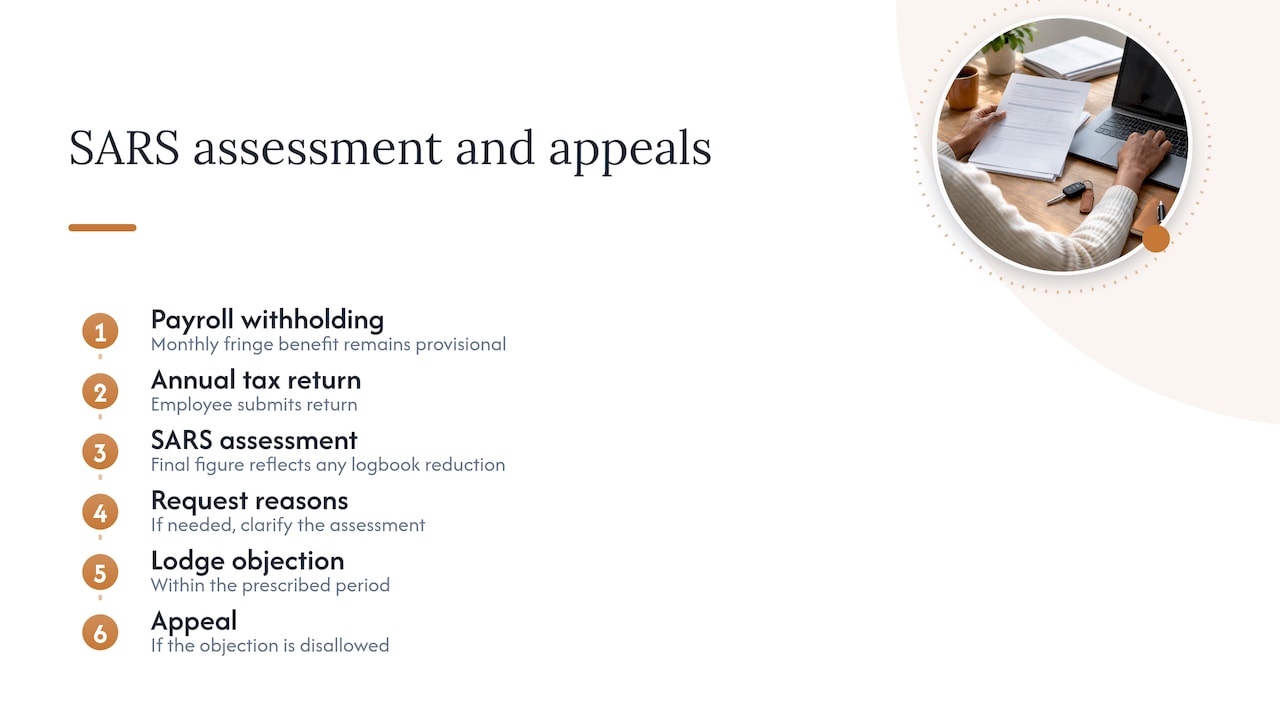
The fringe benefit value calculated monthly through payroll is provisional. The final figure gets settled when the employee submits their annual tax return and SARS issues an assessment, typically reflecting any logbook-based reduction that wasn’t applied during the year.
If the assessment differs from what payroll withheld, perhaps because the logbook supported a larger business-use reduction than the provisional 80% figure assumed, the employee may be due a refund, or in less common cases, owe additional tax. Interpretation Note No.72 sets out the legal basis for these calculation methods and the mechanics for business-use reduction at assessment, including confirming that private use, including ordinary commuting, always counts as a taxable benefit regardless of how the vehicle is otherwise used.
Where an employee disagrees with an assessment, the standard SARS dispute process applies: requesting reasons for the assessment if needed, then lodging an objection within the prescribed period, followed by an appeal if the objection is disallowed. Because these disputes often turn on logbook accuracy, the practical defense is the same records payroll should already be keeping, contemporaneous trip logs, odometer readings, and a clear link between each vehicle and the employee who used it.
10. Why employers often outsource payroll tasks tied to company-car taxation
Tracking determined values, choosing between fixed-percentage and operating-lease methods, enforcing logbook compliance, and applying the correct IRP5 codes adds real administrative weight to payroll, especially as rates and thresholds shift each tax year. Specialist payroll providers absorb this complexity and reduce the risk of a reporting error surfacing at assessment. Our payroll services overview covers how this works in practice for employers hiring in South Africa.
— Roel
How Expand to South Africa handles fringe benefits in your payroll
Running compliant ZAR payroll means getting the company car calculation right every month, not just at year-end, and we built our payroll services to do exactly that: applying the correct fixed-percentage or operating-lease method, filing PAYE through EMP201, and issuing IRP5 and IT3(a) certificates with the right codes attached.

Because we work exclusively in South Africa, our team tracks SARS rate changes and logbook requirements as part of the core service rather than as an add-on, at a flat fee of £299 per employee per month with no setup fees. If your business is weighing up whether to manage this in-house or hand it to a specialist, our employment cost calculator gives you a clear total cost picture before you commit.
This article is general information, not a substitute for advice from a qualified financial advisor. Consult a qualified financial professional about your own circumstances before acting on anything here.
FAQ
Who pays 45% tax in South Africa?
The 45% rate is the top marginal rate on the SARS individual tax tables, applying only to the portion of taxable income above the highest bracket threshold, not to an individual’s entire income. A company car fringe benefit added to gross income can push part of an employee’s earnings into this bracket if their income is already near the threshold.
As a business owner, what is the best way to purchase a car for company use?
There is no single best method since the right choice depends on your cash flow, expected business mileage, and whether you want predictable monthly tax calculations or costs tied to actual lease and fuel expenses. Outright ownership triggers the fixed-percentage method, while an operating lease uses actual cost plus fuel, and each suits different vehicle values and usage patterns.
Can I deduct the cost of a business vehicle from my taxes?
Deductibility depends on how the vehicle is used and owned, and the rules differ for a business claiming vehicle expenses versus an employee receiving a company car as a fringe benefit. For the employee side covered in this guide, the relevant mechanism is a business-use reduction through a logbook, not a direct deduction.
How much business income is not taxable?
This depends on the type of income and the applicable thresholds on the SARS tax tables, including the primary rebate and tax-free threshold for individuals, which change each tax year. For travel-related exemptions specifically, allowances based on actual distance can qualify for exemption up to 495 cents per kilometer under the conditions SARS sets out.