

South Africa requires employers to provide paid annual leave, sick leave, family responsibility leave, UIF contributions, COIDA coverage, and maternity or parental leave, plus PAYE and SDL obligations. Beyond that legal floor, competitive employers add medical aid subsidies, retirement contributions, group life and disability cover, a 13th cheque, and wellness support. The rest of this guide walks through the compliance steps, real cost benchmarks, and a faster route to hiring compliantly through an Employer of Record.
TL;DR:
- Employers must accurately classify workers as employees or independent contractors to avoid costly penalties for misclassification.
- The statutory minimum for employees includes 15 paid working days of annual leave and sick leave proportional to hours worked, with UIF contributions of 1% each side.
- Additional benefits such as medical aid subsidies, retirement contributions, and group risk coverage are essential for attracting skilled talent in South Africa.
- Registering as an employer involves managing PAYE, UIF, COIDA, and SDL filings monthly, with strict timelines and accurate payroll documentation.
- Using an Employer of Record can significantly reduce setup time and compliance burdens for small or testing market entries into South Africa.
Table of Contents
- Benefits for Employees South Africa: Who Actually Qualifies
- Mandatory Statutory Benefits Explained
- Supplementary Benefits That Set Competitive Employers Apart
- Building a Compliance Checklist That Actually Holds Up
- What Benefits Actually Cost: A Worked Example
- What International Employers Consistently Underestimate
- How Expandtosouthafrica Handles South African Employee Benefits for You
- Where to Verify These Rules Yourself
- Sources
Benefits for Employees South Africa: Who Actually Qualifies
Before you calculate a single rand of contribution, you need to know whether the person you’re hiring is legally an employee or an independent contractor. South African labor law draws this line using a “dominant impression” test that looks at control, integration into the business, and whether the person can send a substitute to do the work in their place. If you dictate hours, provide equipment, and the person works exclusively for you, courts and the CCMA will almost always treat them as an employee, regardless of what the contract calls them.
Misclassification is one of the costliest mistakes international employers make. Treating someone as a contractor to dodge PAYE, UIF, and COIDA obligations doesn’t hold up if the underlying relationship looks like employment, and remedial penalties plus back payment liabilities can easily outstrip whatever you saved.
Entitlements also shift depending on employment category:
- Full-time employees get the complete statutory package: leave, UIF, COIDA, and notice protections.
- Part-time employees are entitled to pro-rated versions of most benefits based on hours worked.
- Fixed-term contractors (employees, not independent contractors) accrue leave and benefits for the contract’s duration and may be entitled to permanent-equivalent treatment after three months on repeated renewals.
- Casual or seasonal workers still trigger UIF and COIDA obligations once they cross minimal hour thresholds.
For international employers, this means PAYE registration with SARS, UIF and COIDA registration, and contract language that matches the real working relationship aren’t optional paperwork. They’re the foundation everything else in this guide sits on.
Mandatory Statutory Benefits Explained
Statutory benefits in South Africa are governed almost entirely by three pieces of legislation: the Basic Conditions of Employment Act (BCEA), the Unemployment Insurance Act, and the Compensation for Occupational Injuries and Diseases Act (COIDA). Each one imposes specific numbers, not vague guidance, and getting any of them wrong creates direct liability.

Statutory benefit at a glance: South African employees earn a minimum of 21 consecutive days of annual leave per year (or 15 working days for a standard five-day week), accrue paid sick leave equal to their working days over a six-week period within a 36-month cycle, and are covered by UIF contributions split 1% employer and 1% employee on earnings up to the statutory ceiling.
Here’s how the core statutory obligations break down in practice:
-
Annual leave and holiday pay. The BCEA sets annual leave at 21 consecutive days for employees working a five or six-day week, which translates to 15 working days of leave. Leave must be granted within six months of the leave cycle ending, and accrued leave must be paid out on termination. Employers commonly track this on a rolling annual basis tied to the employee’s start date rather than the calendar year.
-
Sick leave and its overlap with UIF. Employees are entitled to paid sick leave equal to the number of days they’d normally work in six weeks, spread across a 36-month cycle. During the first year of employment, this accrues at one day of paid sick leave for every 26 days worked. Once statutory sick leave runs out, UIF’s illness benefit can step in for employees who’ve contributed and meet the eligibility criteria, but it’s a separate claim process through the Fund, not an automatic extension of pay.
-
Maternity and parental leave. Pregnant employees are entitled to a statutory period of maternity leave, and employers aren’t required to pay salary during this period. Employees claim UIF maternity benefits instead, which requires advance notice to the employer (usually at least four weeks before the intended leave start) and a claim filed directly with the Fund. Parental leave for the non-birthing parent runs to 10 consecutive days, also claimable through UIF.
-
UIF contributions and claims. Both employer and employee contribute 1% of the employee’s remuneration each, for a combined 2%, up to the annual earnings ceiling that SARS and the UIF adjust periodically. Employers register with the UIF (usually alongside SARS registration) and submit monthly contributions through the PAYE reconciliation process. Claims for unemployment, illness, maternity, or dependants’ benefits are filed by the employee, but employers must issue accurate UI-19 records to support them.
-
COIDA coverage. Employers are required to register with the Compensation Fund and pay an annual assessment based on payroll and industry risk classification. Workplace injuries or occupational diseases must be reported within specific timeframes, and COIDA bars injured employees from suing their employer directly. Instead compensation flows through the Fund. Missing the reporting window or failing to register creates direct employer liability outside the fund’s protection.
-
PAYE, SDL, and payslip requirements. Employers withhold PAYE and remit it monthly via the EMP201 return to SARS, alongside the Skills Development Levy (SDL) at 1% of payroll, which funds sector training initiatives. Every employee must receive a payslip on payment, and the BCEA specifies mandatory content: gross pay, deductions, hours worked, and the pay period covered, among other fields.
-
Overtime and working hours. The default workweek is 45 hours. Overtime is paid at 1.5 times the normal rate, or double on Sundays and public holidays, unless a valid averaging agreement spreads hours across a longer period. Employers who ignore overtime rules face CCMA claims and back-pay orders that often dwarf the original savings.
-
Severance for operational-requirements dismissals. Retrenchments require a minimum of one week’s severance pay per completed year of service, on top of statutory notice periods that scale with length of service. Skipping proper consultation before a retrenchment is one of the fastest routes to a successful CCMA challenge.
Supplementary Benefits That Set Competitive Employers Apart
Statutory compliance gets you a legal employee. It doesn’t get you a competitive offer. For skilled roles in South Africa, medical aid is close to a baseline expectation rather than a perk, and market data from Old Mutual shows that employers who skip it struggle noticeably to attract strong candidates.
Most employers structure medical aid as a subsidy, commonly covering 50% to 100% of a mid-tier scheme’s premium, rather than a flat cash allowance. Retirement contributions follow a similar logic: employers typically contribute somewhere in the range of 5% to 10% of base salary into either a pension fund or a provident fund. The distinction matters for tax and payout purposes. Pension funds historically limited lump-sum withdrawals at retirement, while provident funds allowed full cash payouts, though recent reforms have narrowed that gap considerably. Clear pre-retirement communication about which fund an employee is in, and what that means for their eventual payout, avoids a lot of confusion down the line.
Group risk benefits round out a serious package:
- Group life cover, often set at a multiple of annual salary (commonly 1x to 3x).
- Disability income protection, replacing a portion of salary if an employee can’t work.
- Funeral cover, which carries outsized cultural importance in South Africa and is frequently bundled into group risk packages rather than sold separately.
Beyond the core package, differentiating perks increasingly include learning and development budgets, employee assistance programs (EAPs) for mental health support, gym or wellness stipends, and a growing number of employers piloting Earned Wage Access tools that let employees draw a portion of earned salary before payday.
Pro Tip: If you’re offering a year-end payment, specify in the offer letter whether it’s a guaranteed 13th cheque or a discretionary performance bonus. Candidates treat this distinction as a material compensation term, and vague wording creates disputes at the worst possible time: right before the holidays.
A sensible build order looks like this: lock in statutory compliance first, add medical aid and retirement contributions second, then layer in targeted perks based on what your specific talent pool actually values.
Building a Compliance Checklist That Actually Holds Up
Getting registered and staying compliant month over month follows a predictable rhythm once you know the sequence.
- Register as an employer. You’ll need a SARS PAYE reference number, UIF registration (often processed alongside SARS), and COIDA registration with the Compensation Fund if you have employees performing work in South Africa. Expect to provide company registration documents, banking details, and employee information upfront.
- Run the monthly payroll calendar. File the EMP201 return and remit PAYE, UIF, and SDL contributions to SARS by the deadline (typically the 7th of the following month). Issue compliant payslips with every payment, and reconcile contributions quarterly against your EMP501 filing.
- Handle incidents and claims promptly. Report workplace injuries to the Compensation Fund within the required timeframe, and respond to UIF benefit queries with accurate UI-19 documentation. Delayed reporting is one of the most common triggers for COIDA disputes.
- Manage cross-border payroll complications. Decide upfront how currency conversion, payslip language, and tax residency questions get handled, especially if you’re paying from a foreign entity into a South African employee’s local bank account.
- Build internal controls. Require payroll sign-offs before submission, reconcile contributions against payroll registers monthly, and retain employment records for at least the statutory minimum retention period.
| Compliance area | Frequency | Key action |
|---|---|---|
| PAYE / EMP201 | Monthly | File and remit to SARS by the 7th |
| UIF contributions | Monthly | Remit alongside PAYE via EMP201 |
| SDL | Monthly | Remit 1% of payroll |
| COIDA assessment | Annual | Pay based on payroll and risk class |
| Payslip issuance | Every pay period | Issue compliant payslip per BCEA |
| EMP501 reconciliation | Biannual | Reconcile PAYE, UIF, SDL totals |
For employers registering UIF for the first time, the documentation requirements trip up more international teams than the actual contribution math does.
What Benefits Actually Cost: A Worked Example
UIF math is straightforward once you have the ceiling figure: both employer and employee contribute 1% each of monthly remuneration, capped at the statutory earnings ceiling that SARS and the UIF review periodically. On a salary sitting above that ceiling, the contribution is calculated on the capped amount, not the full salary, which caps the employer’s monthly UIF liability regardless of how senior the hire is.
Cost benchmark reality: Market data shows employer retirement contributions commonly landing between 5% and 10% of base salary, while medical aid subsidies often cover half to all of a mid-tier scheme premium. Add COIDA assessment (typically a small fraction of a percent of payroll, varying by industry risk class) and SDL at a flat 1%, and the statutory layer alone adds low-single-digit percentage points on top of base pay.

None of these numbers stay fixed for long, so run your own scenario through Expandtosouthafrica’s employment cost calculator before finalizing an offer.
What International Employers Consistently Underestimate
Most companies expanding into South Africa for the first time think the hard part is understanding the leave entitlements or the UIF percentages. It isn’t. Those numbers are published and stable. The hard part is the operational friction that shows up after you’ve read the statutes: getting a local bank account set up for payroll disbursement, handling POPIA data residency requirements alongside your own GDPR obligations, and drafting contracts that hold up if a dismissal ever reaches the CCMA.
I’ve seen the “we’ll just set up a local entity” instinct cost companies months they didn’t budget for, particularly when the initial hire count is one or two people testing a market rather than a confirmed expansion. A local entity makes sense once you’re committing to double-digit headcount and long-term permanence. Below that threshold, an Employer of Record typically gets you employing legally within days rather than months, without the entity registration, local director requirements, and ongoing statutory filings a subsidiary demands.
Ask yourself three questions before choosing a path: How many people are you hiring in the next 12 months? Is this a market test or a confirmed long-term commitment? And do you have in-house capacity to manage monthly PAYE, UIF, and COIDA filings correctly, indefinitely? If the honest answers point toward “few,” “testing,” and “no,” an Employer of Record solves the compliance question without the entity overhead.
— Roel
How Expandtosouthafrica Handles South African Employee Benefits for You
An Employer of Record alternative to setting up a South African entity offers a flat monthly fee per employee instead of registration costs, local directors, and an in-house team learning EMP201 filings from scratch. Employment runs through a licensed local partner who manages BCEA-compliant contracts, ZAR payroll, PAYE (EMP201), UIF, SDL, and COIDA filings, so every benefit covered in this guide gets administered correctly without you having to become a South African labor law expert.
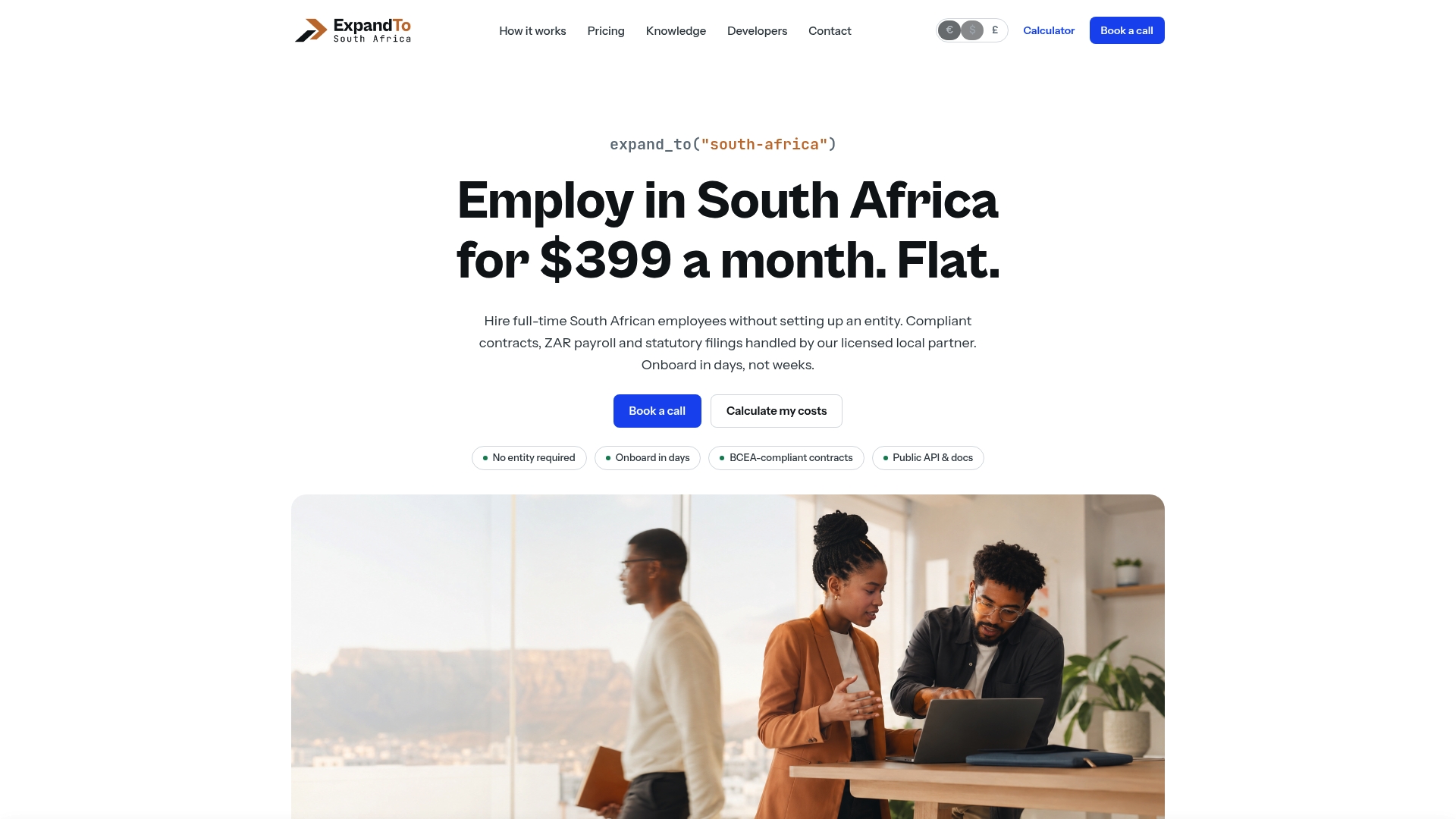
Contracts can be signed quickly and onboarding completed within days, not the months a local entity setup typically requires. Pricing stays transparent with no setup fees or FX loading, and sourcing skilled talent can be included in the process. Run your specific hire through the employment cost calculator to see exact statutory and supplementary costs, then check the EOR services page to get a quote for your first South African hire.
Where to Verify These Rules Yourself
- The Unemployment Insurance Act governs UIF contributions, benefit types, and claims eligibility.
- The BCEA guidance from the Department of Labour covers leave, payslips, and working-hours rules in practical detail.
- COIDA sets out workplace injury compensation, and industry reports from Old Mutual track benefits trends and benchmarks year over year.
Sources
- Unemployment Insurance Act 63 of 2001 | South African Government
- Basic Conditions of Employment Act (BCEA) — South African Department of Labour
- Compensation for Occupational Injuries and Diseases Act (COIDA) — South African Government
- Old Mutual — employee benefits and market insights