

For most international companies hiring in South Africa without a registered local entity, an Employer of Record is the right choice. A PEO is only relevant if you already own a South African legal entity and want a co-employment partner to share HR responsibilities. That single distinction drives almost every other trade-off in this comparison. South Africa’s statutory framework, including monthly PAYE filings via EMP201 to SARS, employer UIF contributions, Skills Development Levy obligations, and COIDA workers’ compensation, requires a legally recognized employer on the ground. An EOR provides that immediately. A PEO cannot, unless your entity already exists.
The speed and compliance coverage of an EOR suits market entry, first hires, and contractor conversions. The control and eventual cost efficiency of owning your entity, potentially paired with a PEO, becomes more attractive as your South African headcount grows larger.
Immediate next steps:
- Confirm whether your company has a registered South African legal entity (if not, an EOR is your only compliant option)
- Verify that your chosen provider covers EMP201/PAYE, UIF, SDL, and COIDA, not just payroll processing
- Assess whether any senior roles or frequent in-country activity could trigger a permanent establishment finding
- Review Expandtosouthafrica’s EOR services as a ready, specialist option
Table of Contents
- How does EOR compare to PEO for hiring in South Africa?
- What exactly does an EOR do, and how is a PEO different?
- What statutory obligations must every South African employer meet?
- How do you decide between an EOR and a PEO for your situation?
- What does switching from an EOR to your own entity or a PEO involve?
- How Expandtosouthafrica covers the compliance gaps that matter
- Key Takeaways
- Expandtosouthafrica: flat-fee EOR with full statutory coverage from day one
- Useful sources for verification and further research
How does EOR compare to PEO for hiring in South Africa?
| Dimension | EOR | PEO |
|---|---|---|
| Local legal entity required | No | Yes |
| Legal employer | EOR is sole legal employer | Co-employment: your entity + PEO |
| Statutory filings (PAYE/EMP201, UIF, SDL, COIDA) | EOR handles all filings | Shared between your entity and PEO |
| Speed to hire | Days; contracts signed within 48 hours | Weeks to months (entity must already exist) |
| Cost structure | Flat monthly fee per employee; no setup cost | Payroll admin fee on top of entity running costs |
| Control over HR policies and compensation | Standard EOR templates; limited bespoke equity plans | Greater flexibility; your entity sets policy |
| Termination / CCMA risk | EOR bears primary legal exposure; indemnities apply | Your entity retains ultimate liability |
| Permanent establishment exposure | Possible if substance-over-form test is applied | Lower if entity is properly constituted |

The most consequential difference for companies entering South Africa is the entity requirement. An EOR removes the need for a local entity entirely, while a PEO presupposes one. For a first hire or a market test, that gap is decisive.
Key differences that matter most for South Africa specifically:
- EOR lets you hire legally within days, bypassing the 3–6 month entity registration process
- PEO co-employment means your entity remains exposed to CCMA claims and LRA obligations
- Flat EOR fees are predictable; entity plus PEO costs compound as you add compliance infrastructure
- Cost economics typically favor EOR for smaller South African teams, after which entity ownership starts to pay off over a longer horizon.
What exactly does an EOR do, and how is a PEO different?
Employer of Record (EOR): An EOR becomes the sole legal employer of your South African staff. It signs BCEA-compliant employment contracts in ZAR, runs local payroll, and handles every statutory filing: EMP201/PAYE with SARS, UIF contributions, SDL, and COIDA registration. You direct the employee’s day-to-day work; the EOR carries the legal employment relationship. Critically, an EOR is not a staffing agency or a Temporary Employment Service. It employs workers you have already selected, not workers it supplies.

Professional Employer Organization (PEO): A PEO enters a co-employment arrangement with your registered South African entity. Both parties share employer responsibilities: your entity retains the primary employment relationship and HR policy control, while the PEO administers payroll, benefits, and compliance support. Because the PEO relies on your entity’s registration, it cannot help you hire before that entity exists.
When each model fits:
- Startup testing the South African market: One or two hires, no entity, tight timeline. An EOR is the only compliant path.
- Established subsidiary offloading HR administration: You have a registered entity, a growing local team, and want to reduce internal payroll overhead. A PEO makes sense here.
- Converting contractors to employees: LRA deeming provisions can reclassify long-term contractors as employees, exposing you to back-pay and benefits claims. An EOR converts them cleanly and quickly.
What statutory obligations must every South African employer meet?
South Africa’s compliance framework is specific, layered, and enforced. Every employer, whether an EOR, a PEO-backed entity, or a standalone subsidiary, must manage the following:
| Obligation | Rate / Threshold | Filing Cadence | Enforcing Body |
|---|---|---|---|
| PAYE (EMP201) | Progressive; based on employee income | Monthly | SARS |
| UIF contribution | 1% employer + 1% employee of salary | Monthly (via EMP201) | SARS / Dept. of Labour |
| SDL | 1% of payroll; applies when annual payroll exceeds ZAR 500,000 | Monthly (via EMP201) | SARS |
| COIDA | Industry risk class rate; varies | Annual return; premiums assessed | Compensation Fund |
SARS enforces monthly EMP201 returns and assesses penalties and interest for late or incorrect filings. This means a missed or miscalculated submission is not just an administrative inconvenience; it generates compounding liability. A competent EOR absorbs that risk entirely. A PEO shares it with your entity, which retains ultimate legal exposure.
Statutory callout: The employer UIF contribution is 1% of each employee’s salary, matched by a 1% employee deduction. SDL kicks in at 1% of total annual payroll once that payroll exceeds ZAR 500,000. COIDA rates vary by industry risk class and are assessed annually.
BCEA and LRA context: The Basic Conditions of Employment Act sets minimum notice periods, leave entitlements, and working-hour limits. The Labour Relations Act governs unfair dismissal, deeming provisions for contractors, and CCMA jurisdiction. Under LRA deeming rules, a contractor who earns below the ministerial earnings threshold and works primarily for one client can be reclassified as an employee, triggering retroactive entitlements. An EOR eliminates that exposure by formalizing the employment relationship from day one.
Pro Tip: When evaluating any EOR or PEO contract, ask three specific questions: (1) Who is contractually responsible for EMP201 filings and PAYE remittances? (2) Are UIF, SDL, and COIDA contributions included in the monthly fee or billed as pass-throughs? (3) Does the provider offer a CCMA indemnity, and under what conditions does it apply?
How do you decide between an EOR and a PEO for your situation?
Work through these filters in order:
- Do you have a registered South African legal entity? If no, stop here. An EOR is your only compliant option. A PEO cannot legally operate without your entity in place.
- Will your South African headcount exceed 15–20 full-time employees within 12 months? If yes, begin planning entity registration in parallel with your EOR engagement. EOR cost advantages erode beyond roughly 15–20 employees, and entity ownership becomes more cost-efficient over a 12–24 month window.
- Do you need bespoke compensation structures, equity plans, or incentive schemes that standard EOR templates cannot support? If yes, and if you already have an entity, a PEO arrangement gives you the policy control to implement them.
Scenario guide:
- First hire or market test: Use an EOR. Contracts in 48 hours, no entity setup, full statutory coverage from day one. Use the employment cost calculator to model total employer cost before committing.
- Local subsidiary at scale: You have an entity and 20+ employees. Evaluate entity-run payroll or a PEO for cost efficiency and HR policy control.
- Contractor-to-employee conversion: Use an EOR. It resolves LRA classification risk immediately and provides a BCEA-compliant contract without requiring entity registration.
Timeline and cost shape: EOR onboarding takes days, with contracts signed within 48 hours. Registering a South African entity typically takes 3–6 months and requires ongoing accounting, tax, and compliance infrastructure. During that window, an EOR lets you hire, operate, and generate revenue without delay. For compliant scaling guidance, the practical cost differential versus UK or EU hires for skilled roles can reach 40–60% in salary savings alone.
Pro Tip: Ask any EOR or PEO provider for three documents before signing: a copy of their local partner’s statutory registration, a sample BCEA-compliant employment contract, and their COIDA class rate schedule. A provider that cannot produce all three within 24 hours is not operationally ready for South Africa.
What does switching from an EOR to your own entity or a PEO involve?
Switching is manageable, but it requires planning. Treat it as a structured project, not a simple administrative handover.
Step-by-step process:
- Set a cutover date at least 90 days out to allow parallel processing
- Register your South African entity (Pty Ltd) with the Companies and Intellectual Property Commission (CIPC) and obtain a SARS tax reference number
- Register as an employer with SARS for PAYE, UIF, and SDL
- Register with the Compensation Fund for COIDA
- Sign new BCEA-compliant employment contracts under your entity’s name
- Migrate payroll to your internal system or a local payroll provider
- Notify SARS, the UIF, and the Compensation Fund of the employer change
- Confirm the EOR’s offboarding process: who issues final payslips, who handles the last EMP201 return, and who retains CCMA indemnity for the period of EOR employment
Realistic timelines and costs: Entity registration alone takes 3–6 months. Payroll system migration adds 4–8 weeks. During the overlap period, you may carry duplicate costs: EOR fees plus entity setup and payroll infrastructure. Budget for this explicitly.
Termination and offboarding differences: Under an EOR, the EOR issues notice, manages the CCMA process, and typically indemnifies the client for claims arising during the employment period. Under a PEO or your own entity, your company bears the primary legal exposure for unfair dismissal claims. A single CCMA unfair-dismissal award can be substantial, which is why BCEA- and LRA-compliant offboarding advice from your provider is worth more than payroll administration alone.

How Expandtosouthafrica covers the compliance gaps that matter
Expandtosouthafrica operates as a single-country EOR, which means every process, every contract template, and every statutory filing is built specifically for South Africa. There is no 150-country generalist platform trying to apply a global template to South African labour law.
| Deliverable | Expandtosouthafrica | Typical EOR promise |
|---|---|---|
| Statutory filings | PAYE/EMP201, UIF, SDL, COIDA via licensed local partner | Often outsourced; depth varies |
| Employment contracts | BCEA- and LRA-compliant, in ZAR | Standard templates; SA-specific compliance varies |
| Data handling | POPIA and GDPR compliant; EU data residency | GDPR often; POPIA compliance varies |
| Onboarding SLA | Contracts signed within 48 hours; full onboarding within days | Days to weeks depending on provider |
| Pricing | Flat €350 / $399 / £299 per employee per month; no setup fees or FX loading | Often variable; FX loading common |
| CCMA guidance | CCMA-safe dismissal guidance included | Rarely included at this level |
| Transfers | Free transfers from other EOR providers | Transfer fees common |
Expandtosouthafrica’s EOR service delivers employment through a licensed local partner, which is the structural detail that separates compliant EOR from payroll-only services. Local specialist providers consistently outperform global platforms on compliance accuracy and CCMA responsiveness for country-specific labour law, and South Africa’s framework is detailed enough that generalist coverage creates real gaps.
Pro Tip: Expandtosouthafrica offers free transfers from other EOR providers. If you are currently on a global platform and experiencing compliance gaps or slow CCMA response, switching carries no transfer cost.
Key Takeaways
For most international companies, an EOR is the correct and only compliant path to hiring in South Africa without a registered local entity, and Expandtosouthafrica’s specialist model covers every statutory obligation the South African framework requires.
| Point | Details |
|---|---|
| EOR is the default choice | Without a South African legal entity, an EOR is your only compliant option for hiring full-time employees. |
| Statutory obligations are non-negotiable | Verify that your provider covers PAYE/EMP201, UIF (1% employer), SDL (1% above ZAR 500,000 payroll), and COIDA before signing. |
| Scale triggers a decision point | EOR cost advantages typically erode as your South African employee count increases; plan entity setup accordingly. |
| PE and CCMA risk run in parallel | Permanent establishment exposure and unfair-dismissal liability must be assessed alongside provider selection, not after. |
| Expandtosouthafrica | Flat monthly pricing, BCEA/LRA-compliant contracts, licensed local partner filings, and CCMA-safe dismissal guidance in one specialist EOR. |
The case for going specialist, not global
The most common mistake companies make when hiring in South Africa is choosing a global EOR platform because it already handles their European or North American payroll, then discovering that South African compliance, specifically COIDA class rates, CCMA procedures, and POPIA data obligations, sits in a support queue rather than a dedicated local team. Legal analysis from Bowmans confirms that EOR arrangements can create unintended permanent-establishment or co-employer exposure unless the contract and operational facts are structured carefully. That risk is not theoretical; it surfaces in senior hires, country manager roles, and situations where the foreign company is visibly represented in South Africa. A specialist provider structures the arrangement to minimize that exposure from the outset. The EOR vs PEO question is ultimately a question about where legal accountability sits, and the answer should be with a provider that knows South African law well enough to defend it.
Expandtosouthafrica: flat-fee EOR with full statutory coverage from day one
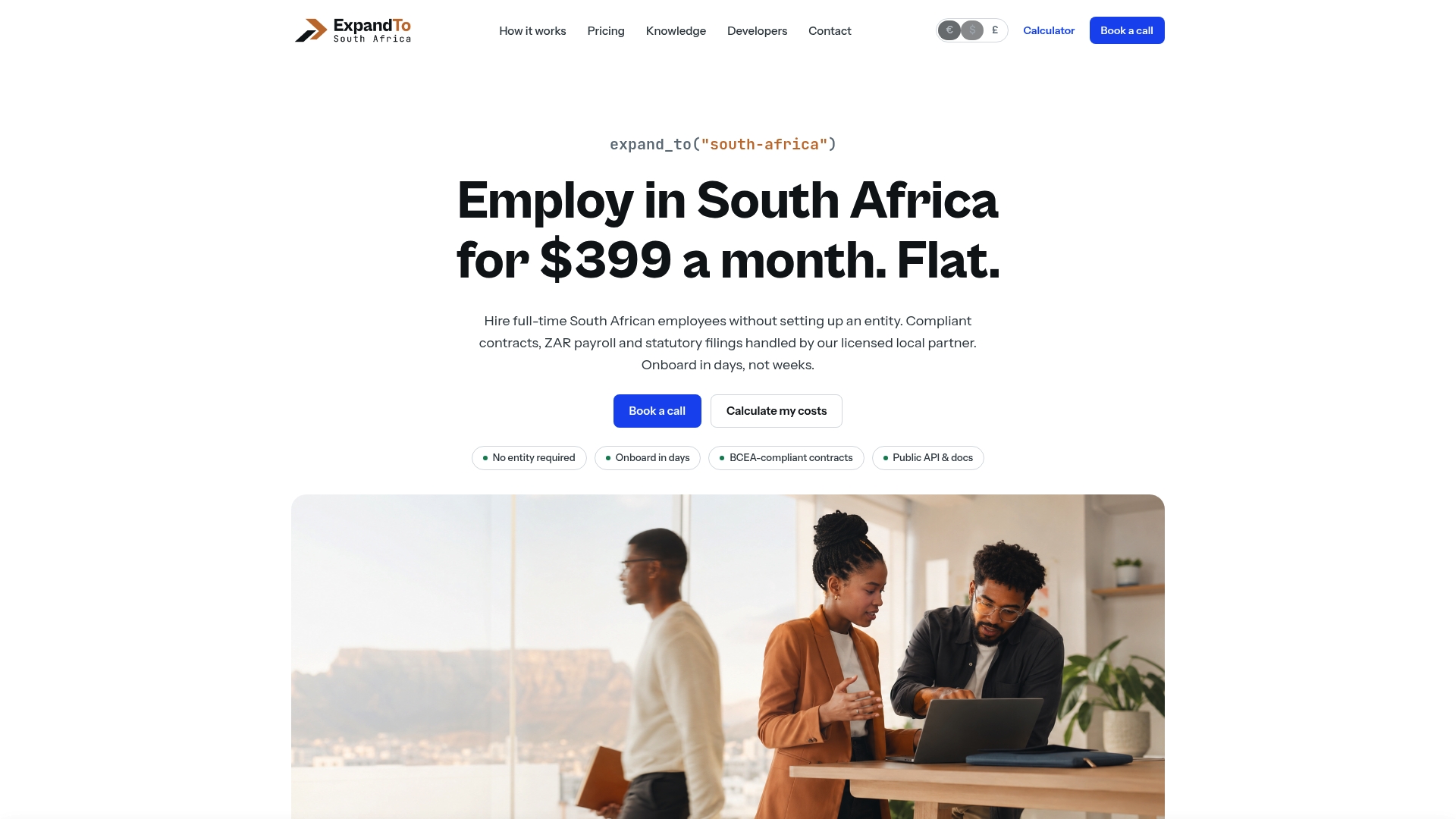
South Africa’s statutory framework is specific enough that compliance gaps from a generalist platform translate directly into financial and legal exposure. Expandtosouthafrica offers a flat monthly fee of €350 / $399 / £299 per employee, with no setup fees, no FX loading, and no hidden pass-throughs for UIF, SDL, or COIDA. Employment contracts are BCEA- and LRA-compliant, signed within 48 hours, and delivered through a licensed local partner who handles every EMP201 filing with SARS. Data is managed under both POPIA and GDPR with EU data residency.
To get started, you will need the candidate’s details, desired start date, and compensation package. From there, Expandtosouthafrica handles the rest: statutory registrations, contract drafting, payroll setup, and ongoing compliance. Use the employment cost calculator to model your total employer cost before your first conversation, then visit the EOR services page to request a quote or begin onboarding.
Useful sources for verification and further research
- SARS: PAYE, EMP201, and employer obligations — primary source for monthly filing requirements, UIF and SDL thresholds, and penalty rules
- Department of Labour: LRA deeming provisions and contractor classification — consult for contractor-to-employee reclassification risk and earnings thresholds
- Bowmans: EOR risks and permanent establishment in South Africa — legal analysis of PE exposure and co-employer findings under South African case law
- HRSpot: EOR vs. TES and how EOR works in South Africa — practical explanation of EOR model distinctions, including the difference from labour brokers
- Reypath: When is an EOR the right choice? — practitioner guidance on scale thresholds, contractor conversions, and cost crossover points
- Expandtosouthafrica: Complete EOR Guide for International Businesses (2026) — detailed legal references, BCEA/LRA/COIDA rates, and employment cost comparisons
- Expandtosouthafrica: PEO in South Africa — for readers evaluating the co-employment model and entity-based approaches
- Expandtosouthafrica: Payroll services — details on EMP201 filing procedures and ZAR payroll handling