

For international founders and HR leads hiring in South Africa, the right Rippling alternative is a single-country Employer of Record (EOR) specialist with direct SARS registration, CCMA-aware dismissal processes, and ZAR payroll. Broad global platforms like Deel, Remote, and Multiplier cover 150+ countries, but that breadth often means layered third-party partners handling your PAYE, UIF, SDL, and COIDA filings rather than a licensed local entity doing it directly. Expandtosouthafrica operates exclusively in South Africa, delivering BCEA-compliant contracts, statutory filings, and onboarding within days at a flat monthly fee per employee, with no setup costs or FX loading.
Table of Contents
- Which Rippling alternatives actually work for South Africa?
- How do you choose the right EOR for South Africa?
- What South African compliance actually requires from an EOR
- Pricing explained: monthly fee vs real total cost-per-employee
- Moving from a broad HR platform or another EOR to a South Africa specialist
- Data residency, POPIA, and GDPR: what to check for
- When should you pick a South Africa specialist?
- How we built the comparisons and cost examples
- Key takeaways
- Why the “global EOR” default costs more than you expect
- Expandtosouthafrica: South Africa EOR without the complexity
- Authoritative sources and further reading
Which Rippling alternatives actually work for South Africa?
The table below maps the four provider archetypes you will encounter when evaluating Rippling competitor software for a South Africa hire.
| Category | Monthly fee (per employee) | Statutory depth (SA) | Payroll currency | Onboarding speed | Data residency |
|---|---|---|---|---|---|
| Single-country SA specialist | Flat fee | PAYE, UIF, SDL, COIDA, BCEA, CCMA | ZAR (local) | Contracts within a couple of days | POPIA + GDPR, EU residency |
| Global EOR platform | $400–$599 | Varies; often third-party partner | USD billed, ZAR paid | 1–3 weeks | Varies by vendor |
| HRIS with payroll module | Quote-only | Limited SA statutory depth | USD/local | 2–6 weeks | Varies |
| Contractor-first platform | — | Contractor only; no EOR | Multi-currency | Fast (no employment) | Varies |
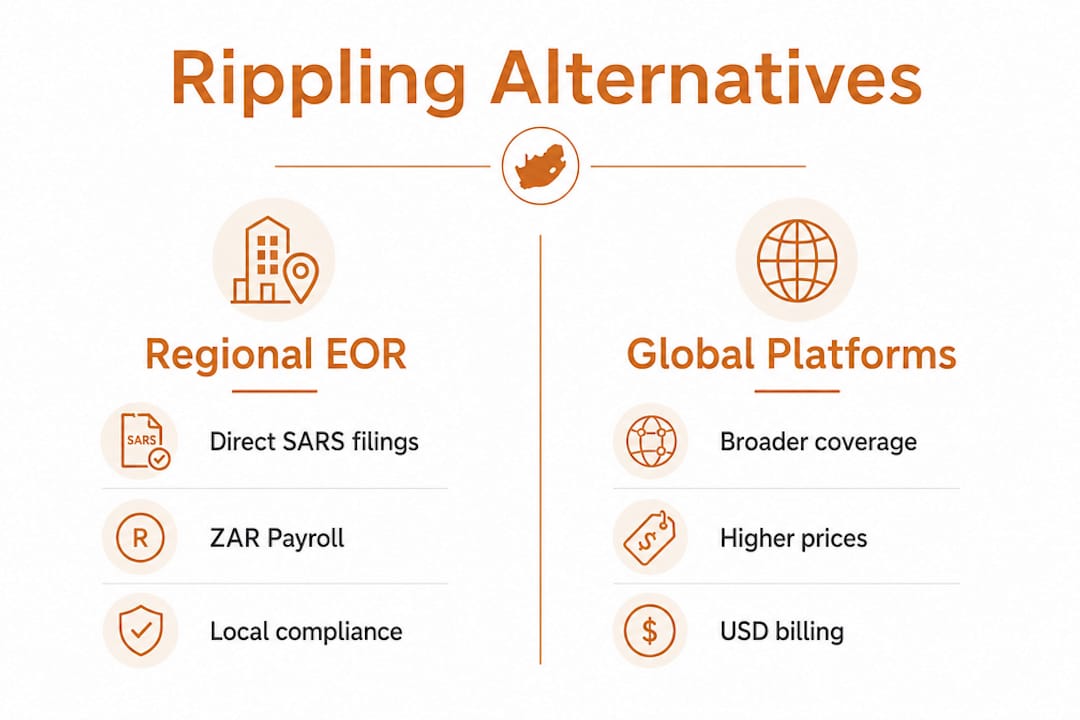
Regional EOR specialists win for single-country hires because they maintain direct relationships with local labor offices and tax authorities, which lowers compliance risk and speeds up document production.

Pro Tip: When a vendor quotes a monthly fee, ask specifically: “Does that include employer statutory contributions (UIF, SDL, COIDA), or are those billed separately?” A $450 headline fee can become $600+ once statutory add-ons appear on your first invoice.
How do you choose the right EOR for South Africa?
Matching your specific operational need matters more than picking the platform with the longest feature list. Use this checklist during shortlisting.
Decision criteria checklist:
- Statutory depth: can the vendor produce SARS EMP201 receipts, UIF returns, and a COIDA certificate on request?
- Payroll currency: does the platform pay employees in ZAR, or does it convert from USD on each cycle?
- Pricing transparency: is the monthly fee flat, or modular and quote-based with add-ons for legal, sourcing, and termination?
- Local liability: who is the legal employer of record? Is that entity licensed in South Africa?
- SLA commitments: what is the documented contract-signing turnaround and first-payroll date?
- API and integrations: does the vendor offer a documented REST API with sandbox access?
- Benefits flexibility: can you customize medical aid, pension, and leave structures?
- Scalability: are there minimum headcount requirements or exit penalties?
Questions to ask in a 20–30 minute vendor call:
- Who legally employs our South African staff, and can you share that entity’s registration documents?
- What is your documented timeline from contract signing to first ZAR payroll disbursement?
- How do you handle CCMA referrals and dismissal processes under the LRA?
- Can you provide a sample PAYE payment receipt and a current COIDA certificate?
- Where is employee personal data stored, and do you hold a signed data processing agreement?
Red flags that should remove a vendor from contention: opaque success fees disclosed only at invoice stage; USD-only billing with no FX protection mechanism; inability to produce statutory filing evidence; no documented POPIA or GDPR commitments.
What South African compliance actually requires from an EOR
An EOR operating in South Africa must perform a specific set of statutory tasks. Global platforms that rely on layered third-party partners for local compliance often struggle to produce source documents quickly and accurately.
| Statutory item | What the EOR must deliver | Key deadline / cap |
|---|---|---|
| PAYE (EMP201) | Monthly withholding and SARS submission | middle of following month |
| UIF | Employee + employer contributions declared to SARS | Monthly with PAYE |
| SDL | 1% of leviable amount submitted to SARS | Monthly with PAYE |
| COIDA | Annual return of earnings; employer liability cover | March annually |
| BCEA / LRA | Compliant written employment contract; minimum conditions | At contract signing |
| CCMA | Documented dismissal process; fair procedure evidence | Before any termination |
Pro Tip: Request a sample PAYE payment receipt (EMP201 confirmation from SARS), a current COIDA certificate of good standing, and the local partner’s company registration number. Any credible EOR can produce these within 24 hours.
Pricing explained: monthly fee vs real total cost-per-employee
Vendor-published pricing is frequently modular and quote-based; the headline number rarely reflects what you will actually pay. Here is how to build a realistic monthly employer cost.
- Start with the base EOR fee. For Expandtosouthafrica, that is $399 flat per employee per month, with no setup fee.
- Add employer statutory contributions. In South Africa, employer contributions include UIF (1% of remuneration, capped), SDL (1% of leviable amount), and COIDA (rate varies by industry risk class). These are calculated on the employee’s ZAR gross salary.
- Add agreed benefits. Medical aid employer contributions, group life, and pension fund contributions are negotiated per employee and added to the monthly cost.
- Account for FX. USD-billed platforms that execute payroll in ZAR expose you to exchange-rate movement on every payroll cycle. A ZAR-billed or flat-USD specialist locks your cost in advance.
- Include sourcing fees if applicable. Recruitment success fees are typically a percentage of annual salary and billed once at placement.
- Factor termination costs. Statutory severance under the BCEA is one week’s pay per completed year of service; CCMA-related settlements can add to this.
Pro Tip: Use Expandtosouthafrica’s public employment cost calculator to model total employer cost in ZAR before your first vendor call. It includes statutory contributions and shows the 40–60% salary saving versus equivalent UK or EU roles.
Moving from a broad HR platform or another EOR to a South Africa specialist
Transferring employees from a global EOR to a specialist is straightforward when you follow a structured sequence. Expandtosouthafrica offers free transfers from other EOR providers.
- Export employee records from the current platform: personal data, payroll history, PAYE records, and benefit elections.
- Notify the outgoing EOR of the transfer date and confirm final payroll cycle and tax reconciliation responsibilities.
- Sign the new EOR service agreement. With Expandtosouthafrica, contracts are ready within 48 hours of receiving employee details.
- Execute BCEA-compliant employment contracts with the new employer of record entity.
- Align payroll cut-off dates so the employee receives no gap or double payment between cycles.
- Confirm first ZAR payroll disbursement date and communicate it to the employee.
Common migration risks include misaligned payroll cycles that create a payment gap, outstanding PAYE reconciliations from the prior provider, and employee notice period obligations. Confirm the outgoing EOR’s final tax submission date in writing before the transfer date.
Pro Tip: Ask the outgoing EOR for a written confirmation of all PAYE and UIF submissions up to the transfer date. This protects you if SARS queries arise after the transition.
Data residency, POPIA, and GDPR: what to check for
US-based companies processing South African employee data must satisfy both POPIA (South Africa’s data protection law) and, where EU nationals are involved, GDPR obligations.
Checklist before signing any EOR agreement:
- Is employee personal data stored in the EU or in a jurisdiction with an adequacy decision?
- Does the vendor have a signed data processing agreement (DPA) ready to execute?
- Has the vendor appointed an Information Officer under POPIA?
- Are cross-border data transfers covered by standard contractual clauses or equivalent safeguards?
- What is the vendor’s documented data retention and deletion policy?
- Has the vendor completed a SOC 2 Type II audit or equivalent, or can they provide an audit summary?
Expandtosouthafrica stores data under POPIA and GDPR with EU data residency, and provides a DPA at contract stage.
When should you pick a South Africa specialist?
Choose a single-country specialist when:
- You need CCMA/LRA-safe dismissal guidance and documented fair procedure.
- ZAR payroll predictability is a financial control requirement.
- You want direct statutory filings (not third-party relayed) with source documents on demand.
- Fast onboarding (contracts in 48 hours, first payroll within days) is a business requirement.
- Transparent flat pricing matters for budget forecasting.
Keep a global EOR if:
- You need a single contract covering 10+ countries simultaneously and can accept layered local partners.
- South Africa is one of many markets and statutory depth is less critical than consolidated vendor management.
For South Africa specifically, the compliance depth of a specialist consistently outweighs the convenience of a single global contract, particularly once CCMA exposure or SARS audit risk enters the picture.
How we built the comparisons and cost examples
Assumptions used in the cost examples:
- Salary bands reflect mid-market skilled roles (software developers, finance analysts, operations leads) in South Africa.
- Employer statutory contributions include UIF, SDL, and COIDA at published SARS rates.
- FX scenarios use illustrative USD/ZAR rates for methodology purposes only; actual rates vary.
- Sourcing fees and bespoke recruitment costs are excluded from base calculations.
Sources selected for credibility:
- South African statutory rules: SARS published rates, BCEA and LRA text, COIDA schedules.
- Industry analyst commentary: Gartner Peer Insights for vendor evaluation signals; editorial roundups for category framing.
- Vendor-published fee structures: Expandtosouthafrica’s public pricing page.
Vendor-specific discounts, negotiated enterprise rates, and bespoke recruitment fees are excluded because they are not reproducible across buyers.
Pro Tip: When reviewing any comparison guide, check whether the author separates EOR platforms from HRIS tools and contractor-first platforms. Mixing these categories in a single ranked list obscures the statutory differences that matter most for full-time South Africa employment.
Key takeaways
For South Africa hiring, a single-country EOR specialist with direct SARS filings, ZAR payroll, and CCMA-safe dismissal guidance delivers more compliance certainty than a global platform at a comparable or lower total cost.
| Point | Details |
|---|---|
| Pick a specialist for statutory depth | Only a South Africa-focused EOR can produce PAYE receipts, UIF returns, and COIDA certificates on demand. |
| Compare total cost, not headline fee | Add employer statutory contributions, benefits, and FX risk to the base monthly fee before comparing vendors. |
| Validate POPIA and GDPR proof | Request a signed DPA and EU data residency confirmation before signing any EOR agreement. |
| Onboarding timelines matter | Contracts signed within 48 hours and first ZAR payroll within days reduce time-to-productivity for new hires. |
| Expandtosouthafrica flat fee | At $399 per employee per month with no setup fees, Expandtosouthafrica is the specialist option for South Africa. |
Why the “global EOR” default costs more than you expect
Most international teams default to a global EOR because it feels simpler. One contract, one invoice, one support team. That logic holds when you are hiring across a dozen countries simultaneously. For South Africa alone, it usually works against you.
Global platforms charge $400–$599 per employee per month for coverage across 150 countries. You are paying for breadth you do not need, and the local compliance layer is typically handled by a third-party partner the platform has contracted in South Africa. That partner relationship can introduce latency when you need a SARS receipt urgently, a COIDA certificate for a tender, or CCMA guidance on a performance dismissal. The platform’s support team often cannot answer South Africa-specific statutory questions directly.
South Africa offers significant salary savings compared to UK or EU roles, which is one of its strongest hiring arguments. Protecting that saving requires predictable employer costs, which means ZAR-denominated billing and direct statutory filings, not USD invoices subject to exchange-rate movement every month.
Expandtosouthafrica: South Africa EOR without the complexity
Hiring a full-time employee in South Africa does not require a subsidiary, a local accountant, or a global platform charging for 149 countries you will never use. Expandtosouthafrica delivers EOR services in South Africa at a flat $399 per employee per month, with BCEA-compliant contracts signed within 48 hours, ZAR payroll, and all statutory filings handled directly through a licensed local partner.
No setup fees. No FX loading. No hidden success fees buried in a modular invoice. POPIA and GDPR compliance with EU data residency is included as standard. If you are currently on a global EOR, transfers are free. Visit expandtosouthafrica.com to get a scoped cost estimate or start the onboarding process today.
Authoritative sources and further reading
- Expandtosouthafrica EOR services: Primary service page with pricing, onboarding SLA, and statutory filing coverage for South Africa.
- Employer of Record South Africa: Complete Guide: Deep-read for compliance methodology, cost modeling, and onboarding timelines.
- Payroll services in South Africa: Statutory filing detail including PAYE, UIF, SDL, and COIDA execution steps.
- Gartner Peer Insights: Rippling alternatives: Verified buyer reviews comparing EOR and HRIS platforms on evaluation, integration, and support.
- Remote hiring guide for South Africa: Practical scaling guidance for international teams adding South African headcount.
- South African employment law knowledge base: Statutory summaries covering BCEA, LRA, CCMA procedures, and employer cost benchmarks.
- Resume platforms and talent sourcing context: External perspective on talent-sourcing tools and their role alongside EOR services.