

Why do so many international firms stumble when entering the Rainbow Nation? It isn’t a lack of talent. It’s the assumption that South African labour law follows the same rules as the UK or Europe. In reality, the local legal landscape is pro-employee and highly regulated. You likely want access to the country’s skilled finance and IT sectors but worry about the complexities of UIF filings, SDL levies, and the 2026 Labour Law Amendment Bill. These hurdles often stall global expansion before it truly begins.
This guide helps you master these complexities. You’ll discover how to hire local staff compliantly without a local entity by using an employer of record South Africa. We provide a clear roadmap for navigating ZAR payroll and statutory filings while ensuring your monthly costs remain predictable. We’ll break down the R30.23 hourly minimum wage, the latest BCEA earnings thresholds, and how to manage the 2026 increase in statutory severance pay without the usual administrative burden. You’ll finish this guide with a definitive plan to onboard South African talent with total confidence and specialized local mastery.
Key Takeaways
- Understand how to legally hire full-time staff without registering a local entity whilst maintaining direct daily management of your South African team.
- Master the essentials of local payroll compliance, including mandatory SARS filings and the calculation of statutory UIF and SDL contributions.
- Learn why a specialised employer of record South Africa offers superior transparency and legal security compared to generalist global platforms.
- Identify the “percentage trap” in global EOR pricing and discover how flat-fee models provide predictable monthly costs for your business.
- Gain a clear roadmap for sourcing local talent and drafting employment contracts that align with the latest 2026 labour law amendments.
What is an Employer of Record in South Africa?
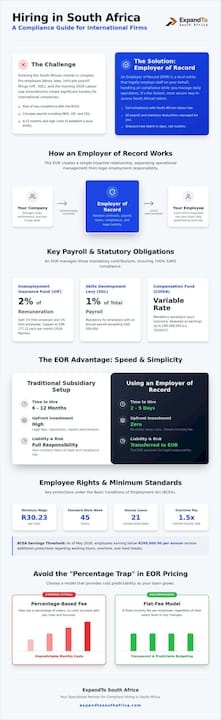
An employer of record South Africa is a local entity that assumes all legal responsibilities for your staff on your behalf. You retain full control over the employee’s daily tasks, performance, and output. Meanwhile, the EOR handles the heavy administrative lifting. This includes everything from drafting contracts to managing ZAR payroll and ensuring compliance with the South African Revenue Service (SARS). It is a strategic partnership that allows you to scale without the weight of local bureaucracy.
This arrangement creates a tripartite relationship. The EOR is the employer on paper. You are the operational manager. The worker is the local talent. This model is often compared to a Professional Employer Organization (PEO), but with a critical distinction: the EOR holds the full legal liability for the staff. It is a cleaner break for international firms that don’t want to deal with the complexities of a foreign legal system.
South Africa is a prime destination for global expansion. The Business Process Outsourcing (BPO) sector has seen annual growth of over 25% recently. This is driven by a highly skilled, English-speaking workforce in a time zone that aligns perfectly with Europe and the UK. Whether you’re looking for finance professionals or software developers, the talent pool is deep. Choosing an employer of record South Africa allows you to tap into this market in days rather than months.
The Legal Framework: EOR SA Ltd and Local Compliance
The EOR manages the statutory risks. They ensure every contract adheres to the Basic Conditions of Employment Act (BCEA). This is vital because South African labour law is notoriously pro-employee. As of May 2026, the BCEA earnings threshold is R269,600.90 per annum. Employees earning below this have specific protections regarding overtime and meal intervals. An EOR ensures you don’t accidentally breach these regulations. Your intellectual property and confidentiality are also protected through locally enforceable agreements.
When to choose an EOR over a Local Subsidiary
Setting up a local subsidiary in South Africa can take 6 to 12 months. It involves complex tax registrations and heavy legal fees. An EOR lets you bypass this. You can onboard a new hire in just a few days. It’s the most cost-efficient way to test the market. If the venture succeeds, you can consider a permanent footprint later. If not, you haven’t wasted months on entity dissolution. It is about speed, agility, and risk mitigation.
Navigating South African Labour Law and Statutory Obligations
South African payroll is not just about transferring funds. It is a high-stakes compliance exercise managed by the South African Revenue Service (SARS). Unlike generalist global platforms that might overlook local nuances, a specialised employer of record South Africa ensures every cent is accounted for through PAYE (Pay As You Earn). This system requires precise monthly deductions and filings. Any error here doesn’t just result in a fine. It triggers a relationship-damaging audit from the tax man.
Beyond income tax, you must manage three primary statutory contributions. First, the Unemployment Insurance Fund (UIF). This is calculated at 2% of remuneration, split equally between the employer and employee. For 2026, the monthly contribution is capped at ZAR 177.12 each. Second, the Skills Development Levy (SDL). If your annual payroll exceeds R500,000, you’ll pay a 1% levy to fund national training initiatives. Finally, there is COIDA. This mandatory insurance covers workplace injuries. For the 2026/2027 period, the earnings threshold for COIDA assessments is R668,000. Managing these variables manually is a recipe for disaster. Using a dedicated Employer Cost Calculator can help you visualise these statutory add-ons before you extend an offer.
Employee Rights and Entitlements in South Africa
The Basic Conditions of Employment Act sets the floor for worker rights. Standard working hours are capped at 45 hours per week. Anything beyond this requires overtime pay at 1.5 times the normal rate. Employees are entitled to 21 consecutive days of annual leave and generous sick leave provisions. You might hear about the “13th cheque.” It’s a common cultural expectation in South Africa, but it isn’t a legal requirement. It remains a discretionary bonus unless you’ve explicitly written it into the contract. A local employer of record South Africa will help you navigate these cultural expectations without creating accidental legal obligations.
Termination and Labour Relations
South Africa is not an “at-will” employment jurisdiction. You cannot dismiss staff without a valid reason and a fair process. If a dispute arises, it usually ends up at the CCMA (Commission for Conciliation, Mediation and Arbitration). This body is pro-employee and highly efficient. Notice periods vary based on length of service, ranging from one week for new hires to four weeks for those employed over a year. The 2026 Labour Law Amendment Bill has also increased statutory severance pay to two weeks’ remuneration per year of service. Procedural fairness is everything. Skipping a disciplinary hearing can lead to a costly reinstatement order or a maximum compensation award of 12 months’ salary.
Global EORs vs. Local Specialists: The Transparency Debate
Choosing an employer of record South Africa often comes down to a choice between global scale and local depth. Global platforms offer a single dashboard for 150 countries. This sounds efficient. However, it often masks a lack of regional expertise and a pricing model that punishes growth. Data from the World Bank’s Doing Business report highlights that local regulatory environments are complex. A generalist dashboard cannot replace a specialist who understands the specific nuances of South African tax law and labour relations. When a crisis hits, you don’t want an automated ticket system. You want a local expert who knows the CCMA procedures inside out.
The “Percentage Trap” is the most significant hurdle for international firms. Many global EORs charge between 10% and 15% of the employee’s total salary. For a high-skilled developer or finance manager, this fee becomes prohibitively expensive. It scales with the employee’s pay, not the administrative work required. A flat-fee model disrupts this. It provides predictable budgeting. You pay for the service, not a percentage of your talent’s hard-earned income. This transparency is essential for maintaining lean operations during a global expansion. It allows your finance team to forecast costs with total precision.
Pricing Models: Flat Fee vs. Percentage
ExpandTo South Africa operates on a fixed monthly fee of €350 per employee. Compare this to a global provider charging 12% on a €5,000 monthly salary. You are looking at €600 versus €350. The savings are immediate. Watch out for hidden costs elsewhere. Many providers bury onboarding fees, termination charges, and aggressive FX markups in the fine print. We believe in ZAR-denominated payroll with a fixed management fee. No surprises. Just clear, predictable costs. This approach prioritises your bottom line over corporate markups.
Technology and Integration
Modern HR teams need data, not just PDFs. Our specialised South Africa Employment API allows you to sync local payroll data directly with your global HRIS. This ensures real-time compliance monitoring across your entire organisation. Automating statutory filings removes the risk of human error. It creates a seamless bridge between your head office and your South African team. Technology should simplify expansion, not add another layer of manual data entry. It is about achieving efficiency through local mastery. Using an employer of record South Africa with a tech-first approach keeps your data clean and your audits painless.
Calculating the Total Cost of Employment in South Africa
Gross salary is only the starting point for your South African budget. To avoid financial surprises, you must calculate the Total Cost to Employer (TCE). This figure includes the base pay plus all mandatory and discretionary contributions. An employer of record South Africa ensures these calculations are accurate from day one, preventing the budget creep that often derails international expansions. What does a R50,000 monthly salary actually cost you? Usually, you should factor in an additional 10% to 15% for statutory contributions and basic benefits.
Budgeting for a new territory requires precision. You cannot rely on global averages when dealing with the South African Revenue Service (SARS). Every line item, from the national minimum wage of R30.23 per hour to industry-specific levies, must be accounted for in your financial forecasting. Failing to do so leads to friction with local staff and potential compliance audits. To get an immediate, accurate breakdown of these figures, you should use our Employer Cost Calculator before finalising any offer letters.
A Breakdown of Statutory Contributions
Statutory add-ons are non-negotiable. The Unemployment Insurance Fund (UIF) requires a total contribution of 2% of remuneration. This is split equally: 1% from the employer and 1% from the employee. For 2026, the monthly contribution is capped at ZAR 177.12 each, based on a ceiling of ZAR 17,712. You must also account for the Skills Development Levy (SDL). This 1% levy applies if your total annual payroll exceeds R500,000. Finally, workers compensation (COIDA) assessments are calculated based on your industry’s risk profile. For the 2026/2027 period, the annual earnings threshold for these assessments is R668,000.
Optional Benefits that Attract Top Talent
Base salary alone rarely secures the best talent in South Africa’s competitive BPO and IT sectors. Private medical schemes are the most requested benefit. Since public healthcare varies in quality, providing a subsidy for a private plan is a standard expectation for professional roles. Retirement funds, such as provident funds or retirement annuities, are also high on the priority list for local staff. Whilst remote work is a drawcard, it introduces new costs. Many firms now provide monthly allowances for high-speed data and backup power solutions. These “load-shedding allowances” ensure your team remains online and productive during national power outages. Including these in your TCE makes your offer far more resilient and attractive.
How to Hire and Onboard South African Talent with ExpandTo
Hiring in a new market often feels like a bureaucratic marathon. It doesn’t have to be. By partnering with a specialised employer of record South Africa, you move from the interview stage to a signed contract with surgical precision. Our process is designed for speed without compromising on the legal rigour required by local authorities. We handle the complexity so you can focus on the talent. You get the benefits of a local office without the administrative weight.
The journey begins with Talent Sourcing. We identify high-quality South African candidates through our integrated networks, ensuring they possess the specific cultural and technical fit your business requires. Next is the Compliance Check. We draft a contract that is fully compliant with the Basic Conditions of Employment Act (BCEA). This step is critical for protecting your intellectual property and ensuring all local labour standards are met. Payroll Setup follows. We organise ZAR payments and ensure all statutory tax registrations with SARS, UIF, and SDL are perfectly in order. Finally, Integration occurs. You manage your new team member through our employer of record South Africa service, using our South Africa Employment API to sync data with your global HRIS.
Fast-Track Onboarding: From Interview to Day One
ExpandTo South Africa reduces the traditional onboarding time to under 48 hours. This is made possible by our deep local presence and pre-vetted legal templates. If you also need help finding the right people, our specialist sourcing partner can find specialised skill sets in finance, tech, and operations. Once the candidate is selected, we handle the transition for remote workers. We ensure they have the necessary legal framework to work from home effectively, addressing the nuances of the local market such as equipment provision and data security.
Scaling Your South African Team
As your footprint grows, our platform scales with you. You can manage multiple employees under a single EOR agreement, simplifying your administrative burden. For modern, data-driven HR teams, our South Africa Employment API allows for programmatic management of your workforce. This means you can automate onboarding workflows and payroll data across your entire South African team. It is about building a sustainable, compliant team at speed. You gain a clear roadmap for growth without the administrative overhead or the 6-12 month delay of registering a local entity. We provide the mastery; you provide the vision.
Ready to hire? Calculate your costs or book a call with ExpandTo South Africa
Take Control of Your South African Expansion
South Africa’s skilled workforce is ready for your business. You don’t need to wait months for entity registration or fear the complexities of the 2026 Labour Law Amendment Bill. By using an employer of record South Africa, you eliminate the guesswork. You’ve seen how local mastery simplifies ZAR payroll and statutory filings. You’ve also learned why a flat-fee model protects your margins better than global platforms that hide costs.
It’s time to move from planning to action. We provide the legal framework through EOR SA Ltd and the technical tools with our specialised South Africa Employment API. This ensures your expansion is both compliant and data-driven. Stop worrying about non-compliance and start building your team today. Hire your first South African employee for a flat fee of €350/month. Your growth in the Rainbow Nation starts now.
Frequently Asked Questions
Is an Employer of Record legal in South Africa?
Yes, using an employer of record South Africa is entirely legal and governed by the Labour Relations Act. It is a recognised tripartite relationship where the EOR becomes the legal employer of record for tax and compliance purposes whilst you maintain daily operational control. This structure is a standard solution for international firms that need to hire local talent without the 6 to 12 month delay of registering a local entity.
How much does an EOR cost in South Africa?
EOR costs generally follow two distinct models: a percentage of the employee’s gross salary or a fixed monthly flat fee. Global generalist platforms typically charge between 10% and 15% of the total remuneration, which can become expensive as your staff receive raises. Specialised providers disrupt this by offering a transparent flat fee per employee. This model ensures your expansion costs remain predictable and prevents you from being penalised for paying your talent a competitive wage.
Do I need a local bank account to pay employees in South Africa?
You do not need a local bank account to pay your South African staff when using an EOR. The provider maintains the necessary local banking infrastructure and ZAR accounts required to distribute salaries and pay statutory bodies like SARS. You simply fund the payroll in your preferred currency, such as Euros or Pounds, and the EOR handles the currency conversion and local disbursements on your behalf.
What is the difference between a PEO and an EOR in South Africa?
The primary difference is the legal distribution of liability. A Professional Employer Organisation (PEO) usually operates on a co-employment model where you share legal responsibilities with the provider. An employer of record South Africa assumes 100% of the legal employer status. This means the EOR is solely responsible for compliance, payroll, and labour law adherence, which offers a much higher level of risk mitigation for foreign companies.
Can an EOR help with South African work visas?
Many EOR providers can facilitate work visa applications, but this depends on their specific corporate registrations with the Department of Home Affairs. South African immigration law requires the employer to prove they couldn’t find a local candidate for the role. If you plan to relocate foreign staff, you must ensure your EOR has the capacity to act as a corporate sponsor and can navigate the complexities of the 2026 immigration quotas.
What are the mandatory employee benefits in South Africa for 2026?
Mandatory benefits include 21 consecutive days of paid annual leave and statutory sick leave as defined by the BCEA. Employers must also contribute to the Unemployment Insurance Fund (UIF) and the Skills Development Levy (SDL) if the annual payroll exceeds R500,000. Coverage under the Compensation for Occupational Injuries and Diseases Act (COIDA) is also required. Whilst medical aid and retirement funds are not legally mandatory, they are standard expectations for skilled talent in the 2026 market.
How does the South Africa Employment API work?
The South Africa Employment API creates a secure digital bridge between your global HRIS and the local payroll system. It allows for the programmatic management of your South African team by automating data transfers for onboarding, salary adjustments, and statutory filings. This technology replaces manual spreadsheets with real-time data, ensuring your head office always has an accurate view of local employment costs and compliance status.
What happens if I misclassify an employee as an independent contractor in South Africa?
Misclassification can lead to severe financial penalties and forced back-payments. If the CCMA determines a worker is actually an employee, you may be ordered to pay up to 12 months of compensation plus all unpaid statutory contributions like UIF and PAYE. SARS also takes a dim view of misclassification and can launch audits that result in heavy fines. Using an EOR ensures your team is correctly classified under local law from day one.

Article by
ExpandTo Editorial Team
The ExpandTo Editorial Team is a group of writers and Employer of Record specialists who create practical, reliable content on global employment, labor law, compliance, payroll, and international hiring. Drawing on industry expertise and ongoing research, the team helps businesses understand complex employment requirements and expand into new markets with confidence.