

A grievance procedure is the written route an employee uses to raise a complaint, and the fixed steps you follow to hear, investigate and answer it. If you employ people in South Africa, the procedure has to be fair, documented and quick, because a mishandled grievance can end up at the CCMA (the Commission for Conciliation, Mediation and Arbitration, South Africa’s statutory dispute body) as an unfair labour practice or a constructive dismissal claim. Foreign employers who hire through our Employer of Record service, from £299 per month per employee, get BCEA-compliant contracts and CCMA-safe dismissal guidance from a team that works on South African employment only. The rest of this article gives you the procedure itself.
TL;DR
- A grievance is a worker’s belief that a right under law, contract, workplace rules or established practice was not respected. A pay request alone is not one.
- A fair procedure is written, easy to find, names who to contact, sets time limits at each stage, and offers a meeting, a written outcome and an appeal.
- Investigate on evidence from all sides, keep written records and protect the complainant from retaliation.
- In South Africa an employee has 90 days to refer an unfair labour practice to the CCMA and 30 days for a dismissal, so slow handling is expensive.
- Consultation rights (workplace forums, retrenchments) are a separate duty from individual grievances.
Table of Contents
- What counts as a grievance
- Grievance, disciplinary and consultation: three different processes
- Why a South African employee’s grievance carries legal weight
- What a fair written procedure contains
- The steps, with where each one goes wrong
- Timelines that work
- Records, confidentiality and protection from retaliation
- What the employee can do next
- The foreign employer’s blind spot: you are not on the ground
- Where a grievance leads to a disciplinary or dismissal question
- Promo: employing in South Africa without the compliance gap
- Perspective
- FAQ
- Sources
What counts as a grievance
The International Labour Organization defines a grievance as a worker’s belief that rights under law, contract, a collective agreement, workplace rules or established practice have not been respected. It separates this from an interest: asking for a higher salary or better equipment is a negotiation, not a rights complaint.
That distinction saves you time. When a South African employee says their overtime was not paid under the contract, or that a manager is bullying them, you are dealing with a grievance and must follow your procedure. When they ask for a raise, you have a compensation conversation. Many complaints contain both, so read what was actually said and log the rights element separately.
Typical grievances you will see with a remote team include:
- Unpaid or incorrectly calculated pay, leave or overtime.
- Bullying, harassment or discrimination by a manager or colleague.
- Unsafe working conditions or a refused leave request.
- Changes to duties or hours that the employee did not agree to.
- Unfair treatment in a disciplinary or performance process.
Grievance, disciplinary and consultation: three different processes
Founders often merge these, and the confusion produces mistakes.
| Process | Who starts it | What it decides |
|---|---|---|
| Grievance | The employee | Whether the employee’s complaint is valid and what remedy follows |
| Disciplinary | The employer | Whether the employee committed misconduct and what sanction applies |
| Consultation | The employer, before a decision | How proposed changes (restructuring, retrenchment) affect staff, after hearing their views |
The grievance route belongs to the employee. The disciplinary route belongs to you, and South African hearings carry their own rules, which we cover in our guide to the disciplinary hearing rules for South African employers. Consultation is a duty to listen before you decide. The UK’s Acas, for instance, says consultation must be a genuine two-way discussion in which you consider views and include affected employees, even those absent from work.
In South Africa, the Labour Relations Act requires that a workplace forum is consulted before proposals on specified matters, and that you answer its alternatives with reasons if you reject them. Workplace forums are a collective structure. They do not replace an individual’s right to raise a grievance, and the UK’s CIPD makes the same point: representative voice channels are distinct from individual grievance casework.
Why a South African employee’s grievance carries legal weight
South African employment law expects an employer to handle complaints fairly and promptly. The Labour Relations Act protects employees against unfair labour practices, and the CCMA hears these disputes. The deadlines are short and run against the employee’s side, which makes them a useful planning tool for you:
- Unfair dismissal: the CCMA says you have 30 days from the date the dispute arose to open a case.
- Unfair labour practice: 90 days.
- Discrimination: six months.
The Act allows late referrals for good cause (condonation), so do not assume a missed deadline closes the door. The practical point is the reverse: an employee who feels ignored has a quick, free route to a third party. A grievance that is acknowledged within days, heard properly and answered in writing is the cheapest dispute you will ever resolve.
A grievance that is ignored often turns into something larger. An employee who believes the employer made the job intolerable may resign and claim constructive dismissal. Our guide to avoiding dismissal errors in South Africa shows how those cases develop.
What a fair written procedure contains
South Africa has no single statute that dictates the wording of a grievance policy, so employers lean on the Labour Relations Act, its codes of good practice and the standards used in comparable systems. The UK government’s guidance lists what a written grievance procedure should say, and its list is a good checklist for any jurisdiction:
- Who to contact about a grievance and how.
- Time limits for each stage.
- A meeting, if informal resolution fails.
- An alternative contact if the usual person is involved in the complaint.
- The right to appeal.
- The right to be accompanied.
Ireland’s Workplace Relations Commission adds that a procedure should be in clear language, rational and fair, reviewed periodically and include an internal appeal. It also names three principles of fair procedure: representation, a chance to respond and an impartial decision.
Put the procedure in the employment contract or the staff handbook, and make sure the employee receives it on day one. If you are drafting contracts for a first South African hire, see our guide to employment contract drafting for South Africa, and the essential clauses worth including.
The steps, with where each one goes wrong
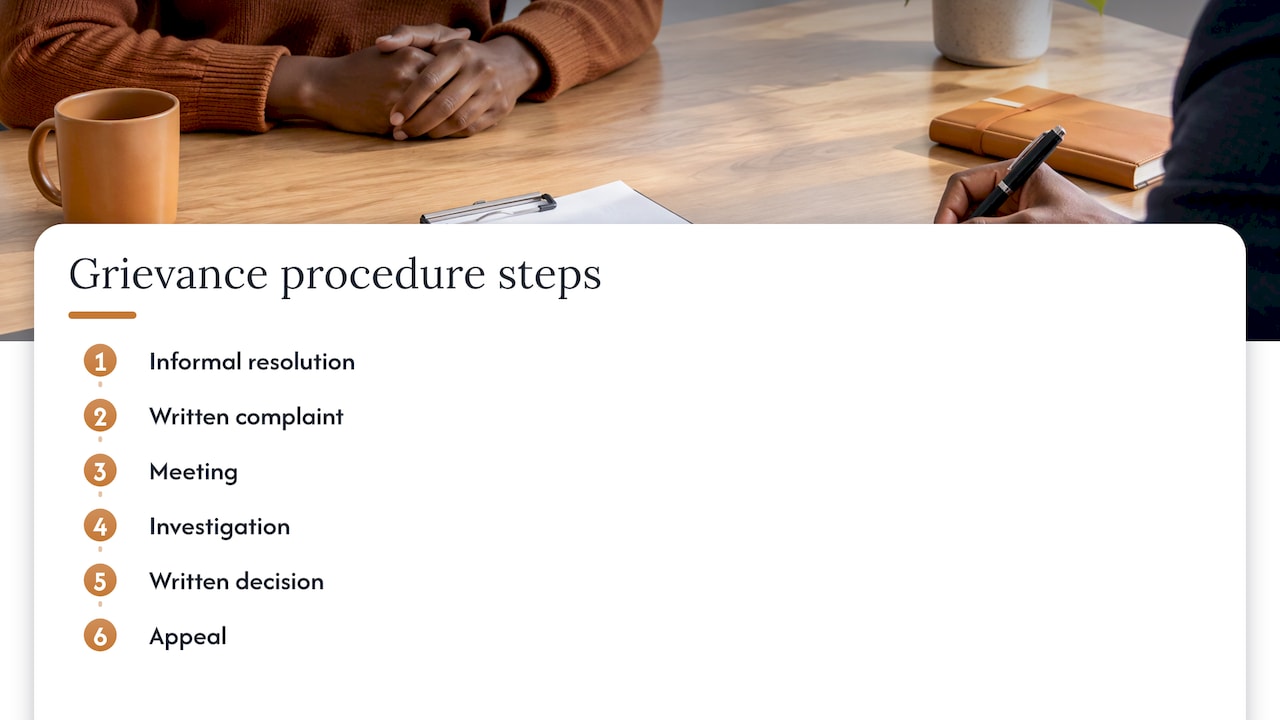
Step 1: Informal resolution
The employee raises the matter first with their direct manager, privately where possible. The Irish Code describes this as the normal starting point, with unresolved matters moving to more senior management or HR. Acas notes that informal resolution can preserve working relationships, but an employee may go straight to a formal grievance if informal steps failed, if they do not want informal handling, or if the matter is very serious, such as sexual harassment or whistleblowing, as set out in Acas’s formal grievance guide.
Where it goes wrong: a founder in Berlin or Austin who manages a South African employee directly may be the person the grievance is about. Name an alternative contact in advance, so the employee never has to complain to the person they are complaining about.
Step 2: Written complaint and acknowledgement
Ask for the grievance in writing, or write it down yourself with the employee and have them confirm it. Acknowledge it within a short, stated time, for example two working days. The point is a dated record: it fixes what was alleged and when the clock started.
Where it goes wrong: treating a chat message as informal chatter. If it describes a rights breach, it is a grievance, and the clock has started.
Step 3: Meeting
Hold a meeting that gives the employee a real chance to explain the concern. Acas says employers should allow a relevant companion; in the UK, that means a colleague or union representative. In South Africa, check your own policy and any collective agreement for who may accompany the employee, and apply it consistently.
Where it goes wrong: deciding the outcome before the meeting, or running it across time zones at an hour that suits you and not them. South Africa’s time zone sits within an hour of Central European Time, so there is no good excuse for a meeting at 6 a.m. their time.
Step 4: Investigation
Investigate fairly. Acas advises gathering evidence from all sides, not prejudging anyone, and not disciplining a person named in the grievance before you have the available evidence. If you need to separate people temporarily, for example with different schedules, explain that it is non-punitive and last only as long as the investigation.
Use someone who is not involved: a senior manager from another team, an HR adviser or an external investigator for serious allegations such as harassment.
Where it goes wrong: relying on one side’s account, or letting the accused manager lead the fact-finding.
Step 5: Decision in writing
Give the outcome in writing, with reasons and any action you will take. Where a grievance has merit, the U.S. Department of Labor says an effective mechanism should provide remediation, not just record a finding. Remedies can be back pay, a corrected schedule, an apology, a changed reporting line, or training for the manager.
Where it goes wrong: a vague answer such as “we looked into it and found no issue”. Say what you examined, what you found and why you reached that view.
Step 6: Appeal
Offer an appeal to a more senior, uninvolved person within a set period. The Northern Ireland Labour Relations Agency lists the same basic sequence: informal raising, formal notification, a meeting, a decision and an offered appeal. For a small company with no one senior to hear an appeal, a director or an outside person can do it, which matches Acas’s point that every employer should use a full and fair process adjusted to its size.
Mediation at any stage
Acas says mediation can be used at any stage: an impartial person works with both sides, and both must agree to it. It suits relationship breakdowns more than clear rights breaches such as unpaid wages.
Timelines that work
There is no universal statutory clock for each internal stage, so set your own and keep to it. A workable pattern for a small team:
| Stage | Target |
|---|---|
| Acknowledge the grievance | 2 working days |
| Hold the meeting | Within 5 to 7 working days |
| Written decision | Within 5 working days of the meeting, longer if the investigation is complex and the employee is told why |
| Appeal request window | 5 working days from the decision |
| Appeal decision | Within 10 working days |
These are our suggested targets, not statutory limits. Singapore’s TAFEP handbook asks for reasonable timeframes and defined escalation levels, and the reason is the same everywhere: the employee needs to know when to expect an answer. Keep the CCMA’s 30-day and 90-day windows in mind. A slow internal process does not pause them.
Records, confidentiality and protection from retaliation
Keep a file for every grievance: the complaint, the acknowledgement, meeting notes, evidence, witness statements, the decision with reasons, actions taken and any appeal. Acas recommends written records of the grievance, decisions and reasons, actions and appeals, and protection of personal information. For an approach to retention and access in a UK setting, see this guide to staff record-keeping requirements.
In South Africa, personal information in these files falls under POPIA, the Protection of Personal Information Act. Limit access to the people who need it, and do not share the complainant’s name or allegations with the wider team.
The Department of Labor’s guidance on grievance mechanisms says they should be confidential and secure, and protect against reprisal. In practice:
- Tell the manager involved, in writing, that retaliation is itself a disciplinary matter.
- Watch for changes to the complainant’s workload, ratings or hours after the grievance.
- Check in with the complainant once the outcome is delivered.
What the employee can do next
If the outcome is unsatisfactory, a South African employee can refer the dispute to the CCMA or the relevant bargaining council within the periods above. The Labour Relations Act text says condonation is possible for good cause, so a late referral is not automatically barred. The employee may also resign and argue constructive dismissal if they claim the employer made continued work intolerable.
This is why a documented, fair process helps you: an arbitrator will ask what you did, when, and whether the employee had a chance to respond. If your file shows an acknowledgement, a meeting, an impartial investigation, a reasoned decision and an offered appeal, you are on solid ground. If your answer is a chat thread that went quiet, you are not.
The foreign employer’s blind spot: you are not on the ground
A company in London or Boston employing a South African team remotely faces three particular risks:
- No local HR to receive the complaint. An employee may not know whom to approach, and a manager abroad may not recognize a grievance when it arrives.
- Mixed legal frameworks. A UK policy template borrowed from Acas guidance is a sensible base, but a South African employee’s rights run through South African law, the CCMA and the BCEA, the Basic Conditions of Employment Act.
- Unclear employer status. When an Employer of Record is involved, someone must be clear about who legally employs the person and who runs the process.
On the last point, we state plainly that our licensed local partner is the legal employer of the people you hire through us, and that disclosure is part of how we work. Our overview of South African labour law for foreign employers explains how the roles divide.
Where a grievance leads to a disciplinary or dismissal question
Some grievances reveal conduct problems, and some grievances are raised in response to a performance process. Keep the tracks separate: finish or pause one deliberately, record why, and do not use a disciplinary step to punish the complainant. If a grievance exposes misconduct, our misconduct dismissal compliance guide shows the route, and our template for final written warnings covers a common step along it. For performance disputes, see the six steps to a defensible poor performance dismissal. If a dispute ends in a CCMA settlement, the 14-day rule on settlement agreements matters for enforceability.
Promo: employing in South Africa without the compliance gap
If you are hiring your first South African employee or moving contractors onto proper employment, our Employer of Record service is priced at a flat €350, $399 or £299 per employee per month, with no setup fees or FX loading. It includes BCEA-compliant contracts, ZAR payroll and the statutory filings: PAYE, UIF, SDL and COIDA. We deliver signed contracts within 48 hours, and we offer free transfers from other EOR providers.

The single-country focus matters for the topic of this article. Our guidance on dismissals is built around what the CCMA expects, and the same South African context applies to how you treat complaints before they become disputes.
Perspective
We work on South Africa and nothing else, so we see the same pattern in how foreign founders approach employee complaints: they treat a grievance as an HR courtesy rather than a legal step. In South Africa it is a legal step. The employee has a short, accessible route to the CCMA, and the employer is judged on process as much as on the merits.
Our view is that a small company gains the most from a simple procedure that it actually follows: one named contact, one alternative contact, a written acknowledgement, a meeting, a reasoned decision and an appeal. Nothing in that list needs a large HR department. It needs the discipline to record each step and to apply South African rules, not a template imported from your home market.
This is why we built our service around one country. Local contracts, local payroll and CCMA-safe guidance on dismissals, together with open disclosure of who the legal employer is, mean you know where responsibility sits before a complaint ever arrives.
Roel
FAQ
What is the difference between a grievance and a complaint?
In everyday use they overlap. A grievance, as the ILO frames it, is a complaint that a right under law, contract, workplace rules or established practice was not respected. A request for a raise or new equipment is an interest, and you can handle it as a normal conversation.
How long does an employer have to respond to a grievance?
There is no single statutory deadline for each internal stage, so you set time limits in your written policy and keep to them. Acknowledge quickly, hold a meeting within about a week and give a written decision soon after. Remember that the employee can go to the CCMA within 30 days for a dismissal dispute and 90 days for an unfair labour practice.
Can an employee bring someone to a grievance meeting?
Acas says employers should allow a relevant companion, and the UK government specifies a colleague or trade union representative. In South Africa, set out in your policy who may accompany the employee and apply the rule consistently to everyone.
Are consultation rights the same as a grievance procedure?
No. Consultation means seeking and considering employees’ views before a business decision, such as a restructuring. Under the Labour Relations Act, a workplace forum must be consulted on specified proposals. A grievance procedure handles an individual’s complaint after something has gone wrong.
What should we do if the grievance is about the founder?
Name an alternative contact in your procedure, such as another director, an HR adviser or an outside investigator. The person the complaint concerns should not investigate it or decide it. Record who handled it and why.
Sources
- ILO: Grievance handling and access to remedy
- Acas: Formal grievance step by step
- Acas: Responding to a formal grievance
- Acas: Holding a consultation
- GOV.UK: Grievance procedure
- Workplace Relations Commission: Code of Practice on Grievance and Disciplinary Procedures
- Labour Relations Agency: Grievances
- U.S. Department of Labor: What is a Grievance?
- TAFEP: Grievance Handling Handbook
- CIPD: Collective employee voice report
- CCMA: Unfairly dismissed or unfairly treated at work
- Labour Relations Act, as amended