

Medical aid on payroll means recording contributions to a registered South African medical scheme on the employee’s payslip. The employee’s share is a deduction, the employer’s share is a taxable fringe benefit, and the scheme’s membership count drives a monthly tax credit that lowers PAYE. Get one of those three wrong and the employee’s tax certificate (IRP5) is wrong too.
This guide is written for foreign founders, HR leads and finance managers who are hiring in South Africa for the first time and have met the term “medical aid”, which is simply the local name for health insurance through a registered medical scheme. Everything below applies to South African employees on a South African payroll. It is not a rule for your home country.
TL;DR
- Employer-paid medical aid is a taxable fringe benefit equal to the employer’s full contribution. SARS reports it under code 3810 and adds it to the employee’s own contributions under code 4005.
- The medical scheme fees tax credit for the 2026/27 tax year is R376 per month for the taxpayer and the first dependant, and R254 for each additional dependant.
- Only contributions to a registered medical scheme qualify. Gap cover and other health insurance do not, and capturing them as medical aid understates PAYE.
- Whether the employer or the employee pays the scheme changes how the payslip is built and what proof of payment you need.
- Foreign companies can hand this payroll work to a licensed local employer of record rather than learning the codes themselves.
Table of Contents
- What “medical aid on payroll” means
- How the payslip shows employer and employee shares
- The medical scheme tax credit: current rates
- Four ways to set it up on the payslip
- Medical aid is not medical insurance
- When no taxable benefit arises
- What this means if you hire through an employer of record
- Perspective
- Pricing and next step
- FAQ
- Sources
What “medical aid on payroll” means
In South Africa, most private health cover is bought through a medical scheme registered under the Medical Schemes Act. Employees pay a monthly premium based on the plan and the number of people covered (the member and any dependants). Many employers pay part or all of it as a benefit.
Payroll has to reflect three separate things:
- The employee’s contribution, shown as a deduction from pay.
- The employer’s contribution, shown as a benefit that SARS (the South African Revenue Service) treats as income.
- The number of scheme members, which decides the size of the medical scheme tax credit.
If you are used to US payroll, the nearest comparison is a health plan premium split between employer and employee. The difference is the tax treatment: in South Africa the employer’s share is taxed as a fringe benefit, and the relief comes back as a fixed monthly credit rather than a pre-tax deduction.
How the payslip shows employer and employee shares
SARS’s employer guide for the 2027 tax year states that an employer’s medical scheme contribution on an employee’s behalf is a taxable fringe benefit, deemed paid by the employee. It is reported under code 3810 and added to the employee’s own contributions under code 4005.
The codes you will see most often:
| Code | What it records | Where it comes from |
|---|---|---|
| 3810 | Medical aid contributions by the employer (taxable fringe benefit) | Employer’s share |
| 4005 | Medical aid contributions paid and deemed paid by the employee, including the employer’s share | Employee’s share plus code 3810 |
| 4474 | Employer’s medical scheme contributions paid for the employee’s benefit | RSM’s IRP5 guide |
The point that trips up new employers is code 4005. Because SARS treats the employer’s contribution as if the employee paid it, the 4005 total on the year-end certificate is larger than what came out of the employee’s pay. If a certificate shows only the employee’s own deductions, it is understated and should be corrected before the employee files.
A worked example
This is an illustration, not a quote from any plan. Say a scheme premium is R6,000 per month for an employee, a spouse and one child, and the employer pays 50%.
- Employer share: R3,000, added to taxable income as a fringe benefit (code 3810).
- Employee share: R3,000, deducted from net pay.
- Code 4005 for the month: R6,000 (the R3,000 deducted plus the R3,000 deemed paid).
- Members on the scheme: three (employee plus two dependants). For 2026/27 that gives a monthly credit of R376 + R376 + R254 = R1,006.
The credit is subtracted from the PAYE calculated on the employee’s salary plus the R3,000 benefit. The employee ends up paying R3,000 for cover that costs R6,000, but is taxed on the R3,000 benefit and offset by the credit.
The medical scheme tax credit: current rates
The credit is a non-refundable rebate. SARS’s guide sets the 2026/27 tax year (1 March 2026 to 28 February 2027) at R376 per month for the taxpayer, R376 for the first dependant and R254 for each additional dependant. RSM’s 2026 tax guide lists the same amounts.
For comparison, tax specialist Mahomed Kamdar confirmed the 2026 tax year monthly credits as R364 for the taxpayer, R728 for the taxpayer plus one dependant and R246 for each additional dependant. He also notes that the credit cannot exceed the tax payable, cannot create a refund and cannot be carried forward.
Two practical consequences:
- Low earners may not use all of it. If PAYE before the credit is smaller than the credit, the unused portion is lost. Check the employee’s PAYE thresholds when you model their net pay.
- Rates change with the budget. The Minister of Finance can change amounts in the national budget, effective for 12 months, so confirm the figures each March. We keep a page on the medical scheme tax credit rates for employers.
Employees aged 65 and over, or with a disability
SARS’s guide on medical tax credits explains that an additional medical expenses credit can be applied in PAYE for taxpayers aged 65 or older. The portion an employer may apply is 33.3% of scheme fees above three times the medical scheme fees credit. Out-of-pocket expenses cannot be used in PAYE; the employee claims those on the annual return.
Four ways to set it up on the payslip
How you build the payslip depends on who pays the scheme and who contributes. The common scenarios are:
- Employer pays everything. The full premium is a fringe benefit and nothing is paid out to the employee.
- Employee has a private plan, no employer contribution. The employee pays the scheme directly. The employer can apply the credit in payroll only if the employee provides proof of payment, and the contribution is reported under code 4005 even though the employer does not pay it. Without proof, the employee claims the credit on their annual ITR12 return.
- Both contribute, employer pays the scheme. The employer pays the full premium to the scheme and deducts the employee’s share from pay.
- Both contribute, employee pays the scheme. The employer’s share is paid to the employee as an allowance, which is taxed in the normal way, and the employee pays the scheme.
Also expect cost-to-company packages. A payslip explainer from SAPayroll notes that many South African employers build a 50% medical aid contribution into total cost of employment rather than paying it on top of salary. If you are quoting a salary to a candidate, state clearly whether the figure includes the employer’s medical aid share. A candidate comparing offers may otherwise assume it is on top.
Medical aid is not medical insurance
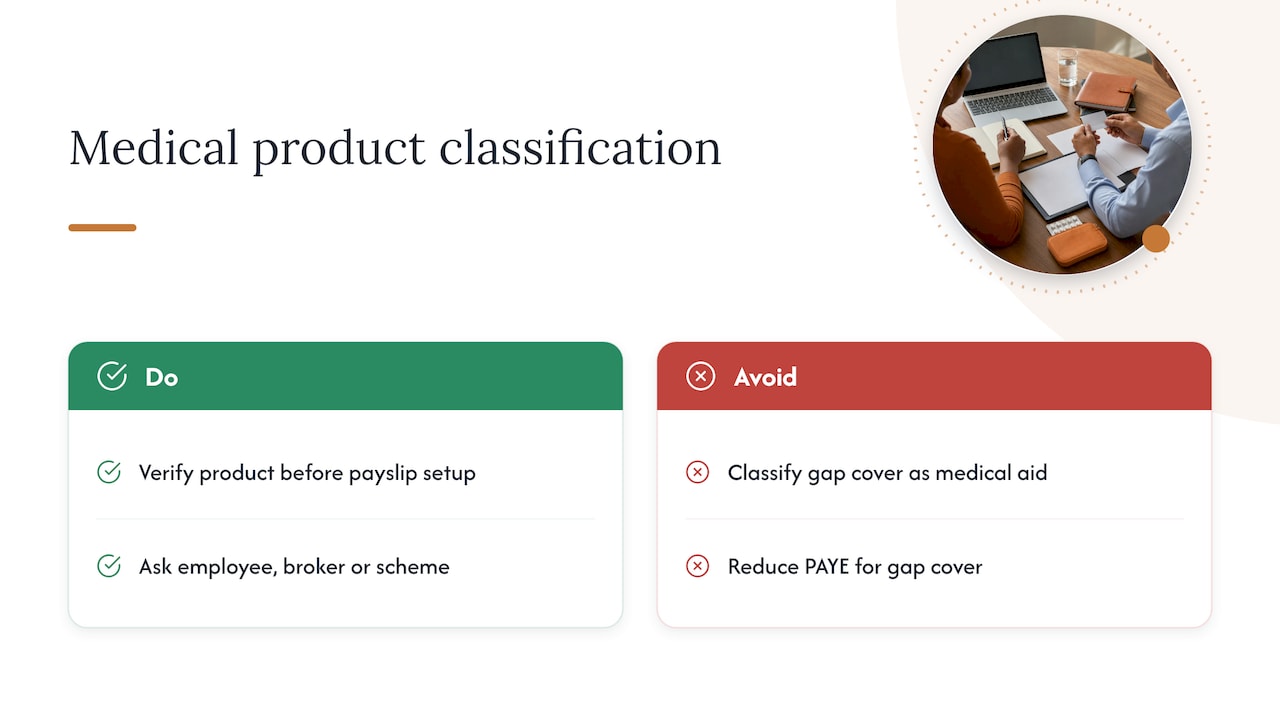
This is where payroll errors start. Only contributions to a registered medical scheme (or a qualifying foreign equivalent) attract the credit. Health insurance products, gap cover and contributions to unregistered funds do not, as Kamdar stresses in his article above.
If you capture a gap cover premium as medical aid, PAYE is reduced when it should not be, and the wrong codes land on the tax certificate. The employer is responsible for paying the right PAYE over to SARS, so confirm with the employee, the broker or the scheme which type of product it is before you set up the payslip item.
The same discipline applies to every payslip line. Teams that want a stronger grounding in payroll and financial records can use that guide as a reference for building clean routines.
When no taxable benefit arises
The taxable value generally equals the employer’s monthly contribution. According to Payspace’s 2026/27 payroll tax guide, no taxable value arises where the employee has retired due to age, ill-health or infirmity, or for dependants of a deceased or retired employee, under paragraphs 2(i) and 12A of the Seventh Schedule. These are narrow exceptions. For a standard full-time employee, assume the benefit is taxable.
SARS’s FAQ on deemed medical contributions adds that the employer’s contribution is both gross income and a contribution deemed made by the employee, so it counts toward the employee’s total when calculating the additional medical expenses credit on assessment.
What this means if you hire through an employer of record
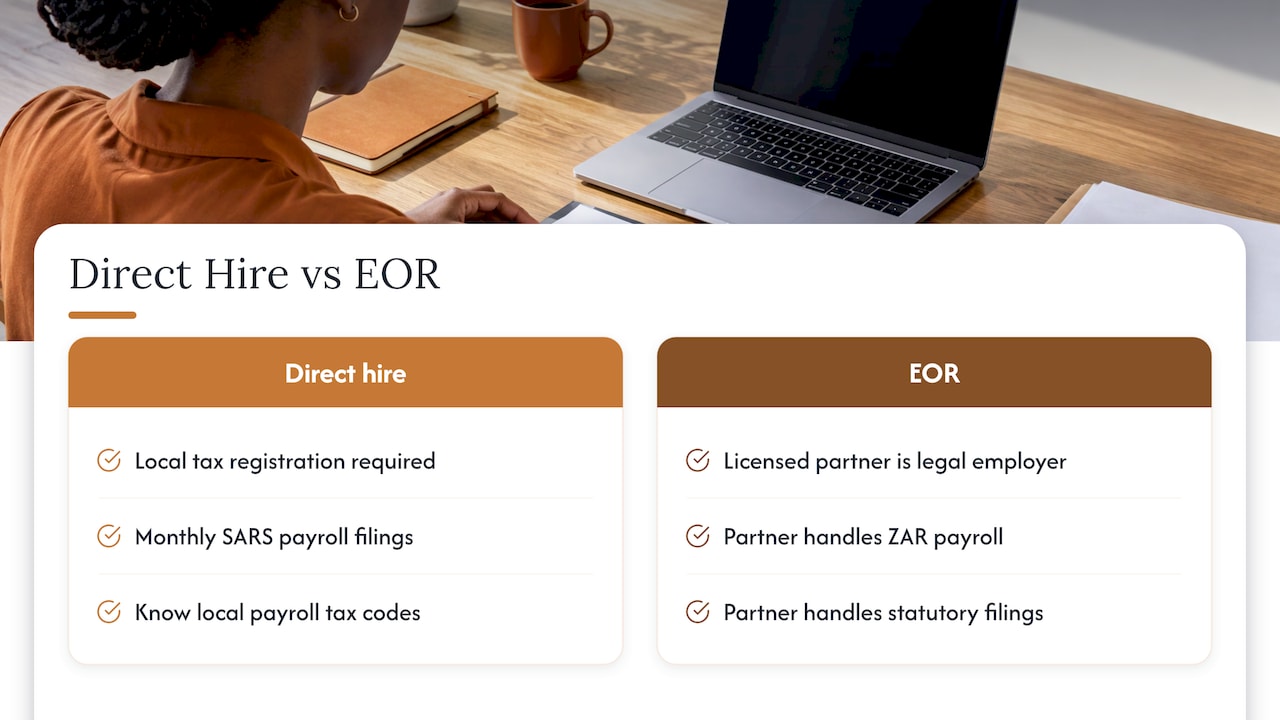
A foreign company that employs people in South Africa directly needs a local tax registration, a payroll that files monthly with SARS and a working knowledge of codes like those above. Our guides on South African employer taxes and registering for payroll taxes within 21 days show how much sits behind a single payslip.
With an employer of record (EOR), a licensed local partner is the legal employer. In our model that partner handles BCEA-compliant contracts, ZAR payroll and the statutory filings: PAYE through the EMP201 return with SARS, UIF, SDL and COIDA. If you want to offer a medical aid benefit, you agree the contribution level with us when the employment package is set, and it is the local payroll that has to reflect it correctly on the payslip.
For the wider picture, see our South Africa payroll and tax guide and our overview of payroll services in South Africa.
Perspective
Foreign employers usually ask about medical aid late, once an offer is already drafted. By then the question is no longer “should we offer it?” but “does the salary figure we quoted include it?” That single ambiguity causes more disputes than any tax code.
We run one country only, so these payslip details are our daily work rather than one of 150 country pages. Our view is simple: decide the medical aid contribution before the offer letter goes out, write it into the contract as part of the package, and let a local payroll that files with SARS every month apply the codes and the credit.
That is also why we charge a flat monthly fee per employee with no setup fees or FX loading. You should be able to budget the employer share of medical aid as a known line next to the fee, and not discover it at year end.
Roel
Pricing and next step
Our employer of record service in South Africa starts from £299 per month per employee. That covers the contract, the ZAR payroll and the statutory filings described above, with contracts signed within 48 hours and onboarding within days. You can see the full terms on our pricing page, or model the whole employment cost, including benefits, in our public employment cost calculator.

If you are comparing structures first, our guides to EOR cost in South Africa and EOR versus a local entity set out the numbers. If you already have South African contractors, converting them to employees is a good moment to set up their medical aid correctly from the first payslip.
FAQ
Is employer-paid medical aid taxable in South Africa?
Yes. SARS treats the employer’s contribution to a registered medical scheme as a taxable fringe benefit, valued at the full contribution. It is reported under code 3810 and is also deemed to be paid by the employee, so it counts toward code 4005. The employee then receives the medical scheme tax credit against PAYE.
How much is the medical scheme tax credit?
For the 2026/27 tax year (1 March 2026 to 28 February 2027), SARS sets it at R376 per month for the taxpayer and the first dependant and R254 for each additional dependant. The Minister of Finance can change these in the annual budget, so check them each March.
Can I put gap cover or health insurance on payroll as medical aid?
No. Only contributions to a registered medical scheme qualify for the credit. Gap cover and other health insurance products do not, and capturing them as medical aid would reduce PAYE incorrectly and put the wrong codes on the tax certificate.
What if the employee pays their medical aid directly?
You can apply the credit in payroll only if the employee gives you proof of payment, and the contribution is still reported under code 4005. If the credit is not applied in payroll, the employee can claim it on their annual ITR12 return.
Sources
- SARS: Guide for Employers in Respect of Employees’ Tax (2027)
- SARS: Guide on the Determination of Medical Tax Credits
- SARS: FAQ on deemed medical contributions
- RSM: Employee guide to your IRP5
- RSM: Tax Guide 2026
- Accounting Weekly: Claiming of medical tax credit in the 2026 tax year
- Payspace: South Africa Payroll Tax Guide 2026-27
- SAPayroll: Understanding your pay slip