

If you employ people in South Africa from the US, UK or EU, you will usually deal with two privacy laws at once: South Africa’s Protection of Personal Information Act (POPIA) for data processed in South Africa, and the EU’s General Data Protection Regulation (GDPR) where your organization or data flows touch the EU. The two overlap heavily, but they differ on who is protected, who is liable, and how data may cross borders. This guide shows where they meet in payroll and what to put in place.
TL;DR
- POPIA applies to personal information processed by means in South Africa, so South African payroll sits inside it whatever your home country.
- GDPR can apply on top when you are established in the EU or you monitor or offer services to people in the EU. EU headquarters handling staff data usually trigger it.
- Payroll providers are processors under GDPR and operators under POPIA. Under POPIA the responsible party keeps the ultimate liability, so a written data processing agreement matters.
- Cross-border transfers of payroll data need a lawful route on each side: adequacy, binding agreements or standard contractual clauses.
- POPIA’s maximum administrative fine is R10 million, and serious cases can also carry criminal liability.
Table of Contents
- When each law applies to your South African employees
- What counts as personal information in payroll
- How POPIA and GDPR differ for employers
- Payroll roles: who is responsible for what
- Moving payroll data across borders
- Breaches and penalties
- A working compliance checklist for payroll
- Our perspective
- Employer of Record support for South African payroll
- FAQ
- Sources
When each law applies to your South African employees
POPIA applies where a responsible party processes personal information using automated or non-automated means in South Africa, unless those means only forward information through the country, according to a Mondaq comparison of the two laws. A South African employee paid by a South African payroll is therefore covered, even when the company that directs the work sits in Austin, London or Berlin.
The same comparison explains that GDPR applies to processing carried out in the context of an EU establishment’s activities. It can also reach non-EU organizations that offer goods or services to people in the EU or monitor them. If your company is EU-based, your HR team’s access to South African payroll records brings the GDPR into the picture. If you are a US company with no EU establishment and only South African staff, POPIA is the primary regime, though your own contracts and group structure may still import GDPR standards.
A simple way to sort your situation:
| Your setup | POPIA | GDPR |
|---|---|---|
| US company, South African employees only | Applies to South African processing | Usually not, unless you also have EU staff or an EU establishment |
| EU or UK-linked group, South African employees | Applies to South African processing | Applies to the EU establishment’s processing; UK GDPR may be relevant for UK entities |
| Any company with EU-based HR or payroll staff handling the data | Applies | Applies to that processing |
We treat the table as a starting point. Group structure, where servers sit and who has access all change the answer, so confirm your position with a privacy lawyer in your home jurisdiction.
What counts as personal information in payroll
Both laws define personal information broadly, and payroll is full of it.
The European Commission says GDPR personal data covers any information relating to an identified or identifiable living person. Pseudonymized data stays personal data, while irreversibly anonymous data does not. The same page lists names, home addresses, company email addresses, ID card numbers, location data and IP addresses as examples, and it names staff management and payroll administration as processing activities.
For the South African side, Cliffe Dekker Hofmeyr’s employment guide says POPIA employment information includes salary, bank account details, personnel files, leave records, performance reviews and application forms. It adds that special personal information can include health, sick leave, criminal screening, biometric and union-related records.
In practice, a South African payroll file typically holds:
- identity and tax reference numbers, bank details and salary history
- leave and sick-leave records, which can reveal health information
- pension, medical aid or UIF-related records
- results of background screening, which are criminal-record data
- performance and disciplinary records
Treat the health, criminal and union items as the high-risk tier. Restrict access to named people, log who views them, and keep them out of general HR chat tools. Our guide to background checks in South Africa covers the screening side.
One point about records handled outside payroll: if you are a UK employer, your own staff files also carry employment data, for example pension enrolment records. The rules on auto enrolment duties for UK employers show how much sensitive employment information a single compliance task generates, and the same discipline applies to your South African files.
How POPIA and GDPR differ for employers
The principles are close: lawful processing, purpose limitation, minimization, accuracy, security and accountability. The differences that matter in payroll are these.
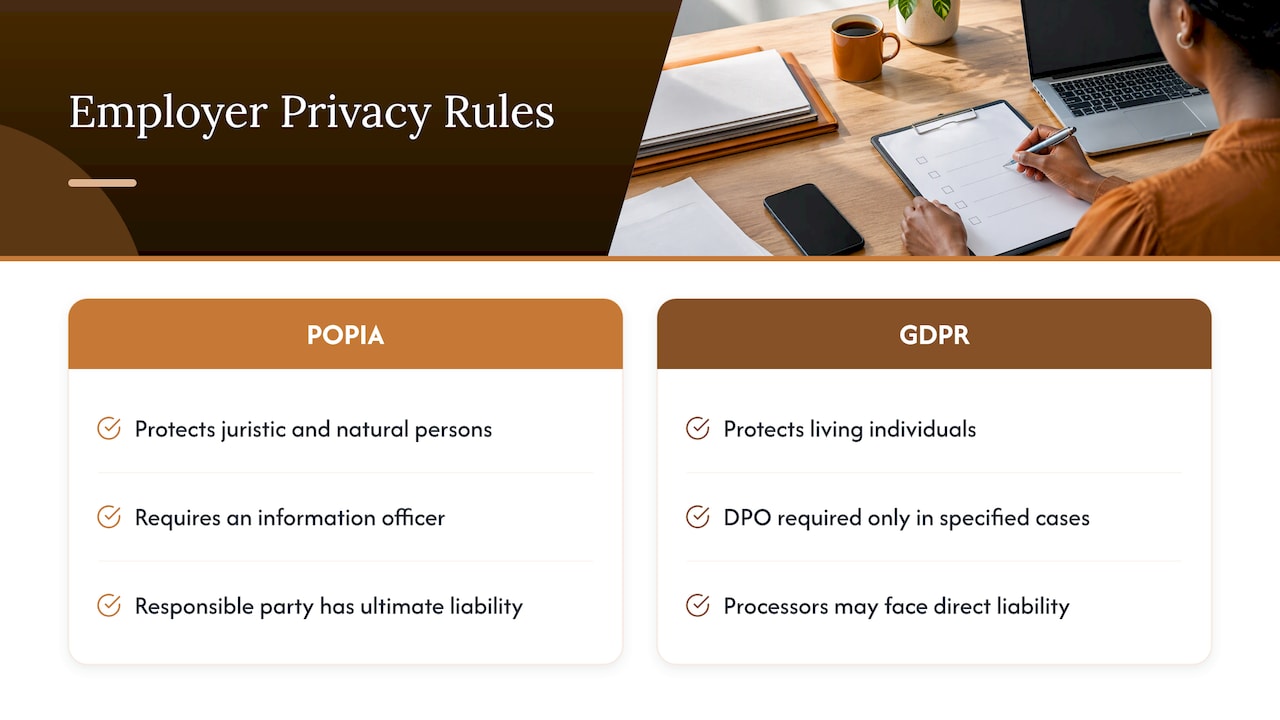
Who is protected. The IAPP’s comparison notes that POPIA protects information about juristic persons as well as natural persons, while GDPR is framed around living individuals. For payroll this affects supplier, contractor-company and client records that sit near your employee data. Treat company records with the same care.
Terminology and officers. POPIA speaks of responsible parties and operators; GDPR speaks of controllers and processors. The same IAPP piece says POPIA requires an information officer, whereas GDPR Article 37 requires a data protection officer only for specified organizations and processing situations. In South Africa, the head of a private body is the information officer by default, so name that person and register them with the Information Regulator.
Liability. DLA Piper Africa’s analysis says POPIA places ultimate liability for lawful processing on the responsible party, while GDPR processors can carry direct statutory liability, including compensation exposure when they fail processor-specific duties or act outside instructions. If you are the employer, your payroll provider’s mistakes can still land on you under POPIA. Choose the provider and write the contract accordingly.
What the GDPR covers. The Commission states that GDPR applies to automated processing and to manual processing in a structured filing system, whether records are electronic or on paper. That includes collection, storage, use, disclosure, restriction and erasure. A filing cabinet of South African personnel files held by an EU group is in scope.
Payroll roles: who is responsible for what
The European Commission identifies payroll companies and cloud providers as processors, and notes that one undertaking in a group may process data for another. Map the roles before you sign anything:
- The employer decides why and how employee data is used. It is the responsible party under POPIA and usually the controller under GDPR.
- The payroll provider processes salary and statutory filings on instruction. It is an operator under POPIA and a processor under GDPR.
- Sub-processors, such as cloud hosts, banks and HRIS vendors, work under the provider and need the same obligations passed down.
If you use an Employer of Record, the structure has an extra layer. A licensed local partner is the legal employer, and the platform handles processing for you. We always disclose who legally employs your people, because that determines who holds responsibility for the records. Your data processing agreement should state the roles, the purposes, the security measures, sub-processor approval, breach reporting and deletion on exit. Our payroll data processing agreement checklist walks through those clauses.
Moving payroll data across borders
This is where most teams slip. A South African payroll file that is mirrored to a US or EU HR system is a cross-border transfer under at least one law.
GDPR. The European Data Protection Board says transfers outside the EEA must meet Chapter V as well as the ordinary lawful-basis, minimization, security and processor-contract duties. The principal routes are adequacy decisions and appropriate safeguards, and safeguards include standard contractual clauses, binding corporate rules, codes of conduct, certification mechanisms and ad hoc clauses.
POPIA. A 2024 South African academic analysis of section 72 says a responsible party may transfer information abroad where the recipient is subject to adequate protection through law, binding corporate rules or a binding agreement, or where alternatives such as consent or contractual necessity apply. The same analysis observes that GDPR Article 46 offers a broader catalogue of safeguards. DataGuidance’s comparison adds that section 72 also permits transfers that benefit the data subject when consent is impracticable and likely would have been given.
What this means for you:
- Keep the master payroll record in one place and limit what you copy into your home HR system.
- Where a copy is needed, put a binding agreement in place that gives the recipient equivalent protection. For EU-origin flows, use standard contractual clauses.
- Do not rely on employee consent alone as the basis. Consent in an employment relationship is hard to show as freely given.
- Record each transfer, its route and the recipient in a simple register.
If you are connecting systems, our HRIS integration guide for South African payroll covers what to sync and what to keep local.
Breaches and penalties
On breaches, the EDPB’s guidelines state that GDPR Article 33(1) requires notification to the competent supervisory authority when a personal data breach has occurred and the conditions are met. POPIA has its own notification duty to the Information Regulator and to affected individuals. Build one incident plan that satisfies the stricter timing of the two, and name who decides whether a payroll incident is reportable.
On penalties, DLA Piper’s South Africa guide says failure to comply with a POPIA enforcement notice can lead to a fine or imprisonment of up to 10 years, or an administrative fine, with a stated maximum fine of R10 million. CMS’s guide confirms the R10 million ceiling and lists the wider exposure: complaints, Information Regulator audits or orders, civil and criminal proceedings. GDPR carries its own fine regime, set out in the regulation and enforced by EU supervisory authorities.
The practical lesson is that the cost of a payroll data incident is rarely the fine alone. It is the investigation, the notification work and the loss of employee trust, so prevention is cheaper than any penalty.
A working compliance checklist for payroll
Use this order when you set up or review South African payroll:
- Map the data. List every field you collect, why, where it is stored and who sees it.
- Set the roles. Document who is employer, who is processor or operator, and who are the sub-processors.
- Sign a data processing agreement with every party that touches payroll data.
- Appoint and register an information officer for the South African side, and a DPO where GDPR requires one.
- Choose a transfer route for each cross-border flow and record it.
- Limit special information. Health, criminal and union data get restricted access and shorter retention.
- Publish a privacy notice to employees explaining what you hold and why, before onboarding documents are collected. Our onboarding documents checklist shows what is normally requested.
- Write an incident plan with named owners, templates and contact details for the Information Regulator.
- Plan for exit. Decide retention periods and deletion when an employee leaves.
Our longer walkthrough, POPIA compliance for foreign employers, expands on each step. If you are an EU business, hiring in South Africa legally from the EU covers the structure questions around it.
Our perspective
Most privacy trouble in cross-border payroll comes from ambiguity, not bad intent. Nobody is sure who the legal employer is, which system holds the master record, or which law governs a copy of a payslip in a US inbox.
That is why we built Expand to South Africa around one country. We handle ZAR payroll and the statutory filings (PAYE through EMP201 with SARS, UIF, SDL and COIDA) through a licensed local partner, and we handle data under POPIA and GDPR with EU data residency. We state plainly who legally employs your people, so the responsibility map is clear from day one.
A single-country focus means we can tell you what the Information Regulator expects and what a South African payroll file should contain, without hedging across 150 jurisdictions. We think privacy is part of the employment service, not a legal footnote added after signing.
Roel
Employer of Record support for South African payroll
If you would rather not run payroll, contracts and data compliance yourself, our Employer of Record service covers them for from £299 per employee per month. That includes BCEA-compliant contracts, ZAR payroll and statutory filings, with no setup fees or FX loading. Contracts are designed to be signed within 48 hours, and onboarding follows within days.
If you already have contractors or an EOR elsewhere, we offer free transfers, and our payroll services page explains how the payroll side works. The ±1 hour time overlap with Central European Time also makes it easier to run privacy approvals and payroll cut-offs with your home team.
FAQ
Does GDPR apply to a US company with employees only in South Africa?
Not automatically. GDPR reaches organizations established in the EU, and non-EU organizations that offer goods or services to, or monitor, people in the EU. A US company with only South African staff is mainly under POPIA, but any EU entity, EU-based HR access or EU-origin data brings GDPR duties in too.
Is POPIA the same as GDPR?
No. They share core principles but differ in detail. POPIA protects juristic persons as well as individuals, requires an information officer, and leaves ultimate liability with the responsible party. GDPR is built around living individuals and gives processors direct obligations.
Can I send South African payroll data to my head office abroad?
Yes, if you have a lawful route. POPIA section 72 allows transfers where the recipient is bound by adequate law, binding corporate rules or a binding agreement, or where an alternative such as contractual necessity applies. If GDPR also applies, add the Chapter V mechanism, such as standard contractual clauses.
What is the maximum POPIA fine?
The stated maximum administrative fine is R10 million. Serious non-compliance can also lead to criminal proceedings and imprisonment of up to 10 years, according to published legal guides.
Sources
- Extraterritorial Application: GDPR vs POPIA (Mondaq)
- Application of the GDPR (European Commission)
- The Protection of Personal Information Act 4 of 2013 (Cliffe Dekker Hofmeyr)
- GDPR matchup: South Africa’s POPIA (IAPP)
- South African data protection law and third-party processing (DLA Piper Africa)
- International data transfers (EDPB)
- Cross-Border Data Flows and the Protection of Personal Information (SciELO South Africa)
- GDPR v. POPIA (DataGuidance)
- Guidelines 9/2022 on personal data breach notification (EDPB)
- Data Protection Laws of the World: South Africa (DLA Piper)
- Data protection and cybersecurity laws in South Africa (CMS)