

A South African hire through an Employer of Record (EOR) usually takes two to six weeks from signed offer to first day. The EOR’s own work, contract and payroll setup, takes days. The candidate’s notice period and any work visa decide the rest. If you plan around those two, not around the EOR, you will hit your start date.
This guide breaks the timeline into stages, shows what each one depends on, and gives you a working-backwards plan for US and European teams.
TL;DR
- EOR activation takes days, not weeks. We issue signed contracts within 48 hours, and full onboarding follows within days once documents are in.
- Notice periods are the real clock. A candidate who is currently employed in South Africa typically owes their employer between one and four weeks of statutory notice, and often more under their contract.
- Visas add roughly a month or more. Home Affairs publishes a four-week target for Critical Skills and General Work visas submitted inside South Africa. Local candidates need no visa.
- Start the EOR process at offer stage. Do not wait for the candidate’s resignation to be accepted. Contracts, documents and statutory registrations can run in parallel.
Table of Contents
- The short answer: how long South African EOR onboarding takes
- Stage by stage: what happens and how long it takes
- A working-backwards plan for your start date
- What delays onboarding, and how to prevent it
- Know who your legal employer is before you sign
- Our perspective: why single-country depth shortens the timeline
- How we onboard South African employees
- FAQ
- Sources
The short answer: how long South African EOR onboarding takes
Separate two clocks, because most published timelines blur them.
- Activation: the time the EOR needs to issue a compliant contract, collect documents, and register the employee for payroll and statutory purposes. This is days.
- Availability: the time before the candidate can legally and practically start. This is governed by notice, and by immigration where the candidate is not a South African citizen or permanent resident.
Other providers’ guides put the whole journey at about 4 to 6 weeks including candidate notice, with activation itself at 3 to 7 business days. Our own experience fits that pattern: we deliver signed contracts within 48 hours and complete onboarding within days, but we cannot shorten what a candidate owes their current employer.
| Scenario | Typical total time, offer to first day | Main driver |
|---|---|---|
| Freelancer or contractor converting to employee | 1 to 2 weeks | Documents and contract signature |
| Unemployed or between roles | 1 to 2 weeks | Documents and contract signature |
| Employed candidate, short notice | 2 to 4 weeks | Statutory notice |
| Employed candidate, one-month or longer contractual notice | 4 to 8 weeks | Contractual notice |
| Foreign national needing a work visa | 6 weeks or more | Visa processing |
These ranges are planning estimates drawn from the stage durations below, not guarantees. They assume documents arrive promptly.
Stage by stage: what happens and how long it takes
Stage 1: Offer and contract (1 to 3 days)
You agree salary, title, working hours and leave with the candidate. We then draft the employment contract. South African law requires written particulars at the start of employment: section 29 of the Basic Conditions of Employment Act lists the employer’s address, job description, remuneration, working hours and leave entitlements among the required details.
Because the contract is built on South African law from the start, there is no translation or adaptation of a foreign template. If you want to know which clauses matter before you negotiate, our guide to essential employment contract clauses for South Africa covers probation, restraint, confidentiality and intellectual property.
Our contract turnaround is 48 hours from your instruction. See how that works on our page about hiring in South Africa fast.
Stage 2: Document collection (2 to 5 days, candidate-dependent)
This is where most avoidable delay happens. The employee needs to supply:
- Full name as shown on their ID or passport
- South African ID or passport number and date of birth
- Residential address
- Contact number and email
- Bank account details for ZAR payroll
- SARS income-tax reference number
- Start date and employment type
- Details of any benefits or deductions
The list follows what SARS expects employers to hold: its 2027 employer tax guide requires records of full names, address, identity or passport number, date of birth, income-tax reference number, and remuneration and tax information. A payroll practitioner’s onboarding checklist lists the same practical items, plus bank details and benefits information.
A candidate who has never been taxed in South Africa will not have a tax reference number yet. That is the single most common reason a start date slips by a few days, so ask for it in the offer letter.
Stage 3: Statutory registration and payroll setup (2 to 5 days, runs alongside Stage 2)
With a traditional entity, you would register the employer for PAYE, UIF, SDL and COIDA yourself. Through an EOR, the licensed local employer already holds those registrations and adds your employee to them. Three obligations sit behind this step:
- PAYE and SDL are reported and paid monthly to SARS. Our guide to paying employees in ZAR explains the EMP201 deadline of the 7th.
- UIF: one provider states that registrations are finalized within 48 hours of receiving the application forms. Our UIF employer registration guide shows what US employers need to know.
- COIDA: section 80 of the Act requires employers to register with the Compensation Commissioner and give particulars of their business. We explain how coverage works in our COIDA guide for employers.
Because the legal employer is already registered, none of this blocks your start date. It only needs the employee’s details to be complete.
Stage 4: Notice period (0 to 8 weeks, the real variable)
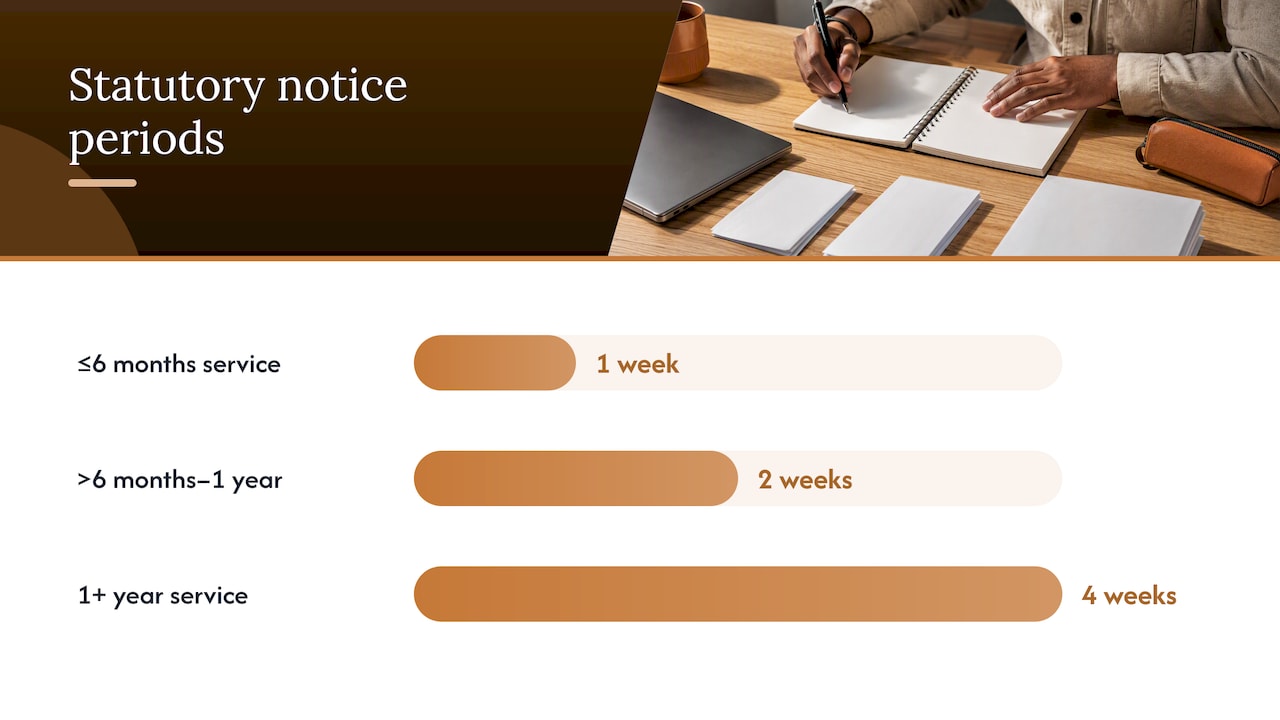
The statutory floor is set by section 37 of the BCEA. As summarized in a 2026 legal reference, the minimum is one week for service of six months or less, two weeks for more than six months up to a year, and four weeks for a year or more. Contracts can and often do ask for more, commonly a calendar month, and senior roles can carry longer terms.
Two practical points:
- Ask early. Put the question “what notice does your current contract require?” in the first call, not after the offer.
- Negotiate carefully. An outgoing employer can agree to shorten notice, but you should never pressure a candidate to breach their current contract. A candidate who leaves badly is a risk to your reputation in a small talent market.
If you are converting an existing contractor, this stage is zero. The person is already working for you, and the change is a legal switch of employer.
Stage 5: Work authorization (only if the candidate is not a citizen or permanent resident)
Most of our clients hire South African citizens, and for them there is no immigration step. If you want to hire someone who needs a permit, build in time. As of July 2026, a professional circular on Home Affairs processing times reports a four-week target for Critical Skills and General Work visas submitted within South Africa. Targets are not guarantees, and applications submitted from abroad can take longer. Confirm the current position with Home Affairs or an immigration practitioner before you promise a start date.
Stage 6: Day one and the first payroll
On the first day, the employee should already have a signed contract, working equipment or access, and a clear reporting line. The first payroll is run in ZAR on the cycle agreed in the contract, with PAYE, UIF and SDL calculated by the legal employer. If you use an HRIS, our practical guide to HRIS integration for South African payroll shows how payroll data flows back to your systems.
A working-backwards plan for your start date
Pick the date you want the employee to be productive, then count back.
- Day 0: verbal offer accepted. Ask for notice terms and the tax reference number. Instruct us the same day.
- Days 1 to 3: contract issued and signed. The candidate then resigns with the signed contract in hand, which protects both sides.
- Days 3 to 8: documents and registration. Collected in parallel with the candidate’s resignation.
- Weeks 1 to 4 or longer: notice runs. Use the time for equipment, accounts and a first-month plan.
- Final week: confirm payroll data and first-day logistics.
If you want a broader view of how a hiring sequence fits together before it reaches the EOR stage, this walkthrough of recruitment process steps is a good companion to the plan above.
A simple rule: add the candidate’s notice period to one week, and that is your earliest realistic start date for a South African citizen. For a visa case, add the visa target on top and leave a buffer.
What delays onboarding, and how to prevent it
| Delay | Typical cost | Prevention |
|---|---|---|
| Missing tax reference number | A few days | Request it with the offer |
| Name mismatch between bank, ID and contract | 1 to 3 days | Use the name exactly as on the ID |
| Contract edited several times | 2 to 5 days | Agree salary, leave and probation before drafting |
| Unclear notice period | Weeks | Confirm in the first call |
| Work visa | 4 weeks or more | Start before the offer if possible, or hire a citizen |
| Switching from another EOR | Days to a few weeks | Align the transfer date with a payroll cycle |
If you are moving existing employees from another provider, we handle transfers at no charge. The practical rule is to keep payroll uninterrupted: employees should never miss a pay date because of a change of employer on paper.
Know who your legal employer is before you sign
A fast timeline is only useful if the structure beneath it is sound. In an EOR arrangement, a licensed local entity is the legal employer: it signs the contract, runs payroll and files with SARS, while you direct the day-to-day work. We state this plainly because some buyers assume the platform itself is the employer. Our checklist on how to confirm the legal employer in South Africa lists six checks for US, UK and EU buyers. Run them before you pay anyone.
Our perspective: why single-country depth shortens the timeline
We see the same pattern in nearly every engagement. Companies expect the EOR to be the slow part, and it almost never is. The slow parts are a candidate’s notice period, a missing SARS number, or a founder who has not yet decided on the benefits package.
Because we only operate in South Africa, our contract templates, payroll calendar and statutory filings are built around one set of rules: the BCEA, the Labour Relations Act, COIDA and SARS requirements. That is why we can promise signed contracts within 48 hours. We are not adapting a generic template for 150 countries.
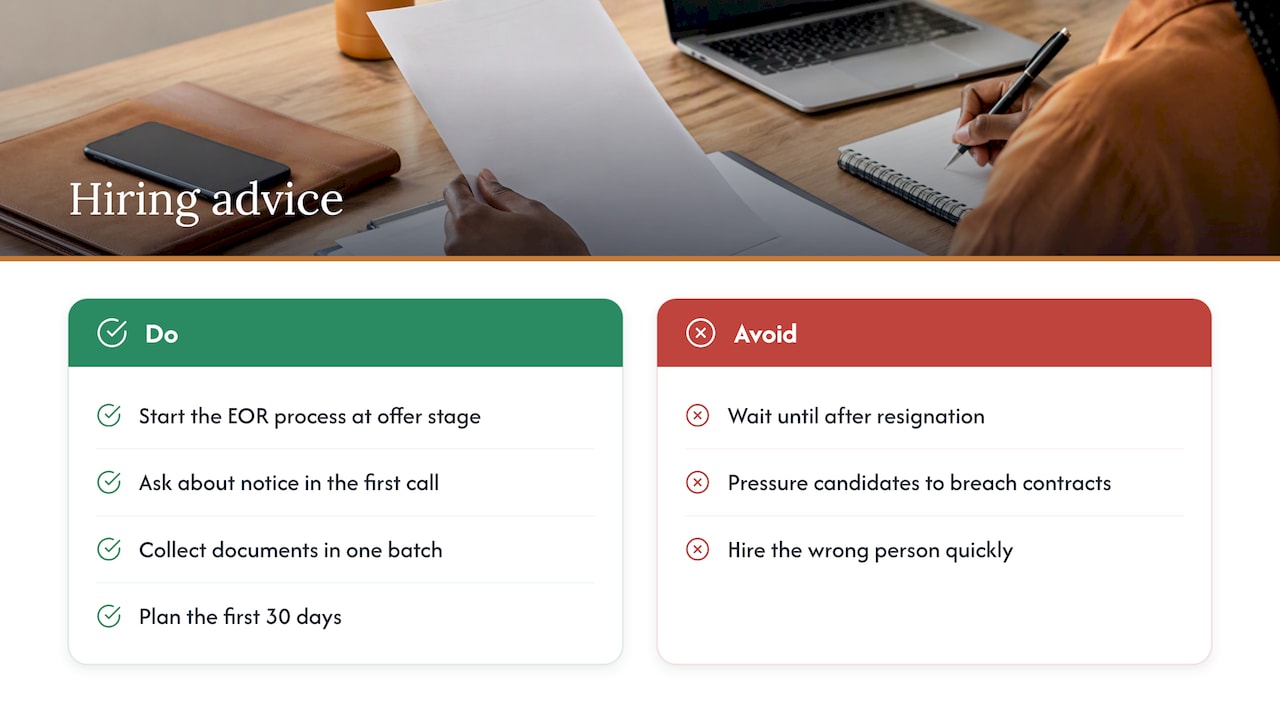
Our advice to first-time hirers is practical. Start the EOR process at offer stage, not after resignation. Ask about notice in the first call. Collect documents in one batch. And plan the first 30 days of the role as carefully as the paperwork, because the time zone is in your favor: South Africa is within about one hour of Central European Time, so European teams get a nearly full overlap, and US East Coast teams share the morning.
For skilled roles, employers commonly find salary costs 40 to 60 percent below UK or EU levels, which makes a four-week wait for the right person worth it. Hiring the wrong person quickly is a more expensive outcome.
— Roel
How we onboard South African employees
Our EOR service starts from £299 per employee per month, with no setup fees and no FX loading. That covers the BCEA-compliant contract, ZAR payroll, and the PAYE, UIF, SDL and COIDA filings described above. You can see the full terms on our pricing page, or read more about what our EOR service includes.
If you have not yet found the person, our talent sourcing service can shortlist vetted candidates, so the sourcing and employment steps run as one process. Our public employment cost calculator lets you model total cost before you make an offer.
FAQ
How long does it take to onboard an employee in South Africa through an EOR?
The EOR’s own steps take days: we issue contracts within 48 hours and complete onboarding within days once documents are in. The total time from offer to first day is usually two to six weeks, because the candidate’s notice period sets the pace. Contractors converting to employees can often start within one to two weeks.
Can we start the EOR process before the candidate resigns?
Yes, and you should. Contract drafting, document collection and payroll setup do not depend on the candidate leaving their current job. Most teams issue the signed contract first, and the candidate then resigns with it in hand.
How long does a work visa add?
For a non-South African candidate, Home Affairs publishes a four-week target for Critical Skills and General Work visas submitted inside the country, as of July 2026. Real timelines vary, so treat that as a minimum and check the current figures before fixing a date. Hiring a South African citizen or permanent resident avoids this step.
What documents does the employee need to provide?
The employee provides their ID or passport details, date of birth, address, contact details, bank account, SARS income-tax reference number, and any benefits or deduction information. Having these ready in one batch is the quickest way to avoid delay.
Sources
- Basic Conditions of Employment Act 75 of 1997
- SARS Guide for Employers, 2027 tax year
- Payroll Onboarding Checklist South Africa
- UIF registration information
- Compensation for Occupational Injuries and Diseases Act, section 80
- Notice periods in South Africa (BCEA s37)
- Visa processing times circular