

A final written warning is a written sanction that places an employee on final terms: if the same or similar misconduct happens again during the warning’s validity, dismissal may be justified, provided the employer followed a fair procedure. It is the last disciplinary step before termination becomes a reasonable outcome, and it carries legal weight only when it is issued correctly and promptly.
TL;DR:
- Issuing a final written warning must follow a fair process, including investigation, notice, hearing, and clear documentation of misconduct.
- The warning’s validity typically ranges from three to twelve months, depending on internal policy and the severity of the misconduct.
- The warning must explicitly state that repeat misconduct within the period may lead to dismissal, but dismissal is not automatic.
- Delays in issuing the warning weaken its deterrent effect and risk losing credibility in arbitration, making prompt action essential.
- Proper records and consistent treatment of employees are crucial to defending the warning and any subsequent disciplinary actions.
Table of Contents
- 1. What a final written warning covers and when it applies
- 2. Legal framework: Schedule 8, CCMA guidance and the Tiger Brands principles
- 3. When to issue a final written warning and how long it should last
- 4. How to draft a final written warning that holds up at the CCMA
- 5. Running the disciplinary process without exposing your business
- 6. Why speed matters more than severity in disciplinary decisions
- When managed payroll support takes the guesswork out of discipline
- FAQ
- Sources
1. What a final written warning covers and when it applies
A final written warning sits above a verbal warning and a written warning on the disciplinary scale, and below dismissal. It tells the employee, in writing, that their conduct is serious enough that a repeat during a defined period will likely end the employment relationship. This differs from a lesser written warning, which flags a problem without putting the employee on notice that their job is at risk.
Certain types of misconduct typically justify this sanction:
- Repeated lateness or absenteeism after earlier warnings failed to correct the behavior.
- Insubordination or refusal to follow a reasonable and lawful instruction.
- Breach of company policy, such as unauthorized use of company property or confidentiality violations.
- Poor performance tied to conduct, such as negligence that causes real operational harm.
A final written warning can also apply as a first sanction when the misconduct is serious but does not yet justify dismissal. Practitioner guidance generally frames this as conduct that falls short of outright dismissible behavior but is too serious to treat as a first-offense written warning. Fighting at work, dishonesty that falls short of theft, or a serious safety breach without injury are common examples where employers skip straight to a final warning.
2. Legal framework: Schedule 8, CCMA guidance and the Tiger Brands principles
South African discipline law rests on a single foundational idea: discipline should correct behavior, not simply punish it. Schedule 8 of the Labour Relations Act, the Code of Good Practice: Dismissal, promotes progressive discipline and requires both a fair reason and a fair procedure before any sanction is imposed. That means an investigation, proper notice of the allegations, a hearing, and a genuine opportunity for the employee to respond before a final written warning is issued, not after.
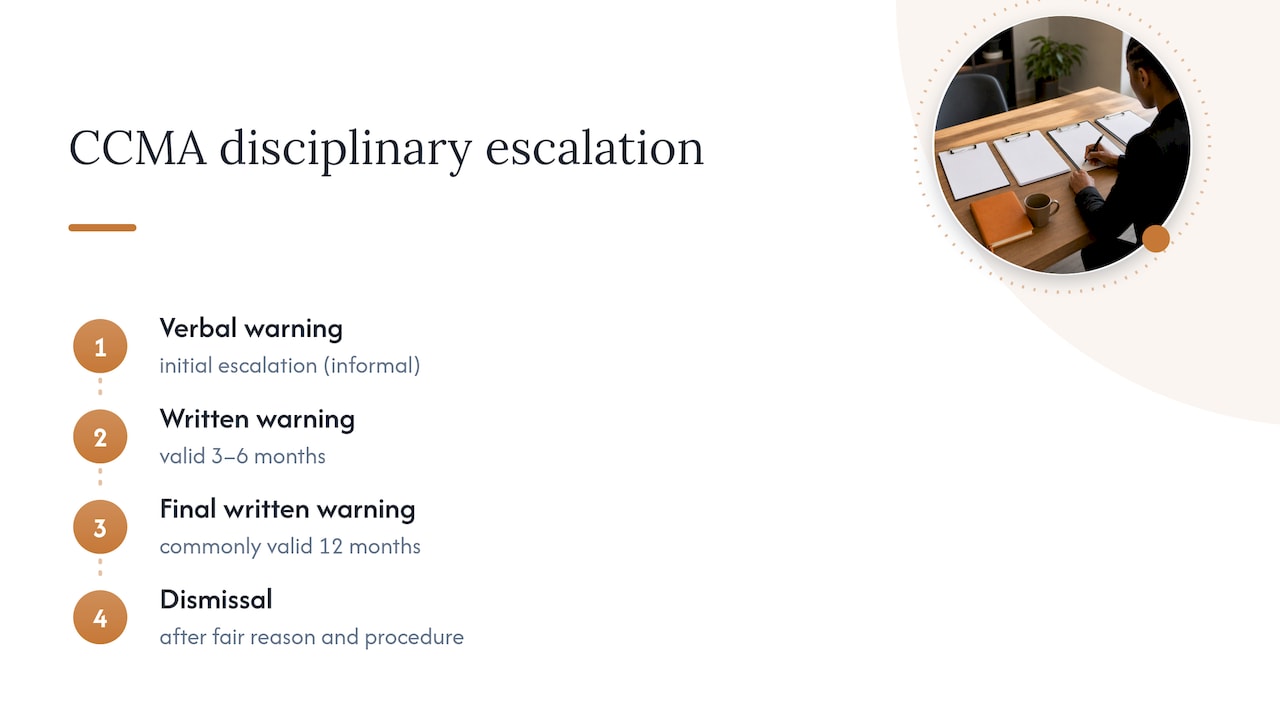
The CCMA’s own guidance confirms the disciplinary sequence employers are expected to follow. The CCMA misconduct info sheet sets out the typical escalation of verbal warning, written warning, final written warning, and dismissal, and notes that written warnings commonly run for 3 to 6 months while final written warnings are often set at 12 months. This single reference point matters because validity periods are not fixed by statute: they depend on what the employer’s own disciplinary code states, and the CCMA expects that code to be clear and consistently applied.
Case law adds a critical timing dimension that short explainers often skip. The Tiger Brands matter illustrates that a warning issued after the fact cannot retroactively justify dismissal for the earlier misconduct; the judgment and related authorities make clear that warnings are prospective, not retrospective. If you wait too long to act, you risk losing the deterrent value of the warning and weakening your position at arbitration. Alongside promptness, consistency is non-negotiable: employers must treat comparable employees in comparable ways, or risk having the sanction overturned on the basis of disparate treatment.
3. When to issue a final written warning and how long it should last
Deciding whether a final written warning is the right sanction comes down to a handful of practical questions. Ask yourself:
- How serious is the misconduct on its own, independent of any history?
- Has the employee received prior warnings for the same or related conduct?
- Is there enough evidence, documented and dated, to support the finding?
- Are there mitigating factors, such as length of service or personal circumstances, that warrant a lighter sanction?
- Would dismissal at this stage survive scrutiny at the CCMA, or is a final warning the more defensible step?
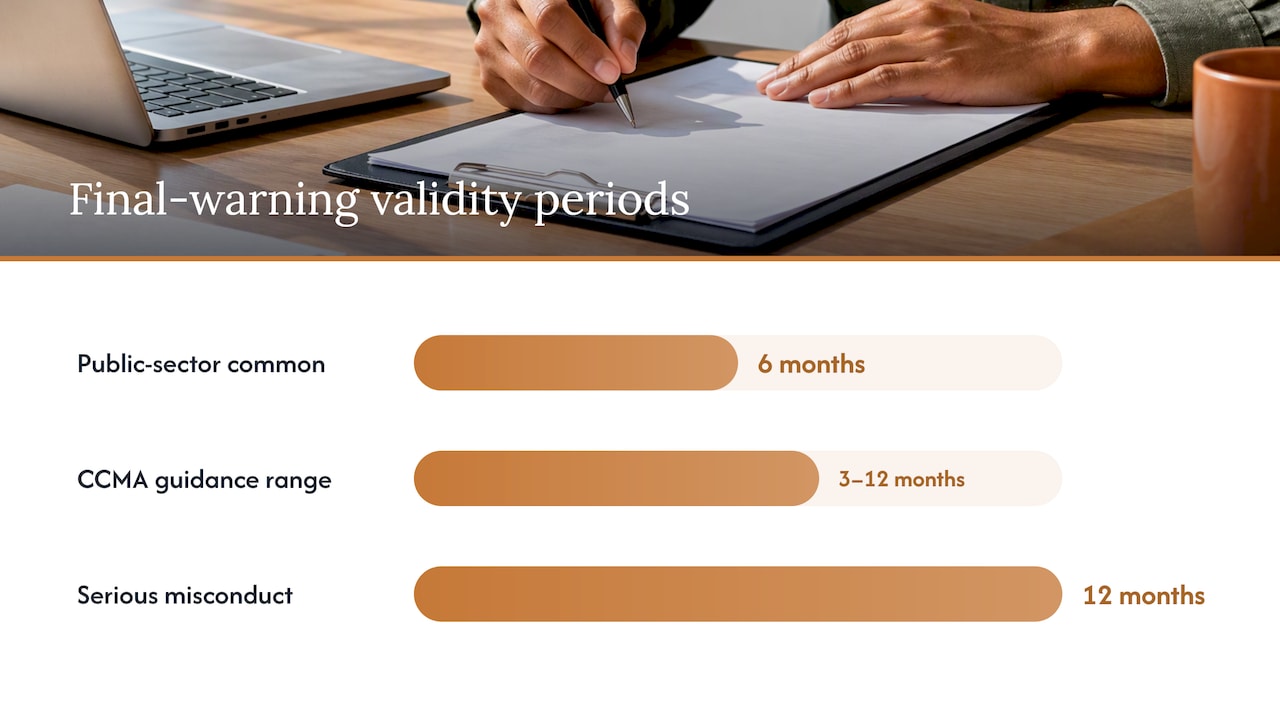
Validity periods vary by employer policy, but practice converges around a few common windows. Public-sector sanctioning guidelines commonly list final written warnings as valid for six months, while the CCMA’s own guidance notes a broader range of 3 to 12 months depending on the offense and the employer’s written policy. A 12-month validity period is generally defensible for serious misconduct, while a shorter period may suit borderline cases where you want to signal seriousness without locking in a long-term record.
Pro Tip: State the exact validity period and expiry date on the warning itself, never leave it to be calculated later from memory or a personnel file.
Different misconduct types call for different approaches within the same framework. A safety violation with no injury might warrant a 12-month final warning given the risk involved, while a first serious instance of insubordination might justify only six months if the employee otherwise has a clean record. The warning should always state plainly what happens if the conduct repeats, and it should never promise an outcome that has not yet been tested against the facts.
4. How to draft a final written warning that holds up at the CCMA
A final written warning that collapses under scrutiny usually fails for the same reasons: vague wording, missing facts, or no clear link between the misconduct and the rule that was broken. A defensible warning follows a structure that leaves no room for ambiguity.
The template should include:
- Heading and employment details: employee name, job title, employee number, date of issue.
- Finding of misconduct: a factual, dated account of what happened, written without speculation.
- Rule or policy breached: a direct reference to the specific clause in the disciplinary code or employment contract that was violated.
- Sanction clause: explicit wording that the employee is being placed on final written warning and what that means going forward.
- Validity period: the exact start and expiry date.
- Consequences of repetition: a statement that repeat misconduct during the validity period may result in dismissal, subject to a fair hearing.
- Appeal instructions: how and when the employee may appeal the sanction internally.
- Signatures and witness notes: employee, chairperson, and a witness where the employee declines to sign.
For the sanction clause itself, precision matters more than length. A workable phrase reads something like: “This constitutes a final written warning valid for 12 months from the date of this notice. Should you commit the same or similar misconduct during this period, your employment may be terminated, subject to a fair disciplinary process.” Avoid language that implies automatic dismissal, such as “will result in immediate termination,” because it overstates what the law actually requires: even a valid final warning does not remove the employer’s obligation to run a fair hearing before dismissing.
Two cautions are worth building into your process:
- Never use speculative or conclusory language in the facts section, such as “clearly intended to,” when the evidence only supports what was observed or admitted.
- Keep the original signed warning and any electronic record in a secure, access-controlled personnel file, since the CCMA may request it months or years later.
Labour Guide’s commentary on warnings reflects common practitioner drafting approaches, and its central caution is worth repeating: a final written warning is meant to be the last step before dismissal, not a formality. Treat the drafting stage as the moment you build the paper trail you will need if the matter ever reaches arbitration.
5. Running the disciplinary process without exposing your business
Getting the warning right on paper is only half the job. The other half is the operational discipline behind it: consistent process, complete records, and a clear line from investigation to monitoring.
A workable workflow looks like this:
- Investigate promptly once misconduct is reported, before memories fade and evidence disappears.
- Issue a notice of the hearing that states the allegations clearly, giving the employee enough time to prepare.
- Hold the hearing, allow representation where your policy permits it, and record the outcome in writing.
- Issue the final written warning within days of the hearing, not weeks, to preserve its deterrent value.
- Calendar the expiry date and review employee conduct against it until the warning lapses.
Keep a documentation file that includes written statements, hearing minutes, the signed warning itself, any prior warnings on record, and notes on how comparable cases were handled. Pro Tip: Build a simple comparator log for each disciplinary category, so when an employee claims inconsistent treatment, you can show exactly how similar cases were handled before.
Showing consistency is often the difference between a sanction that survives arbitration and one that gets overturned. CCMA rulings have reduced or set aside sanctions where comparable employees received materially different treatment for similar misconduct, so your comparator records need to be as complete as the warning itself. For employers managing this process without in-house legal support, CCMA-safe dismissal guidance and contract clause references can close the gaps that an internal HR team might otherwise miss.
6. Why speed matters more than severity in disciplinary decisions
Employers often assume that a harsher sanction is a safer sanction. In practice, a final written warning issued quickly and correctly protects you more than a severe sanction issued late. Delay invites the employee to argue the misconduct could not have been serious if you took weeks to act on it, and that argument tends to land well at arbitration.
The real trade-off HR faces is not deterrence versus leniency, it is speed versus thoroughness. Rushing a hearing to beat a deadline is as risky as dragging it out, because a flawed process can undo an otherwise justified sanction. The better path is a tight but complete process: investigate fast, document everything, and issue the warning within days of the hearing’s conclusion.
Dismissal should remain the last resort, not the default reflex. When an employee’s conduct genuinely repeats during a valid final warning, escalation is usually the right call, and guidance on high-risk terminations can help you confirm the decision is defensible before you act on it.
— Roel
When managed payroll support takes the guesswork out of discipline
Running a compliant disciplinary process from outside South Africa adds a layer most international employers underestimate: local labor law changes in application, not just in text, and a misstep on timing or wording can cost far more than the sanction it was meant to support. A licensed local partner can handle BCEA-compliant contracts, local payroll in ZAR, and statutory filings (PAYE, UIF, SDL, COIDA) that complement any disciplinary records you create.
Some Employer of Record platforms cover multiple countries, while others specialise in South African practice, tailoring contract clauses, warning templates, and CCMA-safe dismissal guidance specifically for local requirements rather than using generic templates. The service runs on a flat fee of £299 per employee per month with no setup fees or FX loading, and signed contracts are typically returned within 48 hours.
If you are weighing whether to manage discipline and payroll in-house or hand the compliance load to a partner who already knows the CCMA’s expectations, check current pricing and see how the numbers compare against the cost of getting a dismissal wrong.
FAQ
What are the rules for a final written warning?
A final written warning must follow a fair procedure under the Labour Relations Act’s Code of Good Practice, including investigation, notice of the allegations, a hearing, and a chance to respond. It must be issued promptly after the misconduct, state a clear validity period, and explain what repeat misconduct during that period could mean for the employee’s job.
Is a final written warning serious?
Yes, a final written warning is the most serious sanction short of dismissal, since it places the employee on notice that repeat misconduct during its validity may justify termination. Even so, dismissal is never automatic: the employer still has to run a fair hearing and show the sanction fits the conduct.
How long does a written warning last in South Africa?
Validity periods depend on the employer’s disciplinary code rather than a fixed legal rule, but CCMA guidance notes that standard written warnings commonly run 3 to 6 months, while final written warnings are often set at 12 months. Public-sector sanctioning guidelines typically list six months as a common benchmark.
What is the next step after a final written warning?
If the same or similar misconduct recurs while the warning is still valid, the employer may proceed to a disciplinary hearing on the new incident and consider dismissal as a fair outcome. If the warning expires without repeat misconduct, it generally falls away and any new issue is assessed on its own facts, often starting lower on the disciplinary scale depending on the offense.
How should an employee respond to a final written warning?
An employee who disagrees with a final written warning should use the internal appeal process stated on the warning itself, and if that fails, may refer an unfair labor practice dispute to the CCMA within the applicable timeframe. Keeping a copy of the warning and any supporting correspondence helps if the dispute proceeds to arbitration.
Sources
- Labour Relations Act 66 of 1995 (Schedule 8: Code of Good Practice: Dismissal)
- CCMA misconduct info sheet
- Tiger Brands (Pty) Ltd v AFADWU obo Mabizela and Others (2023) — case summary / judgment
- LABOUR RELATIONS SANCTIONING GUIDELINES (DPSA / SSSBC annexure)