

The median software engineer salary in South Africa in 2026 sits close to R38,000 to R40,000 per month, or roughly R456,000 to R480,000 a year, though the real figure depends heavily on where you fall on the experience curve. Entry-level developers typically earn from the low twenties of thousands of rand per month, while senior engineers with a decade or more of experience often clear six figures monthly. City, sector, and whether the role pays in foreign currency all shift these numbers further.
TL;DR:
- Remote roles paid in foreign currency offer the potential for salaries exceeding local maximums, but they often lack local benefits such as medical aid and retirement contributions.
- Salary increases become sharper after the six-year mark, with the largest jumps occurring when engineers transition into technical leadership or niche specializations.
- Benchmarking and negotiations should include multiple data sources and be adjusted for city, sector, and remote premium, to accurately reflect the true market value.
- The take-home pay for a mid-level engineer earning R55,000 gross is approximately R41,500 after taxes, highlighting the impact of PAYE and UIF deductions.
Table of Contents
- Current averages and ranges from major salary trackers
- Pay by experience level with a sourced data table
- City and sector differences across the market
- Remote and international pay premium: what to expect
- Take-home pay: PAYE and UIF worked examples
- How to benchmark offers and negotiate: a short checklist
- Market trends in 2026: cooling growth, AI effects, and mobility
- The impact of education and certifications on pay
- Salary progression and career outlook beyond 10 years
- What actually moves your salary in this market
- For employers: an alternative to setting up a local entity
- Sources
- FAQ
Current averages and ranges from major salary trackers
Three trackers dominate benchmarking conversations for South African developers, and each measures something slightly different. PayScale’s 2026 data puts the average annual base salary for a software engineer at R410,541, with a typical range of R121,000 to R769,000 across submitted profiles. That wide spread reflects self-reported data across all experience levels and company types in one pooled figure.
Levels.fyi, by contrast, reports total compensation rather than base pay alone, with a smaller sample skewed toward candidates at larger or international-facing employers. RandTools’ aggregation lands closer to the middle, estimating median monthly pay around R38,000 to R40,000, which tracks well with mid-career developers outside the top tier of compensation.
For quick benchmarking, treat these sources differently rather than averaging them together:
- Use PayScale when you want a broad annual base salary anchor across all experience levels.
- Use Levels.fyi only when comparing total compensation packages at large or multinational firms, since it mixes bonuses and equity into the median.
- Use OfferZen’s experience-banded data when you need the most current, granular figure for your specific career stage.
Pay by experience level with a sourced data table
Experience is the single strongest predictor of software engineer pay in South Africa, and the jumps between bands are not evenly spaced. According to OfferZen’s 2026 developer salary report, monthly averages climb steadily but accelerate sharply after the six-year mark.
| Experience | Average monthly salary |
|---|---|
| 0 to 2 years | R22,181 |
| 2 to 4 years | R34,285 |
| 4 to 6 years | R48,200 |
| 6 to 10 years | R69,019 |
| 10+ years | R100,232 |
The gap between the 6 to 10 year band and the 10+ year band is the largest single jump in the table, and it usually reflects a shift in role rather than just tenure. Engineers who cross into technical leadership, architecture ownership, or scarce specializations such as platform security or machine learning infrastructure tend to capture disproportionate increases, while those who stay in pure implementation roles see flatter growth even with the same years on the clock.
City and sector differences across the market
Location and industry both move the numbers meaningfully, and the effect compounds with seniority. OfferZen’s data shows Cape Town consistently paying more at the senior level, with 10+ year engineers there averaging around R105,092 a month, above the national average for that band. Johannesburg, despite its size, saw entry-level salaries fall year-on-year, a signal that junior hiring has softened in that market specifically.
Sector matters just as much as city:
- FinTech and large corporates tend to offer the highest base salary bands, reflecting both budget depth and competition for scarce skills.
- SaaS companies generally sit in the middle, with more variation tied to funding stage and growth phase.
- Small startups more often compensate with equity, flexibility, or faster promotion paths rather than higher cash salaries.
- Government and public-sector roles typically lag private-sector pay across every experience band.
Company size follows a similar pattern: larger employers with formal salary bands tend to pay a premium over smaller teams operating on tighter budgets.
Remote and international pay premium: what to expect
Remote roles paid in foreign currency represent the clearest path to income above local senior-level ceilings, and it is one of the main reasons top South African engineers look abroad without relocating. RandTools notes that currency-adjusted remote pay is the primary mechanism through which developers exceed the country’s local top ranges, and it has become a real retention challenge for domestic employers.
The premium exists for a few clear reasons: currency insulation against rand depreciation, strong international demand for experienced engineers, and a global shortage of specialized skills that South African talent can fill remotely. The caution is that foreign-paid contracts often exclude the benefits, medical aid contributions, or retirement structuring that a local employer would typically provide, so a headline salary number needs to be weighed against what is missing around it. For a closer look at how these packages compare, see our salary benchmarks for remote workers.
Take-home pay: PAYE and UIF worked examples
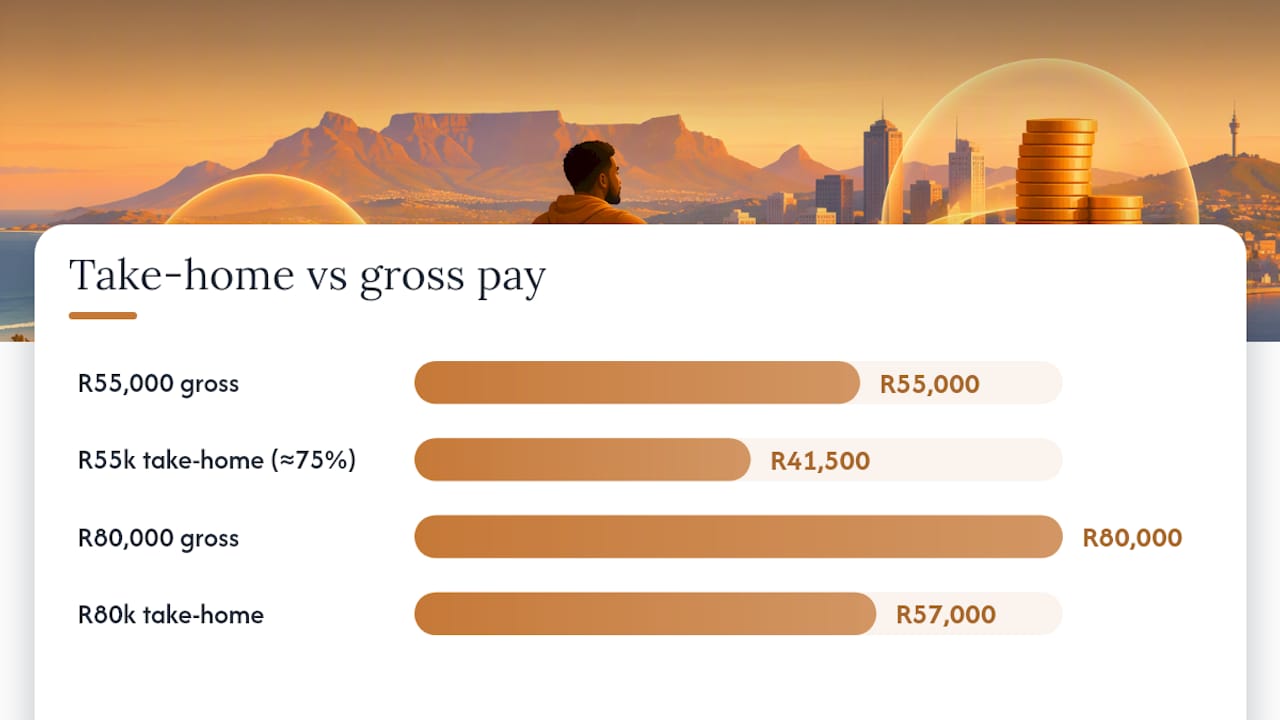
Gross salary tells only part of the story, since PAYE and UIF deductions meaningfully reduce what lands in a bank account each month. CalcMyPay’s examples show a mid-level engineer earning R55,000 gross taking home roughly R41,500 after deductions, while a senior earning R80,000 gross nets around R57,000.
Statistic callout: Take-home pay for a R55,000 gross salary lands near R41,500 a month, meaning roughly 75% of gross pay reaches the employee after PAYE and UIF.
Retirement annuity contributions can reduce taxable income and therefore lower the PAYE bill, which is worth factoring into any offer comparison.
Pro Tip: Ask whether an employer’s total package includes retirement annuity matching, since it can meaningfully improve your net position without changing the headline salary.
How to benchmark offers and negotiate: a short checklist
Benchmarking well means combining recent data with a clear sense of your own leverage before you enter a negotiation.
- Pull current figures from at least two sources, such as OfferZen and PayScale, rather than relying on one.
- Adjust the baseline for your city and sector, since Cape Town seniors and FinTech roles skew above the national average.
- Add a remote premium estimate if the role is foreign-paid, but subtract for any missing benefits.
- Identify your negotiation levers: base salary, sign-on bonus, equity, remote work allowance, and learning budget all carry weight.
- Watch for red flags such as vague total-compensation language or reluctance to discuss raises tied to performance reviews.
- If growth stalls for more than one review cycle without explanation, treat it as a signal to test the external market.
Market trends in 2026: cooling growth, AI effects, and mobility
MyBroadband’s 2026 analysis confirms this cooling trend while noting that 36% of developers reported increased earning potential tied directly to AI adoption.
The effect of AI on pay is uneven rather than uniformly positive. Seniors and specialists tend to capture more of the productivity premium, while juniors face both automation of routine tasks and tougher entry into the market. A related look at how AI is reshaping product development offers useful context for how these productivity shifts are playing out beyond salary alone. At the same time, many engineers are staying put rather than switching jobs, a pattern often called job-hugging, which suppresses the wage growth that usually comes from competitive counteroffers.
The impact of education and certifications on pay
Formal education still matters for entry into the field, but it carries less weight than demonstrated skill once an engineer has a few years of shipped work behind them. A computer science degree or equivalent qualification tends to open doors faster at the junior stage, particularly at larger corporates and FinTech firms that use degree requirements as an initial filter.
Certifications play a narrower but real role. Cloud credentials from AWS, Google Cloud, or Microsoft Azure can support a stronger negotiating position for engineers moving into infrastructure or DevOps-adjacent work, since employers often use them as a proxy for verified skill in a specific toolchain. The same applies to specialized certifications in security or data engineering, where scarce, verifiable expertise commands a premium regardless of the underlying degree.
What tends to matter most by the mid-career stage is a track record: shipped projects, ownership of systems in production, and the ability to mentor or lead. Employers benchmarking senior hires increasingly weight portfolio evidence and interview performance over credentials alone, which means engineers without a formal degree can close much of the gap through demonstrated experience. For engineers earlier in their careers, though, a recognized qualification or certification still functions as a useful signal that shortens the path to that first well-paying role.

Salary progression and career outlook beyond 10 years
Pay growth does not stop at the 10-year mark, but the shape of that growth changes. Below that threshold, salary increases largely track years of experience and technical scope. Beyond it, the biggest gains come from moving into roles that combine technical depth with organizational leverage: staff or principal engineer tracks, engineering management, or ownership of architecture decisions that affect multiple teams.
Engineers who stay purely in individual contributor roles without expanding scope tend to see flatter growth after a decade, even with strong technical skills. Those who take on scarce specializations, cross into technical leadership, or move toward remote and international roles typically see the steepest continued gains. For many senior South African engineers, the ceiling on local pay is real, which is part of why foreign-currency remote work has become such a common long-term strategy rather than a one-off decision.
What actually moves your salary in this market
The biggest mistake I see engineers make is benchmarking against a single number instead of a range built from multiple sources. If you’re early career, a local raise is usually more realistic than chasing a remote role you’re not yet competitive for. If you’re mid to senior level with in-demand skills, testing the remote market is worth the effort, since the pay ceiling there is genuinely higher.
Whichever stage you’re at, benchmark with two sources, prepare one or two specific negotiation asks, and keep evidence of your impact ready. Employers, for their part, should always model total employment cost rather than base salary alone when planning hires.
— Roel
For employers: an alternative to setting up a local entity
If you’re an international employer trying to model what hiring a South African engineer actually costs, an Employer of Record lets you do it without registering a local entity or building payroll infrastructure from scratch. This Employer of Record service focuses on one country exclusively, which means the pricing and compliance guidance is built specifically around South African labor law rather than adapted from a broader global template.

- Flat pricing from £299 per employee per month, with no setup fees or currency conversion loading.
- Local payroll and statutory filings, including PAYE, UIF, SDL, and COIDA, handled through a local partner.
- Data protection compliant with national and international privacy standards, relevant for teams managing employee records across jurisdictions.
Compare that to global platforms covering 150 countries at a similar or higher monthly rate: a single-country focus tends to mean deeper familiarity with the specific rules that affect your hire. If you want to see how the numbers work for your team, you can model your employment costs directly.
Sources
- Software Developer Salary in South Africa (OfferZen, 2026)
- Top paying developer jobs in South Africa in 2026 – MyBroadband
- Average Software Engineer Salary in South Africa (PayScale, 2026)
- Software Developer Salary in South Africa (RandTools)
FAQ
Is R50,000 a good salary in South Africa?
A monthly salary sits comfortably above the national median software engineer pay of roughly R38,000 to R40,000, placing an earner in a strong position relative to most developers in the country. It generally reflects mid to senior-level experience or a role in a higher-paying city or sector.
What is the top 5% salary in South Africa?
There is no single publicly confirmed figure for the exact top 5% income threshold across all professions in South Africa. Within software engineering specifically, senior developers with 10 or more years of experience earning above R100,000 a month sit well into the higher end of the profession’s pay distribution.
What jobs pay R100,000 a month in South Africa?
Senior software engineers with a decade or more of experience commonly reach this level, with OfferZen reporting an average of R100,232 a month for that experience band. Specialized technical leadership roles, architecture positions, and some remote foreign-paid contracts also reach or exceed this figure.
How much does a typical senior developer take home after tax?
Based on worked examples from CalcMyPay, a senior engineer earning R80,000 gross a month takes home approximately R57,000 after PAYE and UIF deductions. The exact figure shifts depending on retirement annuity contributions and other pre-tax deductions.