

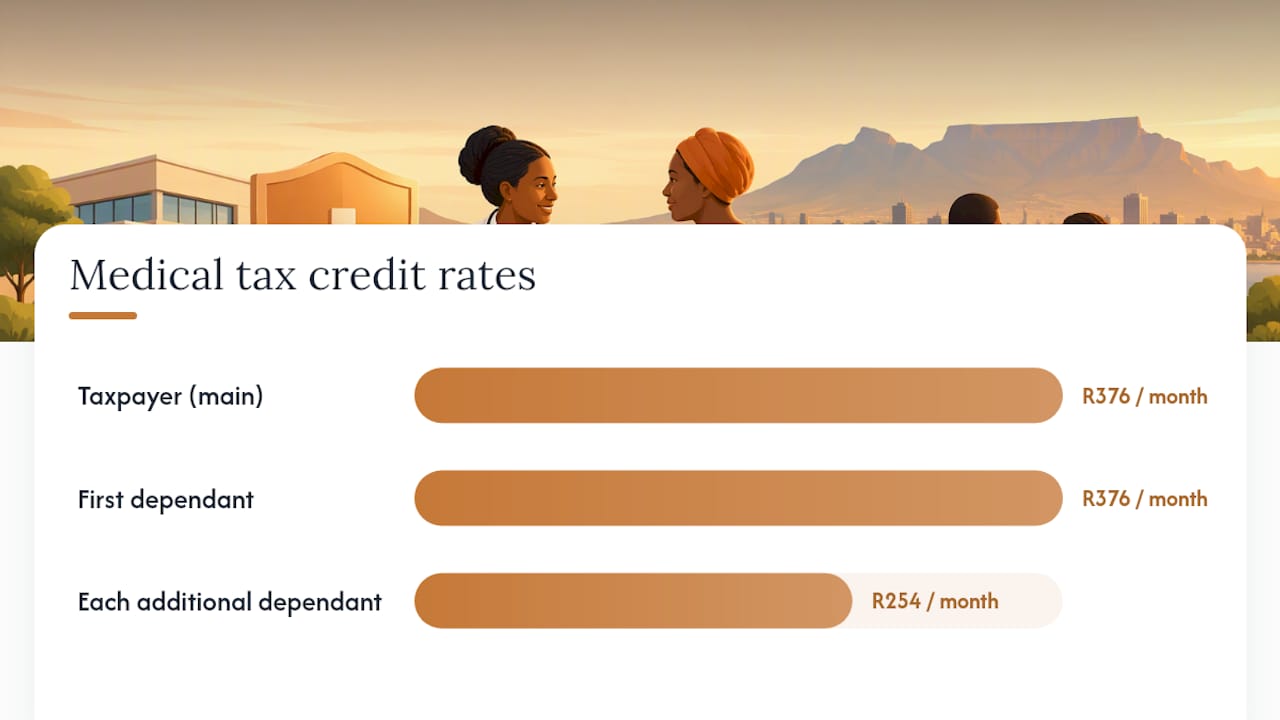
The Medical Scheme Fees Tax Credit (section 6A) is a fixed monthly amount that reduces the normal tax you owe, applied per person covered on a registered medical scheme. For the 2026/27 year of assessment, it pays R376 a month for you and your first dependant, plus R254 a month for each additional dependant, which works out to R4,512 and R3,048 a year respectively. A separate credit, the Additional Medical Expenses Tax Credit (section 6B), covers excess contributions and qualifying out-of-pocket costs at either 25% or 33.3%, depending on your age and disability status.
TL;DR:
- The monthly medical scheme tax credit remains R376 for the taxpayer and first dependant and R254 for each additional dependant in 2026/27; claims depend on scheme registration under the Medical Schemes Act.
- The credit applies only to contributions paid to registered schemes, excluding gap cover policies, standalone insurance, and employer wellness stipends outside the formal framework.
- The Additional Medical Expenses Tax Credit differs by age and disability status, with 33.3% for seniors or disabled individuals and 25% for others, based on unreimbursed medical costs exceeding specific thresholds.
- Accurate documentation of contributions, dependants, and scheme registration is crucial, especially where multiple payers share costs or scheme details change mid-year.
- Future proposals may extend eligibility to certain statutory schemes, but current rates and requirements remain unchanged for the 2026/27 assessment year.
Table of Contents
- Understanding the Medical Scheme Tax Credit and the 2026/27 Rates
- Who Counts as a Qualifying Dependant?
- How the Additional Medical Expenses Credit Is Calculated
- Claiming the Credit: Payroll, ITR12, and the Paper Trail
- A Worked Example You Can Run With Your Own Numbers
- Where Taxpayers and Payroll Teams Lose the Credit
- What’s Changing for 2026 and Beyond
- An Employer’s View on Getting the Medical Credit Right
- Confirm the Rates: Official SARS and Treasury Resources
- Sources
- FAQ
Understanding the Medical Scheme Tax Credit and the 2026/27 Rates
Before 2012, medical scheme contributions worked as a straight deduction from taxable income, which quietly favored high earners in higher tax brackets. Section 6A changed that by converting the benefit into a rebate that comes straight off your tax bill, at the same rand value no matter what you earn.
That distinction between a deduction and a credit trips up a surprising number of taxpayers. A deduction lowers the income SARS taxes; a credit lowers the tax itself, rand for rand. Because it’s non-refundable, the credit can only reduce your tax payable down to zero. It can’t create a cash refund on its own, and it generally can’t be carried forward into the next year.
Here’s how the 2026/27 rates break down, based on SARS’s medical tax credit rates table:
| Covered person | Monthly credit | Annual equivalent |
|---|---|---|
| Taxpayer (main member) | R376 | R4,512 |
| First dependant | R376 | R4,512 |
| Each additional dependant | R254 | R3,048 |
A family of four, for example, main member plus three dependants, generates R376 + R376 + R254 + R254 = R1,260 a month, or R15,120 a year, in section 6A credit alone.
Not every health arrangement qualifies. The credit applies only to contributions paid to a scheme registered under the Medical Schemes Act, or to a comparable foreign fund recognized for this purpose. Products that sit outside that framework don’t count, including:
- Gap cover policies, which top up medical scheme shortfalls but aren’t themselves a registered scheme
- Standalone short-term health insurance products sold outside the Medical Schemes Act framework
- Employer wellness stipends that aren’t routed through a registered scheme
Who Counts as a Qualifying Dependant?
Your spouse, your children, and anyone else who is “wholly or partially dependent” on you for maintenance and registered on your medical scheme generally qualifies as a dependant for both section 6A and section 6B purposes. SARS aligned the two sections’ definitions in 2018, so you no longer need to apply different dependant tests to the monthly credit and the additional expenses credit.
Membership has to sit with a scheme registered under the Medical Schemes Act. Some statutory or bargaining council health funds fall outside that registration and currently don’t qualify, which catches out employees who assume any employer-linked health benefit automatically earns the credit.
Where more than one person contributes toward the same beneficiary, such as divorced parents both paying premiums for a child, the law apportions the credit in the same ratio as each payer’s contribution to the total fees. Keep proof of exactly who paid what, because SARS will ask for it if the split gets questioned.
Before you claim, check your scheme certificate for these details:
- Your name and ID number listed correctly as the main member
- Every dependant’s name matching what you’ll declare on your ITR12
- The total annual contribution figure, split by month if possible
- Confirmation the scheme is registered under the Medical Schemes Act
How the Additional Medical Expenses Credit Is Calculated
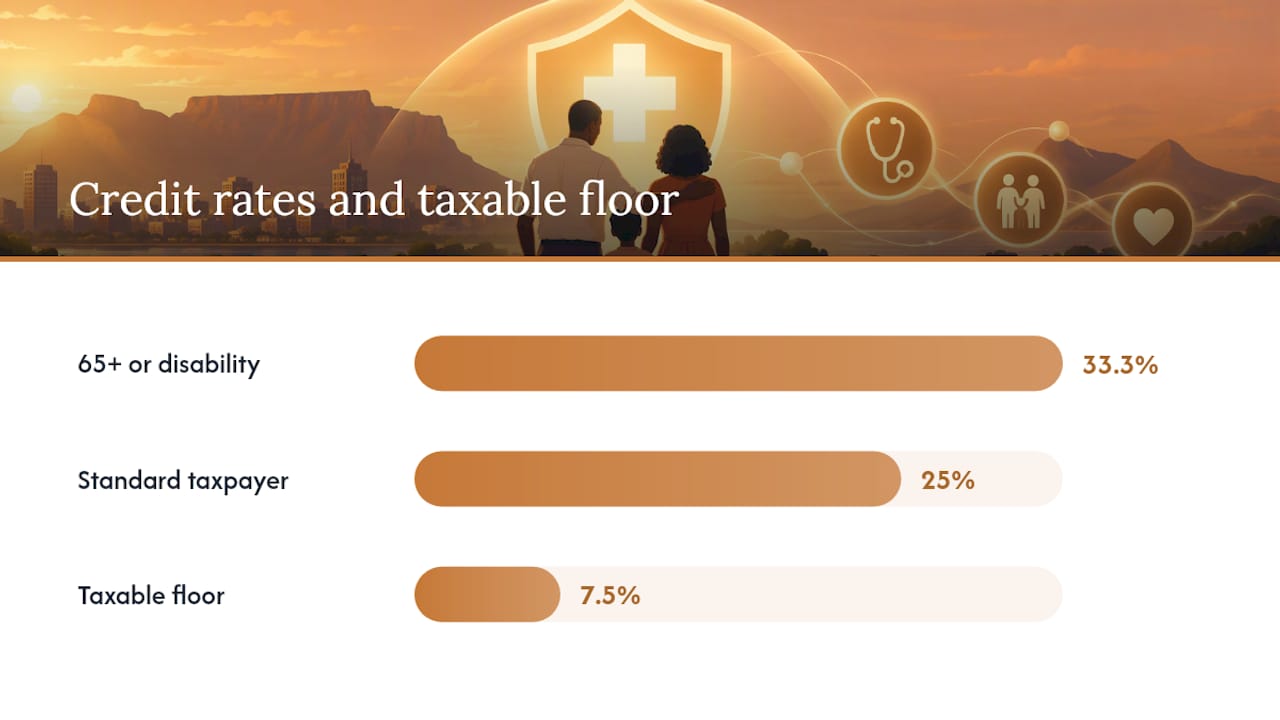
Section 6B rewards people who spend heavily on healthcare relative to their contributions, and the category you fall into changes the math substantially. If you, your spouse, or a dependant is 65 or older, or has a qualifying disability confirmed by SARS, you claim 33.3% of qualifying expenses plus contributions exceeding three times your annual section 6A credit. Everyone else claims 25% of qualifying expenses plus contributions exceeding four times the annual credit, and that amount is further reduced by 7.5% of taxable income.
Pro Tip: The age and disability category matters more than your premium size. The lower multiplier, the higher percentage, and the absence of the taxable-income floor mean a qualifying taxpayer can unlock meaningfully more relief than someone in the standard category with an identical medical bill.
Work through it in this order:
- Calculate your annual section 6A credit (monthly rate multiplied by 12, summed across all covered persons).
- Work out your “excess” contributions: total annual premiums paid, minus three or four times your annual section 6A credit, depending on your category.
- Add any qualifying unreimbursed medical expenses (money your scheme didn’t cover, plus other qualifying medical costs).
- If you’re under 65 with no qualifying disability, subtract 7.5% of your taxable income from that combined total.
- Apply 33.3% (65+ or disability) or 25% (everyone else) to whatever remains.
- Compare the result to your normal tax payable. The credit is capped there and won’t refund beyond it.
Documentation matters here more than anywhere else in the return. For disability claims specifically, a casual doctor’s note isn’t enough; SARS requires a completed ITR-DD confirming the expense is directly linked to the disability and was necessarily incurred.
Claiming the Credit: Payroll, ITR12, and the Paper Trail
Most employed taxpayers never have to think about claiming section 6A manually. Where the employer has contribution details, it applies the monthly credit directly through PAYE, reducing tax withheld from every paycheck. You only need to claim it yourself on the ITR12 if you’re retired and paying premiums privately, self-employed, or if your payroll department simply didn’t apply it correctly during the year.
Before you file, gather:
- Your medical scheme tax certificate for the full year of assessment
- Proof of contributions paid (bank statements work if the certificate is incomplete)
- Invoices and receipts for unreimbursed medical expenses you plan to claim under section 6B
- A completed ITR-DD if you’re claiming based on a qualifying disability
Pro Tip: Cross-check your IRP5 against your medical scheme certificate before you file. If the monthly credit your employer applied doesn’t match what the certificate supports, correct it on your ITR12 rather than letting the mismatch trigger a SARS query later.
A Worked Example You Can Run With Your Own Numbers
Take a 40-year-old taxpayer with a spouse and one child, paying R4,200 a month in contributions, with R6,000 in unreimbursed expenses for the year.
- Annual section 6A credit: R376 + R376 + R254 = R1,006/month, or R12,072/year.
- Annual contributions: R4,200 × 12 = R50,400.
- Four times the annual credit: R12,072 × 4 = R48,288.
- Excess contributions: R50,400 minus R48,288 = R2,112.
- Add unreimbursed expenses: R2,112 + R6,000 = R8,112.
- Subtract 7.5% of taxable income (say R450,000 taxable income, so R33,750). Since R8,112 is below that floor, the section 6B credit for this taxpayer is zero this year.
Now compare a 68-year-old with identical contributions and expenses: the multiplier drops to three times the annual credit (R36,216), there’s no 7.5% floor, and the rate jumps to 33.3%, producing a real additional credit. Any calculator you use, including third-party tools like TaxTim’s medical aid credit calculator, needs the same core inputs: number of covered persons, annual premiums, unreimbursed expenses, taxable income, and disability status. Always confirm the calculator’s year label matches your actual year of assessment, since SARS updates these rates annually.
Where Taxpayers and Payroll Teams Lose the Credit
Most lost credit comes down to paperwork, not eligibility. The recurring culprits: wrong dependant counts on the scheme certificate, a missing or outdated certificate at filing time, claiming the same unreimbursed expense twice across different tax years, and contributing to a scheme that isn’t actually registered under the Medical Schemes Act.
- Reconcile dependant numbers between your scheme certificate and your ITR12 before submitting.
- Keep proof of payment where multiple people fund one beneficiary, since SARS apportions the credit by contribution ratio and will ask for evidence if it’s disputed.
- Run a mid-year payroll check against IRP5 data before issuing final certificates.
- Retain all medical certificates and invoices for at least five years in case of verification.
A common trap during verification is a mismatch between the year label SARS uses on a given page and the year printed on your actual return. The rate history on SARS’s medical credits page is worth checking against your certificate before you assume a rate applies.
What’s Changing for 2026 and Beyond
The 2026/27 monthly rates of R376 and R254 are confirmed. Beyond the numbers, Treasury’s Budget 2026 policy notes propose extending section 6A eligibility to members of certain statutory medical schemes currently outside Council for Medical Schemes authority, provided they meet governance and solvency requirements.
- Confirmed: R376/month for the taxpayer and first dependant, R254/month for each additional dependant.
- Proposed: eligibility extension to qualifying statutory schemes, pending governance and solvency tests.
- Timing: always match the rate you use to the year of assessment on your return, not the calendar year you happen to be filing in.
If the statutory scheme extension goes ahead, it will widen who qualifies for section 6A without changing the rand amounts themselves. Watch for SARS guidance confirming which schemes meet the new tests once the proposal is finalized.
An Employer’s View on Getting the Medical Credit Right
Payroll teams treat the medical scheme tax credit as a monthly mechanical adjustment, but the real risk sits in the gaps between systems: a dependant added mid-year and never updated in payroll, a scheme certificate that arrives after IRP5s are already issued, or an employee who switches schemes without notifying HR. Getting section 6A right in every pay run matters more than fixing it once a year on the ITR12.
For international employers running payroll in South Africa without local HR depth, that’s a specific operational risk worth planning for. Confirm dependant counts at onboarding, build medical credit fields into every payroll cycle, and reconcile IRP5 data against scheme certificates before, not after, filing season closes. An employer of record handling PAYE on your behalf should be running this reconciliation as a matter of course, not as a year-end scramble.
— Roel
Confirm the Rates: Official SARS and Treasury Resources
Verify your own numbers directly against SARS’s medical tax credit rates and medical credits guidance, plus the IT07 determination guide for apportionment rules. Always match the year of assessment wording on the page to the year you’re actually filing.
Running payroll for South African staff from abroad adds another layer to all of this: getting PAYE, UIF, and medical credit fields right every month without a local entity or in-country HR team. Expand to South Africa’s Employer of Record service handles BCEA-compliant contracts and statutory filings, including PAYE, for a flat R299 GBP a month per employee, so these reconciliations happen correctly in every pay cycle rather than getting caught at year end.
This article is general information, not a substitute for advice from a qualified financial advisor. Consult a qualified financial professional about your own circumstances before acting on anything here.
FAQ
What changed with the healthcare tax credit for 2026?
The section 6A Medical Scheme Fees Tax Credit rose to R376 a month for the taxpayer and first dependant, and R254 a month for each additional dependant, for the 2026/27 year of assessment. Treasury’s Budget 2026 notes also propose extending eligibility to certain statutory medical schemes that meet governance and solvency tests, though that change hasn’t been finalized.
Is there a $6,000 tax deduction for seniors in South Africa?
No such deduction exists under South African tax law; that figure comes from unrelated tax provisions in other countries.
Is it worth claiming medical expenses on your tax return?
Yes, when you have qualifying unreimbursed expenses or contributions above the section 6B threshold, since the credit reduces tax payable directly rather than merely lowering taxable income.
What is the current medical scheme tax credit amount?
For the 2026/27 year of assessment, the current monthly amount is R376 for the taxpayer and first dependant, and R254 for each additional dependant. That works out to R4,512 and R3,048 a year per person in those respective categories.
Can my employer apply the wrong medical tax credit amount?
Yes, this happens when dependant counts on file are outdated or a scheme certificate arrives late in the tax year. Reconcile your IRP5 against your actual medical scheme certificate each year and correct any shortfall on your ITR12 rather than letting the discrepancy carry into the next filing.