

Under the BCEA, weekday and Saturday overtime must be paid at 1.5 times the normal hourly rate, and Sunday or public-holiday work is paid at double time when Sunday falls outside the employee’s ordinary hours. These rules apply automatically to employees earning below the current annual earnings threshold. Overtime must be agreed in writing, and it’s capped at 3 hours a day and 10 hours a week, so payroll teams have firm limits to schedule against, not just a rate to apply.
TL;DR:
- Overtime rates are 1.5 times the normal rate for weekdays and Saturdays, but can be higher if sector-specific agreements set different rates.
- Employees earning at or below R269,600.90 annually automatically qualify for BCEA overtime protections; high earners depend on their contracts.
- Overtime is limited to 3 hours daily and 10 hours weekly, with options to average hours or extend shifts through written agreements.
- Employers must maintain detailed records, itemize overtime on payslips, and renew agreements annually to ensure compliance.
- Expandtosouthafrica offers payroll services that ensure lawful overtime calculations, contracts, and filings for South African employers.
Table of Contents
- What Overtime Rates Apply in South Africa?
- Who Is Covered by BCEA Overtime Protections?
- How Many Overtime Hours Can an Employee Work?
- How Do You Calculate Overtime Pay?
- Can Employers Offer Time Off Instead of Overtime Pay?
- Why Does Sunday Work Get Special Treatment?
- What Records Must Employers Keep for Overtime Compliance?
- Two Worked Scenarios and a Quick Compliance Checklist
- A Payroll Specialist’s Take on Getting This Right
- How Expandtosouthafrica Handles Overtime and Payroll Compliance
- Sources
- FAQ
What Overtime Rates Apply in South Africa?
South African labor law sets a clear floor for overtime pay, and it starts with the working week itself. Weekday and Saturday overtime is paid at 1.5 times the employee’s normal hourly wage, while Sunday work and public holidays attract double time, but only when Sunday isn’t part of that employee’s ordinary working schedule.
That distinction trips up more payroll departments than any other overtime rule. An employee whose contract lists Sunday as a normal workday is paid at 1.5× for hours beyond their ordinary shift that day, not 2×. A retail employee whose roster never includes Sundays, called in for a busy weekend, earns double time for every hour worked, according to the BCEA summary from VCA Consulting.
- Weekday overtime: 1.5× normal hourly rate
- Saturday overtime (unless it’s an ordinary workday under contract): 1.5×
- Sunday work (not an ordinary workday): 2×
- Public holidays worked: 2×
These are statutory minimums, not ceilings. Bargaining councils in sectors like metal and engineering, and individual employment contracts, can lawfully set higher overtime multipliers than the BCEA requires.
Who Is Covered by BCEA Overtime Protections?
The BCEA earnings threshold determines who gets automatic overtime protection. As of May 2026, that threshold sits at R269,600.90 per year, which works out to roughly R22,466.74 a month. Earn at or below that figure, and BCEA overtime rules apply to you regardless of what your contract says.
Cross above it, and the picture changes:
- Senior managers who can determine their own hours are excluded outright.
- Sales staff who travel and regulate their own working time typically fall outside the Act’s overtime provisions.
- Employees earning above the threshold lose automatic BCEA overtime cover, though small-business ministerial determinations can set different terms in specific sectors.
Here’s the part employers often miss: a contract can still promise overtime pay to a high earner even though the BCEA no longer requires it. When that happens, the contract terms govern, and Expandtosouthafrica generally recommends that employers honor whatever was agreed rather than relying on the threshold as an excuse to withdraw a benefit already promised.
How Many Overtime Hours Can an Employee Work?
Ordinary working hours are capped at 45 hours a week, split as 9 hours a day on a five-day week or 8 hours a day on a six-day week. Overtime sits on top of that, within firm boundaries.
- Overtime cannot exceed 3 hours on any single day.
- Overtime cannot exceed 10 hours in any single week.
- Combined ordinary and overtime hours on one day cannot exceed 12 hours total, according to Section 10 of the BCEA.
- Employers and employees can agree in writing to average hours over a period of up to four months, smoothing busy and slow weeks.
- A written compressed-week agreement can extend a shift to 12 hours a day, provided the weekly caps still hold.
- Small businesses may fall under a ministerial determination that adjusts these caps for specific sectors, so it’s worth checking whether your industry has its own rules before assuming the general caps apply.
How Do You Calculate Overtime Pay?
Getting the hourly rate right is the foundation everything else builds on. Divide the monthly salary by 4.333 (the average number of weeks in a month), then divide again by the employee’s ordinary weekly hours, according to the calculation method used by YourIncomeCalculator. Some payroll teams use an alternative shortcut of dividing by 195 hours for a standard 45-hour week, which produces a nearly identical figure.
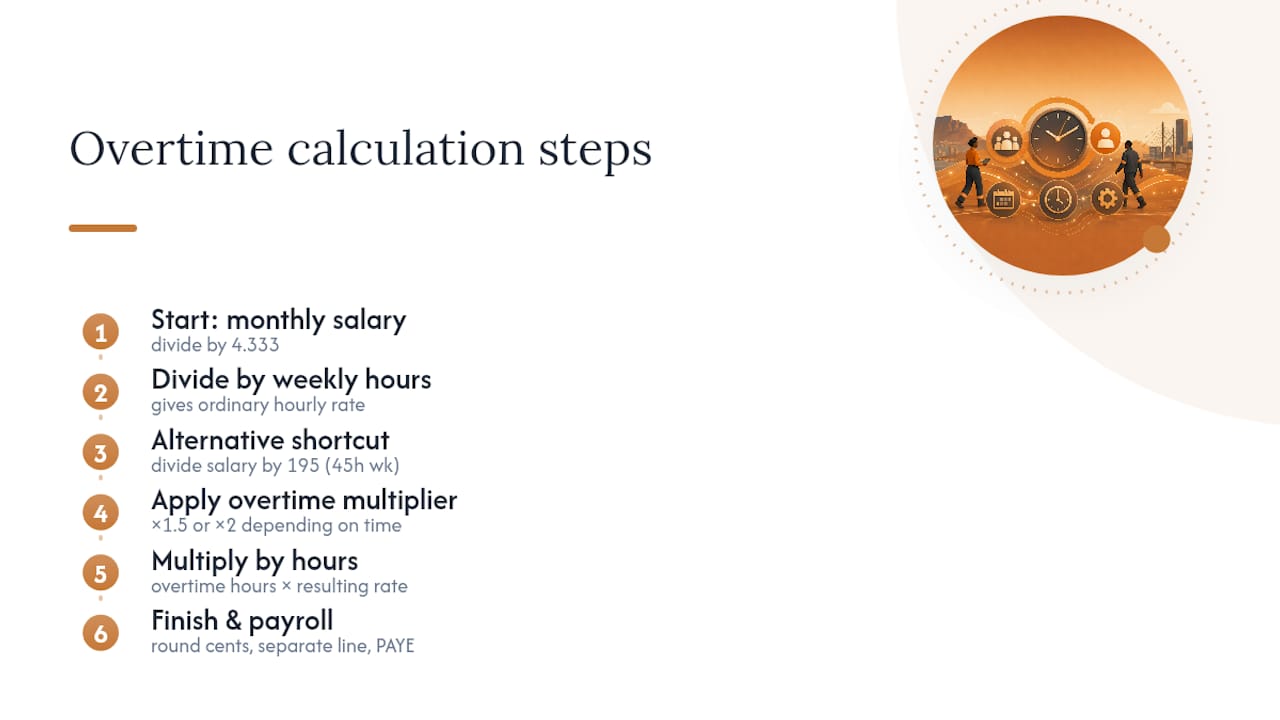
Once you have the ordinary hourly rate, multiply it by 1.5 or 2 depending on when the overtime happened, then multiply that result by the hours worked.
Round to the nearest cent on payslips, and list overtime as its own line item, separate from the basic salary. Overtime pay is taxable income, so PAYE applies to the full amount before it lands in the employee’s account. Calculators like PayTools’ overtime tool apply the current threshold and multipliers automatically, which is worth using to double-check manual payroll runs.
Can Employers Offer Time Off Instead of Overtime Pay?
Section 10 gives employers three lawful ways to compensate overtime, and cash isn’t the only option. An employer can pay the standard overtime rate, or offer paid time off, or combine the two, as long as the arrangement is in writing.
- Paid time off at 30 minutes per hour, on top of the employee’s normal pay for that hour, granted within one month of the overtime being worked.
- Paid time off at 90 minutes per hour worked, with no additional cash payment, taken within the same one-month window unless extended by written agreement to 12 months.
- Agreements signed within an employee’s first three months of employment lapse after 12 months and must be renewed in writing, according to KZN Business School’s overtime guidance.
Miss the deadline for granting that time off, and the employer owes cash instead, calculated at the appropriate overtime rate.
Why Does Sunday Work Get Special Treatment?
Whether Sunday pay hits 1.5× or 2× comes down to one question: is Sunday an ordinary workday under that employee’s contract? If it is, standard overtime rules apply. If it isn’t, every hour worked on Sunday is paid at double time, not just hours beyond a normal shift.
- Public holidays follow a similar logic: employees get their ordinary day’s pay whether they work or not, plus double pay for hours actually worked.
- A retail worker rostered Monday through Friday who’s called in on a public holiday earns double time for those hours, on top of already being paid for the day.
- Clear rosters written into contracts prevent the most common payroll dispute in this area, according to VCA Consulting’s BCEA summary. Vague scheduling language is where most Sunday-pay complaints originate.
What Records Must Employers Keep for Overtime Compliance?
Overtime is voluntary. Employees must consent to it, except in genuine emergencies, and employers can’t unilaterally impose it without a valid agreement in place, according to Legal Advice South Africa.
- Keep detailed time and overtime records for at least three years, covering hours worked and rates applied.
- Itemize overtime pay separately on every payslip, distinct from basic salary and allowances.
- Renew any overtime agreement signed during an employee’s first three months before the 12-month lapse date arrives.
- Update employment contracts annually to reflect current thresholds, rates, and rostering, following the practice recommended by PayTools’ compliance guidance.
- Audit a sample of payslips each quarter against actual clock-in records to catch calculation drift before it becomes a pattern.
Pro Tip: Run a quarterly spot check comparing five random payslips against raw time records and the current earnings threshold. Most compliance failures Expandtosouthafrica sees stem from an outdated threshold figure sitting in payroll software long after the annual update.
Two Worked Scenarios and a Quick Compliance Checklist
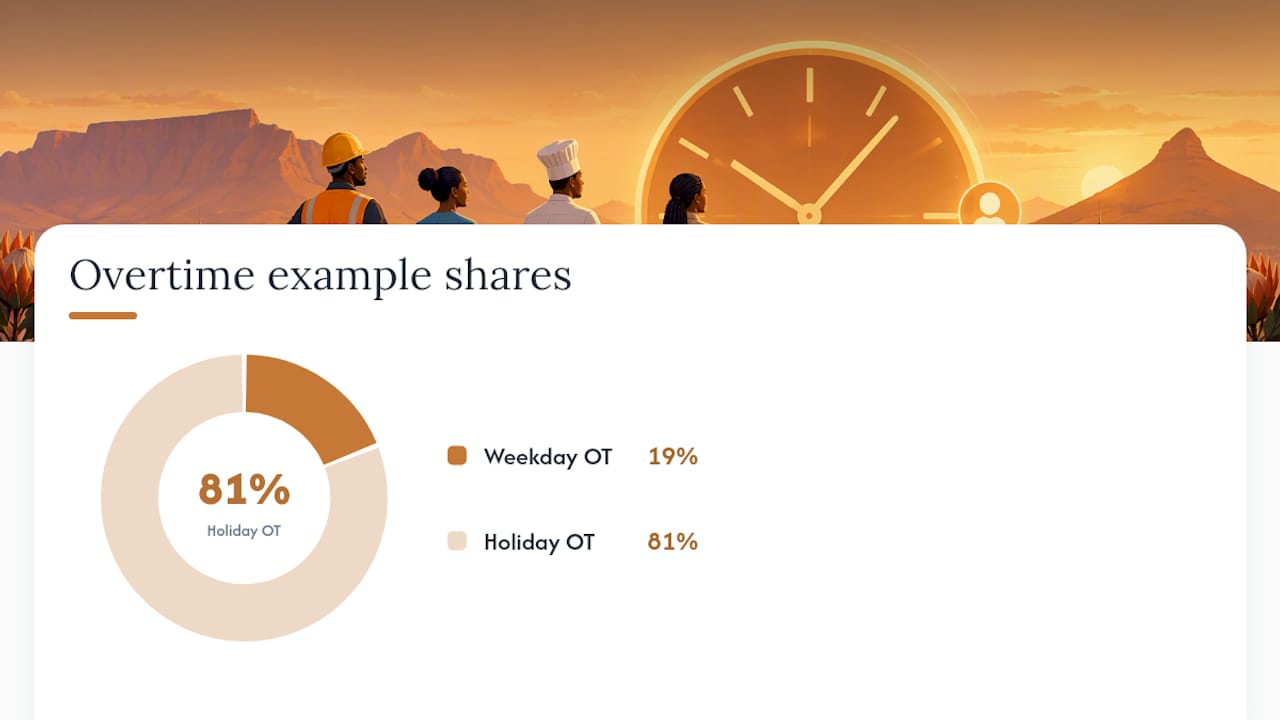
Two examples make the rules concrete. An hourly-paid warehouse worker earning R80/hour who logs 2 hours of weekday overtime earns an extra R240 (R80 × 1.5 × 2). A shift supervisor earning R100/hour called in for 5 hours on a public holiday earns R1,000 in overtime pay alone (R100 × 2 × 5), on top of the guaranteed holiday pay.
Before running payroll, check four things:
- Confirm the employee’s annual earnings against the R269,600.90 threshold.
- Verify a written overtime agreement exists and hasn’t lapsed.
- Confirm the payslip itemizes overtime pay separately from basic salary.
- Retain time records for the full three-year window.
When a scenario doesn’t fit neatly into these examples, involving a bargaining-council rate or a ministerial determination, it’s worth consulting a payroll specialist rather than guessing.
A Payroll Specialist’s Take on Getting This Right
Most overtime disputes Expandtosouthafrica encounters trace back to one habit: contracts that were correct when signed but never updated as the earnings threshold moved. Payroll teams that review contract clauses annually, rather than reactively after a CCMA referral, catch threshold drift before it costs anyone money. Run a sample payroll audit this quarter if you haven’t already.
— Roel
How Expandtosouthafrica Handles Overtime and Payroll Compliance
Expandtosouthafrica is the alternative to setting up a South African entity just to get overtime calculations right. For a flat fee starting at £299 per employee per month, with no setup fees or currency loading, you get BCEA-compliant contracts, accurate ZAR payroll, and payslips that itemize overtime the way the law requires.

Every filing that touches overtime pay, PAYE through EMP201, UIF, SDL, and COIDA, is handled by a licensed local partner who tracks threshold updates so your contracts never fall out of step with current law. Onboarding runs in days, not months, and signed employment agreements typically land within 48 hours. If you’re hiring in South Africa and want overtime handled correctly from day one, review Expandtosouthafrica’s employer of record pricing and start the conversation about your first hire.
This article is general information, not a substitute for advice from a qualified lawyer. Consult a qualified legal professional about your own circumstances before acting on anything here.
Sources
- Basic Conditions of Employment Act summary — VCA Consulting
- Basic Conditions of Employment Act 75 of 1997 — Government Gazette (BCEA text)
- WageIndicator — Overtime compensation and BCEA threshold
- Overtime calculator and method — YourIncomeCalculator
- Overtime Calculator 2026 – PayTools
FAQ
How Is Overtime Pay Calculated in South Africa?
Divide the monthly salary by 4.333, then by ordinary weekly hours, to get the hourly rate. Multiply that rate by 1.5 for weekday and Saturday overtime, or by 2 for Sunday and public-holiday work, following the standard BCEA calculation method.
What Are the Rules Regarding Overtime Pay in South Africa?
Overtime is voluntary, must be agreed in writing, and is capped at 3 hours a day and 10 hours a week under Section 10 of the BCEA. Employers can pay cash at 1.5× or 2×, or offer paid time off instead, as long as the arrangement is documented.
Is a 40-Hour Work Week Legal in South Africa?
Yes. The BCEA sets 45 hours a week as the statutory maximum for ordinary hours, so a standard five-day 9-hours-a-day schedule falls within legal limits. Many employers consider anything above those statutory hours as overtime.
What Is the Salary Threshold for Overtime in South Africa in 2026?
The earnings threshold is R269,600.90 per year, effective May 2026. Employees earning at or below that amount automatically qualify for BCEA overtime protections regardless of job title.
Does Expandtosouthafrica Handle Overtime Calculations for Employers?
Yes. Expandtosouthafrica’s Employer of Record service includes BCEA-compliant payroll that calculates and itemizes overtime pay correctly, starting at £299 per employee per month.