

If your annual payroll is projected to exceed R500,000 in the next 12 months, you must register for the Skills Development Levy with the South African Revenue Service. Once liable, you owe 1% of total remuneration monthly, submitted via EMP201 alongside PAYE and UIF. Registration happens through the EMP101 form, and you have 21 business days from becoming an employer to get it done.
TL;DR:
- Employers exceeding R500,000 in expected annual payroll must register for SDL within 21 business days of hiring, using the same EMP101 form as PAYE and UIF.
- “Total remuneration” includes wages, bonuses, overtime, and taxable allowances, but requires careful classification of directors’ fees and prorated projections for new hires.
- Monthly SDL liability is 1% of total remuneration, with payments due within seven days after each month, and delays can lead to penalties and backdated assessments.
- Exemptions are limited to entities like government departments, certain charities, and organizations below the threshold, but registration may still be required.
- Using a professional payroll service simplifies compliance, helps track thresholds, and ensures timely filings, rather than handling registration and filings independently.
Table of Contents
- Who Has to Pay SDL and How the R500,000 Test Works
- How to Register With SARS and Nominate Your SETA
- Calculating, Filing, and Paying SDL Every Month
- Exemptions and Choosing the Right SETA
- The Payroll Team’s Compliance Checklist
- SDL Compliance Is a Day-One Hiring Decision, Not an Afterthought
- Let Expand to South Africa Handle Your SDL Registration and Filings
- Official Forms and Resources Worth Bookmarking
- Sources
- FAQ
Who Has to Pay SDL and How the R500,000 Test Works
The R500,000 threshold is not a rearview mirror calculation. You test your expected payroll over the next 12 months, not what you paid last year. If you are opening your first South African office with several hires at a combined annual cost exceeding the threshold, you are liable from day one, even though you have zero payroll history.
“Total remuneration” for SDL purposes casts a wide net. It typically includes:
- Gross salaries and wages
- Overtime pay
- Bonuses and commission
- Leave pay and most taxable allowances
Certain items get different treatment. Directors’ fees, for instance, may fall outside the leviable base depending on whether the individual is genuinely an employee or holds a non-executive role with no employment contract. This distinction trips up more small businesses than any other line item on the EMP201, and it is worth confirming with a payroll specialist before you submit your first return.
Part-year payrolls need annualizing. If you hire your first employee in August at R45,000 a month, you cannot just multiply by four remaining months and conclude you are under threshold. SARS expects you to project the full 12-month run rate, which in this example already clears R500,000 before the tax year ends.
One detail catches employers off guard: some organizations exempt from actually paying SDL still carry a registration duty. If you employ anyone liable for normal tax, you generally need to register for PAYE regardless of your SDL payment status, which means the paperwork does not disappear even when the levy itself does.
How to Register With SARS and Nominate Your SETA
Registering for SDL is not a separate process from registering as an employer. It happens through the same EMP101 application that covers PAYE and UIF, which is worth knowing before you go hunting for a standalone SDL form that does not exist.
- Gather your documentation. You will need your company registration number, banking details, a PAYE reference if you already have one, and a realistic projection of your first 12 months of payroll.
- Submit EMP101 through SARS eFiling or your local SARS branch. Most employers handle this online, though the branch route remains available for businesses that prefer in-person processing.
- Indicate your SETA jurisdiction on the same form. You cannot register for SDL without naming which of the Sector Education and Training Authorities your business falls under.
- Track your 21 business-day deadline. The clock starts the day you become an employer, meaning the day your first employee’s contract takes effect, not the day you decide to formalize things.
- Wait for EMP103. SARS issues this as your official notice of registration once EMP101 clears processing.
If your business spans multiple sectors, you still pick one SETA. The Skills Development Levies Act treats this as a binding choice unless the Commissioner directs otherwise, so the decision deserves more thought than picking whichever SETA sounds closest to your industry name.
Pro Tip: Before you submit EMP101, map your workforce by function, not by company name. A logistics company with a large internal software team might belong more logically under a SETA aligned to services than the one its trading name suggests, and getting this right up front avoids a reclassification headache later.
Changing your SETA after the fact is possible but administratively slow, and it can disrupt grant applications that are already in progress. Get the nomination right the first time.
Calculating, Filing, and Paying SDL Every Month
A company with R620,000 in monthly gross payroll owes R6,200 in SDL for that period. The complexity lives in what counts as leviable, not in the multiplication.
A few line items commonly shift the base without employers noticing:
- A one-off bonus run in December inflates that month’s SDL liability
- Backdated salary increases applied retroactively change prior months’ totals
- Termination payouts that include leave pay get included, while certain statutory severance components may not
SDL gets declared on the same EMP201 monthly return that carries your PAYE and UIF figures. If SDL shows as inactive on your SARS profile despite your payroll clearing R500,000, that is a registration gap, not a system glitch, and it needs fixing before your next submission.
1% of total remuneration is the flat SDL rate, filed monthly through EMP201, with payment due within seven days after month-end.
The bigger risk is not the calculation. It is the gap between when you became liable and when you actually registered. SARS can raise estimated assessments for the period you should have been registered, and those estimates rarely land in your favor. Add interest and penalties on top, and a missed registration from six months ago can turn into a payment demand that has nothing to do with your actual payroll.
Exemptions and Choosing the Right SETA
Statutory exemptions from SDL exist, but they are narrower than most employers assume. Public service employers, certain public benefit organizations, and some municipal entities with specific certification can qualify. If you believe your organization falls into one of these categories, secure formal recognition through the SARS Tax Exemption Unit rather than assuming exemption applies by default.
Common exemption categories include:
- National and provincial government departments
- Registered religious or charitable institutions meeting specific criteria
- Employers whose total remuneration falls genuinely below the R500,000 threshold
Exemption from paying the levy does not always mean exemption from registering. If you employ staff liable for normal tax, PAYE registration duties generally continue regardless of your SDL payment status, so do not treat “exempt” as “no further paperwork.”
Choosing a SETA comes down to three practical factors: what your workforce actually does day to day, how your payroll is distributed across departments, and where your genuine training needs sit. Picking the wrong SETA does not just create an administrative mismatch. It can make your business ineligible for mandatory and discretionary grants tied to skills development spending, which defeats much of the point of paying the levy in the first place.
The Payroll Team’s Compliance Checklist
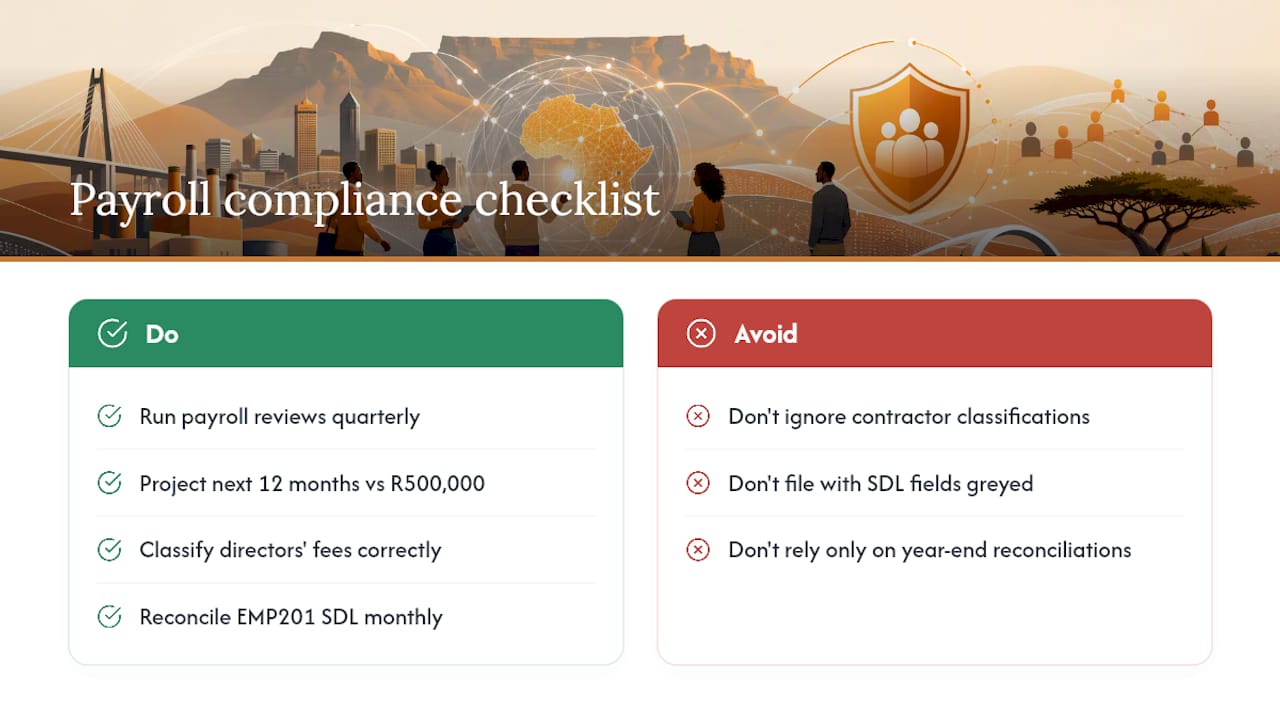
Catching a threshold breach before SARS does is the difference between routine compliance and an unpleasant estimated assessment. Run an annual payroll review, ideally each quarter, projecting your next 12 months against the R500,000 line rather than reviewing it once and forgetting about it.
Pay particular attention to how you classify directors’ fees and contractor payments. A contractor reclassified as a deemed employee under South African labor law changes your leviable base retroactively, and SARS will not accept “we didn’t realize” as a defense during an audit.
Before every EMP201 submission, check that SDL fields are not greyed out or defaulting to zero, a common glitch when payroll systems are configured before SDL registration completes. Keep supporting documentation on hand: board minutes referencing your SETA nomination, signed employment contracts, payslip breakdowns showing leviable versus non-leviable items, and any correspondence with your SETA. Cross-referencing payroll figures against your payroll service provider’s general ledger accounts before filing catches mismatches early, well before SARS does it for you.
Pro Tip: Reconcile your EMP201 SDL line against your general ledger payroll expense account every month, not just at year-end. A ten-minute check catches configuration errors before they compound into six months of understated returns.
SDL Compliance Is a Day-One Hiring Decision, Not an Afterthought
Most companies treat SDL registration as a back-office detail to sort out after the first hire starts. That is backwards. The 21 business-day clock starts the moment you become an employer, which means SDL registration needs to be part of your hiring plan, not a task you get to after payroll is already running.
Working with a specialist local payroll partner removes most of the risk here, since EMP201 activations and SDL registration are exactly the kind of recurring, deadline-driven filings that fall through the cracks when HR is juggling contracts, onboarding, and everything else that comes with a first South African hire.
— Roel
Let Expand to South Africa Handle Your SDL Registration and Filings
Expand to South Africa is the alternative to building an in-house payroll function from scratch when your only goal is to hire compliantly in South Africa. Instead of learning EMP101 forms, SETA nomination rules, and monthly EMP201 mechanics yourself, our licensed local partner handles SDL registration, activation, and ongoing filings as part of a flat-fee Employer of Record service, with contracts signed within 48 hours of you deciding to hire.

Our service covers compliant contracts, payroll, PAYE, UIF, SDL, and COIDA statutory filings under a predictable monthly cost per employee instead of an accumulating set of compliance tasks. If you are weighing whether to register directly with SARS yourself or hand the whole process to a partner who does it daily, our Employer of Record services are built for exactly that decision point. Check current pricing on our site and see what it costs to have SDL, PAYE, and UIF handled correctly from your first South African hire onward.
Official Forms and Resources Worth Bookmarking
- SARS Skills Development Levy page: rate, threshold, and payment mechanics straight from the source
- SARS PAYE registration guide: EMP101 submission process and the 21-day deadline
- SASSETA employer SDL guidance: EMP101/EMP103 procedural detail and SETA grant eligibility
- Skills Development Levies Act No. 9 of 1999: the legal text governing registration, exemptions, and penalties
Sources
- Skills Development Levy | South African Revenue Service
- Registering for Employees’ Tax Pay-As-You-Earn (PAYE) | South African Revenue Service
- SASSETA: Skills development levy (employers)
- Skills Development Levies Act (No. 9 of 1999) – Government Gazette
FAQ
Who needs to pay SDL in South Africa?
Any employer whose total annual remuneration is expected to exceed R500,000 in the next 12 months must register and pay SDL, calculated at 1% of total remuneration.
Is SDL the same as UIF?
No. SDL funds skills development and training through SETAs, while UIF provides unemployment insurance; both get declared on the same EMP201 return but serve entirely different purposes and carry separate rates.
Is it mandatory to pay SDL?
Yes, once your payroll crosses the R500,000 threshold, though certain public service employers and qualifying public benefit organizations may qualify for exemption from payment while still carrying PAYE registration duties.
How much is the SDL?
The rate is a flat 1% of total remuneration paid to all employees, filed and paid monthly through EMP201 within seven days after month-end.
What happens if I register late for SDL?
SARS can raise estimated assessments backdated to when you should have registered, plus interest and penalties, which is why tracking the 21 business-day deadline from your first hire date matters more than most employers realize.