

Yes. If a third party processes payroll data on your behalf, POPIA requires a written operator agreement, and that agreement must guarantee more than confidentiality. It needs to define scope and purpose, lock in security measures under section 19, require immediate breach notification, control sub-processors, and set out data return or destruction terms. Skip the written agreement and you are already in contravention, with administrative fines reaching up to R10 million on the table.
TL;DR:
- Without a proper written operator agreement, companies risk contravening POPIA and facing fines up to R10 million.
- Proper payroll data processing agreements must specify scope, security measures, breach reporting, sub-processor control, and data destruction protocols.
- Key clauses include details on data categories, security controls, breach notifications, audit rights, and rules for cross-border data transfers.
- Generic terms of service are inadequate; vendors should provide specific contractual commitments aligned with POPIA requirements before signing.
- Using a licensed local partner in South Africa simplifies compliance, as the Operator of Record agreement already incorporates all necessary legal, security, and procedural provisions.
Table of Contents
- What Is a Data Processing Agreement for Payroll, and Why Does POPIA Demand One?
- Core Clauses Every Payroll DPA Must Contain
- POPIA’s Payroll-Specific Rules: Sections 19, 21, 22, and 72
- Building the Processing Schedule and Security Annex
- Reviewing a Vendor’s Payroll DPA: Red Flags That Should Stop You
- How Expand to South Africa Structures Payroll Operator Agreements
- Why Some Clauses Matter More Than Others
- Get a POPIA-Compliant Payroll Setup Without Drafting the Contract Yourself
- Where to Verify These Rules Yourself
- Sources
- FAQ
What Is a Data Processing Agreement for Payroll, and Why Does POPIA Demand One?
A data processing agreement for payroll is the contract that governs how a third party, your payroll provider, your Employer of Record, or your HR software vendor, handles employee personal information on your behalf. Under South African law, this document is usually called an operator agreement, and the terms are functionally interchangeable: what GDPR calls a “data processing agreement,” POPIA calls an “operator agreement,” with the responsible party (you, the employer) and the operator (the vendor) mapped to equivalent roles.
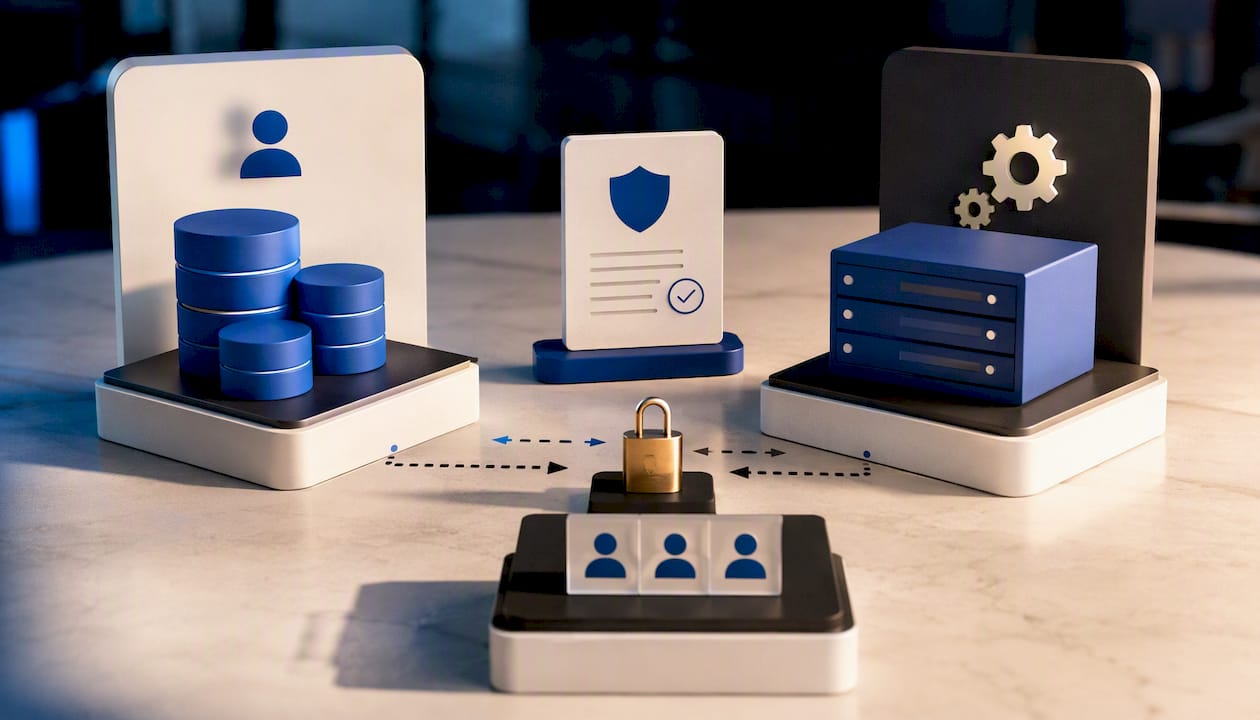
Section 21 of POPIA makes this contract mandatory, not optional, the moment a third party processes personal information for you. A vendor’s standard terms of service will not satisfy that requirement on their own. A POPIA operator agreement needs audit rights, breach-notification timelines, and explicit data return or destruction clauses that generic ToS documents almost never include.
Payroll data makes this especially urgent because of what it contains. A single pay run touches bank account numbers, tax reference numbers, medical aid contributions, garnishee orders, and sometimes health-related information tied to sick leave or disability benefits. That is a wider blast radius than most HR systems, and it is exactly the kind of data set POPIA’s drafters had in mind when they wrote section 21.
Core Clauses Every Payroll DPA Must Contain
A properly drafted payroll operator agreement is not a one-page addendum. These documents typically run 15 to 40 pages depending on how complex the processing is, and the length reflects the number of distinct obligations that need to be spelled out in writing rather than assumed.
At minimum, expect these clauses:
- Scope and purpose of processing. The agreement should state exactly what the operator does with the data, calculating pay, generating payslips, filing statutory returns, and attach a schedule of processing activities as an annex rather than burying it in prose.
- Categories of personal data. List payroll figures, banking details, tax identification numbers, benefits and medical aid data, and any absence or health-related information the payroll system touches.
- Operator obligations. The vendor must process only on your documented instructions, maintain confidentiality, and vet personnel who have access to the data.
- Security measures tied to section 19. Encryption, access controls, and monitoring should be named specifically, not gestured at with a vague “appropriate measures” line.
- Breach-notification protocol. The contract should require immediate notice of any suspected compromise, with defined content requirements for that notification.
- Sub-processor controls. Any downstream vendor the operator uses needs the same obligations cascaded down, in writing, with your prior consent or at least advance notice.
- Audit rights and certification. You should be able to request proof of independent security certification, such as ISO 27001 or SOC 2, without needing to negotiate that access after a breach has already happened.
- Return and destruction procedures. When the relationship ends, the agreement needs to specify how and when data gets returned or destroyed, with confidentiality obligations surviving termination.
Pro Tip: Ask your payroll vendor for their operator agreement before you sign a services contract, not after. If they can only offer you a generic terms-of-service page, that is your answer about how seriously they take POPIA.
POPIA’s Payroll-Specific Rules: Sections 19, 21, 22, and 72
Three sections of POPIA do most of the work in a payroll context, and a fourth matters the moment data crosses a border.
Section 21 is the trigger. It requires a written contract whenever an operator processes personal information for a responsible party, and it applies regardless of company size or industry. There is no informal-arrangement exception for payroll, even when the “operator” is a boutique bookkeeping firm processing payslips for twelve employees.
Section 19 sets the security bar. It requires responsible parties, and by extension their operators, to implement appropriate technical and organizational measures against loss, damage, and unauthorized access. In a contract, this translates into naming specific controls: encryption at rest and in transit, role-based access, and monitoring. Referencing an ISO 27001 certification gives you an objective benchmark instead of relying on a vendor’s own assurances.
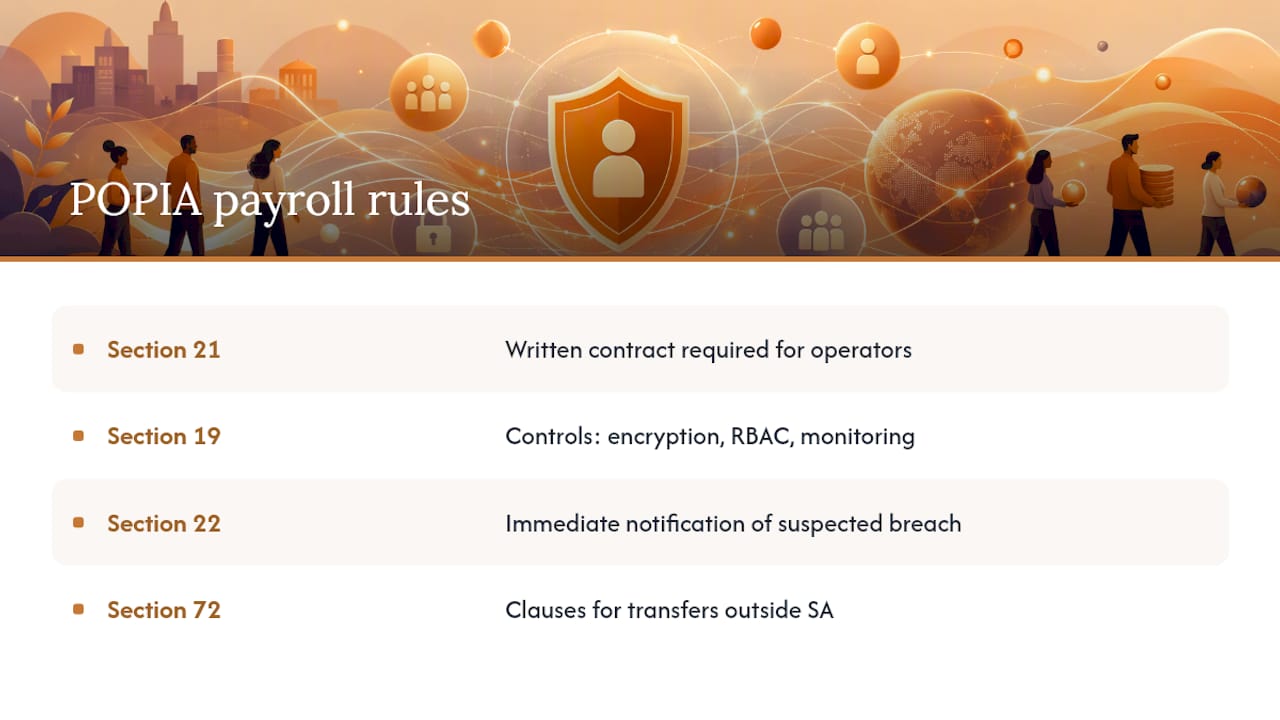
Section 22 governs notification. Operators must notify you immediately of any suspected compromise, because your statutory clock for reporting to the Information Regulator and affected data subjects starts running from the moment you become aware, not from when the operator finally tells you. A vendor that only commits to notifying you “within a reasonable time” is quietly shifting regulatory risk onto your business.
Section 72 covers cross-border transfers. If your payroll provider stores or processes data outside South Africa, the agreement needs clauses addressing that transfer, similar in function to GDPR’s standard contractual clauses.
Enforcement is not theoretical. The Dis-Chem case involved roughly 3.6 million records and was driven substantially by the absence of a proper operator agreement in the vendor relationship, an outcome regulators are increasingly willing to pursue.
Building the Processing Schedule and Security Annex
Every payroll DPA should attach two annexes: a processing description and a security schedule. Treat these as living documents you can adapt to your specific payroll setup rather than boilerplate you paste in once and forget.
The processing description should cover:
- Activities performed. Pay calculation, payslip generation and delivery, statutory submissions like EMP201 filings, and any benefits administration.
- Data categories processed. Salary figures, bank details, tax numbers, medical aid and pension contributions, and leave or absence records.
- Data subjects covered. Current employees, former employees whose records are retained, and dependents where medical aid data is involved.
9 Retention periods. How long payroll records are kept after employment ends, and under what statutory basis. - Recipients and jurisdictions. Which parties receive the data downstream and where those parties are located.
The security annex should map directly to section 19 obligations. A practical checklist looks like this:
| Control area | What to specify |
|---|---|
| Encryption | At rest and in transit, with named protocol standards |
| Access control | Role-based access, least-privilege principle |
| Authentication | Multi-factor authentication for administrative access |
| Logging and monitoring | Audit trails for who accessed what data and when |
| Patching | Defined schedule for security updates |
| Testing | Regular penetration testing with summary results shared |
| Backups | Frequency, encryption, and recovery testing |
| Physical security | Data center access controls where relevant |
Breach notification deserves its own line item in the schedule: require immediate notice, with the notification specifying what data was affected, how many records, when the compromise was discovered, and what remediation steps are already underway. Sub-processor changes deserve the same discipline. Require the operator to give you advance notice before adding a new sub-processor, with a genuine right to object, not just a courtesy heads-up after the fact. When the contract ends, insist on written certification that data has been returned or destroyed, not a verbal assurance.
Reviewing a Vendor’s Payroll DPA: Red Flags That Should Stop You
Most payroll vendor contracts were written with GDPR compliance in mind and never updated for South African law. That gap shows up in predictable places.
Watch for these warning signs:
- GDPR-only language with no POPIA references. If the contract never mentions sections 19, 21, or 72, it was probably drafted for a European client and adapted lazily.
- Vague breach-notification timing. “Without undue delay” is not the same as immediate, and the difference matters when your own reporting clock is running.
- Permissive sub-processor clauses. If the vendor can add sub-processors without notifying you, you have no visibility into who else touches your payroll data.
- No audit evidence on offer. A vendor that cannot produce a current ISO 27001 certificate or SOC 2 report, even in summary form, is asking you to take their security on faith.
Before signing, ask directly: where is the data stored, who are the current sub-processors, has there been a security incident in the past 24 months, and can you show recent penetration test results? A vendor that cannot answer these plainly is telling you something.
Pro Tip: If a vendor refuses back-to-back obligations for their own sub-processors, or refuses to commit to a specific notification window, in writing, treat that as a reason to escalate to legal review before signing anything.
How Expand to South Africa Structures Payroll Operator Agreements
Expand to South Africa operates as an Employer of Record, which means the operator relationship is built into how the entire service works, not bolted on as an afterthought. Employment runs through a licensed local partner that handles BCEA-compliant contracts and ZAR payroll, alongside the statutory filings that create ongoing data-processing obligations: PAYE through EMP201 with SARS, UIF, SDL, and COIDA.
That combination of filings is exactly where operator agreements earn their keep, because each submission moves employee data to a different statutory body, and each move needs to be accounted for in the contract.
A few things worth noting about how this plays out in practice:
- Data handling runs under POPIA and GDPR, with EU data residency for records that cross borders.
- Pricing is a flat fee, disclosed upfront.
- Contracts get signed promptly, and onboarding completes quickly, timelines that work when the operator agreement terms are settled in advance rather than negotiated deal by deal.
Businesses using this model can review the underlying payroll services structure directly rather than reverse-engineering compliance from a vendor’s marketing copy.
Why Some Clauses Matter More Than Others
Most negotiations over payroll DPAs waste time on indemnity boilerplate while glossing over the three clauses that actually transfer risk: breach notification, sub-processor control, and audit rights. An indemnity clause pays you back after something goes wrong. A tight notification clause and real audit access help you catch the problem before it becomes a regulatory filing.
Unified HR and payroll platforms make this more urgent, not less. Once performance reviews, benefits enrollment, and absence tracking sit in the same system as salary data, the scope of what needs protecting expands quietly, and a DPA written for “payroll processing” alone may not cover it.
There is a point where you accept a vendor’s ISO 27001 report as sufficient evidence and move on, and a point where you should walk. If a vendor refuses immediate breach notification or will not cascade obligations to their own sub-processors, no amount of commercial convenience should talk you into signing.
— Roel
Get a POPIA-Compliant Payroll Setup Without Drafting the Contract Yourself
Every clause covered above, scope of processing, section 19 security measures, immediate breach notification, sub-processor controls, is already built into how Expand to South Africa structures its Employer of Record agreements, so you are not negotiating operator terms from scratch with a vendor who has never heard of POPIA.
Working through a licensed local partner means your South African hires get BCEA-compliant contracts, ZAR payroll, and statutory filings handled under an agreement that already accounts for PAYE, UIF, SDL, and COIDA reporting, with data governed under POPIA and GDPR and EU data residency for cross-border records. Pricing is a flat fee with no setup costs and no currency loading, and contracts typically get signed within 48 hours. If you want to see what a compliant operator agreement actually looks like before you commit to hiring, review the Employer of Record services page or request a compliance walkthrough for your first South African hire.
Where to Verify These Rules Yourself
- POPIA operator agreement template and commentary, for a usable drafting starting point.
- Operator obligations and enforcement examples, including the Dis-Chem case.
- ISO 27001 standard details, for benchmarking security annex requirements.
- Payroll outsourcing cost considerations, for comparative context on provider risk versus cost.
Sources
FAQ
Is a Data Processing Agreement Legally Required for Payroll in South Africa?
Yes. POPIA section 21 requires a written operator agreement whenever a third party processes personal information on your behalf, and payroll processing falls squarely within that requirement.
What Happens If We Don’t Have a Written Operator Agreement?
Operating without one is a contravention of POPIA, and enforcement can carry administrative fines of up to R10 million, alongside reputational damage if a breach occurs.
How Fast Must a Payroll Vendor Report a Data Breach?
POPIA requires operators to notify the responsible party immediately upon discovering a suspected compromise, since the employer’s own statutory reporting clock starts from that notification.
Can We Use a Vendor’s Standard Terms of Service Instead of a Dedicated DPA?
No. Standard terms of service typically lack the audit rights, breach-notification timelines, and data return or destruction clauses that a proper operator agreement requires.
Does Expand to South Africa Provide a Compliant Operator Agreement for Payroll Data?
Yes. Its Employer of Record model routes payroll data handling through a licensed local partner under agreements structured around POPIA and GDPR, including EU data residency for cross-border records.