

Four statutory obligations sit on every South African payroll: PAYE, UIF, SDL, and COIDA. The one action that protects you from penalties on all four is the same: register as an employer within 21 business days of your first hire, then treat the monthly EMP201 submission as non-negotiable.
TL;DR:
- Employers must register within 21 business days of hiring their first employee to avoid penalties and ensure compliance with all payroll obligations.
- The employer’s cost for UIF, SDL, and COIDA can significantly increase overall headcount expenses, even though only PAYE is deducted from employee pay.
- Accurate monthly filings using EMP201 and timely reconciliation via EMP501 are crucial, as errors can lead to penalties and SARS estimates.
- Small businesses under R500,000 annual payroll are exempt from SDL, but variable pay and proper documentation are essential to maintain the exemption.
- Using an external payroll service or Employer of Record can reduce compliance risk and help manage the complex filing deadlines more effectively.
Table of Contents
- What Payroll Taxes Do Employers Pay in South Africa?
- How Does PAYE Work for Employers?
- How Much UIF Do Employers Need to Pay?
- Do Small Employers Have to Pay SDL?
- What Are Employer Obligations Under COIDA?
- Registration, EMP201, and EMP501: The Compliance Calendar
- What Compliance Mistakes Cost Employers the Most?
- The Real Risk Isn’t the Tax Rate. It’s the Filing Rhythm.
- How Expand to South Africa Handles Your Statutory Filings
- Where to Verify These Rules Yourself
- Sources
- FAQ
What Payroll Taxes Do Employers Pay in South Africa?
Before you build a payroll calendar, you need the full liability list in front of you. Missing even one of these creates exposure that compounds monthly.
- PAYE (Pay As You Earn): Deducted from employee remuneration using SARS tax tables, paid over in full by the employer. The employee bears the cost; you carry the filing risk.
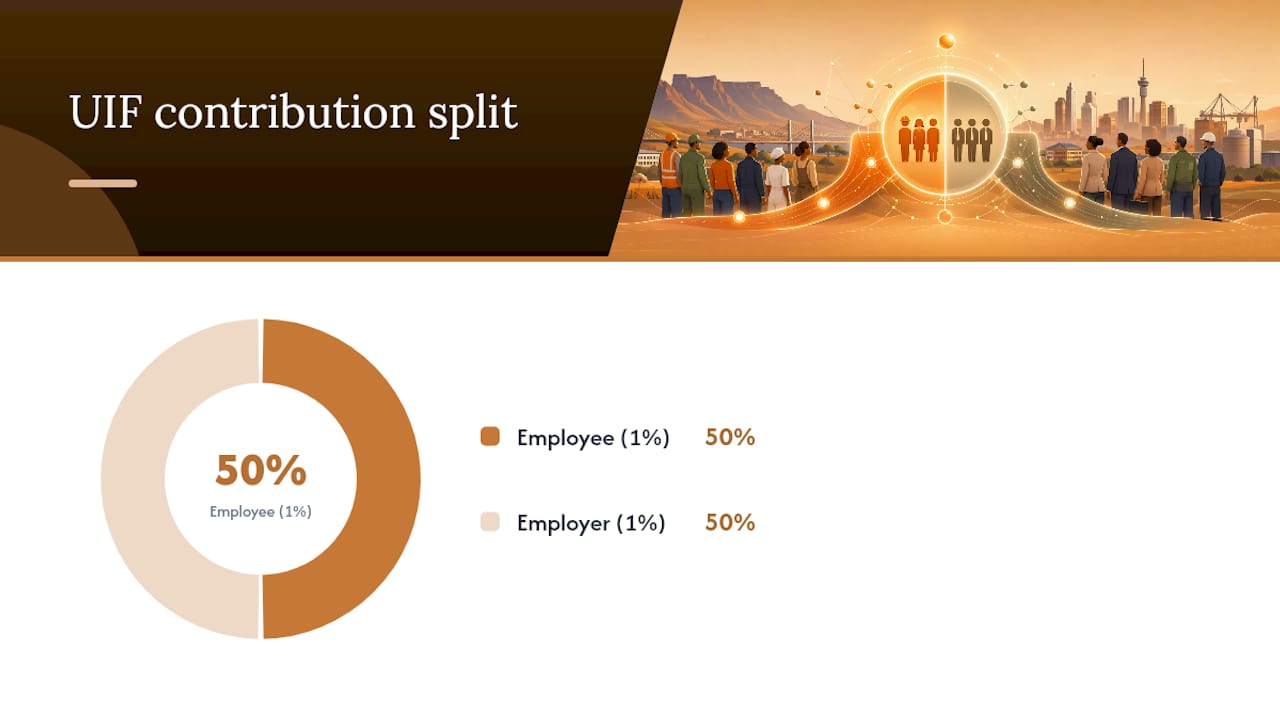
- UIF (Unemployment Insurance Fund): Split evenly, 1% from the employee’s pay and 1% from the employer, capped at a monthly remuneration ceiling of R17,712.
- SDL (Skills Development Levy): 1% of leviable payroll, paid entirely by the employer, with a full exemption for businesses whose annual payroll stays under R500,000.
- COIDA (Compensation for Occupational Injuries and Diseases): An annual assessment based on assessable earnings and your sector’s risk classification, paid entirely by the employer.
PAYE and the employee half of UIF are deductions from staff pay. SDL and COIDA, plus the employer half of UIF, are direct costs you absorb on top of gross salary. If you’re budgeting headcount costs, those employer-only charges are what typically get forgotten until the first EMP201 lands.
How Does PAYE Work for Employers?
The employer’s duty here is absolute: you must deduct employees’ tax from remuneration at the time you pay it, not at some later reconciliation point. SARS is explicit that PAYE takes priority over voluntary deductions, meaning you cannot let a garnishee order or a savings scheme reduce the amount available for tax withholding.
Calculating the deduction starts with taxable remuneration, which is gross pay minus allowable items like retirement fund contributions within statutory limits. From there, you apply the current SARS deduction tables or, where an employee has unusual circumstances (multiple income sources, unusual allowances), a tax directive issued by SARS. Getting this step wrong doesn’t just shortchange SARS. It creates a liability that lands back on the employer, not the employee, if an audit finds under-deduction.
Pro Tip: Update your payroll software’s tax tables the moment Budget changes take effect, not weeks later. The 2025 Budget’s PAYE table revisions took effect March 1, 2025, and any payroll run using stale tables underwithholds, which you then have to correct retroactively.
Two filings anchor the whole system:
- EMP201, monthly. This declaration reports PAYE, UIF, and SDL together and generates a Payment Reference Number (PRN) that links your payment to the correct liability. Payment is due within seven days after month-end, moved forward if that date falls on a weekend or public holiday.
- EMP501, twice yearly. The interim and annual reconciliations match what you declared on twelve months of EMP201s against the IRP5 and IT3(a) certificates you issue employees. Mismatches here are where most compliance problems surface, often months after the underlying payroll error happened.
Before your first EMP501 window opens, confirm every employee’s income tax reference number is valid and correctly captured. A mismatched or missing number is the single most common reason reconciliations get rejected. Keep payroll registers as required under the Fourth Schedule to the Income Tax Act. These are the records SARS will ask for if a reconciliation flags a discrepancy, and reconstructing them after the fact is far harder than filing them correctly the first time.
How Much UIF Do Employers Need to Pay?
UIF is the most mechanically simple of the four taxes, and also the one most likely to be misrouted through the wrong filing channel.
The math is straightforward: 1% of remuneration from the employee, 1% matched by the employer, remitted monthly. The SARS UIF external guide sets a monthly remuneration cap of R17,712 for calculating contributions, meaning higher earners still only generate UIF liability up to that ceiling rather than on their full salary. A detailed breakdown of how that cap interacts with EMP201 filing sits in our UIF contributions guide.
Where employers stumble is channel selection:
- Businesses whose UIF is administered by the UI Commissioner register and file through uFiling.
- Businesses whose UIF is bundled with SARS-administered payroll taxes use eFiling or e@syFile, the same platforms used for EMP201 and EMP501.
Using the wrong channel doesn’t just create an inconvenience. Payments can land in the wrong system entirely, leaving you technically in arrears even though you paid on time. Confirm which channel applies to your registration before your first submission, not after a payment goes missing.
Pro Tip: If you run irregular pay intervals, weekly wages, biweekly staff, monthly salaried employees, file separate UI-19 declarations for each pay cycle rather than trying to batch them into one monthly submission. It keeps your records aligned with actual payment dates and avoids confusion during an audit.
Do Small Employers Have to Pay SDL?
Not always. SDL is levied at 1% of leviable payroll, but employers whose total annual payroll stays under R500,000 are fully exempt. That threshold catches a lot of small businesses and startups by surprise, since many assume SDL applies universally the moment they hire their first employee.
Leviable payroll is broader than base salary. It includes bonuses, leave pay, and commissions, which means a business that looks like it’s under the R500,000 line on salaries alone can cross it once variable pay is added in. Document how you tested for the exemption each tax year. If your payroll grows past the threshold partway through the year, you need evidence of when that happened.
SDL registration also requires SARS to classify you under the correct Sector Education and Training Authority (SETA). This isn’t a formality. Your SETA classification determines which skills development levies fund which training programs, and getting it wrong can misdirect levies you’re entitled to claim back through training grants.
Common reporting mistakes on the EMP201 include:
- Double-counting allowances that were already included in the PAYE calculation.
- Applying SDL to the wrong base (net pay instead of leviable gross).
- Continuing to file SDL after legitimately qualifying for the small-employer exemption, which overpays the levy unnecessarily.
What Are Employer Obligations Under COIDA?
COIDA obligations run on a different track from PAYE, UIF, and SDL, but they carry equally real financial consequences. Every employer must register with the Compensation Fund, or an approved insurer, and pay annual contributions calculated on assessable earnings rather than a flat percentage.
Assessable earnings are your total payroll cost, subject to an annual earnings ceiling that the Department of Labour updates periodically. Your actual rate depends on your industry’s risk classification. A logistics company with a fleet of delivery vehicles pays a materially different rate than a software business with desk-based staff, even at identical headcount.
The core administrative task is the Return of Earnings (ROE), submitted annually to declare actual earnings paid during the assessment period. This return determines your final contribution and next year’s provisional assessment.
Practical steps that keep COIDA compliance clean:
- Confirm your sector’s current assessment rate rather than assuming last year’s rate still applies.
- Maintain an accident register (often called an accident book) at every workplace, even if incidents are rare.
- Notify your insurer or the Department of Labour promptly after any workplace injury. Delayed notification can complicate a claim and expose you to disputes over liability.
Registration, EMP201, and EMP501: The Compliance Calendar
Payroll compliance in South Africa runs on a strict administrative rhythm, and the deadlines matter as much as the calculations.
- Register within 21 business days. The moment you become an employer, you must register for employees’ tax using forms EMP101e or EMP102e, submitted through eFiling, e@syFile, or a SARS branch. New employers frequently miss this window simply because payroll setup gets deprioritized behind hiring paperwork.
- File EMP201 monthly. Each submission generates a PRN that ties your payment to PAYE, UIF, and SDL liabilities together. Payment is due within seven days of month-end, and if that date lands on a weekend or public holiday, it shifts to the prior business day, not the next one.
- Reconcile via EMP501 twice a year. The interim window (typically running from late September through the end of October) and the annual reconciliation both require your twelve months of EMP201 data to match the IRP5 and IT3(a) certificates issued to staff.
The penalty structure for late or inaccurate EMP501 filings escalates fast: administrative penalties increase by 1% per month, up to a maximum of 10% of the outstanding amount. Beyond that, SARS holds the power to estimate your liability where filings are missing or clearly inaccurate, and that estimate becomes your legal obligation until you file a correction. Employers remain liable for the shortfall on any under-deduction, even when the error was unintentional or caused by outdated payroll tables.
What Compliance Mistakes Cost Employers the Most?
The single most common failure point sits at the EMP201, not the annual reconciliation. Timing and allocation errors on the monthly filing are what generate SARS estimates and penalty notices, long before an EMP501 mismatch ever surfaces.
A few controls prevent most of this:
- Validate every employee’s income tax reference number before the first payroll run, and again before EMP501. A single invalid number can cause a reconciliation rejection that delays every certificate tied to it.
- Standardize how pay elements map to SARS definitions (which allowances are taxable, which are exempt) so your gross to PAYE, UIF, SDL calculation is consistent month over month.
- Close payroll a few business days before month-end to leave room for reconciliation and PRN generation, especially in months where a public holiday falls early.
Pro Tip: If your business operates from outside South Africa, understand that legal liability for payroll shortfalls stays local. Being headquartered abroad offers no insulation from SARS penalties. That is precisely the exposure an Employer of Record structure is built to absorb on your behalf.
For companies weighing in-house payroll against an Employer of Record arrangement, the decision usually comes down to whether you have local payroll expertise on staff or are building it from scratch under time pressure.
The Real Risk Isn’t the Tax Rate. It’s the Filing Rhythm.
Most employers who get burned on South African payroll didn’t miscalculate PAYE. They missed a filing window, used an outdated tax table, or let an invalid tax number sit unnoticed until EMP501 season turned it into a formal rejection. The seven day payment rule, the 21 business day registration deadline, and the twice yearly reconciliation cadence are what actually trip up growing companies.
If you’re hiring your first South African employee, the practical move is to either commit to a payroll calendar that treats EMP201 as immovable, or hand statutory filing to a specialist who already runs that calendar for other employers. Trying to learn the system in real time, on your first few payroll cycles, is where the expensive mistakes happen.
— Roel
How Expand to South Africa Handles Your Statutory Filings
Some employers use a service provider to manage BCEA-compliant contracts, monthly PAYE filing through EMP201, UIF and SDL remittance, and COIDA registration and reporting, so their finance teams do not handle SARS deadlines directly.

Filings are typically managed through a licensed local partner under a flat monthly fee, with no setup charges or currency conversion markups. Data handling may follow POPIA and GDPR standards with EU data residency, useful if compliance teams need to adhere to European data protection rules as well as South African ones. Contracts often get signed within 48 hours of agreement, and full onboarding can complete within days rather than the weeks required to register a local entity.
If you want to see what a hire actually costs once PAYE, UIF, SDL, and COIDA are factored in, run the numbers through our employment cost calculator before you commit to a headcount plan, or explore our EOR services directly to see how the filing workload shifts off your plate entirely.
Where to Verify These Rules Yourself
Primary sources worth bookmarking: the SARS PAYE guide, the UIF external guide, and PwC’s South Africa tax summary for SDL thresholds. For managed payroll support, see Expand to South Africa’s payroll services. For third-party payroll advisory perspective, T-Ledgers covers general payroll compliance practices.
Sources
FAQ
How Much Do Employers Pay for Payroll Taxes?
PAYE is deducted from employee pay rather than an added employer cost.
How Much Tax Do Employees Pay in South Africa?
Employees pay PAYE according to SARS tax tables based on their taxable income, plus a 1% UIF contribution matched by their employer. The exact PAYE rate depends on income bracket and any applicable tax directives.
How Does Payroll Work in South Africa?
Employers register with SARS within 21 business days of hiring their first employee, then run monthly payroll that deducts PAYE and UIF, calculates employer-side UIF, SDL, and COIDA liabilities, and files an EMP201 declaration with payment due within seven days of month-end. Twice a year, an EMP501 reconciliation matches those filings against employee tax certificates. Companies without in-house payroll infrastructure often route this through an Employer of Record to avoid managing the filing calendar directly.