

Total employer cost equals gross salary, plus statutory on-costs, plus your Employer of Record’s monthly fee. For a mid-level UX designer earning roughly R45,000 a month, expect a total employer cost slightly above the gross salary range, before adding an EOR fee of €350 / $399 / £299. Entry-level and senior hires shift the salary line, but the statutory and EOR components barely move. The Basic Conditions of Employment Act, SARS’s payroll guidance, and Expand to South Africa’s own pricing are the three sources behind every number below.
TL;DR:
- Total employer costs for hiring a UX designer include statutory contributions, a monthly EOR fee, and optional extras, often exceeding the gross salary by a small margin.
- Employer contributions such as UIF, SDL, and COIDA depend on salary thresholds and industry risk, with SDL applying only if annual payroll exceeds R500,000.
- An Employer of Record handles legal responsibilities like issuing contracts and filing taxes, minimizing compliance risks and ensuring timely remittances.
- For a mid-level UX designer earning R45,000 monthly, total employer cost is roughly R45,990 plus the EOR fee, with additional costs for benefits or sourcing if applicable.
- Using a dedicated employment cost calculator helps verify budget figures and tailor employer costs based on specific salary, benefits, and statutory obligations.
Table of Contents
- Breaking Down the Real Cost of a UX Designer Hire
- The Statutory Rules That Actually Move Your Number
- Who Handles What: EOR Duties vs. Your Responsibilities
- Three Worked Examples: Entry, Mid, and Senior UX Hires
- From Offer to First Payroll: What the Timeline Looks Like
- Turning This Into a Budget Line: Your Next Steps
- Why Single-Country Depth Changes the Budgeting Conversation
- Get an Exact Employer-Cost Quote Without the FX Guesswork
- Primary Sources for Verifying These Figures
- Sources
Breaking Down the Real Cost of a UX Designer Hire
Most international employers start budgeting from the wrong number. They see a UX designer’s advertised salary and treat it as the full cost of the hire. It isn’t. Gross salary is what lands in your designer’s bank account before their own tax; employer cost is what leaves your company’s account every month, and the gap between those two figures is where budgets quietly fall apart.
That gap has three parts. First, the statutory contributions you owe as the employer, on top of salary. Second, your EOR’s monthly management fee. Third, any voluntary extras you choose to offer.
Employer statutory contributions are the least understood piece. Some, like the Unemployment Insurance Fund, split between employer and employee. Others, like the Skills Development Levy and the Compensation Fund, are employer-paid only and never touch the employee’s payslip. Getting this split wrong is the single most common budgeting error we see from founders new to South African payroll.
The EOR fee is the second line, and it’s where pricing models diverge sharply. Some EOR providers charge a flat fee per employee per month covering payroll processing, BCEA-compliant contracts, statutory filings, and data protection-aligned handling. Broader multi-country platforms often price differently, with monthly EOR fees ranging from roughly $199 to $699 or more per employee depending on country and service tier.
Add-ons round out the picture: medical aid contributions, retirement fund matching, or a one-time recruitment fee if you use talent sourcing to find the designer in the first place. None of these are mandatory under South African law, but they’re common enough in competitive UX hiring that you should budget for at least one.
The Statutory Rules That Actually Move Your Number
Three statutory schemes and one filing process determine your on-costs, and each has a specific trigger you need to check before you finalize a budget.
UIF costs the employer 1% of the employee’s monthly earnings, matched by another 1% deducted from the employee, with both remitted monthly to SARS. There’s a monthly earnings ceiling for UIF contribution purposes, so above a certain salary the contribution flattens rather than scaling with income.
SDL only applies once your total annual payroll across all employees exceeds R500,000. If this UX designer is your first South African hire and their salary alone won’t cross that threshold, you may owe no SDL at all. Once your combined payroll does cross it, SDL is 1% of leviable payroll, remitted with the same monthly filing.
COIDA is an industry-rated assessment paid entirely by the employer into the Compensation Fund. Desk-based digital roles like UX design typically sit in a lower risk band than manufacturing or construction, so the assessment percentage is modest, but it still needs a real number, not a guess.
| Statutory item | Who pays | Rate / trigger |
|---|---|---|
| UIF | Employer + employee | 1% each, monthly earnings cap applies |
| SDL | Employer only | 1% of payroll, once annual payroll exceeds R500,000 |
| COIDA | Employer only | Industry-rated assessment, varies by risk class |
| PAYE | Employer withholds | Filed via EMP201, due monthly |
Pro Tip: Run your annualized payroll projection before you assume SDL doesn’t apply to you. A single hire might sit under the R500,000 threshold today, but a second or third South African hire this year could push you over it retroactively.
Who Handles What: EOR Duties vs. Your Responsibilities
An EOR doesn’t just cut a paycheck. It carries specific legal obligations on your behalf, and knowing where those obligations start and stop protects you if something goes wrong.
- The EOR issues a BCEA-compliant written contract and payslip, since the Act requires written particulars at the start of employment and defined payslip content.
- The EOR files EMP201 and remits PAYE, UIF, and SDL, with payment due within seven days after month-end.
- The BCEA requires remuneration records to be kept for three years; ask your EOR for confirmation this retention is built into their process.
- CCMA-safe dismissal guidance and free transfer support, where a publisher offers it, remove two of the riskiest parts of managing South African staff yourself.
Missing an EMP201 remittance isn’t a minor slip. SARS can hold the employer personally liable for the shortfall, which is exactly the exposure a competent EOR is built to absorb on your behalf.
Three Worked Examples: Entry, Mid, and Senior UX Hires
Here’s how the math actually runs, using conservative assumptions you can adjust for your own numbers.
- Entry-level UX designer, R28,000 gross monthly salary. Add UIF employer share (1% = R280), assume a modest COIDA assessment (roughly R56), skip SDL if this is your only South African hire, then add the EOR fee. Total employer cost lands around R28,336 plus €350 / $399 / £299.
- Mid-level UX designer, R45,000 gross monthly salary. UIF employer share is calculated as a small percentage of the monthly salary, COIDA contribution roughly proportional to salary and industry risk, SDL adds R450 if your combined payroll exceeds R500,000 annually. Total employer cost is approximately R45,990 plus the EOR fee.
- Senior UX designer, R70,000 gross monthly salary. UIF contributions are subject to a monthly earnings ceiling, COIDA contribution varies by industry risk and salary level, SDL adds a levy when triggered by payroll threshold. Total employer cost sits around R70,840 to R70,980 plus the EOR fee.
A few notes worth flagging:
- These ZAR figures translate to roughly €1,500 to €3,700 depending on the tier, though exchange rates shift daily, so treat any EUR/USD conversion as directional, not exact.
- COIDA rates vary by industry classification, with digital roles generally in a lower risk category resulting in a modest assessment.
- If you use talent sourcing to fill the role, add that one-time fee separately. It doesn’t recur monthly like the other components.
Run your own inputs through the employment cost calculator to replace these assumptions with your actual numbers.
From Offer to First Payroll: What the Timeline Looks Like
Budgeting a hire is only half the job. Knowing when the money actually starts moving matters just as much for cashflow planning.
Some EOR providers aim for contract signing shortly after a confirmed offer, with full onboarding completed within days rather than weeks. That timeline typically runs through these milestones:
- Offer accepted and salary terms confirmed.
- BCEA-compliant contract issued and signed.
- SARS, UIF, and Compensation Fund registrations processed for the new employee.
- Payroll setup completed in ZAR.
- First EMP201 submission filed the following month.
The most common blocker isn’t the EOR’s process. It’s missing employee documentation: a delayed tax number, an unresolved sectoral determination question, or a benefits package still being negotiated. Get those documents moving on day one, not after the contract is signed.
Turning This Into a Budget Line: Your Next Steps
You now have every input you need to build a defensible employer-cost line item. Here’s how to finish the job.
- Set your target gross salary based on the seniority level you’re hiring.
- Confirm your COIDA industry band, since desk-based UX roles usually fall low but should still be verified.
- Decide whether you’re offering medical aid, retirement matching, or other voluntary benefits.
- Add the EOR flat fee to your running total.
- Check whether your combined South African payroll crosses the R500,000 SDL threshold.
- Run the employment cost calculator to confirm your manual math.
Once your internal number is set, request a written quote from your EOR to confirm it against theirs before you finalize the budget.
Why Single-Country Depth Changes the Budgeting Conversation

Most of the confusion around South African employer costs comes from applying multi-country EOR logic to a market with its own specific rules. A platform juggling 150 jurisdictions treats South Africa as one entry in a spreadsheet. A provider that only operates here treats COIDA classification and SDL thresholds as the daily job, not an edge case.
That focus shows up in speed and clarity, not just marketing copy. When your local partner has handled hundreds of CCMA-safe terminations and knows exactly which COIDA band applies to digital roles, your budget stops being a rough estimate and starts being a number you can defend to your finance team.
— Roel
Get an Exact Employer-Cost Quote Without the FX Guesswork
Certain EOR providers offer flat-rate pricing per employee per month with no setup fees, covering BCEA-compliant contracts, ZAR payroll processing, EMP201 filings, UIF, SDL, and COIDA administration, data protection aligned handling, and access to talent sourcing.
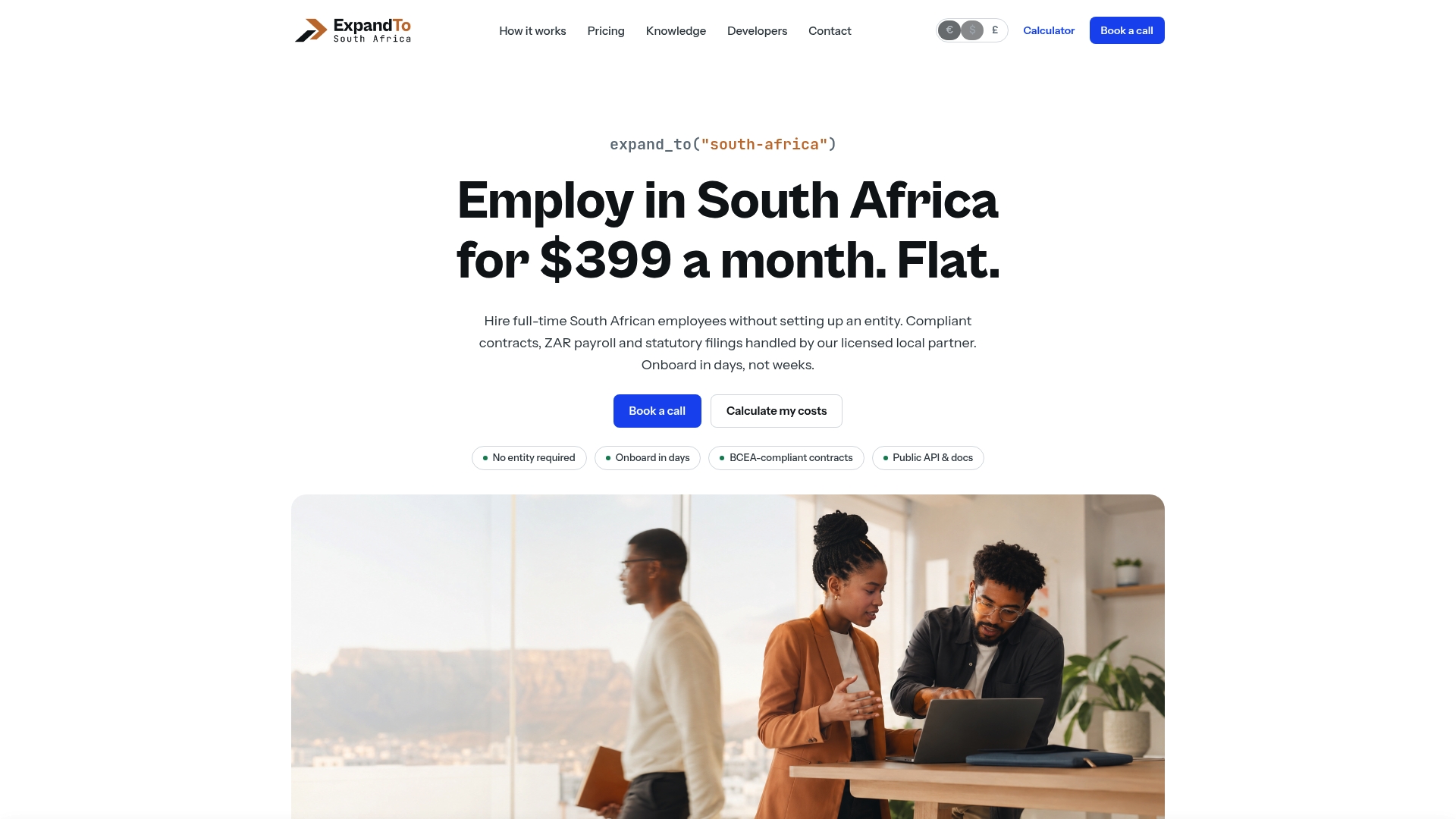
Every one of those components is priced into the flat fee, not billed separately as your headcount grows. If you want to see how your specific salary target and benefits package translate into a full budget line, run the numbers through the employment cost calculator or request a tailored quote through the EOR services page. Either path gets you a real number within days, not a rough range you’ll need to revisit before you can commit to the hire.
Primary Sources for Verifying These Figures
- Basic Conditions of Employment Act 75 of 1997, for contract and payslip requirements.
- SARS employer’s guide to PAYE, UIF, and SDL, for exact statutory rates and filing deadlines.
- Expand to South Africa’s EOR services page, for a written quote and service scope.
- For comparative context on payroll timing in other markets, see this overview of employer payroll rules.
Sources
- Basic Conditions of Employment Act 75 of 1997 | South African Government
- Guide for employers on employees’ tax and related payroll items (SARS 2026) | SARS