

The Employer of Record is the legal employer, full stop. It signs the employment contract, runs payroll, withholds taxes, and answers to labor and tax authorities. The hiring company keeps operational control over the worker’s daily tasks and output, but it never holds the statutory employer role, and that distinction determines who bears liability if something goes wrong.
TL;DR:
- Verifying an EOR requires confirming its registered legal entity, recent tax filings, and statutory insurance proof in the worker’s country.
- The EOR handles contractual, payroll, and statutory obligations, but the hiring company retains control over daily supervision and work direction.
- Risks arise if managers issue offers or payments directly, blurring the line of de facto employment and exposing the company to regulatory penalties.
- Switching from an EOR to a local entity is justified when headcount grows, complex control is needed, or long-term costs favor forming a legal entity.
- South Africa’s EOR model involves a registered local entity, statutory filings, and compliance with local laws like POPIA, with clear operational and cost advantages.
Table of Contents
- Legal Employer Under EOR: What the EOR Actually Owns
- What the Hiring Company Still Controls (and Where That Gets Risky)
- How to Verify an EOR’s Legal Employer Status Before You Sign
- EOR vs. Local Entity: Which One Actually Fits Your Situation
- How Expand to South Africa Handles the Legal Employer Role
- What I’d Check on Day One and Before First Payroll
- Let Expand to South Africa Handle the Legal Employer Role for You
- Sources
Legal Employer Under EOR: What the EOR Actually Owns
Confusion about the phrase “legal employer under EOR” almost always comes from mixing up two different jobs that sit side by side in the arrangement. One party manages the work. The other party owns the legal and financial relationship with the state. Getting this backward is how HR teams end up assuming protections or liabilities that were never theirs to claim.
The Employer of Record model exists specifically to separate these functions. The EOR is the registered legal entity in the worker’s country, and it takes on every duty that comes with that registration.
Four responsibilities define the role:
- Contract issuance: the EOR drafts, signs, and stores the local employment contract, using terms that satisfy the labor code of that jurisdiction rather than a template borrowed from the client’s home country.
- Payroll execution: it calculates gross-to-net pay, withholds income tax and social contributions, and remits both to the correct authorities on schedule.
- Statutory benefits administration: leave entitlements, sick pay, retirement contributions, and termination procedures all run through the EOR’s systems, not the client’s HR stack.
- Regulatory accountability: when a labor inspector or tax authority has a question, the EOR is the entity that answers, because its name is on the registration.
ADP’s employer-of-record framework describes this as a split between employment administration and day-to-day direction. The EOR handles the paperwork and the payment rails. The client tells the worker what to build, sell, or fix.
Pro Tip: Ask any prospective EOR to show you a signed contract sample and a redacted payroll register before you commit. If they hesitate to produce either, that hesitation is itself the answer to whether they can actually deliver on the legal employer role.
Here is the number that should shape your due diligence: compliance checklists built for this exact question consistently flag entity ownership verification, payroll tax registration, and worker classification as the three items most often skipped by buyers, and skipped items are where audits find trouble. An EOR that cannot produce proof of its own tax registration in the worker’s country is not functioning as a legal employer. It is functioning as an invoice with a logo on it.
None of this means the EOR is invisible in daily operations. It shows up when the worker has a payroll question, a leave dispute, or a termination that needs to follow local notice rules. But it stays out of performance reviews, project assignments, and the conversations that actually shape how the work gets done. That separation is the whole point of the model, and it is also where the next set of risks begins.
What the Hiring Company Still Controls (and Where That Gets Risky)
You keep the parts of employment that make the hire useful to your business. Direction, performance management, goal setting, and daily supervision all remain yours under an EOR arrangement, and no compliant EOR will try to take them from you.
The risk shows up when that control tips into something regulators call de facto employment. If your managers issue employment offers directly, negotiate salary outside the EOR’s process, or sign anything resembling an employment document, you start looking less like a client and more like the actual employer in the eyes of a labor inspector.
Practical scenarios where this matters:
- A manager emails a candidate an offer letter on company letterhead before the EOR issues the formal contract.
- The client’s finance team pays a bonus directly to the worker instead of routing it through EOR payroll.
- A worker is given a title, email domain, and reporting structure indistinguishable from a direct employee, with no visible separation from the EOR relationship.
Regulators in several jurisdictions focus enforcement on who exercises integrated managerial control, because that is a better indicator of the real employment relationship than a piece of paper. Some countries also require licenses for arrangements that resemble worker leasing, which raises the stakes for clients who blur the operational and legal roles too aggressively.
Pro Tip: Route every written offer, compensation change, and disciplinary action through the EOR’s process, even when it feels slower than sending an email yourself. That paper trail is your best defense if a regulator ever asks who was really directing the relationship.
The reputational exposure runs alongside the legal exposure. If your EOR misses a tax filing or misclassifies a worker, you may not be the named party in the resulting penalty, but you are the company whose name the worker associates with the failure. A botched termination or an unpaid statutory benefit reflects on your brand even when the liability sits legally with the EOR of record.
How to Verify an EOR’s Legal Employer Status Before You Sign
Trusting a sales page is not due diligence. Before you commit headcount to any EOR, run through a short verification sequence that confirms the provider can actually do what “legal employer” requires.
- Confirm the registered legal entity. Ask for the exact entity name that will appear on the employment contract and check that it is registered in the worker’s country, not a shell registered elsewhere that merely partners with a local firm.
- Request recent filing evidence. A provider that has been running payroll for real employees should be able to show redacted proof of statutory tax remittances without treating the request as unusual.
- Read the contract wording closely. The employer name on the contract should match the registered entity exactly, and the document should reference the correct statutory clauses for that country’s labor code.
- Verify employer-side insurance and statutory coverage. In South Africa, for example, this means confirmation of active COIDA coverage and UIF registration, not a verbal assurance that “it’s handled.”
- Assess data protection posture. Ask for evidence of controls consistent with frameworks like SOC 2 or ISO 27001, plus a clear statement of which data protection law governs the worker’s personal information.
- Check KYC and right-to-work processes. A provider that skips identity and eligibility verification on the way in is unlikely to be rigorous on the way out.
Every one of those six checks maps to items that dedicated compliance checklists identify as the highest-value verification points, because they are also the items vendors most often gloss over when they operate as a thin reseller layer rather than a licensed employer.
Watch for these red flags specifically: a “partner-only” model where the sales entity cannot name who actually employs the worker; no willingness to share filing proof, even redacted; vague or nonexistent escalation channels when a payroll issue arises; and contract language that names a different entity than the one presented during sales conversations. Any one of these on its own is a yellow flag. Two together should end the conversation.
EOR vs. Local Entity: Which One Actually Fits Your Situation
An EOR is the right tool for a specific set of situations, and forming a local legal entity is the right tool for a different set. Confusing the two costs either time or money, sometimes both.
An EOR makes sense when you are testing a market with a pilot hire, need to move fast on a single candidate, or expect headcount in that country to stay in the single digits for the foreseeable future. Contract turnaround measured in days beats the months typical entity registration takes in most jurisdictions, and you avoid the ongoing cost of local corporate compliance for one or two people.
A local entity becomes the more sensible option once headcount and permanency change the math. Workday’s analysis of employer-of-record economics notes that entity formation tends to become more cost-effective as a team grows, largely because per-employee EOR fees start to outweigh the fixed cost of running your own registered entity with full legal control and transparency.
Model the decision against three factors:
- Total cost of employment: compare the EOR’s flat or percentage fee against the ongoing cost of local incorporation, accounting, and compliance staffing.
- Control needs: an entity gives you the legal employer role directly, which matters if you need to issue equity, structure complex benefits, or maintain a board presence locally.
- Termination and collective-employment exposure: entities carry direct liability for group terminations and collective bargaining obligations that an EOR shields you from during smaller-scale hiring.
The practical signal to switch is rarely a single number. It is usually a combination of sustained headcount growth, a need for direct control over equity or complex benefits, and a long enough time horizon that the fixed costs of an entity stop looking scary. If you are weighing entity formation seriously, a resource like MyInc Team’s guide to getting an EIN abroad walks through what nonresident founders actually face on the registration side.
How Expand to South Africa Handles the Legal Employer Role
South Africa adds its own layer of statutory specificity to the general EOR picture, and this is where the abstract checklist becomes concrete. Expand to South Africa operates through a licensed local partner that issues BCEA-compliant employment contracts and runs ZAR payroll under the country’s own filing regime: PAYE through EMP201 submissions to SARS, UIF, SDL, and COIDA.
That structure answers the verification checklist point by point. There is a registered legal entity behind the contract. There is proof of ongoing statutory filings rather than a promise of future compliance. There is employer-side insurance coverage through COIDA, and there is UIF registration handled as part of standard onboarding rather than an optional add-on.
Data handling runs under POPIA, South Africa’s data protection law, alongside GDPR where clients require EU data residency, which matters for any European company sending employee records across borders.
A few operational details worth noting for HR and finance teams comparing options:
- A flat monthly fee with no setup charges or currency conversion markup, so cost modeling stays simple.
- CCMA-safe guidance on dismissals, which matters because South African termination procedures carry real procedural requirements that differ from at-will assumptions common in the US or UK.
- A time zone roughly one hour from CET, which keeps daily standups and real-time collaboration workable for European teams.
Pro Tip: If you are moving from another EOR provider, ask specifically about transfer terms before you sign anything new. A provider that makes switching easy usually has less to hide about what happens after you commit.
Contracts typically get signed within 48 hours of approval, with full onboarding completed within days rather than the weeks some providers quote.
What I’d Check on Day One and Before First Payroll
Before you relax into “the EOR handles it,” verify a few things yourself. Confirm the contract was signed by the actual registered entity, not a marketing shell, and get written proof the worker is enrolled in payroll.
Request the most recent tax filing and insurance certificates before the first payroll run clears, not after. Document a single named contact at the EOR for escalations, so a payroll question doesn’t disappear into a support queue.
And keep the hired worker out of any contract negotiation or signing authority on your side. That boundary is small, but it’s the one clients cross most often without realizing they’ve done it.
— Roel
Let Expand to South Africa Handle the Legal Employer Role for You
Expand to South Africa removes the ambiguity that trips up companies hiring across borders for the first time: you get one flat fee, one licensed legal entity signing the contract, and full statutory filing coverage from day one, with none of the multi-country pricing complexity that platforms covering 150 countries carry.
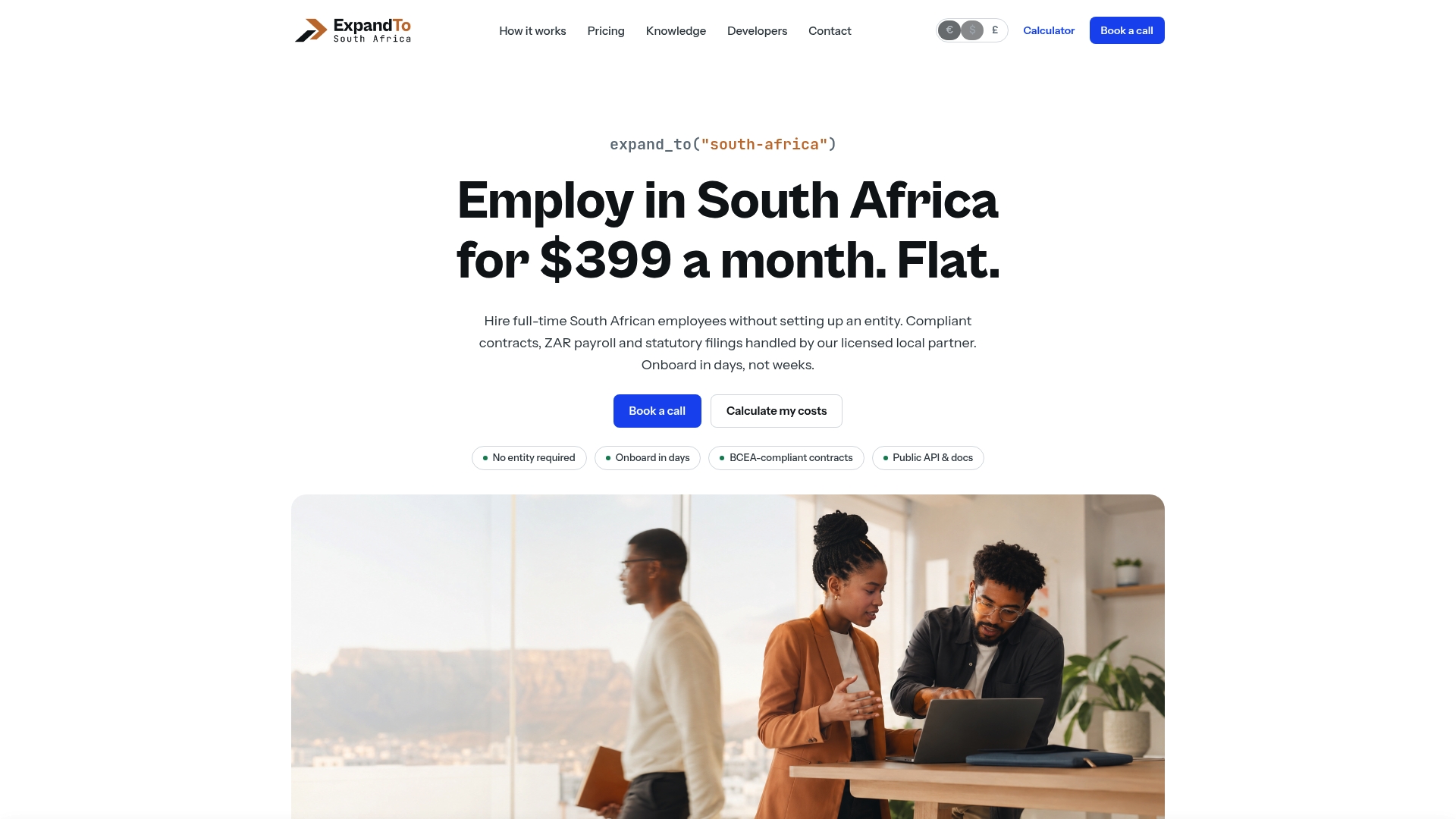
Every capability maps directly to the verification checklist covered above. Entity ownership is clear and disclosed upfront. Statutory filings for PAYE, UIF, SDL, and COIDA run on schedule with proof available on request. Data handling follows POPIA and GDPR with EU residency. Pricing stays flat regardless of salary or role, so your cost modeling doesn’t require guesswork.
If you’re weighing an EOR against building your own compliance process from scratch, start with the employment cost calculator to see the actual numbers for your situation, or request a compliance review to confirm your hiring plan holds up against South African labor law before you make an offer.
This article is general information, not a substitute for advice from a qualified lawyer. Consult a qualified legal professional about your own circumstances before acting on anything here.
Sources
- What Is An Employer Of Record? Key Roles & Major Considerations | Workday
- What is an Employer of Record? | ADP
- EOR Compliance: Your Provider Is the Legal Employer, Your Standup Is the Factual One | Conectia
- Employer of Record compliance checklist 2026 | RiseWorks