

Yes, you can automate global hiring for South Africa, and the practical route is a country-specialist Employer of Record paired with an open API. That combination handles the legal employment relationship, BCEA-compliant contracts, and the recurring SARS obligations, EMP201 monthly filings, UIF, SDL, and COIDA, without you registering a local entity. Expandtosouthafrica runs exactly this model for international employers.
TL;DR:
- Automating South African hiring requires a local employer of record, open API integration, SARS-compliant payroll, and data residency controls to avoid manual processes.
- Integration steps involve confirming salaries, API-triggered offer creation, automatic contract issuance, collection of tax and bank details, and monthly payroll automation before offboarding.
- Employers must register for PAYE, UIF, and SDL within 21 days of hiring and file EMP201 returns by the 7th of each month, with five-year record retention essential for compliance.
- South Africa’s employment costs include gross salary, UIF, SDL, COIDA, and a flat EOR fee, typically 40-60% lower than UK or EU equivalents for similar roles.
- To maintain compliance and reliability, companies should implement regular reconciliation, limit PII exposure, and adapt API workflows to country-specific labor and filing requirements.
Table of Contents
- What Does It Take to Automate South African Hiring?
- How Do You Connect Your HR System to an EOR for Full Automation?
- Compliance Essentials: Registrations, Filing Windows, and Recordkeeping
- What Does a South African Hire Actually Cost Per Month?
- How Do You Keep Automated Payroll Reliable and Compliant?
- Beyond EOR and API: What Other Tools Automate Global Hiring?
- What Breaks When You Try to Scale Automated Hiring Fast?
- How Does Hiring Compliance Differ Outside South Africa?
- Does Automated Onboarding Improve the Candidate Experience?
- How Do You Protect Employee Data During Automated Hiring?
- Author Perspective: Why a South Africa Specialist Matters
- Automate Hiring Without the Compliance Guesswork
- Sources
What Does It Take to Automate South African Hiring?
Automating a South African hire isn’t about bolting a chatbot onto your applicant tracking system; it’s about wiring five distinct components together so a new employee can be offered, contracted, paid, and reported to SARS without a human re-typing the same data four times.
Here’s what actually needs to be in place before you call any of this “automated”:
- A legal employer on record: sign an Employer of Record service agreement that names the entity legally employing your South African staff, since you cannot employ someone directly without a local entity.
- An open API for the hiring lifecycle: offers, onboarding, payroll runs, and terminations should all be triggerable through API calls rather than email threads and PDF attachments.
- A payroll engine tied to SARS: the system needs to generate and submit EMP201 returns monthly and support annual EMP501 reconciliations without manual recalculation.
- ZAR-native payroll infrastructure: local banking rails, IRP5 payslip generation, and record retention that matches South African rules, not a global template retrofitted for Rand.
- Data residency controls: employee PII has to move through systems that respect both POPIA and GDPR, which matters if your HR team sits in the EU or UK.
Miss any one of these and you don’t have automation. You have a manual process with a nicer dashboard. The Employer of Record South Africa guide walks through how each piece fits together for companies building this out for the first time.
How Do You Connect Your HR System to an EOR for Full Automation?
Most companies already run an ATS or HRIS. The question is how to hook that system into a South African EOR without creating a second source of truth. Here’s the sequence that works.
- Confirm the gross salary in ZAR and budget the on-costs. Before anything touches an API, finance needs to sign off on the base salary plus UIF, SDL if applicable, and COIDA.
- Push the offer through an API call that creates the employment record. This is the trigger point: one call should generate the employee profile inside the EOR’s system and log it back into your ATS.
- Let the EOR issue a BCEA-compliant contract. This step should not be manual. A specialist EOR generates the contract clauses required under the Basic Conditions of Employment Act automatically, based on role and salary data already in the system.
- Collect tax and banking details through a structured intake flow. Employee ID or passport number, tax reference number, and bank details all need to be captured before payroll can run, and the EOR handles SARS employer registration where required.
- Automate the monthly payroll cycle. Payslip issuance, EMP201 submission, and payment all need to land by the 7th of the following month, every month, without a spreadsheet reconciliation.
- Schedule EMP501 reconciliation and five-year record retention as recurring tasks, not annual fire drills.
- Build offboarding into the same automated flow, preserving documentation that would hold up at the CCMA if a dismissal is ever challenged.
Pro Tip: Never let a payroll run fire before the employee’s tax reference number and Payment Reference Number (PRN) are confirmed in the system. A payroll run without a linked PRN creates an EMP201 mismatch that takes weeks to untangle with SARS.
Compliance Essentials: Registrations, Filing Windows, and Recordkeeping
Automation only works if the underlying compliance calendar is accurate. Get the dates wrong and you’ve automated a penalty.
Employers must register for PAYE, UIF, and SDL through SARS eFiling within 21 business days of becoming an employer. That clock starts the moment you have someone on payroll, not when it’s convenient to file paperwork.
21 business days is the registration window SARS gives new employers, and the 7th of the following month is the deadline for both submitting and paying EMP201 returns. Miss either date and interest starts accruing immediately.
The recurring filing obligations break down like this:
- EMP201: a monthly declaration combining PAYE, UIF, and SDL, submitted and paid by the 7th of the following month, using a unique Payment Reference Number to link the payment to the declaration.
- SDL liability: kicks in once expected annual payroll exceeds R500,000, calculated at 1% of payroll when applicable.
- COIDA contributions: a separate compensation fund obligation tied to workplace injury cover, assessed annually against your payroll.
- EMP501 reconciliation: an annual employer reconciliation (with an interim window mid-year) that squares every EMP201 filed against actual tax certificates issued.
- Record retention: SARS requires employers to keep payroll records for five years from the date of submission, along with employee particulars like tax reference numbers and ID or passport details.
None of this is exotic. It’s just unforgiving if a manual process drops a date. That’s precisely why payroll services in South Africa built around EMP201 automation exist, so the filing cadence runs on system triggers instead of someone’s calendar reminder.
What Does a South African Hire Actually Cost Per Month?
Budgeting gets messy when finance teams try to estimate South African employment costs using assumptions borrowed from EU or UK payroll. The line items are different, and so are the proportions.
A realistic monthly model needs five components: gross salary in ZAR, the employer’s UIF contribution, SDL if the company is liable, an estimated COIDA charge, and the EOR’s flat fee. Here’s a worked example for a mid-level skilled hire.

The statutory on-costs are modest compared to what UK or EU employers are used to budgeting for national insurance or social charges. Combined with typical salary differentials of 40 to 60 percent for skilled roles compared to UK or EU equivalents, the total monthly cost for this hire still lands well below what the same role would cost domestically. There’s no setup fee and no FX loading on top, which matters when finance is trying to forecast twelve months out rather than react to a surprise line item. Run your own numbers through the employment cost calculator before finalizing an offer.
How Do You Keep Automated Payroll Reliable and Compliant?
The failure mode in automated hiring isn’t usually a missed filing. It’s silent data drift between systems that nobody notices until reconciliation day.
A few operational habits prevent that:
- Use sandbox API keys during integration testing, and build webhooks that are idempotent so a retried payroll trigger doesn’t double-fire a payment.
- Reconcile your ATS or HRIS output against payroll every cycle, matching Payment Reference Numbers rather than trusting that both systems agree by default.
- Limit how much employee PII lives outside the EOR platform. EU-resident storage where required helps satisfy both POPIA and GDPR expectations simultaneously.
- Align retention policies with the five-year SARS rule, and schedule a compliance audit at least annually rather than only when a filing goes wrong.
- Define a RACI for payroll sign-off so there’s no ambiguity about who approves the run and who escalates to the EOR when something looks off.
Pro Tip: Build your escalation SLA with the EOR into the contract itself, not a side conversation. If a payroll dispute takes three days to resolve because nobody defined response times, that delay compounds every month it happens.
Beyond EOR and API: What Other Tools Automate Global Hiring?
An EOR with an API solves the legal employment and payroll layer, but most companies stack additional tools around it for the parts of hiring that happen before someone’s name ever reaches a payroll system.
Applicant tracking systems handle sourcing and interview scheduling. Background check platforms verify credentials and criminal history before an offer goes out. E-signature tools close the loop on contract execution. Document automation platforms, the kind covered in Docupow’s HR document automation guide, reduce the manual re-entry that happens when a new hire’s paperwork moves between five different systems before it lands in payroll.
None of these tools replace an EOR. They feed it. A well-built automation stack routes candidate data from the ATS into the EOR’s onboarding API, lets the EOR generate the compliant contract, and pushes signed documents into permanent storage automatically. The mistake companies make is assuming a single “global hiring platform” can do all of this uniformly across 150 countries. Generic multi-country platforms often apply templated compliance logic that doesn’t reflect the nuance of a specific country’s labor code, which is a real problem when that code, like South Africa’s BCEA and LRA, has teeth.
What Breaks When You Try to Scale Automated Hiring Fast?
The first automated hire is easy. The tenth, hired across three countries in the same quarter, is where most companies discover their process wasn’t actually a process.
The most common breakdown is treating every country as interchangeable. A workflow tuned for hiring in Germany doesn’t map cleanly onto South Africa’s statutory filing calendar or its CCMA dismissal procedures, and companies that force a single global template often discover the gap only when a dismissal gets challenged. A second common failure is data fragmentation: candidate data lives in the ATS, contract data lives with the EOR, and payroll data lives somewhere else, with no single source of truth reconciling all three.
Best practice looks less glamorous than it sounds. It means designating one internal owner for cross-border hiring compliance, even if that person’s day job is finance. It means auditing your automation stack quarterly rather than assuming integrations that worked at hire five still work at hire fifty. And it means resisting the temptation to onboard three new countries in the same sprint just because the API technically allows it. Compliance risk scales faster than headcount does, particularly once you’re relying on EORs in multiple jurisdictions with different filing cadences and different definitions of what counts as a compliant termination.
How Does Hiring Compliance Differ Outside South Africa?
If South Africa is one leg of your global hiring strategy, the automation logic that works there won’t transfer cleanly elsewhere, and assuming otherwise is how companies end up with compliance gaps.
The UK requires right-to-work checks and different termination notice periods than South Africa’s BCEA framework. The EU layers in country-specific works council requirements in places like Germany and France that have no South African equivalent. The US complicates things further with state-by-state variation in at-will employment rules, meaning a termination workflow built for South Africa’s CCMA-conscious process would be entirely wrong for a Texas-based hire and insufficient for a California one.
The practical implication for automation is that your API integration needs country-specific logic branching, not a single universal workflow. A mature multi-country strategy treats each jurisdiction’s EOR relationship as its own compliance module, feeding into a shared dashboard for visibility, but never sharing contract templates or filing logic across borders. South Africa’s requirements, EMP201, UIF, SDL, COIDA, BCEA, and LRA, are specific enough that treating them as a variant of a UK or EU template is where the earlier CCMA-related contract failures tend to originate.
Does Automated Onboarding Improve the Candidate Experience?
Candidates notice when onboarding is slow, and they notice even more when it’s inconsistent. A new hire who waits two weeks for a contract while chasing HR by email starts the job already unsure whether the company has its act together.
Automated onboarding workflows change that dynamic in a way that’s easy to underestimate. When contract generation, tax form collection, and banking setup all happen through a structured API flow instead of scattered email attachments, a South African hire can go from signed offer to first payslip in days rather than weeks. That speed signals competence before the person has done a single hour of work.
There’s a compliance upside too. Automated flows enforce the BCEA-compliant contract clauses every time, rather than relying on whoever drafted the offer letter to remember the right language. Candidates also get a single, consistent portal for document collection instead of a scavenger hunt across email threads, which reduces the anxiety that comes with international hiring in particular, since employees are often unsure whether a foreign employer even understands local labor protections. Getting that first impression right matters more than most hiring teams budget for.
How Do You Protect Employee Data During Automated Hiring?
Automated hiring moves sensitive data, tax numbers, banking details, ID documents, through more systems and more API calls than a manual process ever would. That’s efficient, but it also means more points where a mistake could expose someone’s personal information.
The baseline protections that matter most: encrypted data transmission at every API touchpoint, sandbox environments for testing that never touch real employee records, and role-based access controls so payroll data isn’t visible to everyone with system access. POPIA governs how personal information can be processed for South African employees, and GDPR applies in parallel if your HR team or systems sit in the EU or UK, which means data residency decisions aren’t optional extras. They’re part of the compliance architecture.
Practically, that means limiting how much employee PII gets exported into secondary systems like spreadsheets or shared drives, since every copy is another place a breach could happen. It means audit logging every access to sensitive records, so if something does go wrong, you can trace exactly who touched what and when. And it means building retention deletion schedules that align with the five-year SARS requirement rather than keeping data indefinitely out of convenience. Security here isn’t a one-time setup. It’s a policy that needs revisiting every time you add a new integration to the stack.

Author Perspective: Why a South Africa Specialist Matters
The recurring mistake I see is companies applying a global HR template to South Africa and assuming the BCEA works like a generic labor code. It doesn’t. CCMA-safe dismissal guidance requires knowing local case precedent, not just the statute text, and misapplied templates are exactly how contract enforcement fails when a dismissal gets challenged. Single-country focus isn’t a limitation. It’s what makes the filing and contract details reliable enough to automate in the first place.
— Roel
Automate Hiring Without the Compliance Guesswork
Expandtosouthafrica removes the single biggest bottleneck in cross-border hiring: waiting weeks or months to set up a local entity before you can legally pay someone. As a licensed EOR partner, we issue BCEA-compliant contracts, run ZAR payroll, and handle every statutory filing, PAYE through EMP201, UIF, SDL, and COIDA, on your behalf, with POPIA and GDPR-aligned data handling built in from day one.
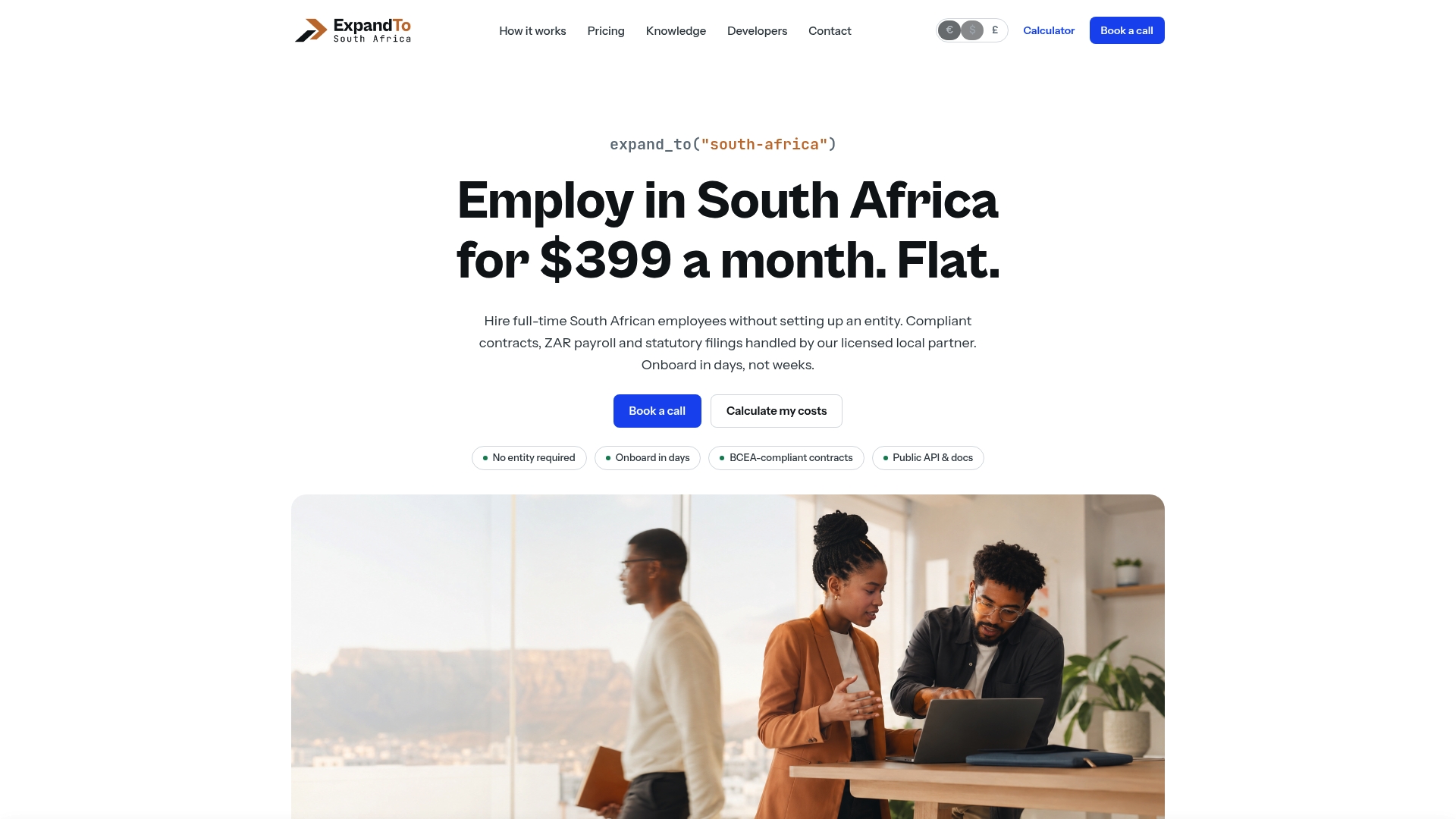
Everything connects through an open API with public documentation and sandbox keys, so your ATS or HRIS can trigger offers, onboarding, and payroll runs without manual re-entry. Pricing is flat and transparent, €350, $399, or £299 per employee per month, with no setup fees and no FX loading buried in the invoice. If you’re ready to see what a compliant South African hire actually costs before you commit, run the numbers and start the onboarding conversation at Expandtosouthafrica.
Sources
- Registering for employees’ tax (PAYE) | SARS
- PAYE-GEN-01-G20 – Guide for Employers iro Employees Tax for 2026 – External Guide
- Government regulatory filing – COIDA, UIF and SDL (with EMP201) – FHBC
- Pay As You Earn (PAYE) | SARS