

A Section 197 transfer automatically moves existing employment contracts to the buyer when a business, or a defined part of it, is transferred as a going concern under South Africa’s Labour Relations Act. The new employer steps directly into the old employer’s rights and obligations, inheriting wages, accrued leave, pension contributions, disciplinary records, and any pending claims, with no gap in employment continuity.
For HR teams and legal advisors managing a deal, the immediate implication is this: you cannot simply ignore the workforce and treat a business acquisition as a clean asset purchase. If the operational capacity of the business transfers, the employees transfer with it, on their existing terms.
The highest-risk outcomes to flag before any transaction closes:
- Automatic unfair dismissal: Any dismissal connected to the transfer, rather than a legitimate operational reason, is automatically unfair under section 187(1)(g) of the LRA, exposing the employer to CCMA referrals and Labour Court remedies including reinstatement or up to 24 months’ compensation.
- Severance liability on the seller: If the seller dismisses employees before transfer to avoid passing them to the buyer, those employees may be entitled to severance pay and the dismissal may still be challenged.
- Inherited liabilities: The buyer inherits all accrued obligations, including unpaid fund contributions and unresolved disciplinary processes, unless a valid section 197(6) agreement is in place.
- Failed transfer test: If the deal does not meet the “going concern” threshold, section 197 does not apply, and the seller may owe severance to employees whose contracts are terminated.
Key Takeaways
A Section 197 transfer automatically substitutes the new employer in all existing employment contracts when a business transfers as a going concern, making pre-transaction due diligence and clear contractual allocation of employee liabilities the most important risk controls available to buyers and sellers.
| Point | Details |
|---|---|
| When section 197 applies | Courts use a fact-based “going concern” test focused on operational capacity, not deal structure or asset labels. |
| Immediate employer duties | The new employer inherits all wages, leave balances, fund contributions, disciplinary records, and pending claims from day one. |
| Automatic unfair dismissal risk | Dismissals connected to a transfer are automatically unfair under section 187(1)(g), exposing employers to up to 24 months’ compensation. |
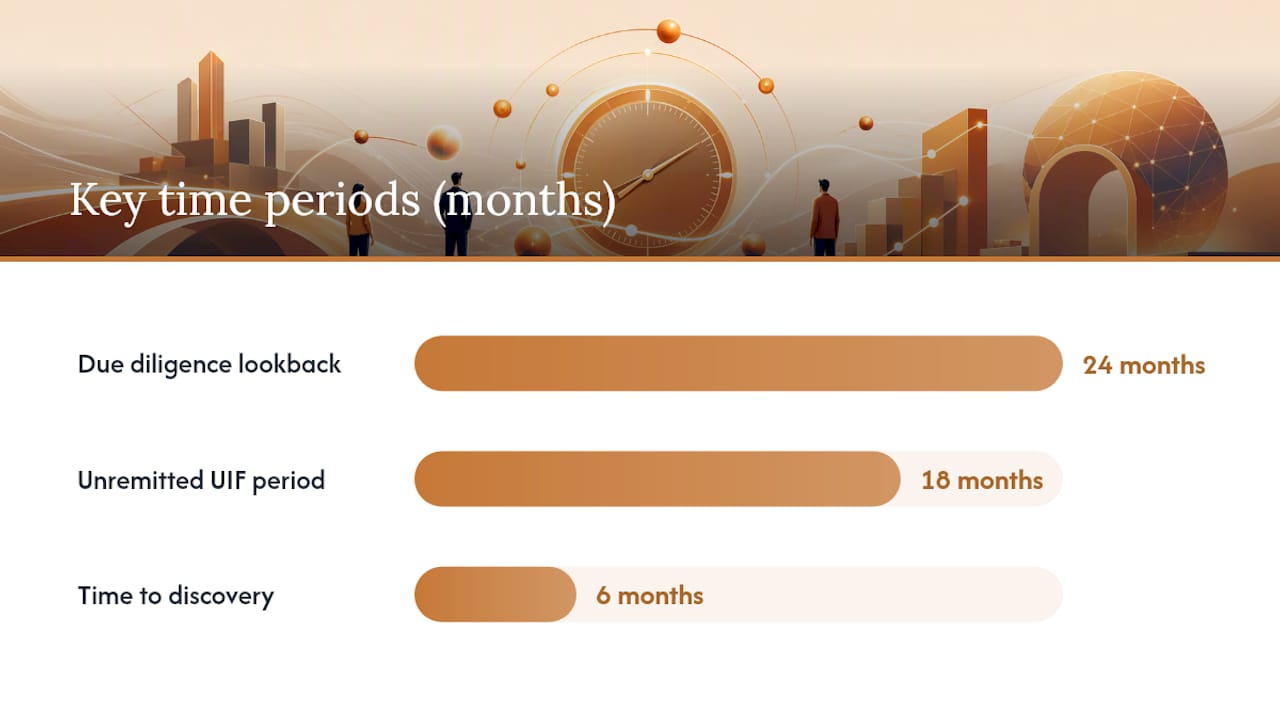
| Top due-diligence priority | Request 24 months of payroll records, fund contribution schedules, all written contracts, and a full list of pending CCMA referrals before signing. |
| Expandtosouthafrica EOR option | Expandtosouthafrica provides compliant interim employment covering payroll, PAYE, UIF, SDL, and COIDA from day one of transfer. |
Table of Contents
- What the LRA and case law say about when a section 197 transfer applies
- Exactly what transfers to the new employer after a going-concern deal
- How dismissals, severance, and liability work around a transfer
- How fixed-term contracts, secondments, and casual workers are treated on transfer
- A compliance checklist for sellers and buyers before, during, and after a transfer
- How disputes over section 197 transfers are resolved at the CCMA and Labour Court
- Practical guidance for US employers acquiring or engaging South African staff
- How a South Africa specialist EOR helps manage section 197 risk
- What HR and deal teams often get wrong about section 197
- Expandtosouthafrica handles the employment mechanics when a transfer closes
- Sources
What the LRA and case law say about when a section 197 transfer applies
The operative test under section 197 is whether a business, or part of it, has been transferred as a “going concern.” That phrase carries significant legal weight. Courts do not ask whether every asset changed hands. They ask whether the essential operational capacity of the business moved from one employer to another.
Eversheds Sutherland’s analysis of South African case law confirms that courts focus on whether the business retained its identity and operational capacity after the transfer, not on the formal structure of the deal. This means a carefully structured asset-only purchase can still trigger section 197 if the buyer ends up running the same operation with the same people.
Courts apply a fact-specific enquiry, often called the “snapshot test,” which compares the business immediately before and after the transfer. The factors they weigh include:
- Whether the same assets, premises, or equipment are being used
- Whether the same employees are performing the same functions
- Whether the same clients or customers are being served
- Whether the business continues to generate revenue from the same operational activity
- Whether goodwill, intellectual property, or client relationships transferred
For asset-reliant businesses such as manufacturing plants or logistics operations, the physical transfer of equipment and premises is usually decisive. For labor-intensive businesses such as cleaning services, security firms, or professional service providers, the transfer of the workforce itself may be sufficient to trigger section 197, even without a formal transfer of assets.
Consider two scenarios. In the first, a buyer acquires the machinery, lease, and client contracts of a small manufacturer and retains all employees on the same production lines. Section 197 almost certainly applies. In the second, a buyer acquires only the intellectual property of a software firm and hires none of the developers. The operational capacity has not transferred, and section 197 likely does not apply, leaving the seller with severance obligations.
Section 197(6) and 197(7) do allow parties to agree on different terms for the transfer, but only within strict procedural limits: the agreement must be in writing, must be concluded before the transfer, and must not reduce employees’ rights below the statutory minimum. Any purported contracting-out that falls short of these requirements is void.
Exactly what transfers to the new employer after a going-concern deal
When section 197 applies, the new employer inherits a defined set of rights and liabilities. Understanding this list is the foundation of any buyer’s due diligence.
What automatically transfers:
- All salary and wage obligations at the current rate
- Accrued annual leave, sick leave, and family responsibility leave balances
- Provident fund and pension fund contribution obligations, including any arrears
- Disciplinary records and any active disciplinary or grievance processes
- In-force collective agreements and bargaining council obligations
- Pending CCMA referrals or Labour Court claims against the old employer
- Written employment contracts, including all agreed terms and conditions
- Probationary status and any performance improvement plans in progress
The BizCommunity report on fund contribution liability makes the pension exposure concrete: acquiring employers have been held responsible for honoring provident fund contributions even when the sale agreement was silent on the point. Courts treat continuity of operations as continuity of obligation.
What the new employer cannot do unilaterally is change any of these terms after transfer. Salary cuts, benefit reductions, or changes to working hours require the employee’s written agreement. Collective agreements that were binding on the old employer remain binding on the new employer for the duration of their term, unless the parties negotiate otherwise through the relevant bargaining council.
Pro Tip: During seller due diligence, request a full schedule of all provident and pension fund contributions for the preceding 24 months, including any payment deferrals or arrears. Unpaid fund contributions are a common hidden liability that does not appear on a standard balance sheet but becomes the buyer’s problem the moment the transfer closes.
A practical scenario: a buyer acquires a call center as a going concern and discovers six months post-transfer that the seller had not remitted UIF contributions for 18 months. The Labour Court has confirmed that the acquiring employer bears responsibility for those arrears. The indemnity clause in the sale agreement is the only protection, and it is only as good as the seller’s solvency.
How dismissals, severance, and liability work around a transfer
Dismissal risk is where most employers underestimate their exposure. Section 187(1)(g) of the LRA classifies any dismissal that is related to a transfer as automatically unfair. The burden of proof shifts to the employer to show the dismissal was for a reason unrelated to the transfer.

NEASA’s analysis of the section 197 versus section 189 dilemma identifies the most common trap: sellers who conduct a retrenchment process under section 189 immediately before a transfer, arguing that the operational requirements of the business have changed. Courts examine whether the retrenchment was genuine or whether it was structured to strip employees of their transfer rights. If the latter, the dismissals are automatically unfair and the employees retain their right to transfer, or to compensation.
The liability question is equally complex. Both the old and new employer can be joined in CCMA or Labour Court proceedings. In practice:
- If the seller dismissed employees before transfer, the seller bears primary liability for the automatically unfair dismissal.
- If the buyer dismisses employees after transfer for a reason related to the transfer, the buyer is liable.
- Where the transfer agreement is ambiguous about which employer is responsible for pre-transfer liabilities, both parties may be pursued, and the court will allocate liability based on the facts.
Clear transfer agreements with explicit indemnity clauses, warranty provisions, and escrow arrangements for employee liabilities are the practical answer. These do not eliminate the risk, but they allocate it between buyer and seller with contractual precision.
How fixed-term contracts, secondments, and casual workers are treated on transfer
Non-standard employment arrangements create specific complications that standard due diligence checklists often miss.
Fixed-term contracts generally transfer under section 197 in the same way as permanent contracts, provided the contract has not expired and the termination was not lawful before the transfer date. The new employer steps into the fixed-term arrangement and must honor its remaining duration. If the contract was due to expire within days of the transfer, the new employer must still honor the notice and termination provisions in the contract. Attempting to use contract expiry as a mechanism to avoid transfer obligations, when the expiry is artificially timed, carries the same automatically-unfair-dismissal risk as a pre-transfer retrenchment.
Seconded employees present a different problem. Where an employee is seconded from a parent company to the business being transferred, the question is whether the employment relationship is with the entity being transferred or with the seconding entity. If the employment contract is with the seconding entity, section 197 may not transfer that employee at all, leaving the buyer without key personnel and the seconding entity with an employee who has no role.
Agency and casual workers require careful analysis. Where a labor broker supplies workers to the business being transferred, those workers are generally not employees of the business and do not transfer automatically. However, if the arrangement has the substance of a permanent employment relationship, courts may look past the agency structure. The BCEA’s deeming provisions on labor broking are relevant here.
Documentation to inspect before any transfer closes:
- Original employment contracts, including all amendments and addenda
- Fixed-term contract renewal history and any written expectation of renewal
- Secondment agreements and the identity of the employing entity
- Labor broker agreements and the duration of individual worker placements
- Notice periods and termination provisions for each category of worker
Courts have found that selective offers, where a buyer offers permanent employment to some fixed-term employees but not others, can constitute unfair discrimination if the selection criteria are not objectively justifiable. The risk is not theoretical.
A compliance checklist for sellers and buyers before, during, and after a transfer
Structured process management reduces liability. The table below maps the key compliance actions across the three phases of a transfer.
| Phase | Action | Responsible Party |
|---|---|---|
| Pre-signing due diligence | Obtain full payroll history for 24 months, including all statutory remittances (PAYE, UIF, SDL, COIDA) | Buyer’s legal/HR team |
| Pre-signing due diligence | Request schedule of all provident and pension fund contributions and confirm no arrears | Buyer’s legal/HR team |
| Pre-signing due diligence | Obtain copies of all written employment contracts, collective agreements, and bargaining council obligations | Buyer’s legal/HR team |
| Pre-signing due diligence | Confirm status of all pending CCMA referrals, Labour Court claims, and disciplinary processes | Buyer’s legal/HR team |
| Sale agreement drafting | Include section 197 transfer clause, indemnity for pre-transfer liabilities, and warranty that all statutory filings are current | Both parties’ legal counsel |
| Sale agreement drafting | Include escrow or retention mechanism for quantified employee liability exposure | Both parties’ legal counsel |
| Notification and consultation | Notify all affected employees in writing of the transfer, the new employer’s identity, and the date of transfer | Seller (before transfer date) |
| Notification and consultation | Conduct meaningful consultation with employees or their representatives on any proposed changes to terms | Both parties |
| Post-transfer administration | Update payroll records, PAYE registration, UIF and SDL filings with SARS and the Department of Employment and Labour | New employer’s payroll team |
| Post-transfer administration | Confirm fund membership transfers or new fund enrollment for all transferred employees | New employer’s HR team |
Pro Tip: Sellers should disclose all pending disputes, unpaid contributions, and disciplinary files in a formal disclosure schedule attached to the sale agreement. Buyers who discover undisclosed liabilities post-transfer have a contractual remedy, but pursuing it is costly. Disclosure upfront is cleaner for both sides.
Consultation under the LRA is not a formality. It must be meaningful, which means the employer must share relevant information, genuinely consider employee representations, and document the process. Preserve all consultation minutes, written notices, and employee acknowledgments. These records are your primary defense in any subsequent CCMA referral.
How disputes over section 197 transfers are resolved at the CCMA and Labour Court
When a section 197 transfer is disputed, the enforcement path follows a defined sequence. Understanding the stages helps HR teams anticipate timelines and resource the response appropriately.
-
Referral to the CCMA or bargaining council. An employee who believes their transfer rights were violated, or that they were unfairly dismissed in connection with a transfer, refers the dispute to the Commission for Conciliation, Mediation and Arbitration (CCMA) or the relevant bargaining council within 30 days of the dismissal or dispute arising.
-
Conciliation. A CCMA commissioner facilitates a conciliation meeting, typically within 30 days of referral. Most disputes are either settled here or issued with a certificate of non-resolution. Settlement at this stage avoids arbitration costs and preserves the employment relationship where reinstatement is sought.
-
Arbitration. If conciliation fails, the matter proceeds to arbitration. For automatically unfair dismissal claims, the Labour Court has jurisdiction, not the CCMA. The Labour Court process is longer and more expensive, typically taking 6–18 months from referral to judgment, depending on the complexity of the matter and court availability.
-
Remedies. The Labour Court may order reinstatement (with or without back pay), re-employment, or compensation of up to 24 months’ remuneration for automatically unfair dismissal. For ordinary unfair dismissal, the CCMA may award up to 12 months’ remuneration.
-
Review or appeal. Labour Court judgments may be taken on review to the Labour Appeal Court, adding further time and cost to the process.
Evidence to preserve from day one: signed employment contracts, payroll records for the 24 months preceding transfer, all consultation minutes and written notices, the sale agreement and any transfer-related correspondence, and fund contribution records. A referral that arrives without these documents is significantly harder to defend.
From a settlement perspective, buyers and sellers who have allocated liability clearly in the sale agreement are better positioned to negotiate early resolution. Employers who cannot produce consultation records or who have no written transfer agreement face a materially weaker position at conciliation.
Practical guidance for US employers acquiring or engaging South African staff
US companies acquiring South African businesses, or taking on South African employees as part of a cross-border deal, face a layer of complexity that domestic transactions do not. South African labour law is employee-protective by design, and the consequences of non-compliance are not limited to financial penalties. They include reinstatement orders that can be difficult to enforce across jurisdictions.
Before any transaction closes, your local South African counsel must confirm:
- Whether the transaction structure triggers section 197 on the facts, not just on the deal documents
- Whether all PAYE, UIF, SDL, and COIDA filings are current with SARS and the Department of Employment and Labour
- Whether any employees are on probation, under a performance improvement plan, or subject to active disciplinary processes
- Whether the seller’s payroll is ZAR-denominated and BCEA-compliant, including correct overtime, leave, and notice period calculations
Currency and benefits continuity deserve specific attention. South African employees are paid in ZAR. If the buyer’s payroll infrastructure is USD-based, there is an immediate operational gap. Benefits such as medical aid contributions and provident fund membership are often employer-specific, and the new employer must either continue the existing arrangements or negotiate equivalent replacements with employee consent.
Red flags that should pause a transaction:
- Payroll records that show inconsistent or missing statutory deductions
- Employees who have been on fixed-term contracts for more than three months without a written justification for the fixed term (a BCEA compliance risk in its own right)
- No written employment contracts, or contracts that reference outdated minimum wage figures
- Provident or pension fund contribution arrears of any amount
- Pending CCMA referrals that the seller has not disclosed in the data room
Pro Tip: Insist on a section 197 transfer clause in the sale agreement that explicitly states which employer bears responsibility for pre-transfer employee liabilities. Without it, both parties may be jointly pursued, and the allocation of liability becomes a litigation question rather than a contractual one.
Probationary employees raise a specific issue for US buyers. South African law allows probationary periods, but the BCEA and LRA impose procedural requirements on termination during probation. A US employer who terminates a probationary employee post-transfer without following the correct process faces an unfair dismissal claim, even if the employee has been employed for only a few weeks.
How a South Africa specialist EOR helps manage section 197 risk
An Employer of Record in South Africa employs staff through its own registered local entity, handling payroll, PAYE, UIF, SDL, and all statutory filings while the international client directs the day-to-day work. For transactions involving section 197, an EOR serves a specific and practical function: it provides immediate, compliant local employment continuity when the buyer is not yet in a position to employ directly.
Where an EOR reduces transfer risk:
- Interim employment during deal closing: When a transaction is delayed but employees need to remain employed, an EOR can employ them compliantly while the asset transfer completes, avoiding a gap in employment continuity that could trigger severance obligations.
- Hiring where a local entity is impractical: US companies that acquire South African operations but do not intend to register a local subsidiary can use an EOR to maintain compliant employment without establishing a Permanent Establishment.
- Post-transfer payroll continuity: An EOR can take over payroll and statutory filings immediately, preventing the PAYE and UIF filing gaps that often arise in the weeks following a business transfer.
- CCMA-safe offboarding: Where a transfer results in redundant roles, an EOR with South African labour law expertise can manage the section 189 consultation process and CCMA-safe termination procedures.
The limitation is important to state plainly. An EOR cannot retroactively fix a defective transfer or shield a buyer from liability for pre-transfer dismissals. What it can do is provide a compliant employment wrapper from day one, reducing the operational and compliance risk that accumulates when international employers try to manage South African payroll and statutory filings from abroad.
What HR and deal teams often get wrong about section 197
The most persistent misconception in cross-border M&A is that structuring a deal as an asset purchase, rather than a share purchase, automatically avoids section 197. It does not. The test is factual, not formal. If the operational capacity of the business transfers, the employees transfer with it, regardless of what the sale agreement calls the transaction.
A second underestimated risk is the consultation requirement. Many employers treat the notification of employees as a compliance checkbox rather than a genuine process. Courts distinguish between informing employees that a transfer will happen and consulting them on the implications. The latter requires sharing financial and operational information, inviting representations, and genuinely considering them. An employer who can produce only a single notification letter, with no evidence of a response or a follow-up meeting, is in a weak position at the CCMA.
The practical stance for any HR team facing a potential section 197 situation is straightforward: assume it applies until your South African counsel confirms otherwise. The cost of treating a non-section-197 transaction as if it were one is minimal. The cost of treating a section 197 transaction as if it were not is potentially years of litigation and reinstatement orders.
For US employers in particular, the decision between negotiating a formal transfer agreement and using an EOR for interim employment is not either/or. The transfer agreement resolves the legal obligations. The EOR handles the operational employment from day one. Both are often necessary in the same transaction.
Expandtosouthafrica handles the employment mechanics when a transfer closes
Managing employment continuity during a South African business transfer is operationally demanding, especially for US companies without a local entity. Expandtosouthafrica provides EOR services in South Africa with competitive flat fees per employee per month, no setup fees, no FX loading, and signed contracts within a short turnaround time.
The service covers BCEA-compliant employment contracts, ZAR payroll, PAYE filings via EMP201 with SARS, UIF, SDL, and COIDA remittances, all managed through a licensed local partner. For transactions where the buyer needs immediate employment continuity while the transfer agreement is finalized, Expandtosouthafrica can employ transferred staff from day one, preventing the payroll and statutory filing gaps that create liability exposure. Data is handled under POPIA and GDPR with EU data residency.
To see how Expandtosouthafrica can support your next South African transaction, visit the EOR services page or use the employment cost calculator to model total employer cost before the deal closes.
Sources
The following sources informed this article and are recommended for further reference:
- Slamming the Shams: Section 197 transfers as a going concern
- LABOUR RELATIONS ACT: UNDERSTANDING SECTION 197
- NEW OWNER, OLD OBLIGATIONS: Business Transfers and Severance Liability: the 197 v 189 dilemma – NEASA – LABOUR LAW AND INDUSTRIAL RELATIONS EXPERTS
- Employers can’t sidestep employee fund contributions despite business transfer
- Employer of Record South Africa: How EOR Services Work
This article is general information, not a substitute for advice from a qualified lawyer. Consult a qualified legal professional about your own circumstances before acting on anything here.